APA or MLA? If you have ever started an academic paper, reached the citation section, and suddenly wondered whether the author’s name should be followed by a year, a page number, or something else entirely, you’re not alone.
At first glance, APA and MLA can seem almost interchangeable. Both help you document sources, structure academic writing, and show readers where your information comes from. But once you start formatting citations, references, headings, and the paper itself, the differences become much easier to notice.
So, what actually separates APA from MLA, and how do you know which one you should use? Let’s put the two styles side by side.
💡 Quick Difference: APA vs MLA
The main difference between APA and MLA lies in how they cite sources and structure papers:
- APA Style (American Psychological Association) used in social sciences like psychology, education, and business. It emphasizes dates to show how current the research is. Example: (Smith, 2022)
- MLA Style (Modern Language Association) used in humanities like literature, language, and cultural studies. It focuses on authors and page numbers for textual analysis. Example: (Smith 45)
In short, APA highlights “when” the source was published, while MLA highlights “where” in the text the information appears.
What is the Difference Between APA and MLA?
APA and MLA are both academic writing and documentation styles, but they follow different conventions and are commonly associated with different academic disciplines. APA generally uses an author-date approach for in-text citations, while MLA generally uses an author-page approach when page numbers are available.
The two styles also differ in their source lists, formatting, headings, title-page conventions, quotations, and the way source information is presented. APA commonly uses a References page, while MLA uses a Works Cited page.
In simple terms, APA tends to place greater emphasis on the publication date, while MLA commonly emphasizes the specific location of the cited material within a source. However, neither style is universally better. The appropriate choice depends on your assignment, academic discipline, instructor, institution, or publisher requirements.
If you are trying to decide which one to use, your instructor, institution, publisher, or assignment requirements should take priority over personal preference.
APA vs MLA at a Glance
The easiest way to understand APA and MLA is to compare the decisions a writer has to make when preparing an academic paper.
| Feature | APA | MLA |
| Common disciplinary use | Social sciences, psychology, education, and related fields | Humanities, especially literature, language, and cultural studies |
| In-text citation emphasis | Author and publication year | Author and page number when available |
| End documentation | References | Works Cited |
| Publication date | Usually important in the citation | Often less prominent in the basic in-text citation |
| Page number in citation | Added when required, especially for quotations or specific passages | Commonly included for paginated sources |
| Paper title | Formatted according to APA paper requirements | Centered according to MLA paper-formatting guidance |
| Headings | Uses a defined hierarchy of heading levels | Uses a consistent hierarchy when headings are needed |
| Title page | Depends on whether it is a student or professional paper and the assignment requirements | Usually no separate title page unless the instructor or institution requests one |
| Source list | References | Works Cited |
| Main purpose | Clear documentation with strong attention to authorship and recency | Documentation that helps readers identify and locate the cited work |
The table gives you the quick comparison, but it does not tell you why the systems differ. That becomes important when you actually have to format a paper.
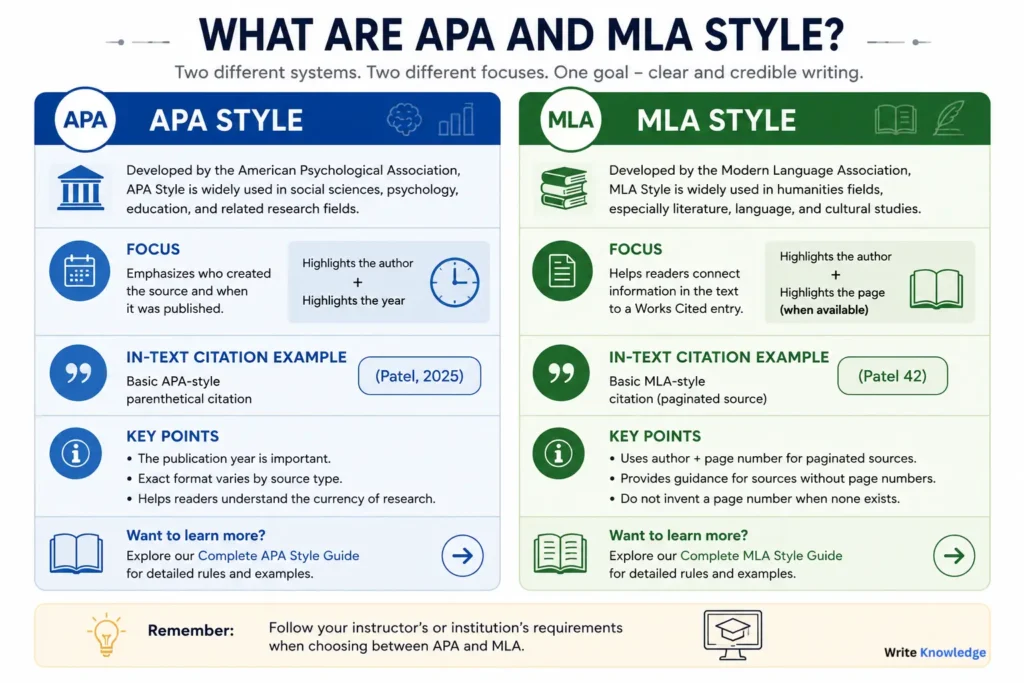
What are APA and MLA Style?
This creates a useful path:
Compare → Choose → Learn the relevant style → Apply it
Okies, so let’s begin understanding them one-by-one.
What is APA Style?
APA Style is a documentation and writing system developed by the American Psychological Association. It is widely associated with academic and research writing in psychology and other social and behavioural sciences, as well as fields such as education and related disciplines.
APA places substantial emphasis on who produced a source and when it was published. That makes the publication year particularly useful when readers need to understand the currency of research.
For example, a basic APA-style parenthetical citation might look like:
(Patel, 2025)
The exact format can change depending on the source and the information available.
If you want to study the system independently, our complete APA style guide provides a fuller explanation of APA conventions.
What is MLA Style?
MLA Style is developed by the Modern Language Association and is strongly associated with humanities scholarship, particularly literature, language, and related fields.
MLA’s documentation system is designed to help readers connect material in the text with a Works Cited entry. For a paginated source, a basic citation commonly identifies the author and page:
(Patel 42)
MLA also provides guidance for sources that do not have page numbers. In those situations, writers should not invent a page number.
For a more detailed treatment of MLA conventions, see our complete MLA style guide.
And if you’re still unsure about the broader writing context, our Writing Style Guides post brings together the major style systems covered by Write Knowledge.
APA vs MLA: What is the Main Difference?
The biggest practical difference is the way the two systems key in-text citations to their source lists.
APA commonly uses an author-date system:
(Patel, 2025)
MLA generally uses an author-page system when a page number is available:
(Patel 42)
This reflects a broader difference in emphasis.
APA often gives readers the publication date because when research was published can matter significantly in fields where newer findings may change how a subject is understood.
MLA, by contrast, often directs readers toward the specific location of the material within the work, such as a page in a book or journal article.
Neither system is simply “better.” They are designed around different academic traditions and documentation needs.
⚠️ Common Mistake
Treating APA and MLA citations as interchangeable. APA generally uses an author-date system, while MLA commonly uses author-page citations when page numbers are available.
Simply replacing the style name or changing the reference list is not enough. Each system has its own conventions for citations, source documentation, and formatting. Always apply the rules of the style your assignment requires.
APA vs MLA Citations: How Are They Different?
Citations are one of the first places where students notice a difference.
APA In-Text Citations
APA generally uses the author’s surname and publication year.
For example:
(Sharma, 2024)
If you are quoting directly and need to identify a specific location, additional information may be required.
A narrative citation can instead incorporate the author into the sentence:
Sharma (2024) argues that clear documentation improves research communication.
The exact citation depends on the source type and the circumstances in which you are citing it.
MLA In-Text Citations
MLA generally uses the author’s surname and the relevant page number for paginated sources:
(Sharma 42)
You can also include the author’s name in your sentence:
Sharma argues that clear documentation improves research communication (42).
If the author’s name has already been given in the prose and the source has no page or part number, MLA guidance indicates that repeating the author’s name in parentheses is unnecessary.
APA vs MLA Citation Examples
| Situation | APA | MLA |
| Paraphrase with author and year/page not required | (Sharma, 2024) | (Sharma) |
| Paginated quotation | (Sharma, 2024, p. 42) | (Sharma 42) |
| Author in the sentence | Sharma (2024) explains… | Sharma explains… (42) |
These are simplified examples. The correct form can change depending on the source and the type of material being cited.
APA References vs MLA Works Cited
Another major difference appears at the end of the paper.
APA Uses a References Page
APA uses a References section for the sources cited in the work.
The purpose is to provide enough information for readers to identify and locate the sources used in the paper.
The publication year is particularly prominent in many APA references.
MLA Uses a Works Cited Page
MLA uses a Works Cited list.
MLA documentation is built around a template of core elements, which can include the author, title, container, publication details, location, and other relevant information depending on the source. The MLA Style Center provides examples for online works, journal articles, databases, blogs, government publications, and other source types.
The Works Cited page is also formatted with hanging indents. MLA guidance specifies that subsequent lines of a multi-line entry are indented by half an inch.
References vs Works Cited: The Key Difference
The easiest way to remember the distinction is:
APA → References
MLA → Works Cited
But the difference is not simply the heading at the top of the page. The systems also organize source information differently.
APA vs MLA Formatting
Citation differences are only part of the comparison.
The two systems also have different approaches to formatting an academic paper.
APA Formatting
APA paper formatting can include requirements relating to:
- Page setup
- Title information
- Headings
- Page numbers
- Tables and figures
- References
- Quotations
- Student or professional paper requirements
The exact requirements can depend on whether you are preparing a student paper, professional manuscript, or another type of document.
MLA Formatting
MLA also provides guidance for page layout, titles, headings, quotations, tables, illustrations, and the Works Cited list.
For example, MLA’s research-paper guidance places the Works Cited list on a new page and uses a half-inch hanging indent for entries that run onto multiple lines.
The MLA Style Center also notes that headings should be used to organize longer or more complex works and that heading levels should be styled consistently.
APA vs MLA Headings
Headings are another area where the two systems should not simply be treated as interchangeable.
APA Heading Levels
APA uses a defined hierarchy of heading levels.
This allows readers to distinguish major sections from subordinate sections and gives longer academic papers a consistent visual structure.
MLA Headings
MLA allows headings and subheadings when they genuinely help organize the work.
The MLA Style Center recommends styling headings consistently and using descending levels of prominence. It also notes that shorter papers may not need numerous internal headings.
This leads to an important practical point:
Do not assume that an APA heading hierarchy can simply be copied into an MLA paper.
The two styles have different conventions, so check the requirements of the style you are actually using.
APA vs MLA Title Page
This is one of the differences students often notice immediately.
Does APA Require a Title Page?
APA student papers generally use a title page, although the exact elements and formatting depend on the type of paper and the requirements you have been given.
For professional papers, APA requirements can differ.
So if you are writing an assignment, follow your instructor’s instructions alongside the applicable APA guidance.
Does MLA Require a Title Page?
MLA papers generally do not require a separate title page unless the instructor or institution asks for one.
Instead, the first page commonly contains identifying information followed by the paper title.
This is one reason you should not simply take an APA template and replace the citation format with MLA.
APA vs MLA for Quotations
Both styles require writers to distinguish their own words from material taken from another source, but their citation conventions differ.
Short Quotations
A short quotation can normally be incorporated into your own sentence.
For example:
Clear documentation can make research “easier to follow” (Gupta, 2024, p. 42).
The exact APA format depends on the source and quotation.
In MLA, the same basic idea might be documented as:
Clear documentation can make research “easier to follow” (Gupta 42).
Longer Quotations
Longer quotations use block-quotation formatting rather than ordinary quotation marks.
The precise rules differ between APA and MLA, so don’t assume that a block quotation formatted correctly in one style is automatically correct in the other.
This is another situation where the style guide you’re actually required to use matters more than a generic formatting template.
Which Subjects Use Each Style?
This is where the comparison becomes more useful for a student deciding what to use.
Where is APA Commonly Used?
APA is commonly associated with fields such as:
- Psychology
- Education
- Social sciences
- Behavioural sciences
- Related research fields
The exact requirement depends on the institution, publication, instructor, or assignment.
Where is MLA Commonly Used?
MLA is strongly associated with humanities subjects such as:
- English literature
- Language studies
- Literary criticism
- Cultural studies
- Film and media studies
- Related humanities disciplines
The MLA Style Center describes MLA as a system for research, writing, and documentation and identifies the MLA Handbook as its core publication.
If you’re interested in the broader forms of writing used across different subjects, our Types of Writing resource can help you understand how writing purpose changes from one context to another.
When Should You Use APA and MLA?
This is the question that matters most when you are actually preparing an assignment.
Choose APA for Social Sciences and Research-Focused Writing
APA is commonly used in fields such as psychology, education, social sciences, and behavioral sciences. It is particularly useful in research-oriented writing where the publication date of a source can be important, since readers may need to know how current the research is.
If your instructor, department, institution, or publisher specifically requires APA, follow that requirement even if another style might seem more familiar.
Choose MLA for Humanities and Literature-Focused Writing
MLA is most commonly associated with humanities subjects, including English literature, language studies, literary criticism, cultural studies, and related fields. Its citation system commonly directs readers to the specific location of information within a source, such as a page number.
Again, the subject alone should not be the deciding factor. If your instructor, institution, or publisher specifies MLA, use MLA and follow its conventions consistently.
📌 Remember
APA → Social sciences + research-oriented work
MLA → Humanities + literature/language-oriented work
What if Your Instructor has not Specified a Style?
Don’t automatically choose one based on personal preference.
Check:
- Your assignment instructions
- Your department’s requirements
- Your institution’s guidelines
- Your course materials
- Your publisher’s requirements, if applicable
- The conventions of your academic discipline
If the instructions remain unclear, ask the instructor or supervisor before formatting the entire document.
That can save you from having to redo citations and references later.
APA vs MLA: Which One is Better?
Neither style is universally better. The right choice depends on what you’re writing, where you’re writing it, and which requirements you have been given.
Consider Your Subject, Assignment, and Citation Requirements
APA is generally a strong fit for research-focused work in areas such as psychology, education, and the social and behavioural sciences, where the publication date of a source can be particularly relevant.
MLA is generally associated with humanities-focused work, including literature, language, and related fields, where citations commonly point readers to the specific location of information within a source.
However, these are typical uses, not strict rules. A university department may require a particular style regardless of the subject, and an instructor’s or publisher’s requirements should always take priority.
Don’t Choose a Style Simply Because It Looks Easier
APA and MLA involve much more than choosing between two citation formats. Each has its own conventions for citations, source lists, paper formatting, headings, quotations, and other details.
So, if you’re deciding between the two, don’t ask only, “Which one looks simpler?” Ask instead:
“Which style does my assignment, institution, discipline, or publisher require?”
Once you know that, use the appropriate style consistently rather than mixing rules from APA and MLA.
✍️ Writing Tip
Don’t choose an academic style because it seems easier or more familiar. First, check what your subject, assignment, instructor, or institution requires. APA and MLA follow different conventions for citations and formatting, so using the wrong style can create unnecessary corrections later. When in doubt, confirm the required style before you start writing.
APA vs MLA: Which One is Easier?
There isn’t a universal answer.
A student who frequently works with author-date citations may find APA intuitive. Another student may find MLA easier because the author-page system feels straightforward.
But “easy” should not determine your choice.
The correct style is the one required for your assignment, discipline, institution, publisher, or other context.
Once you know which system applies, learning its rules becomes much easier because you no longer have to compare two systems while trying to write.
APA vs MLA: Key Differences You Should Remember
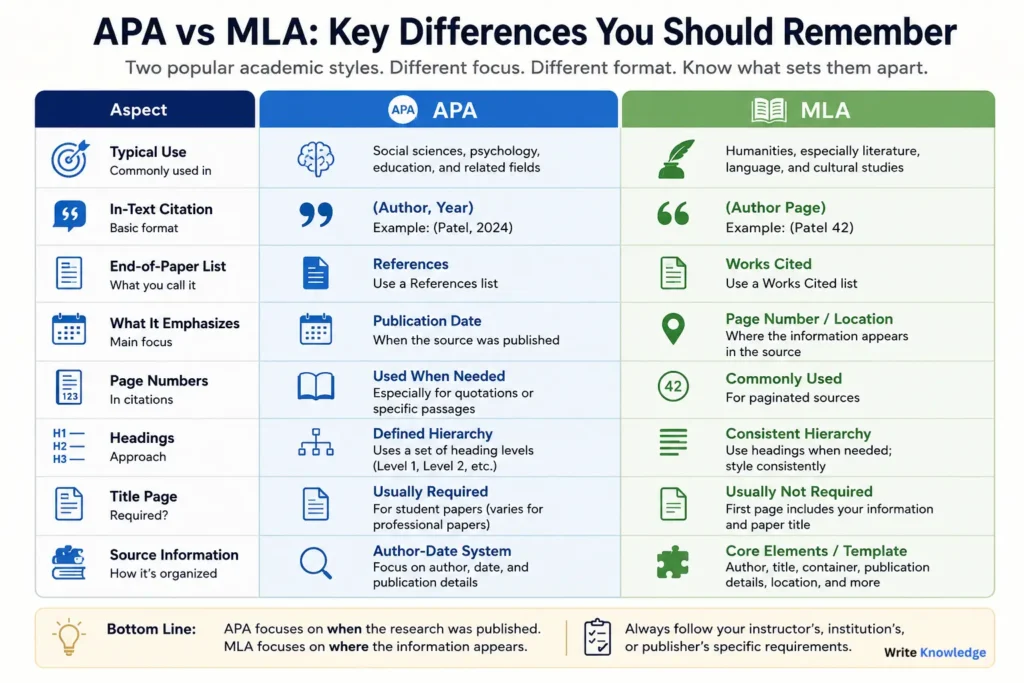
If you only need the main points, remember these:
| Area | APA | MLA |
| Typical disciplinary association | Social and behavioural sciences, education, related fields | Humanities, especially literature and language |
| Basic in-text pattern | Author + year | Author + page when available |
| End list | References | Works Cited |
| Date emphasis | Generally stronger | Generally less prominent in the basic in-text citation |
| Page numbers | Used when appropriate or required | Commonly used for paginated sources |
| Headings | Defined hierarchy | Consistent hierarchy when headings are needed |
| Title page | Commonly used for student papers | Usually not separate unless required |
| Source documentation | Reference-entry system | MLA core-elements/template approach |
The important thing is not to memorize the table as a collection of isolated rules.
Understand the underlying difference:
APA and MLA are two different systems for helping readers understand and locate the sources behind academic writing.
📚 Continue Learning
So, if you have enjoyed and learnt from our APA vs MLA comparison, then you will surely enjoy and learn our AP vs APA comparison.
✅ Key Takeaways
- APA and MLA are both academic documentation systems, but they are associated with different disciplinary traditions.
- APA commonly uses an author-date citation approach.
- MLA commonly uses an author-page approach for paginated sources.
- APA uses a References list, while MLA uses a Works Cited list.
- APA and MLA have different formatting and heading conventions.
- A separate title page is common in APA student papers but is generally not required for MLA papers unless requested.
- Neither style is universally better.
- Your instructor, institution, publisher, or discipline should determine which style you use.
- A comparison page can help you choose, but the complete style guide is what you need when you start applying the rules.
Conclusion
APA and MLA may appear similar because both help academic writers document sources, but they are built around different conventions and expectations. The most noticeable differences involve in-text citations, source lists, formatting, headings, and the kinds of academic work with which each style is commonly associated.
If you’re deciding between the two, don’t ask only which style is easier. Ask which style your assignment, discipline, institution, or publisher requires. Once you’ve made that decision, move from comparison to application using the appropriate complete guide.
Frequently Asked Questions About APA vs MLA
Is APA or MLA better?
Neither is universally better. The appropriate choice depends on your assignment, academic discipline, institution, instructor, or publisher requirements.
What is the main difference between APA and MLA?
The most noticeable difference is their basic in-text citation approach. APA commonly uses author and publication year, while MLA commonly uses author and page number for paginated sources.
Is APA or MLA used for English?
MLA is strongly associated with English literature and language-related humanities work. However, always follow the specific requirements of your course or institution.
Is APA or MLA used for psychology?
APA is strongly associated with psychology and related social and behavioural sciences.
Does APA use Works Cited?
No. APA uses a References list. MLA uses a Works Cited list.
Does MLA use a reference page?
MLA uses a Works Cited page rather than an APA-style References page.
Does APA use page numbers in citations?
Yes, page numbers can be included when appropriate, particularly when directly quoting or referring to a specific passage from a paginated source.
Does MLA always require page numbers?
No. MLA does not require writers to invent a page number when a source has no page numbers or another suitable part number.
Does MLA require a title page?
Generally, no separate title page is required unless the instructor or institution asks for one.
Can I use APA and MLA together in the same paper?
Generally, you should not mix the two systems arbitrarily. Choose the style required for the assignment and apply its conventions consistently.

Sachin is a Postgraduate in Technical Writing in Business Management specializing in creating SEO-friendly, User-friendly, and Reader-focused website articles on Education, Tech, Sports, Games, and Entertainment.
Through Write Knowledge, he helps students, bloggers, editors, and professionals develop practical writing skills using clear explanations, real-world examples, and internationally recognized writing standards.