Let’s say you’re writing a research paper for an English or literature class. You have your ideas, you’ve found your sources, and you’ve started writing.
Then comes the less exciting part: How exactly are you supposed to format everything?
That’s where MLA style comes in.
💡 Quick Answer
MLA style is a writing and documentation system commonly used in the humanities. It provides guidelines for formatting research papers, incorporating quotations, creating in-text citations, and documenting sources in a Works Cited list.
What Is MLA Style?
MLA style (Modern Language Association Handbook) is a set of guidelines developed by the Modern Language Association for documenting sources and presenting scholarly writing. It is particularly common in the humanities, especially English, literature, language, and cultural studies.
MLA style helps readers understand where information comes from and makes it easier to connect an in-text reference with the corresponding entry in the Works Cited list.
What is MLA Style Used For?
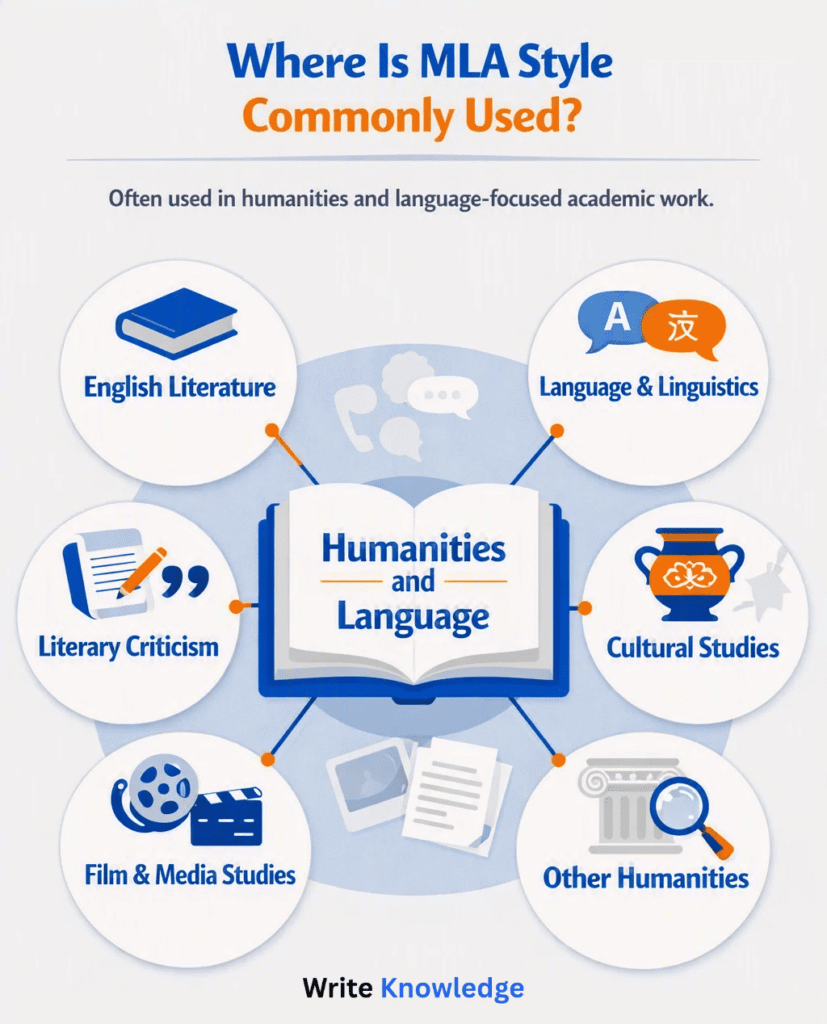
MLA is most commonly associated with subjects in the humanities.
You may be asked to use MLA style when writing about:
- English literature
- Language and linguistics
- Literary criticism
- Cultural studies
- Film and media studies
- Other humanities subjects
The important thing is not simply knowing that “MLA is for English.” You also need to understand what MLA is designed to do.
At its core, MLA helps writers document the sources they use while keeping source information from interrupting the flow of their writing.
MLA Paper Formatting
Before worrying about citations, you need to get the basic structure of your paper right.
MLA formatting covers elements such as the paper’s heading, title, page numbering, spacing, and overall organization.
The First Page
A typical MLA paper begins with identifying information followed by the paper’s title and the body of the paper.
Your instructor or institution may provide additional requirements, so always follow those instructions when they differ from a general MLA setup.
The Paper Title
The title of the paper is centered.
It should be clear and appropriately capitalized rather than treated like a decorative headline.
If your paper uses internal headings, MLA recommends styling those headings consistently and arranging them in descending levels of prominence.
Page Numbers
MLA papers generally use page numbers to help readers navigate the document and identify passages when necessary.
Follow your instructor’s requirements if they specify a particular header or page-number format.
Spacing and Margins
A properly formatted MLA paper should have consistent spacing and margins throughout.
Do not manually create spacing by repeatedly pressing Enter or Space. Use your word processor’s paragraph and page-layout settings instead.
MLA Headings and Subheadings
Headings are useful when a paper is long or complex enough to need additional organization.
The MLA Style Center recommends using headings consistently and arranging them according to their level of prominence. Headings should generally be flush with the left margin, while the paper’s main title is centered.
For example:
Level 1 Heading
A major section of the paper can use a prominent heading.
Level 2 Heading
A smaller subsection can use a less prominent heading.
The exact visual treatment can vary, but consistency matters. If you use a particular style for one heading level, use the same style for other headings at that level.
✍️ Writing Tip
Don’t add headings simply because you can. A short paper with several tiny sections may become harder to read rather than easier.
How MLA In-Text Citations Work
This is one of the most important parts of MLA style.
An in-text citation briefly identifies the source you’re using and directs the reader to the corresponding entry in your Works Cited list. When relevant, it also identifies the specific location of the information in the source.
The basic idea is simple:
Source information in your writing → brief MLA citation → full source information in Works Cited
Parenthetical Citations
Suppose you’re discussing a source written by Naomi Baron.
You might write:
Reading and writing are closely connected skills (Baron).
If you’re quoting a specific page, you can include the page number:
Reading is “just half of literacy” (Baron 194).
The citation should contain enough information to direct the reader to the appropriate Works Cited entry.
Author Mentioned in the Sentence
You don’t need to repeat information that you’ve already provided in your sentence.
For example:
According to Naomi Baron, reading is “just half of literacy” (194).
Notice that Baron doesn’t appear again inside the parentheses because the author’s name has already been given in the prose.
This keeps the citation concise.
When There is No Page Number
Not every source has page numbers.
Web pages, for example, may not provide stable page numbers. In such cases, don’t invent a page number. Instead, use the information that appropriately keys the citation to the Works Cited entry.
For example:
Suppose you’re quoting a sentence from a web article by Maria Lopez, titled Why Students Struggle With Academic Writing. The page has no page numbers.
You could write:
Lopez argues that “students often struggle because academic writing requires them to balance evidence with their own analysis.”
You wouldn’t write:
(Lopez 7)
because there is no page 7.
Instead, if you’ve already identified Lopez in the sentence, no parenthetical citation may be necessary if the source can be clearly identified from the context and your Works Cited entry.
If the author’s name hasn’t been mentioned, you would generally use the information needed to connect the citation to the Works Cited entry, such as:
“Students often struggle because academic writing requires them to balance evidence with their own analysis” (Lopez).
The key idea: Don’t make up a page number just to make the citation look complete. MLA citations should reflect the information the source actually provides.
How to Create a Works Cited List
The Works Cited list provides the full publication information for the sources you’ve cited.
MLA uses a system of core elements to build these entries. Common elements include the author, title of source, title of container, other contributors, version, number, publisher, publication date, and location. You include the elements that apply to the source you’re documenting.
This approach is important because not every source is published in exactly the same way.
What Is a Container in MLA?
A container is a larger work that contains the source you’re citing.
For example, imagine you are citing a journal article.
The article is the source.
The journal in which that article appears is the container.
A book chapter can similarly appear inside an edited book, while a web article can appear within a website.
MLA’s container concept helps writers identify not just the work but also the version and larger publication in which they found it.
Basic Book Citation
For a book by one author, a basic MLA entry can look like this:
Mantel, Hilary. Wolf Hall. Picador, 2010.
The MLA Style Center gives this as an example of a basic book entry.
Basic Website Citation
For a specific web page, the entry depends on the information available on that page.
A simplified example might look like:
Smith, Bradley. “Tips for Teaching Community-Engagement Projects in the College Writing Classroom.” The MLA Style Center, Modern Language Association of America, 19 Feb. 2019, style.mla.org/community-engagement-writing/.
MLA advises citing the specific web page or resource, rather than creating a citation for an entire website as a whole.
How to Format the Works Cited Page
Creating the entries is only part of the process. The list itself also needs to be formatted properly.
Alphabetize the Entries
Arrange entries alphabetically according to the appropriate information at the beginning of each entry.
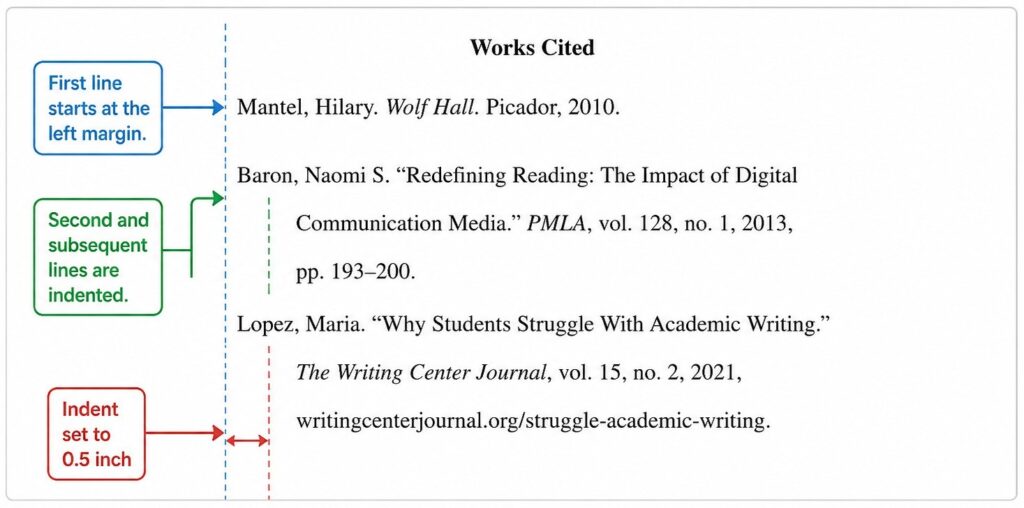
Use Hanging Indents
A hanging indent means the first line begins at the left margin while subsequent lines are indented.
For example:
Mantel, Hilary. Wolf Hall. Picador, 2010.
For longer entries, the second and following lines should be indented.
The MLA Style Center recommends a 0.5-inch hanging indent for Works Cited entries.
Include Only Sources You Cited
Your Works Cited list should correspond to the sources you actually cite in your work.
Don’t treat the page as a general reading list unless your assignment specifically asks for a bibliography or another type of source list.
How MLA Handles Direct Quotations
A direct quotation reproduces another writer’s exact words.
For example:
According to Brown, “clear writing requires deliberate choices” (42).
The quotation is incorporated into your sentence, while the citation identifies the source and location.
Short Quotations
Short quotations can generally be incorporated into your own sentence using quotation marks.
Don’t simply drop a quotation into a paragraph without explaining why it matters.
Instead, introduce the quotation and then connect it to your argument.
Example
Short quotations should fit naturally into your own sentence. For example:
Good writing is not simply about following rules; it is about making ideas clear to the reader. As William Zinsser explains, “clutter is the disease of American writing” (6). This observation highlights why writers should remove unnecessary words and focus on clarity.
Here, the quotation is introduced, followed by the MLA parenthetical citation, and then connected to the writer’s own explanation rather than being left on its own.
Block Quotations
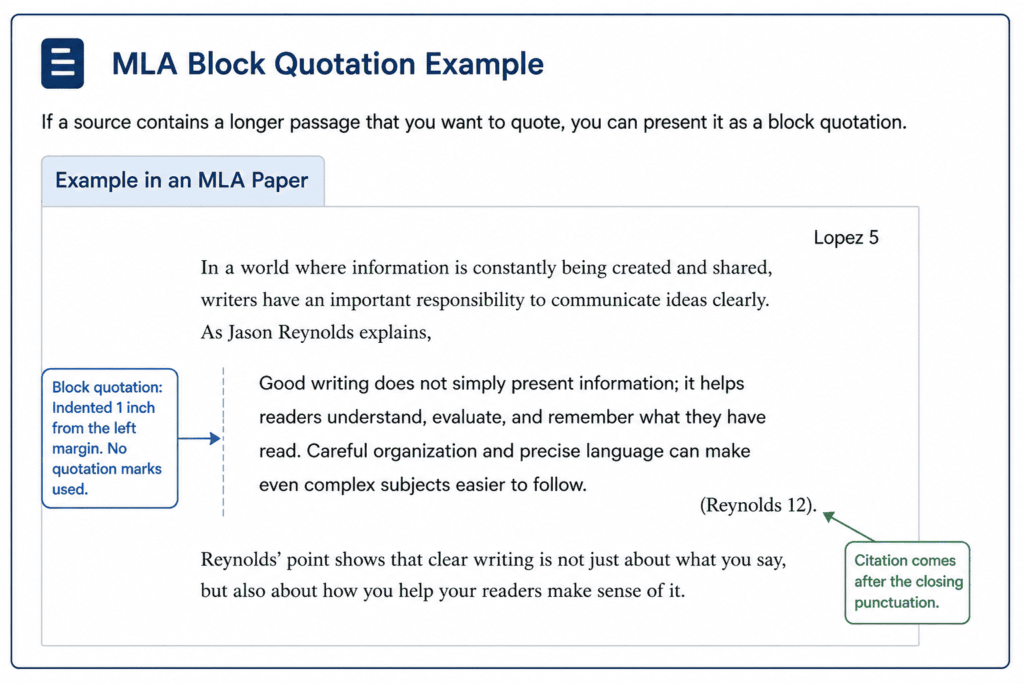
Longer quotations are presented using a block quotation format rather than ordinary quotation marks.
If a source contains a longer passage that you want to quote, you can present it as a block quotation.
The important thing is to follow MLA’s block-quotation rules rather than deciding the format based only on how long the quotation visually appears on your screen.
After the block quotation, you should explain how the passage relates to your own point. In MLA style, a block quotation is indented from the left margin and does not use quotation marks. The citation is placed after the closing punctuation.
MLA Works Cited Examples by Source Type
MLA’s core-elements approach means that the exact citation depends on the source you’re using.
Book
Mantel, Hilary. Wolf Hall. Picador, 2010.
Journal Article
Baron, Naomi S. “Redefining Reading: The Impact of Digital Communication Media.” PMLA, vol. 128, no. 1, 2013, pp. 193–200.
The MLA Style Center uses this type of journal entry to demonstrate how an article can be documented using its author, title, journal container, volume, issue, date, and page range.
Web Page
Smith, Bradley. “Tips for Teaching Community-Engagement Projects in the College Writing Classroom.” The MLA Style Center, Modern Language Association of America, 19 Feb. 2019, style.mla.org/community-engagement-writing/.
The specific information available on the page determines which core elements you include.
Online Source With a Container
Some sources have more than one container.
For example, an article may appear in a journal that you accessed through an online database.
MLA can therefore require information about both the journal and the database.
This is one reason why MLA citations don’t always follow one short, universal formula.
MLA Citation vs. APA Citation
MLA and APA both document sources, but they do so differently.
| Feature | MLA | APA |
| Common use | Humanities | Social sciences and related fields |
| In-text emphasis | Author/title + location when relevant | Author + year + location when relevant |
| Full source list | Works Cited | References |
| Citation approach | Core elements and containers | Author-date system |
| Publication year | Not usually central to basic in-text citation | Important in in-text citations |
For example, MLA may use:
(Baron 194)
while APA generally uses an author-date structure such as:
(Baron, 2013, p. 194)
The two systems are designed around different documentation principles, so it’s better to learn the logic behind each rather than simply memorizing punctuation differences.
Common MLA Style Mistakes
MLA becomes much easier once you understand its basic logic, but a few mistakes appear frequently.
Repeating the Author’s Name
If you’ve already identified the author in your sentence, don’t unnecessarily repeat the same information inside the parentheses. MLA emphasizes concise, nonredundant in-text references.
Treating Every Source the Same Way
A book, journal article, web page, and database article don’t necessarily require the same information.
MLA’s core-element system exists precisely because sources differ.
Adding Information You Don’t Need
Don’t fill a citation with every piece of information you can find.
The goal is to provide enough information for readers to identify and locate the source.
Forgetting the Works Cited Entry
An in-text citation and its corresponding Works Cited entry work together.
If you’ve cited a source in the paper, the reader should be able to find the corresponding entry in the Works Cited list.
Using Inconsistent Heading Styles
If you use headings, don’t randomly change their font size, alignment, capitalization, or formatting.
MLA recommends consistency across heading levels.
How to Use MLA Style Without Memorizing Everything
Here’s the good news: you don’t have to memorize every MLA rule before you can write successfully in MLA style.
Start with the basic framework:
- Format your paper consistently
- Identify the source you’re using
- Determine which core elements apply
- Build the Works Cited entry
- Create a concise in-text citation that connects your writing to that entry
- Check the specific MLA rule when you’re dealing with an unusual source
The MLA Style Center itself provides format-specific examples and a Works Cited practice template, so writers can work from the structure instead of relying entirely on memory.
✍️ Writing Tip
Don’t ask, “What is the one MLA citation formula?” Ask instead, “What kind of source am I citing, and what information does a reader need to find the exact version I used?” That question will take you much further.
When Should You Use MLA Style?
Use MLA when your instructor, institution, publication, or discipline requires it.
It is particularly associated with humanities writing, but the assignment instructions always take priority.
If you’re writing an English literature paper, for example, MLA may be the expected style. If you’re writing a psychology research paper, APA may be more appropriate.
The important thing is to follow the required style consistently from the beginning rather than converting the paper at the last minute.
✅ Key Takeaways
- MLA style is commonly used in humanities writing.
- MLA covers paper formatting, headings, quotations, in-text citations, and Works Cited lists.
- In-text citations connect information in your writing to the corresponding Works Cited entry.
- MLA Works Cited entries are built from core elements rather than one rigid formula for every source.
- Containers help identify where a source appears within a larger work.
- Works Cited entries generally use alphabetical order and hanging indents.
- MLA citations should contain enough information to help readers identify and locate the source.
- Always follow your instructor’s specific requirements when they add instructions beyond the general MLA guidelines.
Conclusion
MLA style (Modern Language Association Handbook) can look complicated when you first encounter citations, containers, headings, and Works Cited entries. But the system becomes much easier once you understand its basic purpose: help readers identify the sources behind your writing without interrupting the reading experience.
You don’t need to memorize every possible citation variation. Learn the basic MLA structure first, understand how sources and containers work, and then check the appropriate rule when you encounter a less common source.
Frequently Asked Questions
What is MLA style?
MLA style is a system for formatting and documenting academic writing, particularly in the humanities. It provides guidelines for in-text citations, Works Cited lists, quotations, headings, and other elements of scholarly writing.
What is a Works Cited page in MLA?
A Works Cited page is the list of sources cited in a paper. MLA entries are constructed using relevant core elements such as author, title, container, publisher, publication date, and location.
What is the difference between MLA and APA?
MLA is commonly used in humanities disciplines and uses a Works Cited system, while APA is commonly associated with social sciences and uses an author-date citation system with a References list.
Does every MLA citation need a page number?
No. Page numbers are included when they are available and relevant to locating the cited passage. Many online sources do not have page numbers, so you should not invent one. MLA’s in-text citation system uses whatever information is needed to direct readers to the appropriate Works Cited entry and, when relevant, the cited location.
📚 Continue Learning
If you’re still trying to understand how MLA fits alongside other major editorial standards, our guide to writing style guides explains how MLA compares with APA, Chicago, AP, and IEEE and when each one is typically used.

Sachin is a Postgraduate in Technical Writing in Business Management specializing in creating SEO-friendly, User-friendly, and Reader-focused website articles on Education, Tech, Sports, Games, and Entertainment.
Through Write Knowledge, he helps students, bloggers, editors, and professionals develop practical writing skills using clear explanations, real-world examples, and internationally recognized writing standards.