
So, after enough sleepless nights (and resistance) you decided to become a content writer!
Good.
Creative people should be doing creative things. Simple.
Now, it’s the best time to talk about the writing careers.
Many people believe that the only way to make a living through writing is to become an author or a journalist.
In reality, the writing industry is far more diverse.
It should be very clear to everyone that, businesses, publishers, technology companies, educational institutions, healthcare organizations, marketing agencies, governments, and startups all hire professional writers. Whether you’re creating blog posts, user manuals, advertisements, research papers, or technical documentation, strong writing skills are valuable across almost every industry.
The flash-speed growth of digital publishing has also created entirely new career paths that barely existed two decades ago. Roles such as SEO Content Writer, UX Writer, Technical Writer, Content Strategist, and AI Content Specialist are now established professions with opportunities around the world.
As a new content writer (and even the seasoned ones), you are at the right place. This guide will introduce you to the major professional writing roles, explain the skills they require, and help you identify the career path that aligns with your interests.
💡 Quick Answer
A writing career is any profession where creating, editing, or managing written content forms a significant part of the job.
Professional writers work across many industries, each requiring different writing skills, subject knowledge, and communication styles.
The table below provides a quick overview of some of the most common writing careers.
| Career Category | Examples |
| Content Writing | Content Writer, SEO Writer, Blog Writer |
| Marketing & Advertising | Copywriter, Content Strategist |
| Technical Communication | Technical Writer, Documentation Specialist |
| Publishing & Editorial | Editor, Proofreader, Copy Editor |
| Journalism & Media | Journalist, News Reporter, Feature Writer |
| Academic & Research | Academic Writer, Research Writer |
| Creative Writing | Novelist, Screenwriter, Script Writer |
| Business Communication | Business Writer, Proposal Writer, Grant Writer |
| Specialized Writing | Medical Writer, Legal Writer, UX Writer, Ghostwriter |
Each of these professions serves a different audience, solves different communication problems, and requires its own combination of knowledge and writing expertise.
What Are Writing Careers?
A writing career is a professional path where writing is not simply a skill … it is the primary way of informing, explaining, educating, simplifying, persuading, and entertaining ideas.
Depending on the role, a writer may spend their day:
- Researching topics
- Interviewing subject matter experts
- Writing original content
- Editing existing documents
- Reviewing factual accuracy
- Collaborating with designers and developers
- Or improving content based on audience feedback
Some writers create content for millions of readers online, while others prepare highly specialized documents used only within organizations.
Although the industries differ, every professional writer shares one common goal: communicating ideas effectively for a specific audience.
📝 Example
Imagine five different writers working on the same topic: Artificial Intelligence.
- A Content Writer writes a beginner-friendly blog post explaining AI.
- A Technical Writer prepares software documentation for an AI platform.
- A Copywriter creates advertising copy promoting an AI product.
- An Academic Writer publishes research on machine learning.
- A Journalist reports on the latest AI developments.
The subject is identical.
The audience, purpose, writing style, and career are completely different.
Why Consider a Career in Writing?
Writing is no longer limited to newspapers, books, and magazines.
Today, nearly every organization publishes content in some form. Whether it’s websites, product documentation, marketing campaigns, educational materials, internal reports, or social media communication.
As a result, skilled writers are needed in industries such as:
- Technology
- Healthcare
- Education
- Finance
- Manufacturing
- E-commerce
- Entertainment
- Travel
- Government
- Nonprofit organizations
The demand isn’t simply for people who can write grammatically correct sentences. Employers increasingly look for professionals who can communicate clearly, understand audiences, and organize information effectively.
Employers are not just looking for the writers who can write grammatically correct sentences, but also, who can understand audiences and communicate clearly.
Many writing careers also offer flexibility.
Depending on the profession, writers may work:
- Full-time
- Freelance
- Remotely
- As consultants
- Or as independent business owners
How Types of Writing Shape Professional Careers
One of the biggest misconceptions about writing careers is that every professional writer performs the same kind of work.
In reality, each career relies on different types of writing.
For example:
- A Copywriter primarily uses persuasive writing.
- A Technical Writer specializes in technical and expository writing.
- A Journalist combines expository and descriptive writing.
- A Screenwriter focuses on creative writing.
- An Academic Writer relies heavily on academic and research writing.
Understanding these writing categories helps you identify which careers naturally match your strengths and interests.
Why Professional Writers Also Learn Style Guides
Writing well is only part of becoming a successful professional writer.
Many careers also require writers to follow established editorial standards.
For example:
- Journalists often work with AP Style.
- Academic writers may use APA, MLA, or Chicago Manual of Style.
- Technical writers frequently follow IEEE or organization-specific documentation standards.
- Publishers often rely on Chicago Manual of Style for books and manuscripts.
Not every writing job requires a formal style guide, but understanding these standards makes it easier to work with editors, publishers, clients, and organizations that expect consistent formatting and documentation.
If you’re unfamiliar with these editorial systems, our writing style guides resource explains when they’re used and how they differ.
Writing as a Skill vs Writing as a Profession
Almost everyone writes.
Students write assignments.
Employees send emails.
Business owners prepare proposals.
People post on social media every day.
Professional writers, however, do much more than write words.
- They solve communication problems.
- They research complex topics.
- They organize information for specific audiences.
- They adapt their writing to different industries, goals, and publication standards.
Understanding this difference is the first step toward building a successful writing career.
Explore Professional Writing Career Paths
Writing is one profession with countless specializations.
While every professional writer communicates through words, the purpose of their writing varies significantly. Some educate readers, others persuade customers, explain complex technologies, report current events, or tell compelling stories.
Choosing the right writing career isn’t about finding the “best” job … it’s about finding the role that matches your interests, strengths, and long-term goals.
One of the easiest ways to understand the writing industry is to group careers into major professional categories.
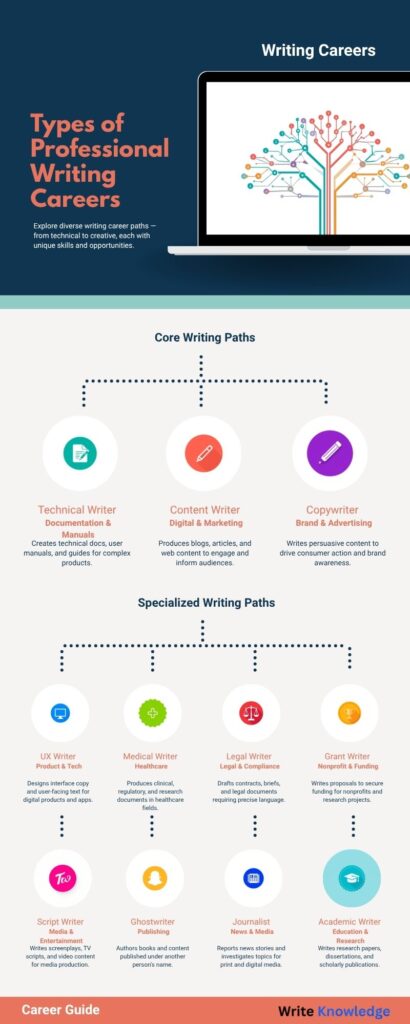
1. Marketing and Digital Writing Careers
These careers help businesses communicate with customers, build brand authority, generate traffic, and increase sales.
Let’s see who can work for this industry.
Content Writer
A Content Writer creates informative and engaging content for websites, blogs, online publications, and businesses.
Their primary goal is to educate, answer readers’ questions, and build trust through valuable information rather than direct selling.
Typical Responsibilities
- Blog posts
- Website pages
- Guides and tutorials
- Resource articles
- Industry news
- Educational content
Common Employers
- Digital marketing agencies
- SaaS companies
- E-commerce businesses
- Educational websites
- Corporate blogs
- Media organizations
Primary Writing Types
Content writers commonly use:
- Expository writing
- Informational writing
- Technical Writing (depending on the niche)
SEO Writer
An SEO Writer specializes in creating content that performs well in search engines while still providing genuine value to readers.
Unlike traditional content writing, SEO writing combines research, search intent, keyword strategy, content structure, and user experience.
Today’s SEO writers also optimize content for GEO (Generative Engine Optimization), AEO (Answer Engine Optimization), and SXO (Search Experience Optimization).
However, it must be noted that the difference between ‘content writer’ and ‘SEO writer’ is too thin and their responsibilities overlap. But the companies do ask specifically for ‘SEO Writers’.
Typical Responsibilities
- SEO blog posts
- Pillar pages
- Cluster content
- Buying guides
- Product comparisons
- Evergreen resources
Common Employers
- SEO agencies
- Digital marketing companies
- Publishers
- Affiliate websites
- SaaS businesses
Primary Writing Types
- Expository writing
- Informational writing
Copywriter
A Copywriter writes content designed to persuade readers to take action.
Instead of simply informing, copywriting focuses on conversions … encouraging people to purchase, subscribe, register, or engage with a brand.
Typical Responsibilities
- Advertisements
- Landing pages
- Product descriptions
- Email campaigns
- Sales pages
- Marketing campaigns
Common Employers
- Advertising agencies
- Marketing companies
- Startups
- E-commerce brands
- Corporate marketing teams
Primary Writing Types
- Persuasive writing
Content Strategist
While content writers create content, Content Strategists plan it.
They decide what content should be created, when it should be published, who the audience is, and how it supports broader business objectives.
Many experienced content writers eventually transition into content strategy roles.
Typical Responsibilities
- Editorial planning
- Content calendars
- Topic research
- Audience analysis
- SEO planning
- Content audits
Common Employers
- Large businesses
- Publishing companies
- Marketing agencies
- Enterprise organizations
2. Publishing & Editorial Careers
Not every writing professional creates original (first-hand) content.
Many professionals improve, edit, and refine content produced by others before publication.
These roles are essential for maintaining accuracy, clarity, consistency, and quality.
So let’s see, who all come under this.
Editor
Editors shape manuscripts into publishable work.
Depending on their specialization, they may improve structure, strengthen arguments, ensure consistency, verify facts, or prepare documents for publication.
Typical Responsibilities
- Structural editing
- Line editing
- Copy editing
- Fact-checking
- Editorial feedback
Common Employers
- Publishers
- Newspapers
- Educational institutions
- Marketing agencies
- Corporate communications
Editors frequently work with formal writing style guides to ensure every document follows consistent editorial standards.
Proofreader
Proofreaders perform the final quality review before publication.
Their responsibility is to eliminate spelling mistakes, punctuation errors, formatting inconsistencies, and typographical issues that remain after editing.
Typical Responsibilities
- Final grammar review
- Punctuation correction
- Formatting checks
- Consistency review
Common Employers
- Publishers
- Universities
- Businesses
- Freelance clients
Copy Editor
A Copy Editor sits between an editor and a proofreader.
Rather than rewriting an entire manuscript, copy editors focus on improving sentence-level clarity while ensuring consistency with the publication’s editorial standards.
Typical Responsibilities
- Grammar correction
- Consistency checks
- Fact verification
- Applying house style
- Style guide compliance
Common Employers
- Publishing houses
- Newspapers
- Magazines
- Digital publications
Ghostwriter
Ghostwriters don’t write ghost stories😂
Ghostwriters create books, articles, speeches, blogs, or other written material that is published under someone else’s name (Awww! You don’t get the credit at all.).
Confidentiality and adaptability are central to this profession.
Typical Responsibilities
- Books
- Memoirs
- Articles
- Speeches
- LinkedIn content
- Executive thought leadership
Common Employers
- Authors
- Business executives
- Public figures
- Entrepreneurs
- Publishers
Primary Writing Types
Ghostwriters often adapt to multiple writing styles depending on the client and project.
Quick Comparison
| Career | Primary Goal | Main Writing Type | Common Employers |
| Content Writer | Educate readers | Expository | Blogs, SaaS companies, publishers |
| SEO Writer | Increase search visibility | Informational | SEO agencies, digital publishers |
| Copywriter | Persuade customers | Persuasive | Marketing agencies, brands |
| Content Strategist | Plan content | Strategic communication | Enterprises, marketing teams |
| Editor | Improve manuscripts | Editorial | Publishers, media organizations |
| Proofreader | Remove final errors | Editorial review | Publishers, universities |
| Copy Editor | Ensure consistency | Editorial | Newspapers, magazines |
| Ghostwriter | Write for others | Adaptive | Authors, executives, public figures |
3. Technical & Specialized Writing Careers
Some writing careers require more than excellent language skills. They also demand expertise in a particular industry or subject.
These professionals don’t just write well; they understand complex concepts and communicate them accurately for highly specific audiences.
The world around us is increasingly getting specialized. This has in-turn increased the demand for subject-matter experts who can also write clearly.
Time to look who can join the party here.
Technical Writer
A Technical Writer explains complex products, systems, or processes in a way that ordinary users can easily understand.
Their work focuses on clarity, precision, and usability rather than creativity.
Good technical documentation helps users complete tasks successfully while reducing support requests.
Typical Responsibilities
- User manuals
- Software documentation
- API documentation
- Product documentation
- Installation guides
- Knowledge base articles
Common Employers
- Software companies
- Engineering firms
- Manufacturing companies
- Telecommunications
- Artificial Intelligence companies
- Healthcare technology providers
Primary Writing Types
Technical writers primarily use:
- Technical writing
- Expository writing
- Instructional writing
Because technical documentation often follows strict editorial standards, knowing about IEEE Style Guide would be an added advantage for the technical writers.
Medical Writer
Medical writers translate scientific and healthcare information into clear, accurate documents for professionals, patients, and regulatory organizations.
Since accuracy directly affects healthcare decisions, medical writing requires strong research skills and attention to detail.
Typical Responsibilities
- Clinical study reports
- Pharmaceutical documentation
- Healthcare articles
- Patient education materials
- Regulatory documents
- Medical research summaries
Common Employers
- Pharmaceutical companies
- Hospitals
- Healthcare organizations
- Medical publishers
- Clinical research organizations
Primary Writing Types
- Technical writing
- Scientific writing
- Informational writing
→ Read our Complete Guide to Medical Writing Careers
Legal Writer
Legal writers simplify legal concepts while maintaining accuracy.
Their work helps lawyers, businesses, and the general public understand laws, regulations, contracts, and legal procedures.
Typical Responsibilities
- Legal articles
- Contracts
- Case summaries
- Compliance documents
- Legal research
- Policy documentation
Common Employers
- Law firms
- Government agencies
- Corporate legal departments
- Legal publishers
Primary Writing Types
- Technical writing
- Informational writing
→ Read our Complete Guide to Legal Writing Careers
Business Writer
Business writers help organizations communicate professionally with employees, investors, partners, and customers.
Unlike marketing writers, business writers prioritize clarity, professionalism, and decision-making.
Typical Responsibilities
- Business reports
- White papers
- Corporate communication
- Internal documentation
- Executive summaries
- Policy documents
Common Employers
- Corporations
- Consulting firms
- Financial organizations
- Government departments
Primary Writing Types
- Business writing
- Technical writing
- Expository writing
→ Read our Complete Guide to Business Writing Careers
Proposal Writer
Proposal writers prepare documents that help organizations win projects, contracts, funding, or partnerships.
Their writing combines persuasive communication with detailed business information.
Typical Responsibilities
- Business proposals
- Tender documents
- RFP responses
- Project proposals
- Service proposals
Common Employers
- Consulting firms
- IT companies
- Construction companies
- Government contractors
Primary Writing Types
- Persuasive writing
- Business writing
→ Read our Complete Guide to Proposal Writing Careers
Grant Writer
Grant writers prepare funding applications for nonprofit organizations, educational institutions, charities, and research organizations.
Their work requires persuasive writing backed by evidence, planning, and measurable outcomes.
Typical Responsibilities
- Grant proposals
- Funding applications
- Research summaries
- Budget narratives
- Program descriptions
Common Employers
- Nonprofit organizations
- Universities
- Research institutions
- Charitable foundations
Primary Writing Types
- Persuasive writing
- Academic writing
- Business writing
→ Read our Complete Guide to Grant Writing Careers
Documentation Specialist
Documentation Specialists manage large collections of organizational knowledge.
Although similar to technical writers, their role often includes organizing, maintaining, updating, and improving documentation systems rather than creating individual manuals alone.
Typical Responsibilities
- Internal documentation
- Process documentation
- Knowledge management
- Standard operating procedures (SOPs)
- Documentation audits
Common Employers
- Enterprise software companies
- Manufacturing organizations
- Healthcare institutions
- Government departments
Primary Writing Types
- Technical writing
- Instructional writing
→ Read our Complete Guide to Documentation Careers
4. Journalism & Media Writing Careers
Journalism remains one of the most recognized writing professions.
However, modern media includes much more than newspapers. Today’s media writers create content for digital publications, magazines, television, podcasts, newsletters, and specialized online platforms.
Here are the profiles for this writing family.
Journalist
Journalists gather, verify, and present information that helps the public understand current events and important issues.
Typical Responsibilities
- News reporting
- Interviews
- Feature stories
- Investigative reporting
- Current affairs coverage
Common Employers
- Newspapers
- Digital news websites
- Television channels
- Broadcasting organizations
Primary Writing Types
- Expository writing
- Descriptive writing
Most journalists work with AP Style, making familiarity with editorial style guides an important professional advantage.
→ Read our Complete Guide to Journalism Careers
News Writer
News writers focus on producing concise, factual reports under strict deadlines.
Unlike feature writers, they prioritize speed, accuracy, and objectivity.
→ Read our Complete Guide to News Writing Careers
Feature Writer
Feature writers produce longer, more detailed stories that explore people, trends, places, and events.
Their writing often combines storytelling with research.
→ Read our Complete Guide to Feature Writing Careers
Travel Writer
Travel writers inform and inspire readers by covering destinations, cultures, hotels, experiences, and tourism.
Their work appears in magazines, travel websites, guidebooks, and tourism publications.
→ Read our Complete Guide to Travel Writing Careers
Press Release Writer
Press release writers prepare official announcements for organizations.
These announcements are distributed to journalists and media outlets to communicate important news.
→ Read our Complete Guide to Press Release Writing Careers
Columnist
Columnists regularly publish opinion-based articles on specific topics such as politics, business, sports, technology, or culture.
Unlike journalists, whose role emphasizes objectivity, columnists are expected to express informed viewpoints.
→ Read our Complete Guide to Column Writing Careers
Reviewer
Reviewers evaluate products, books, movies, software, games, restaurants, and services to help readers make informed decisions.
Successful reviewers balance personal opinion with objective analysis and evidence.
→ Read our Complete Guide to Review Writing Careers
Quick Comparison
| Career | Primary Goal | Main Writing Type | Common Employers |
| Technical Writer | Explain complex systems | Technical | Software and engineering companies |
| Medical Writer | Communicate healthcare information | Scientific | Healthcare and pharmaceutical companies |
| Legal Writer | Explain legal concepts | Technical | Law firms and legal publishers |
| Business Writer | Support organizational communication | Business | Corporations and consulting firms |
| Proposal Writer | Win projects and contracts | Persuasive | IT, consulting, construction |
| Grant Writer | Secure funding | Persuasive | Nonprofits and universities |
| Documentation Specialist | Manage organizational knowledge | Technical | Enterprise organizations |
| Journalist | Report factual information | Expository | News organizations |
| News Writer | Publish timely news | Informational | Newspapers and digital media |
| Feature Writer | Explore stories in depth | Descriptive | Magazines and online publications |
| Travel Writer | Inform and inspire travelers | Descriptive | Tourism and travel media |
| Press Release Writer | Announce organizational news | Informational | Businesses and PR agencies |
| Columnist | Share informed opinions | Persuasive | Newspapers and magazines |
| Reviewer | Evaluate products and experiences | Analytical | Media organizations and publishers |
5. Academic & Educational Writing Careers
Academic and educational writers help people learn.
Their work is built on research, evidence, structured thinking, and clear explanations. Unlike marketing content, which aims to persuade, educational writing aims to improve understanding.
These careers are ideal for people who enjoy researching topics, organizing information logically, and explaining complex ideas to different audiences.
Academic Writer
If you like educating people, then this role is for you.
Academic writers produce scholarly content for schools, colleges, universities, and research organizations.
It is very important that every claim must be supported by reliable evidence, making research and referencing essential parts of the writing process.
Typical Responsibilities
- Research papers
- Literature reviews
- Academic essays
- Journal articles
- Conference papers
- Research reports
Common Employers
- Universities
- Research institutions
- Academic publishers
- Educational organizations
Primary Writing Types
- Academic writing
- Analytical writing
- Research writing
As an academic writer, it would be nice to know about some writing style guides, particularly APA, MLA, and Chicago Manual of Style.
→ Read our Complete Guide to Academic Writing Careers
Research Writer
Research writers collect, analyse, verify, and organise information before presenting it in a structured and objective manner.
Unlike academic writers, research writers may work in both educational and commercial environments.
Typical Responsibilities
- Industry reports
- White papers
- Research summaries
- Market research
- Policy documents
- Background research
Common Employers
- Research firms
- Think tanks
- Government agencies
- Consulting companies
- Universities
Primary Writing Types
- Research writing
- Expository writing
→ Read our Complete Guide to Research Writing Careers
Instructional Writer
When you buy a new mobile and the open the box, then apart from your favorite new shiny mobile, the box also contains some papers.
And if you have opened those papers, you must have noticed that one folded booklet-style ‘thing’ contains diagrams with lines and arrows and the corresponding mini details.
That’s the instruction for you how to operate and maintain your new device.
And this is where Instructional Writer comes handy.
Instructional writers create educational material that teaches people how to perform tasks or understand concepts.
Their work appears in both traditional education and corporate training.
Typical Responsibilities
- Training manuals
- Learning modules
- Course material
- Tutorials
- User education
- Assessment content
Common Employers
- Educational publishers
- EdTech companies
- Corporate training departments
- Government organisations
Primary Writing Types
- Instructional writing
- Technical writing
- Expository writing
→ Read our Complete Guide to Instructional Writing Careers
6. Creative Writing Careers
If you have the flare for creativity, then this is exactly what you need!
Creative writing focuses on storytelling, imagination, emotion, and entertainment.
Unlike technical or business writing, creativity becomes the primary tool rather than factual explanation.
Script Writer
So, you recently watched a video on YouTube and thoroughly enjoyed it.
You liked the content for its editing, color-tone, visuals, and overall story.
But guess what, whatever you were looking was preplanned! And the person who plans all this is none other than – Script Writer.
Script writers create scripts for audio, video, and multimedia content intended to inform, educate, promote, or entertain.
With the growth of YouTube, podcasts, online education, digital marketing, and corporate communication, script writing has become one of the fastest-growing writing careers.
Typical Responsibilities
- YouTube videos
- Educational videos
- Corporate training videos
- Podcast episodes
- Promotional videos
- Advertisement scripts
- Social media video content
- Explainer videos
Common Employers
- Marketing agencies
- Media companies
- Educational organisations
- Corporate training companies
- YouTubers and content creators
- Advertising agencies
Primary Writing Types
- Creative writing
- Narrative writing
- Expository writing
- Persuasive writing
Screenwriter
Screenwriters write scripts specifically for dramatic productions such as films, television, web series, and streaming platforms.
Unlike many script writers who focus on educational, marketing, or informational content, screenwriters primarily create fictional stories by developing characters, dialogue, plots, and dramatic structure for the screen.
Typical Responsibilities
- Feature films
- Television series
- Web series
- Short films
- Streaming platform originals
- Animated films
- Screen adaptations
Common Employers
- Film studios
- Television networks
- OTT platforms
- Production houses
- Independent filmmakers
Primary Writing Types
- Creative writing
- Narrative writing
→ Read our Complete Guide to Screenwriting Careers
Speech Writer
Heard the speech of your favorite leader?
The chances are, that speech was prepared by a Speech Writer.
Speech writers prepare speeches for public figures, business leaders, executives, politicians, educators, and event speakers.
Writing an effective speech requires understanding both the audience and the speaker’s voice.
Typical Responsibilities
- Conference speeches
- Political speeches
- Corporate presentations
- Award ceremonies
- Public addresses
- Keynote presentations
Common Employers
- Government organisations
- Corporations
- Public relations agencies
- Consulting firms
Primary Writing Types
- Persuasive writing
- Creative writing
→ Read our Complete Guide to Speech Writing Careers
Novelist (Author)
Novelists create original fictional works for readers.
Although becoming a successful author often takes time, many writers combine book writing with other professional writing careers.
Typical Responsibilities
- Novels
- Short stories
- Fiction series
- Literary works
Common Employers
Most novelists are self-employed or work with publishing houses.
Primary Writing Types
- Creative writing
- Narrative writing
→ Read our Complete Guide to Becoming a Novelist
7. Emerging Writing Careers
Technology continues to reshape the writing profession.
Many careers that barely existed ten years ago are now becoming mainstream, while traditional writing roles are evolving alongside artificial intelligence and digital products.
Writers who continuously learn new tools and technologies often discover exciting opportunities in these emerging fields.
UX Writer
UX (User Experience) Writers create the text users see while interacting with websites, mobile apps, and software.
Their goal is to make products intuitive, simple, and easy to use.
Typical Responsibilities
- Button labels
- Error messages
- Navigation text
- Onboarding instructions
- User flows
Common Employers
- Software companies
- SaaS businesses
- Technology startups
- Product companies
Primary Writing Types
- Technical writing
- Instructional writing
→ Read our Complete Guide to UX Writing Careers
AI Content Specialist
Artificial Intelligenssssssss!
AI has changed how content is planned, produced, and edited.
Rather than replacing professional writers, many organisations now hire specialists who understand how to combine human expertise with AI-assisted workflows responsibly.
Typical Responsibilities
- AI-assisted content production
- Prompt design
- Content review
- Human fact-checking
- AI workflow optimisation
Common Employers
- Marketing agencies
- Technology companies
- AI startups
- Enterprise organisations
Primary Writing Types
This role varies depending on the project and often combines multiple writing disciplines.
→ Read our Complete Guide to AI Content Careers
Knowledge Base Writer
Knowledge Base Writers organise support documentation that helps customers solve problems independently.
Their work improves customer experience while reducing support requests.
Typical Responsibilities
- Help centre articles
- FAQs
- Troubleshooting guides
- Product documentation
- Customer support content
Common Employers
- SaaS companies
- Software providers
- Customer support organisations
→ Read our Complete Guide to Knowledge Base Writing
Localization Writer
Ever read a document written in YOUR language and instantly felt connected with it?
That’s what Localizatin Writers do.
Localization writers adapt content for different countries, cultures, and languages.
Instead of performing direct translation, they ensure the content feels natural and culturally appropriate for local audiences.
Typical Responsibilities
- Website localisation
- Product localisation
- Marketing adaptation
- Regional content
Common Employers
- Global corporations
- Technology companies
- Translation agencies
- International publishers
→ Read our Complete Guide to Localization Writing
Essential Skills Every Professional Writer Needs
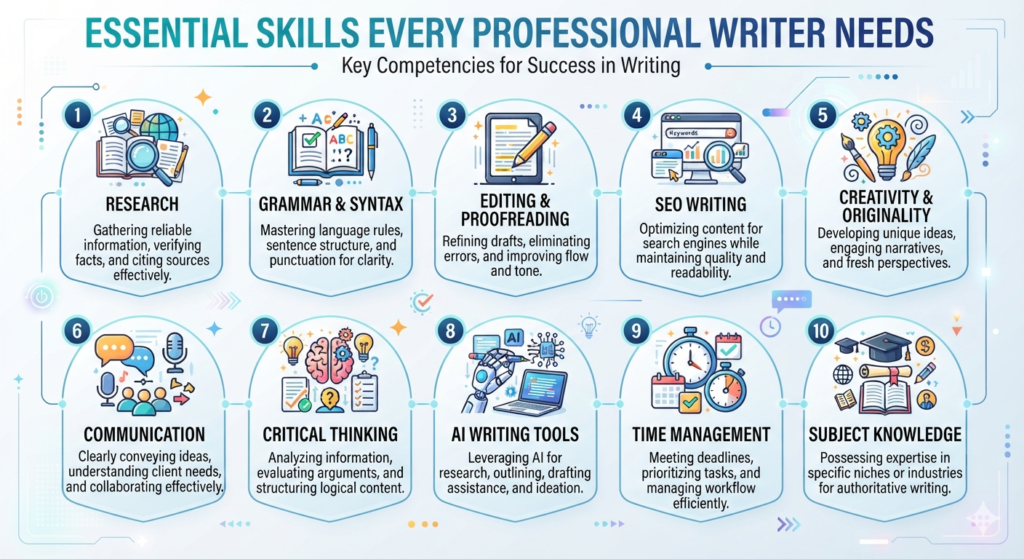
Although every writing career is different, successful writers share several core skills.
These abilities become even more valuable as writers specialise and progress professionally.
Research Skills
Professional writing begins with accurate information.
Whether you’re writing a technical manual, an academic paper, or a blog post … strong research helps build credibility and trust.
Clear Communication
The best writers explain ideas in language their audience can easily understand.
Clarity is often more valuable than complexity.
Grammar and Language Fundamentals
Strong grammar improves readability and professionalism.
Even experienced writers continue refining their language skills throughout their careers.
Editing and Self-Review
First drafts are rarely perfect.
Professional writers spend considerable time revising, reorganising, and improving their own work before publication.
Understanding Different Types of Writing
Each profession uses different writing techniques.
Understanding the major types of writing helps writers adapt to different audiences and objectives.
Familiarity with Style Guides
Not every writing career requires a formal editorial standard, but knowing when and how to use major writing style guides is a valuable professional skill.
Digital and AI Literacy
Modern writers increasingly work alongside content management systems, SEO tools, collaboration platforms, and artificial intelligence.
Learning how to use these technologies responsibly is becoming an important part of long-term career development.
Quick Comparison of Professional Writing Careers
| Career Family | Best For | Common Employers |
| Marketing & Digital Writing | Writers who enjoy educating, marketing, and online publishing | Businesses, agencies, publishers |
| Publishing & Editorial | Writers who enjoy improving content | Publishers, newspapers, media organisations |
| Technical & Specialised Writing | Writers with industry expertise | Software, healthcare, engineering, law |
| Journalism & Media | Writers interested in current events and reporting | News organisations, magazines, broadcasters |
| Academic & Educational Writing | Researchers and educators | Universities, educational publishers |
| Creative Writing | Storytellers and entertainment writers | Publishers, studios, production companies |
| Emerging Writing Careers | Technology-oriented writers | SaaS companies, AI startups, digital product companies |
No matter which path you choose, every professional writing career is built on the same foundation: strong writing skills, continuous learning, and the ability to communicate clearly for a specific audience.
How to Choose the Right Writing Career
With so many writing careers available, it’s natural to wonder:
Which writing career is right for me?
There isn’t a single correct answer. The best writing career depends on your interests, strengths, preferred work environment, and long-term goals.
| If You Enjoy… | Consider These Careers |
| Explaining ideas clearly | Content Writer, Technical Writer, Instructional Writer |
| Persuading people | Copywriter, Proposal Writer, Grant Writer |
| Research and analysis | Academic Writer, Research Writer, Medical Writer |
| Technology | Technical Writer, UX Writer, Knowledge Base Writer |
| Storytelling | Script Writer, Screenwriter, Novelist |
| Current affairs | Journalist, News Writer, Feature Writer |
| Editing and improving content | Editor, Proofreader, Copy Editor |
| Business communication | Business Writer, Proposal Writer |
| Healthcare and science | Medical Writer |
| Law and policy | Legal Writer |
| Travel and culture | Travel Writer |
You don’t have to choose only one career.
Many professional writers work across multiple specializations throughout their careers.
For example:
- A Content Writer may become an SEO Writer
- A Technical Writer may transition into UX Writing
- A Journalist may become a Content Strategist
- An Academic Writer may begin freelance editing
- A Copywriter may eventually become a Brand Strategist
Writing careers are often flexible, allowing professionals to continuously expand their expertise.
Freelance vs Full-Time Writing Careers
Another important decision is how you want to work.
Professional writers generally choose one of two career models.
Full-Time Employment
Working as an employee provides stability and long-term career progression.
Advantages include:
- Regular salary
- Employee benefits
- Team collaboration
- Structured career growth
- Mentorship opportunities
Potential drawbacks include:
- Fixed schedules
- Less flexibility
- Limited client variety
Freelance Writing
Freelancers work independently for multiple clients.
Advantages include:
- Flexible working hours
- Remote work opportunities
- Freedom to choose projects
- Unlimited earning potential
- Diverse industries and clients
Potential drawbacks include:
- Finding clients
- Income fluctuations
- Managing business responsibilities
- Handling taxes and invoices
Many writers begin with a full-time job before gradually transitioning into freelance work.
Others combine both through part-time freelancing.
→ Read our Complete Guide to Freelance Writing Careers
Can You Switch Between Writing Careers?
Absolutely.
In fact, many successful writers do.
Unlike professions that require completely new qualifications, writing careers often share the same core foundation.
For example:
A writer might progress like this:
Content Writer → SEO Writer → Content Strategist
Or:
Technical Writer → UX Writer → Product Documentation Manager
Or:
Journalist → Editor → Publishing Manager
Or:
Academic Writer → Research Writer → Educational Content Developer
Because every role strengthens research, communication, editing, and critical thinking, moving between writing careers is often much easier than changing professions entirely.
How Artificial Intelligence Is Changing Writing Careers
Artificial Intelligence has transformed the writing profession, but not in the way many people expected.
Instead of eliminating writers, AI is changing how professional writers work.
Today, many writers use AI to:
- Brainstorm ideas
- Generate outlines
- Summarize research
- Improve readability
- Automate repetitive tasks
However, AI still struggles with:
- Critical thinking
- Original analysis
- Iterviewing experts
- Verifying facts
- Understanding business context
- Maintaining brand voice
- Exercising editorial judgment
These remain uniquely human strengths.
As a result, employers increasingly value writers who can combine strong writing skills with responsible AI usage.
The future belongs not to writers who compete against AI, but to writers who know how to work alongside it effectively.
→ Explore AI Writing Careers
How to Start Your Writing Career
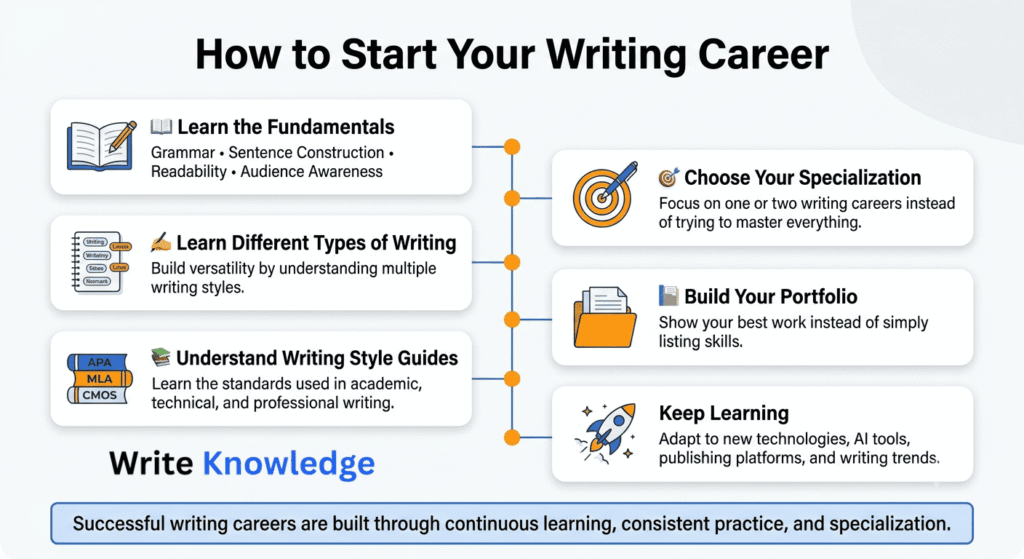
Beginning a writing career doesn’t require decades of experience.
It requires continuous learning, consistent practice, and a willingness to improve.
A simple roadmap looks like this:
Step 1: Learn the Fundamentals
Understand:
- Grammar
- Sentence construction
- Readability
- Audience awareness
Step 2: Learn Different Types of Writing
Different careers require different writing approaches.
Building a strong understanding of the major types of writing helps you develop versatility.
Step 3: Become Familiar with Writing Style Guides
Not every profession requires formal editorial standards, but understanding major writing style guides prepares you for academic, journalistic, technical, and publishing careers.
Step 4: Choose a Specialization
Rather than trying to become an expert in everything, focus on one or two career paths initially.
Specialization often leads to faster professional growth.
Step 5: Build a Portfolio
A portfolio demonstrates your writing ability better than simply listing skills on a resume.
Include your strongest work across your chosen specialization.
Step 6: Keep Learning
The writing industry continues to evolve.
New technologies, publishing platforms, AI tools, and communication formats constantly create new opportunities.
Writers who continue learning remain valuable throughout their careers.
✅ Key Takeaways
- Writing offers diverse career opportunities across technology, education, publishing, marketing, journalism, healthcare, law, and entertainment.
- Every writing career serves a different purpose, audience, and industry.
- Understanding Types of Writing helps you identify careers that match your strengths.
- Familiarity with major Writing Style Guides becomes increasingly valuable as writers specialize.
- Freelance and full-time writing both offer unique advantages depending on your goals.
- AI is reshaping writing careers, but human creativity, critical thinking, and editorial judgment remain essential.
- Continuous learning is one of the most important factors in building a successful long-term writing career.
Conclusion
Writing is no longer confined to books, newspapers, or academic journals. Today, professional writers contribute to nearly every industry, helping businesses communicate, educators teach, researchers publish, organizations document knowledge, and creators tell compelling stories.
Whether you choose content writing, technical communication, journalism, copywriting, academic publishing, or one of the many emerging specializations, there is no single “correct” path. Only the one that best aligns with your interests, skills, and ambitions.
Frequently Asked Questions
What is the best writing career for beginners?
Content Writing is often considered one of the most accessible starting points because it develops research, organization, editing, and communication skills that transfer well to many other writing careers.
Do all professional writers need to know writing style guides?
No.
Many content writers, copywriters, and bloggers primarily follow company editorial guidelines. However, understanding major style guides is valuable for careers in publishing, journalism, academic writing, and technical communication.
Can I switch from one writing career to another?
Yes.
Many writers move between specializations during their careers. For example, a Content Writer may become a Content Strategist, while a Technical Writer may transition into UX Writing.
Is freelancing better than a full-time writing job?
Neither option is universally better. Full-time employment offers stability and structured career growth, while freelancing provides flexibility, independence, and the opportunity to work with diverse clients.
Will AI replace professional writers?
AI is changing how writers work, but it is unlikely to replace skilled professionals. Human writers continue to provide critical thinking, creativity, editorial judgment, subject expertise, and audience understanding that AI cannot consistently replicate.