Harvard referencing style helps you acknowledge sources in academic writing using an author’s surname and the year of publication. You will commonly see citations such as (Singh, 2024) in university assignments, research papers, essays and dissertations. The full details of the source appear in a reference list at the end of the document.
Although Harvard referencing is widely used in universities and research, it does not have one universally accepted set of rules. Different institutions follow their own versions, which can vary in punctuation, author formatting, page numbers and online source details. This guide explains the core principles of Harvard referencing, shows how to cite common sources, and highlights the rules to check before submitting your work.
What Is Harvard Referencing Style?
Harvard referencing is an author–date system that connects information in your writing to the sources you consulted. It allows readers to identify the author and publication year quickly, then find the complete source details in your reference list.
For example:
In-text citation: Effective academic writing requires careful organization (Singh, 2026).
Reference list entry: Singh, R. (2026) Academic writing essentials. Oxford University Press.
These examples illustrate the basic author–date approach. The book title, publisher details and punctuation are illustrative; the exact format should follow your institution’s Harvard guide.
Harvard referencing is commonly used in business, social sciences, education, humanities and other academic disciplines. However, the required referencing system depends on the university, department, assignment or publisher.
Important: Harvard referencing is not an official style manual issued by Harvard University. It is a general name for several related author–date referencing systems. Always check which version your institution requires.
How Does Harvard Referencing Work?
Harvard referencing has two connected parts: in-text citations and a reference list. Both are necessary to acknowledge sources properly.
In-Text Citations
An in-text citation appears in the body of your writing wherever you use information, ideas or words from another source.
The basic format is:
(Author’s surname, Year)
Example:
Regular feedback can help students identify areas for improvement (Singh, 2026).
You can also incorporate the author’s name naturally into your sentence:
Singh (2026) argues that regular feedback helps students identify areas for improvement.
Both examples attribute the idea to Singh and identify the year of publication.
Reference List
The reference list appears at the end of your assignment and provides the full details needed to identify each source cited in the text.
For example:
Singh, R. (2026) Academic writing essentials. Oxford University Press.
The citation and reference entry must correspond to each other. If you cite Singh (2026) in your writing, the matching source should appear in your reference list.
The reference list is generally arranged alphabetically by the author’s surname. However, follow your institution’s instructions for headings, punctuation, ordering and any additional requirements.
Harvard Referencing Rules with Examples
The precise rules can differ between Harvard versions, but the following principles provide a useful starting point.
1. Citing a Source with One Author
For a source written by one author, include the surname and publication year.
Parenthetical citation:
The findings support the proposed approach (Singh, 2026).
Narrative citation:
Singh (2026) supports the proposed approach.
Use the narrative format when the author’s name fits naturally into your sentence. Use the parenthetical format when you want to focus on the information rather than the author.
2. Citing a Source with Two Authors
When a source has two authors, many Harvard versions use both surnames joined by “and”.
Example:
Effective feedback can improve learning outcomes (Singh and Verma, 2026).
Alternatively:
Singh and Verma (2026) discuss the role of feedback in learning.
Some Harvard variants use different punctuation or formatting conventions. Follow the rules specified by your institution.
3. Citing a Source with Three or More Authors
Many Harvard versions use the first author’s surname followed by et al. in in-text citations for sources with three or more authors.
Example:
The study identified several barriers to participation (Singh et al., 2026).
Here, et al. means “and others”. The reference-list entry may require the names of all authors, depending on the version you follow.
Do not assume that the same author-list rule applies to every Harvard guide.
4. Citing a Direct Quotation
A direct quotation reproduces the exact words of a source. You should identify the author, year and page number when one is available and required.
Example:
“Clear communication improves collaboration” (Singh, 2026, p. 35).
If the author’s name appears in the sentence, the citation can be written as:
Singh (2026, p. 35) states that “clear communication improves collaboration”.
The quoted wording above is illustrative, not a quotation taken from an actual publication.
For sources without page numbers, consult your institution’s guidance on locating quotations, such as by using a paragraph number or section heading where appropriate.
5. Paraphrasing and Summarising
Paraphrasing means expressing another author’s ideas in your own words. Summarising means presenting the main points more briefly.
Both require a citation, even when you do not use the original wording.
Original idea, expressed as a paraphrase:
Students may improve their academic performance when they receive regular, constructive feedback (Singh, 2026).
A page number may not be compulsory for every paraphrase under every Harvard variant, but it can help readers locate a specific idea. Check your institution’s rules.
Changing a few words from the original source is not sufficient paraphrasing. You should understand the idea, express it independently and acknowledge its source.
6. Citing Multiple Sources
When a statement is supported by several sources, you can include multiple citations in the same set of brackets.
Example:
Regular feedback can support student learning (Singh, 2022; Verma, 2026).
The separator and ordering rules may vary between Harvard versions. Make sure each source appears as a complete entry in your reference list.
7. Citing Multiple Works by the Same Author
If an author has published more than one work in the same year, many Harvard systems distinguish those works using lowercase letters after the year.
Example:
(Singh, 2024a) and (Singh, 2024b)
The same letter suffixes must appear in the corresponding reference-list entries. The letters are assigned consistently according to the relevant style guide’s ordering rules.
How to Write a Harvard Reference List
A Harvard reference list gives readers the information needed to identify and locate the sources cited in your work. The information required depends on the type of source.
The following examples demonstrate common reference formats. They are illustrative templates rather than a universal Harvard standard.
Harvard Referencing for a Book
A typical book reference includes the author’s surname and initials, year, title and publisher.
General format:
Surname, Initial(s). (Year) Title of book. Edition if applicable. Publisher.
Example:
Singh, R. (2026) Academic writing essentials. Oxford University Press.
The treatment of editions, publication locations and punctuation varies between Harvard guides. Include the details required by your institution.
Harvard Referencing for a Journal Article
A journal article reference commonly includes the author, year, article title, journal title, volume, issue, page range and DOI when available.
General format:
Surname, Initial(s). (Year) ‘Title of article’, Journal Title, volume(issue), pp. xx–xx. DOI.
Illustrative example:
Singh, R. (2026) ‘Feedback and student learning’, Journal of Academic Practice, 12(2), pp. 45–58.
The journal title and publication details above are fictional. Add a DOI when required and available, using the format specified by your institution.
Harvard Referencing for a Website
For a webpage, you will generally need the author or organisation, publication year or date, page title, website name where required, URL and access date if the relevant guide requires one.
General format:
Author or Organisation (Year) Title of webpage. Available at: URL (Accessed: Day Month Year).
Illustrative example:
National Education Research Centre (2024) Guide to academic study. Available at: https://example.com/academic-study (Accessed: 15 October 2026).
The organisation, page and URL in this example are fictional. Replace them with the details of the actual webpage you used.
If no individual author is named, the responsible organization may be used as the author. If no publication date is available, check your required Harvard guide for the correct treatment of undated webpages.
Harvard Referencing for a Chapter in an Edited Book
When citing a chapter written by one author within a book edited by someone else, you generally need details of both the chapter and the book.
General format:
Chapter Author, Initial(s). (Year) ‘Title of chapter’, in Editor Initial(s). Surname (ed.) Title of book. Publisher, pp. xx–xx.
Illustrative example:
Singh, R. (2026) ‘Planning an academic argument’, in V. Verma (ed.) Approaches to university writing. Oxford University Press, pp. 30–45.
The example is fictional. Check your institution’s requirements for editor formatting, publication details and page ranges.
Harvard Referencing for a Newspaper Article
A newspaper article reference may include the author, year, article title, newspaper name, publication date and page number or URL, depending on the source and version of Harvard used.
Illustrative example:
Singh, R. (2026) ‘Universities expand digital learning programmes’, The Daily Chronicle, 12 September.
This is a fictional example. Online newspaper articles may require additional details, such as a URL and access date, under your institution’s rules.
Harvard Referencing vs APA Style
Harvard and APA both use author–date citations, which makes them look similar at first. However, they are not interchangeable.
| Feature | Harvard Referencing | APA Style |
| Citation system | Author–date | Author–date |
| Official standard | No single universal Harvard manual | Published by the American Psychological Association |
| In-text citation | Often uses author and year; formatting varies by version | Follows defined rules for author, year and page or location details |
| Reference list | Formatting varies by institution or guide | Follows the rules of the specified APA edition |
| Common use | Various university courses and academic disciplines | Psychology, education and many social sciences |
For example, a Harvard citation might appear as (Singh, 2024), while an APA citation can look identical. The differences become more apparent in the complete reference entry and other formatting requirements.
Do not choose Harvard simply because it resembles APA. Use the style required by your university or publisher. For a fuller comparison, see full comparison on our Harvard vs APA referencing guide.
📚 Continue Learning
Read more APA comparisons with other Style Guides:
Common Harvard Referencing Mistakes
Small inconsistencies can make a reference list difficult to verify. Check for these common problems before submitting your work.
- Missing citations: A paraphrased idea still needs a citation, even when you use your own wording
- Incomplete references: A reference should contain the information required to identify the source
- Mismatched citations and references: Check that every cited source has a corresponding reference-list entry and that entries are not included unnecessarily
- Incorrect author details: Verify spelling, author order and publication year against the original source
- Inconsistent formatting: Apply the same punctuation, capitalisation, italics and ordering rules throughout
- Missing quotation details: Include page numbers or other location details when required and available
- Unverified online sources: Confirm that the URL works and that the source actually supports your statement
- Mixing Harvard versions: Avoid combining rules from different university guides without checking whether they are compatible
The most reliable way to prevent these errors is to choose one approved Harvard guide and use it consistently from the beginning of the assignment.
How to Use Harvard Referencing Correctly
You do not need to memorise every referencing rule to use Harvard effectively. A repeatable process can help you keep track of your sources and reduce last-minute corrections.
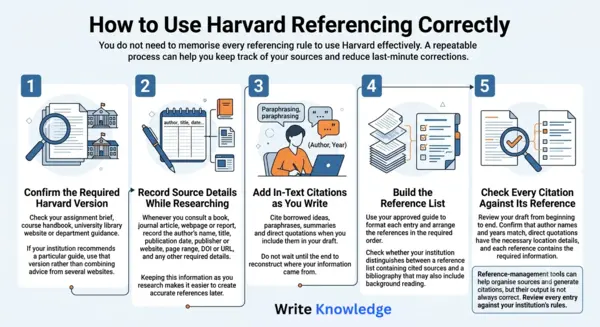
Step 1: Confirm the Required Harvard Version
Check your assignment brief, course handbook, university library website or department guidance. If your institution recommends a particular guide, use that version rather than combining advice from several websites.
Step 2: Record Source Details While Researching
Whenever you consult a book, journal article, webpage or report, record the author’s name, title, publication date, publisher or website, page range, DOI or URL, and any other required details.
Keeping this information as you research makes it easier to create accurate references later.
Step 3: Add In-Text Citations as You Write
Cite borrowed ideas, paraphrases, summaries and direct quotations when you include them in your draft. Do not wait until the end to reconstruct where your information came from.
Step 4: Build the Reference List
Use your approved guide to format each entry and arrange the references in the required order. Check whether your institution distinguishes between a reference list containing cited sources and a bibliography that may also include background reading.
Step 5: Check Every Citation Against Its Reference
Review your draft from beginning to end. Confirm that author names and years match, direct quotations have the necessary location details, and each reference contains the required information.
Reference-management tools can help organize sources and generate citations, but their output is not always correct. Review every entry against your institution’s rules.
✅ Key Takeaways
- Harvard referencing uses an author–date system to connect information in your writing with its original source.
- In-text citations and a reference list work together to acknowledge sources.
- Books, journal articles, websites and other sources require different reference details.
- Harvard does not have one universally standardized manual, so formatting can vary between institutions.
- APA and Harvard both use author–date citations, but their full referencing rules are different.
- Always follow your institution’s guidance and check every citation against the final reference list.
Conclusion
Harvard referencing becomes easier when you understand its two essential parts: brief author–date citations in your writing and complete references at the end. Once you know how to apply these principles to books, journal articles, websites and other sources, you can acknowledge research clearly and make your work easier to verify.
The key is consistency. Choose the Harvard version required by your institution, keep accurate source details as you research, and review every citation before submitting your work.
Learn more about Writing Style Guides to enhance your writing skills
Frequently Asked Questions
Is Harvard referencing the same as APA?
No. Both use author–date citations, but Harvard has multiple versions and no single universal manual. APA follows a defined set of rules published by the American Psychological Association. Their reference-list formats and other conventions can differ.
Does Harvard referencing require page numbers?
Page numbers are generally important for direct quotations when available. Requirements for paraphrases vary by institution and Harvard version. Follow the guidance provided by your university or publisher.
Does Harvard referencing use footnotes?
Harvard primarily uses in-text author–date citations rather than footnotes for source attribution. Footnotes may still be used for supplementary information if the assignment or institutional rules permit them.
How should I arrange a Harvard reference list?
A Harvard reference list is generally arranged alphabetically by the author’s surname or the organization’s name. Follow your institution’s guidance for sources without authors, multiple works by the same author and other special cases.
Can I use a citation generator for Harvard referencing?
Yes. Citation generators and reference-management tools can save time, but they may use a different Harvard version or produce incomplete details. Check their output against the style guide required for your assignment.

Sachin is a Postgraduate in Technical Writing in Business Management specializing in creating SEO-friendly, User-friendly, and Reader-focused website articles on Education, Tech, Sports, Games, and Entertainment.
Through Write Knowledge, he helps students, bloggers, editors, and professionals develop practical writing skills using clear explanations, real-world examples, and internationally recognized writing standards.