
Have you ever been told to write your assignment in APA Style, submit a manuscript following the Chicago Manual of Style, or prepare a research paper using IEEE Style?
If you’re new to writing, these names can seem confusing. Why are there so many writing style guides? Which one should you use? Do you always have to follow one?
The short answer is no. Not every piece of writing requires a formal style guide. However, when you’re writing for universities, publishers, journals, newspapers, or professional organizations, using the correct style guide becomes essential.
Writing style guides provide a common set of standards that help writers present information consistently. They establish rules for formatting, citations, punctuation, abbreviations, numbers, headings, references, and many other aspects of writing.
Instead of every writer following their own preferences, everyone follows the same editorial standard. This makes documents easier to read, edit, publish, and maintain.
Today, dozens of style guides exist across different industries and academic disciplines.
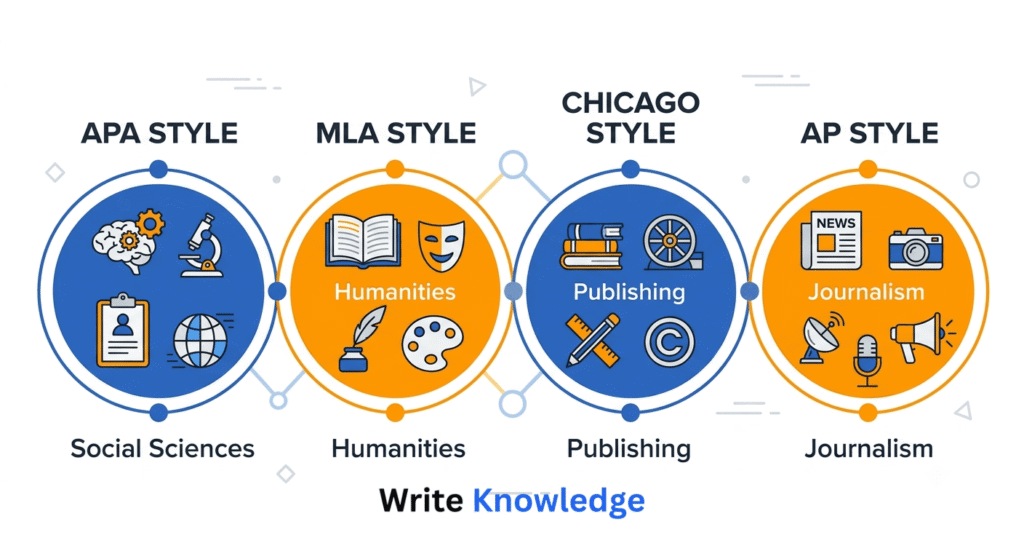
However, it is impossible to give the details of each style guide. So, this post with walk you through the five most commonly used:
- AP Style
- Chicago Manual of Style (CMOS)
- APA Style
- MLA Style
- IEEE Style
These five cover the needs of most journalists, editors, publishers, students, researchers, technical writers, and professional communicators.
Alright, let’s dig deeper.
💡 Quick Answer
A writing style guide is a standardized set of editorial rules that explains how written content should be formatted and presented. It helps writers maintain consistency in grammar preferences, punctuation, citations, references, capitalization, abbreviations, headings, and document structure.
The five major writing style guides are:
| Writing Style Guide | Commonly Used By |
| AP Style | Journalists, newspapers, magazines, digital media |
| Chicago Manual of Style (CMOS) | Publishers, editors, historians, book authors |
| APA Style | Psychology, education, social sciences |
| MLA Style | Literature, humanities, language studies |
| IEEE Style | Engineering, computer science, technical research |
The right style guide depends on who you’re writing for, what you’re writing, and where it will be published.
What are Writing Style Guides?
A writing style guide is a document that establishes consistent rules for written communication.
Think of it as a rulebook that tells writers and editors how information should appear, NOT what they should write.
For example, a style guide may explain:
- How to format headings
- How to write dates
- When to capitalize words
- Whether numbers should be written as words or numerals
- How to abbreviate titles
- How to cite sources
- How references should be presented
- How quotations should be formatted
These standards help ensure that every document produced by an organisation, publisher, university, or journal follows the same editorial style.
Without style guides, every writer would make different formatting decisions, creating inconsistency throughout a publication.
📝 Example
Imagine five writers contributing to the same magazine.
One writes 10 September 2026.
Another writes September 10, 2026.
A third writes 10/09/26.
A style guide tells everyone which format to use, ensuring consistency across every article.
You wouldn’t want to look unprofessional in a professional world☺️
Why Do Writing Style Guides Matter?
Good writing is about more than correct grammar.
Professional writing also needs to be consistent.
Readers should never be distracted by inconsistent formatting. Instead, they should be able to focus entirely on the ideas being presented.
Writing style guides make this possible.
They create shared standards that allow writers, editors, reviewers, publishers, and readers to work with documents more efficiently.
Some of the biggest benefits include:
- Consistent formatting across documents
- Improved readability
- Easier editing and proofreading
- Professional presentation
- Accurate attribution of sources
- Better collaboration among writers and editors
- Increased credibility and trust
📝 Example
Imagine reading a textbook where every chapter follows a different formatting style.
Some chapters use footnotes.
Others use author-date citations.
Some capitalize every heading.
Others don’t.
Even if the information is accurate, the inconsistent presentation makes the book feel unprofessional.
A writing style guide prevents this problem.
Writing Style Guide vs Grammar vs Writing Style
These three terms are often confused, but they describe different aspects of writing.
| Aspect | Purpose | Example |
| Grammar | Explains how a language works. | Correct sentence structure, verb agreement, punctuation rules. |
| Writing Style | Describes the writer’s tone and way of expressing ideas. | Formal, conversational, persuasive, technical, descriptive. |
| Writing Style Guide | Provides standardized editorial rules for formatting and presentation. | APA, MLA, Chicago, AP, IEEE. |
All three work together to produce clear, professional writing.
Why Every Writer Should Understand Style Guides
Even if your current work doesn’t require a formal style guide, understanding them is still valuable.
Many writers move between different industries during their careers.
You might write:
- Blog posts today
- Academic papers next year
- Technical documentation later
- And eventually edit books or publish research
Learning how style guides work gives you the flexibility to adapt to different writing environments with confidence.
More importantly, it helps you recognise that professional writing isn’t just about creativity … it’s also about consistency, accuracy, and meeting your readers’ expectations.
The Five Major Writing Style Guides
Although dozens of writing style guides exist around the world, only a handful are used regularly by universities, publishers, news organizations, researchers, and professional writers.
Among them, five stand out because of their broad adoption across education, publishing, journalism, and technical communication:
- AP Style
- Chicago Manual of Style (CMOS)
- APA Style
- MLA Style
- IEEE Style
Each guide serves a different purpose. None is universally “better” than another. The right choice depends on your audience, discipline, and publishing requirements.
1. AP Style
The Associated Press Stylebook (AP Style) is the standard writing guide for journalism and news reporting.
It was developed by the Associated Press to ensure consistency across newspapers and news agencies. Today, AP Style is widely used by digital media, magazines, public relations agencies, corporate communications teams, and many online publishers.
It provides detailed guidance on:
- Headlines
- Dates and time
- Numbers
- Titles
- Abbreviations
- Capitalization
- Punctuation
- Names of organizations and locations
- Current terminology
Commonly Used By
- Newspapers
- News websites
- Television journalism
- Broadcast media
- Press release writers
- Public relations professionals
- Corporate communication teams
Best For
If your primary goal is informing a general audience through news, media, or online journalism, AP Style is usually the preferred standard.
📝 Example
Sentence:
“According to the World Health Organization, regular physical activity reduces the risk of chronic diseases.”
Notice that AP Style attributes the source naturally within the sentence instead of using formal academic citations.
2. Chicago Manual of Style (CMOS)
The Chicago Manual of Style (CMOS) is one of the oldest and most comprehensive editorial style guides in the publishing industry.
Originally developed for book publishing, it has evolved into a complete editorial reference used by authors, editors, publishers, scholars, and historians.
Unlike some style guides that focus mainly on citations, CMOS also covers:
- Editorial style
- Grammar preferences
- Manuscript preparation
- Book publishing
- Typography
- Indexing
- Document formatting
- Publishing conventions
Chicago is especially valued because it offers flexibility. It supports both the Notes and Bibliography system and the Author-Date system.
Commonly Used By
- Editors
- Historians
- Academic publishers
- Independent authors
- Universities
- Publishing houses
Best For
Chicago Manual of Style is ideal for long-form publications where editorial consistency is just as important as accurate citations.
📝 Example
Footnote
¹ Stephen King, On Writing: A Memoir of the Craft (New York: Scribner, 2000), 45.
Bibliography
King, Stephen. On Writing: A Memoir of the Craft. New York: Scribner, 2000.
3. APA Style
The American Psychological Association (APA) Style is the most widely used writing standard in the social sciences.
Developed to support academic research, APA emphasizes clarity, evidence, and proper attribution of sources.
One of its distinctive quality is the Author–Date citation system. This allows readers to identify the source without interrupting the flow of the text.
APA also provides recommendations for:
- Research papers
- Literature reviews
- Tables
- Figures
- Headings
- Bias-free language
- Reference formatting
Commonly Used By
- Psychology
- Education
- Sociology
- Nursing
- Business
- Social sciences
- University research
Best For
If you’re writing research papers or university assignments in the social sciences, APA is usually the required style guide.
📝 Example
In-text citation
Writing improves through deliberate practice (King, 2000).
Reference
King, S. (2000). On writing: A memoir of the craft. Scribner.
4. MLA Style
The Modern Language Association (MLA) Style is the standard writing guide for literature, languages, and many humanities disciplines.
Unlike APA, which emphasizes publication dates, MLA focuses more on the specific location of information within a source.
This makes it particularly useful when discussing novels, plays, poems, essays, and other literary works.
MLA uses the Author–Page citation system, allowing readers to locate the exact page being discussed.
Commonly Used By
- English literature
- Language studies
- Humanities
- Cultural studies
- Philosophy
- Literary criticism
Best For
MLA is ideal for writing that analyzes books, literature, language, culture, and other humanities subjects.
📝 Example
In-text citation
Practice remains the foundation of good writing (King 45).
Works Cited
King, Stephen. On Writing: A Memoir of the Craft. Scribner, 2000.
5. IEEE Style
The Institute of Electrical and Electronics Engineers (IEEE) Style was developed for technical and scientific communication.
Unlike APA and MLA, IEEE uses numbered citations, making it easier to reference numerous technical sources without interrupting the flow of complex research.
It is particularly effective for documents containing:
- Engineering research
- Mathematical formulas
- Technical reports
- Scientific papers
- Conference publications
IEEE also includes detailed recommendations for presenting:
- Figures
- Tables
- Equations
- References
- Technical terminology
Commonly Used By
- Engineering
- Computer science
- Electronics
- Information technology
- Artificial intelligence
- Robotics
- Telecommunications
- Technical journals
Best For
IEEE is the preferred choice for engineering and technology professionals who need precise, structured, and highly organized documentation.
📝 Example
In-text citation
Consistent documentation improves technical communication [1].
Reference
[1] S. King, On Writing: A Memoir of the Craft. New York, NY, USA: Scribner, 2000.
Quick Comparison of the Five Major Style Guides
The table below summarizes the primary purpose of each writing style guide.
| Style Guide | Primary Audience | Citation Method | Best For |
| AP Style | Journalists and media professionals | Natural attribution within the text | News reporting, journalism, digital media |
| Chicago Manual of Style (CMOS) | Publishers, editors, historians | Footnotes or Author–Date | Books, publishing, history, scholarly works |
| APA Style | Researchers and students | Author–Date | Social sciences and academic research |
| MLA Style | Humanities scholars | Author–Page | Literature, language, and humanities |
| IEEE Style | Engineers and technical researchers | Numbered references | Engineering, computer science, technical publications |
At first glance, these guides may appear similar. However, each was designed to solve different communication challenges for different audiences.
Why These Five Writing Style Guides?
If you’ve explored writing or academic publishing, you’ve probably noticed that there are dozens of writing style guides available.
Along with AP, Chicago, APA, MLA, and IEEE, you may also come across:
- Harvard Style
- AMA (American Medical Association)
- ACS (American Chemical Society)
- Vancouver Style
- Bluebook
- Turabian
- Oxford Style
- CSE (Council of Science Editors)
- APSA (American Political Science Association)
So why does this guide focus primarily on only five?
The answer is simple.
These five style guides cover the needs of the overwhelming majority of writers across journalism, publishing, education, research, and technical communication.
For most students, editors, content writers, journalists, researchers, authors, and technical professionals, understanding these five provides a strong foundation before exploring more specialized styles.
The remaining style guides are equally valuable, but they are generally designed for specific professions or academic disciplines rather than general writing.
If you’re just beginning to learn editorial standards, start with the major guides first.
Once you’re comfortable with them, learning specialized style guides becomes much easier.
Comparing Writing Style Guides
One of the most common questions writers ask is:
Which writing style guide should I use?
The answer depends on three factors:
- Your subject
- Your audience
- Your publisher or institution
Because several style guides appear similar at first, writers often compare them before choosing the most appropriate one.
The following comparisons are among the most searched and most useful because they help writers understand the differences between the world’s most widely used writing style guides.
1. APA vs MLA
APA and MLA are the two writing styles that many students encounter first.
Although both provide rules for formatting, citations, references, and document structure, they were designed for different academic disciplines.
Generally speaking:
- APA Style is associated with the social sciences.
- MLA Style is associated with literature and the humanities.
The biggest differences involve:
- Citation format
- Reference pages
- Treatment of publication dates
- Document formatting
- Preferred source types
Understanding these differences helps students avoid formatting mistakes when moving between subjects.
2. AP vs APA
Confused between AP and APA?
As a new writer, you are not alone. Many writers tend to get confused due to similar sounding abbreviations.
Despite their similar abbreviations, they were created for completely different purposes.
Generally speaking:
- AP Style is used for journalism, news writing, magazines, and digital media.
- APA Style is used for academic writing in the social sciences.
The biggest differences involve:
- In-text citations
- Reference lists
- Writing tone
- Formatting requirements
- Capitalization rules
- Numbers and dates
- Source attribution
- Document structure
While APA places strong emphasis on academic citations and research documentation, AP Style focuses on readability, consistency, and concise writing for news audiences.
Understanding the distinction helps writers choose the correct style guide for their profession, assignment, or publication.
3. CMOS vs AP
Chicago Manual of Style and AP Style are often compared because both are widely used by professional writers and editors.
However, they serve very different publishing environments.
Chicago evolved from book publishing and scholarly editing.
AP Style was created for fast-paced journalism and news reporting.
As a result, they differ in areas such as:
- Capitalization
- Punctuation
- Abbreviations
- Numbers
- Dates
- Titles
- Editorial conventions
- Attribution practices
Read our complete CMOS vs AP comparison
4. MLA vs Chicago
MLA and Chicago frequently appear in the humanities, which naturally leads many students to compare them.
Although both are accepted in certain humanities disciplines, they organize citations differently and support different editorial workflows.
Chicago also offers greater flexibility by supporting both Notes and Bibliography and Author-Date systems.
The correct choice usually depends on your institution, instructor, publisher, or research discipline.
→ Read our complete MLA vs Chicago comparison
5. CMOS vs APA
Chicago Manual of Style and APA Style are often compared because both are widely used for academic and professional writing.
However, they were designed for different disciplines and publishing needs.
Chicago evolved from book publishing and scholarly editing.
APA Style was created for academic research in the social and behavioral sciences.
Generally speaking:
CMOS Style is associated with history, humanities, book publishing, and scholarly writing.
APA Style is associated with psychology, education, sociology, business, and the social sciences.
The biggest differences involve:
- Citation format
- Footnotes and endnotes
- Reference pages
- Treatment of publication dates
- Document formatting
- Headings
- Title capitalization
- Writing tone
- Tables and figures
- Source attribution
While APA uses an author-date citation system and places strong emphasis on reporting current research clearly, CMOS offers two citation systems: Notes and Bibliography and Author-Date.
Understanding these differences helps writers choose the correct style guide for their subject, assignment, publication, or research project.
Why Isn’t IEEE Included in These Comparisons?
You may have noticed that IEEE doesn’t appear in the comparison above.
This isn’t an oversight.
IEEE is fundamentally different from AP, Chicago, APA, and MLA.
The first four serve broad audiences that include students, editors, journalists, publishers, and researchers across multiple disciplines.
IEEE, on the other hand, is a discipline-specific technical style guide.
It is primarily used in:
- Engineering
- Computer science
- Electronics
- Telecommunications
- Technical research
- Scientific conferences
Because of its specialized purpose, writers rarely compare IEEE with MLA, APA, or Chicago when deciding how to format general writing.
Instead, engineering and technical writers typically know from the beginning that IEEE is the required standard for their field.
→ Read our complete IEEE Style Guide
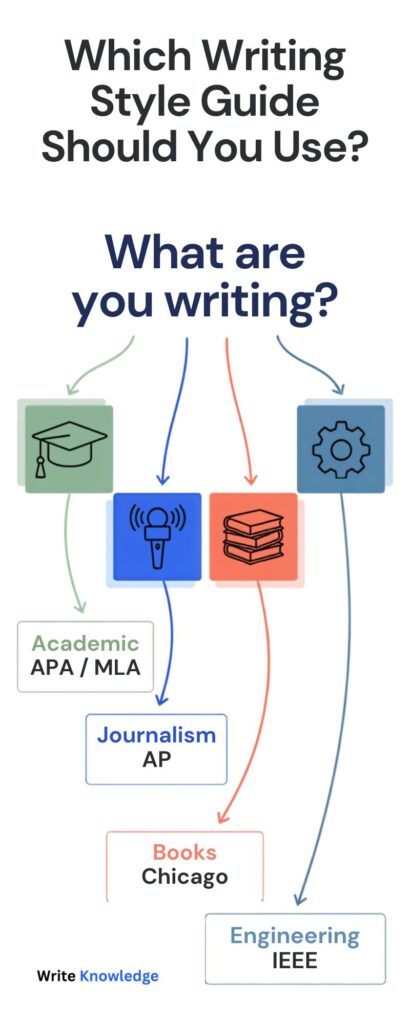
A Simple Decision Guide
| If you’re writing for… | Use… |
| Newspapers and news websites | AP Style |
| Book publishing | Chicago Manual of Style |
| Psychology, education, social sciences | APA Style |
| Literature and humanities | MLA Style |
| Engineering and computer science | IEEE Style |
Following the correct style guide demonstrates professionalism and makes your work easier for editors, reviewers, and readers to evaluate.
→ Learn how to choose the correct writing style guide
When You Don’t Need to Strictly Follow a Style Guide
One of the biggest myths about professional writing is that every article must follow a formal writing style guide.
That’s simply not true.
Many writers produce content that doesn’t belong to academic publishing, journalism, technical documentation, or scholarly research.
For example, you may be writing:
- Gaming articles
- Sports news
- Celebrity biographies
- Entertainment updates
- Movie reviews
- App tutorials
- Technology news
- Product announcements
- Event coverage
- SEO blog posts
- Listicles
- Short informational articles
These articles are often:
- 300–800 words long
- Written quickly
- Updated frequently
- Intended for general readers
In these situations, applying every rule from AP, APA, Chicago, MLA, or IEEE would add unnecessary complexity without improving the reader’s experience.
Practical Example
Imagine you’re writing a short article like:
How to Get David Beckham Skins in Fortnite
The goal is to help readers complete a task quickly.
Readers don’t expect:
- Academic citations
- Footnotes
- Formal bibliographies
- Scholarly formatting
Instead, they want:
- Accurate information
- Clear instructions
- Readable formatting
- Fast answers
For this type of content, following your website’s editorial style is usually more important than following a formal academic style guide.
Likewise, many technology, gaming, entertainment, and lifestyle websites publish hundreds of short articles every month.
Their priority is consistency within the publication, not strict adherence to style guides.
📌 Remember
You should follow a formal writing style guide when you’re writing for:
- Universities
- Research journals
- Books
- Newspapers
- Publishers
- Technical documentation
- Scholarly publications
You usually don’t need a formal style guide when writing:
- Blog posts
- Gaming content
- Technology tutorials
- Celebrity articles
- Entertainment news
- Sports updates
- SEO content
- Short informational resources
In these situations, focus on clarity, consistency, factual accuracy, and your client’s editorial guidelines.
A writing style guide is an important professional tool … but like any tool, it should be used when the situation calls for it, not simply because it exists.
Common Mistakes Writers Make When Using Style Guides
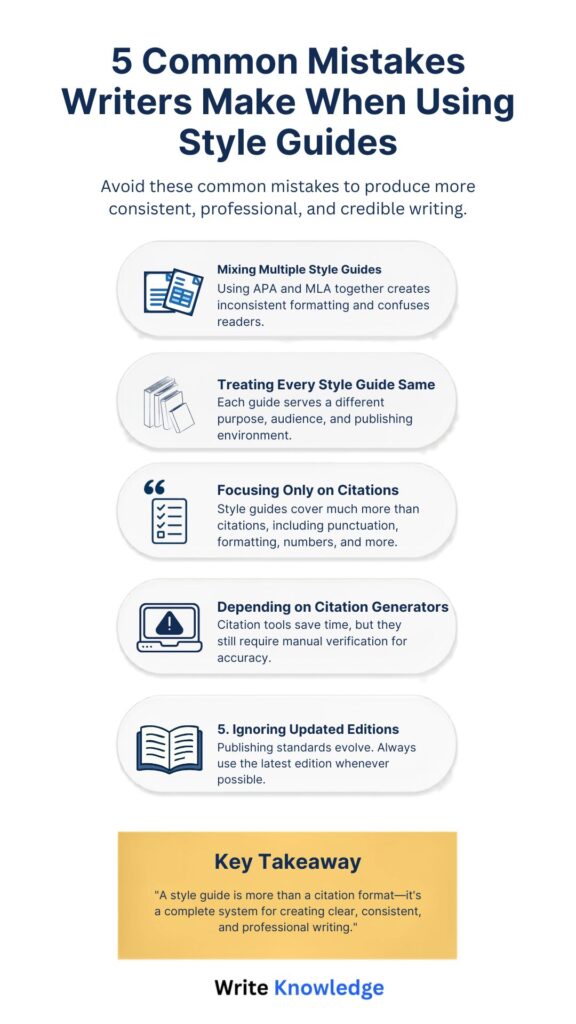
Learning a writing style guide takes time. Most mistakes happen because writers mix different style guides, misunderstand their purpose, or apply them where they aren’t needed.
Being aware of these common issues can help you produce more professional and consistent writing.
1. Mixing Multiple Style Guides
One of the most common mistakes is combining rules from different style guides within the same document.
New writers are especially more prone to this habit. They tempt to show their writing prowess and eventually end up getting scolded by the boss or losing the client.
For example, a writer may use APA in-text citations but format the reference list according to MLA. Another may follow Chicago punctuation while using AP capitalization rules.
Once you’ve selected a style guide, follow it consistently throughout your document.
2. Treating Every Style Guide the Same
Although style guides share the same goal—CONSISTENCY—they don’t solve the same problems.
AP Style is designed for journalism.
APA supports research writing.
MLA focuses on humanities.
Chicago serves publishing.
IEEE is built for technical documentation.
Using the wrong guide often results in formatting errors and unnecessary revisions.
3. Focusing Only on Citations
Many beginners think a style guide is simply a citation guide.
In reality, citations represent only one part of the overall editorial system.
Most style guides also include recommendations for:
- Headings
- Numbers
- Abbreviations
- Punctuation
- Quotations
- Capitalization
- Document structure
- Tables and figures
Ignoring these recommendations means you’re only partially following the guide.
4. Depending Entirely on Citation Generators
You were hoping this would not pop-up, right!
Well, this is a common practice among the new writers. Even the experienced writers on tight schedule may also at times use it.
Citation generators can save time, but they aren’t always accurate.
Automatically generated references may:
- Omit important information
- Format sources incorrectly
- Use outdated rules
- Misidentify source types
Always review automatically generated citations before submitting your work.
5. Ignoring Updated Editions
Writing style guides evolve over time.
Language changes.
Publishing practices change.
Technology changes.
New editions often introduce updated recommendations, revised terminology, and improved examples.
Whenever possible, consult the latest edition required by your institution, employer, or publisher.
Expert Tips for Learning Writing Style Guides
Mastering a writing style guide isn’t about memorizing hundreds of pages.
It’s about understanding the purpose behind the rules and knowing where to find reliable answers when needed.
Start With the Guide You Actually Need
Don’t try to learn every writing style guide at once.
Begin with the one required by your:
- University
- Employer
- Cient
- Publisher
- Research journal
Understand the “Why”
Instead of memorizing formatting rules, ask yourself why the rule exists.
For example:
- Why does APA emphasize publication dates?
- Why does MLA use page numbers?
- Why does AP avoid unnecessary abbreviations?
Understanding the reasoning makes the rules easier to remember.
Practice With Real Documents
Reading a style guide is helpful.
Applying it is even better.
Practice by:
- Formatting assignments
- Editing articles
- Reviewing published examples
- Comparing your work with official examples
Keep the Official Guide Nearby
Professional editors rarely memorize every rule.
Instead, they know where to find reliable information quickly.
Treat the official manual as a reference … not something you must remember word for word.
Prioritize Consistency
Readers rarely notice perfect formatting.
They do notice inconsistent formatting.
Being consistent throughout your document is often more important than achieving absolute perfection.
✅ Key Takeaways
- A writing style guide provides standardized rules for presenting written content.
- Different industries and academic disciplines use different style guides.
- AP, Chicago, APA, MLA, and IEEE are the five most widely used writing style guides.
- Style guides cover much more than citations. They also standardize formatting, punctuation, document structure, and editorial conventions.
- No single style guide is “best” for every situation. The correct choice depends on your audience and purpose.
- Many everyday blog posts and online articles don’t require a formal style guide, but they still benefit from clear, consistent writing.
- Learning one major style guide makes it much easier to understand others.
Conclusion
Writing style guides bring consistency, credibility, and professionalism to written communication. Whether you’re preparing a university assignment, publishing a book, reporting the news, or writing technical documentation, following the appropriate editorial standard helps readers focus on your ideas instead of formatting inconsistencies.
The most effective writers understand both when to follow a formal style guide and when practical, reader-focused writing is enough.
Frequently Asked Questions
What is a writing style guide?
A writing style guide is a standardized set of editorial rules that explains how written content should be formatted, organized, cited, and presented. It helps writers maintain consistency across documents and publications.
Which writing style guide is the most widely used?
There isn’t a single universal standard. AP Style, Chicago Manual of Style, APA Style, MLA Style, and IEEE Style are the five most widely recognized guides, each serving different industries and academic disciplines.
Do I always need to follow a writing style guide?
No.
Formal style guides are essential for academic writing, publishing, journalism, technical documentation, and research. However, many blog posts, gaming articles, technology tutorials, entertainment news, and short informational content rely on an organization’s own editorial guidelines.
Can I combine different writing style guides in one document?
Generally, no.
Mixing formatting and citation rules from multiple style guides creates inconsistencies and can confuse readers and editors. It’s best to follow a single style guide throughout the document unless your publisher or institution specifies otherwise.
How do I know which writing style guide to use?
The correct choice is usually determined by your university, employer, publisher, client, journal, or professional discipline. If no requirements are provided, choose the style guide most commonly used in your field.