Choosing between CMOS and APA depends less on personal preference and more on the expectations of your subject, instructor, publisher, or workplace. Both systems help writers present clear, consistent, and traceable research, but they organize citations and formatting differently.
CMOS refers to The Chicago Manual of Style, while APA refers to the style created by the American Psychological Association. CMOS offers both Notes and Bibliography and Author-Date citation systems, whereas APA consistently uses an author-date system with in-text citations and a reference list.
💡 CMOS vs APA: Quick Answer
Use APA mainly for social and behavioral sciences. Use CMOS most often in history, publishing, literature, and some humanities fields, especially when footnotes are preferred.
What are the Differences in CMOS vs APA?
CMOS: The Chicago Manual of Style
CMOS is a broad editorial and citation guide used in publishing and academic writing. Its flexibility is one of its defining features: writers can use either footnotes or parenthetical author-date citations, depending on the discipline and assignment.
The two CMOS systems are:
- Notes and Bibliography: Uses superscript note numbers in the text, followed by footnotes or endnotes and usually a bibliography.
- Author-Date: Uses parenthetical citations with the author’s surname and publication year, followed by a reference list.
For a fuller overview, read the Chicago Manual of Style guide.
APA: American Psychological Association Style
APA is a formal writing and citation style designed for research communication. It is widely used in psychology, education, sociology, business, nursing, and other social or behavioral sciences.
APA citations connect a brief in-text citation to a complete entry in a reference list. Each cited work needs both parts, and the year in the text should match the year in the reference entry.
Learn the core rules in this APA style guide.
CMOS vs APA at a Glance
| Feature | CMOS | APA |
| Full name | Chicago Manual of Style | American Psychological Association style |
| Common fields | History, humanities, publishing, literature | Psychology, education, social sciences |
| Citation options | Notes and Bibliography or Author-Date | Author-Date only |
| In-text source method | Footnotes/endnotes or parenthetical citations | Parenthetical citations |
| End-of-paper source list | Bibliography or reference list | Reference list |
| Writing emphasis | Editorial flexibility and detailed source notes | Clear reporting of current research |
| Typical date placement | Varies by CMOS system | Appears immediately after the author in references |
Citation Differences Between CMOS and APA
In-Text Citations
APA uses the author’s surname and publication year in the sentence or parentheses. This helps readers immediately see how recent a source is.
APA example:
Clear feedback can improve revision decisions (Patel, 2024).
CMOS Author-Date looks similar:
Clear feedback can improve revision decisions (Patel 2024).
Notice the key difference: APA places a comma between the author and year, while CMOS Author-Date generally does not. CMOS also permits a Notes and Bibliography approach, where a superscript number directs readers to a footnote instead of showing the source details in parentheses.
Footnotes and Endnotes
Footnotes are a major difference between the styles. CMOS Notes and Bibliography uses numbered notes, which are useful when a writer needs to cite sources while also adding brief explanations, translations, or related context.
APA does not use footnotes as its standard citation method. Its main system keeps citations in the text and full publication details in the reference list.
✍️ Writing Tip
If your paper contains many historical sources, archival documents, or explanatory side notes, CMOS Notes and Bibliography may make the main text easier to read.
Bibliography vs Reference List
CMOS Notes and Bibliography normally ends with a bibliography. CMOS Author-Date and APA both use a reference list, though their entry formats differ.
APA reference entries follow four core elements: author, date, title, and source. The date is placed in parentheses after the author information.
Formatting and Writing Differences
Tone and Voice
APA emphasizes direct, precise writing that explains research clearly. It commonly uses headings to organize longer papers and encourages writers to describe methods, evidence, and results in a logical order.
CMOS works across a wider range of writing, from scholarly history papers to books and magazine publishing. This makes it more adaptable to different editorial needs, including titles, punctuation, capitalization, notes, and bibliographies.
Numbers, Dates, and Titles
Both styles have detailed rules, so consistency matters more than guessing based on appearance. APA and CMOS may differ in how they handle title capitalization, dates, quotations, tables, figures, and source entries.
⚠️ Common Mistake
Do not combine APA citations with a Chicago bibliography. Select one style and apply its rules consistently from the first citation to the final reference entry.
When Should You Use CMOS or APA?
Use the style your instructor, department, publisher, or client requests. If no style is specified, consider the kind of writing and the audience.
Choose APA when:
- You are writing a psychology, education, social science, health, or business research paper.
- The publication date of each source is important to the argument.
- Your assignment requires author-date citations and a reference list.
Choose CMOS when:
- You are writing history, literature, theology, arts, or humanities research.
- Your assignment requires footnotes or endnotes.
- You need room for explanatory notes alongside your source citations.
- You are preparing editorial, book, or publishing-focused content.
CMOS does include an Author-Date option, so it can suit research projects that need parenthetical citations without requiring APA.
CMOS vs APA: How to Choose the Right Style Guide
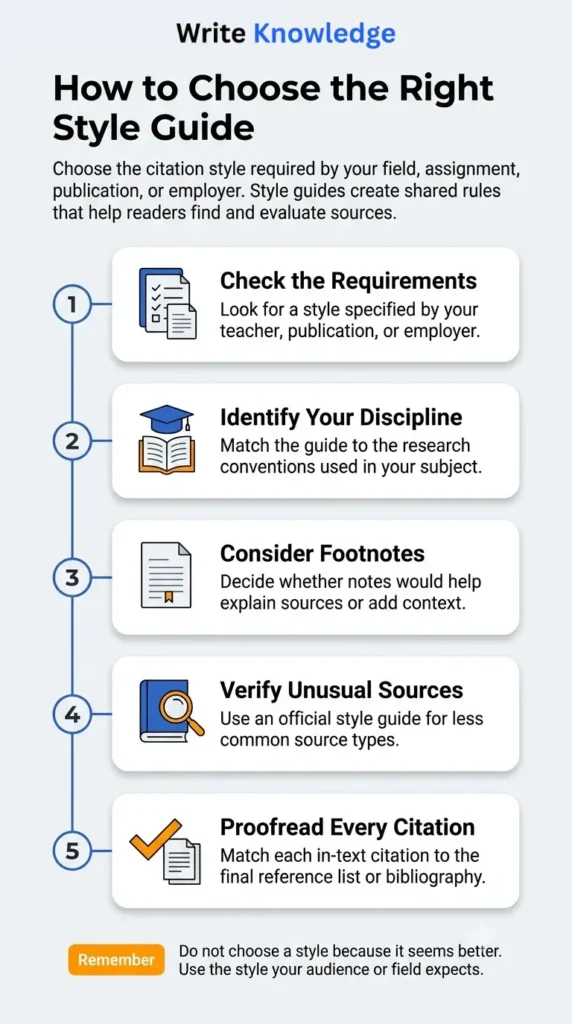
Start with the assignment instructions. The required citation style is usually not a judgment about which style is “better”; it is a shared convention that helps readers in a field locate and evaluate sources quickly.
Use this simple decision process:
- Check whether your teacher, publication, or employer names a required style.
- Identify your discipline and its usual research conventions.
- Determine whether footnotes would add useful context.
- Use an official guide or reliable style resource to check unusual source types.
- Proofread every in-text citation against the final reference list or bibliography.
📚 Continue Learning
Also check out these comparisons that are quite useful for your writng journey.
✅ Key Takeaways
- CMOS and APA are both professional writing systems that create consistency in research and citations.
- APA uses author-date in-text citations and a reference list for every cited work.
- CMOS provides two citation options: Notes and Bibliography, or Author-Date.
- APA is commonly associated with social and behavioral sciences.
- CMOS is especially common in history, humanities, and publishing contexts.
- The correct style is the one required by your academic discipline, instructor, publisher, or client.
Conclusion
CMOS and APA share the same purpose: helping writers communicate evidence clearly and give proper credit to sources. Their biggest difference is citation design. APA relies on author-date citations, while CMOS lets writers choose between author-date citations and a footnote-based system.
Once you know your audience, subject, and assignment requirements, the choice becomes much easier. Explore the full Writing Style Guides hub to understand how major writing styles serve different fields and writing goals.
Frequently Asked Questions
Is CMOS the same as Chicago style?
Yes. CMOS is the abbreviation for The Chicago Manual of Style, often called Chicago style. It includes both Notes and Bibliography and Author-Date citation systems.
Is APA easier than CMOS?
Neither style is automatically easier. APA can feel more straightforward when you are used to parenthetical author-date citations, while CMOS Notes and Bibliography can be easier for work that benefits from footnotes and extra source context.
Can I use footnotes in APA?
APA does not use footnotes as its regular source-citation system. APA citations are generally placed in the text and matched with entries in a reference list.
Should I use CMOS or APA for a history paper?
Many history courses prefer CMOS Notes and Bibliography because footnotes allow detailed citations and additional historical context. However, always follow your instructor’s stated requirements.
What is the main difference between CMOS and APA citations?
APA uses author-date citations in the text, such as (Patel, 2024). CMOS can use a similar author-date approach without the comma, or it can use numbered footnotes and a bibliography.

Sachin is a Postgraduate in Technical Writing in Business Management specializing in creating SEO-friendly, User-friendly, and Reader-focused website articles on Education, Tech, Sports, Games, and Entertainment.
Through Write Knowledge, he helps students, bloggers, editors, and professionals develop practical writing skills using clear explanations, real-world examples, and internationally recognized writing standards.