Choosing between MLA and Chicago style can become confusing when a writing project requires consistent citations, source documentation, and formatting. Both are established style systems, but they approach documentation differently.
MLA is strongly associated with language, literature, and humanities writing, while Chicago provides two major citation systems that are used across a wider range of disciplines and publishing contexts. The right choice depends less on personal preference and more on the requirements of the project, organization, publication, or field.
This guide explains the major differences between MLA and Chicago, including citations, footnotes, source lists, formatting, examples, and practical situations in which each system may be appropriate.
💡 Quick Answer: MLA vs Chicago Style
MLA usually uses in-text citations with a Works Cited list, while Chicago offers Notes and Bibliography or Author-Date systems. The right choice depends on the requirements of your field, publication, or writing project.
What Is the Difference Between MLA and Chicago?
MLA generally uses brief in-text citations that connect readers to a Works Cited list. A citation commonly identifies the author and, when relevant, a page or other location marker.
Chicago has two main documentation systems: Notes and Bibliography, which uses numbered footnotes or endnotes and usually a bibliography, and Author-Date, which uses parenthetical author-year citations and a reference list.
The simplest distinction is:
MLA → in-text citations + Works Cited
Chicago Notes and Bibliography → footnotes/endnotes + bibliography
Chicago Author-Date → author-year citations + reference list
Neither system is universally better. The appropriate choice depends on the requirements and context of the writing project.
MLA vs Chicago at a Glance
| Feature | MLA | Chicago |
| Main association | Language, literature, and humanities | Humanities, publishing, history, arts, sciences, and social sciences |
| Current major handbook | MLA Handbook, 9th ed. | The Chicago Manual of Style, 17th ed. |
| Main documentation options | In-text citation + Works Cited | Notes and Bibliography or Author-Date |
| Standard in-text approach | Author/location | Author-year or numbered notes |
| Footnotes | Used for specific purposes | Central to Notes and Bibliography |
| End source list | Works Cited | Bibliography or reference list |
| Source-entry approach | MLA core elements | System-specific citation structures |
| Publication date emphasis | Usually not central to the basic in-text citation | Central to Author-Date citations |
| Best approach | Follow the required MLA format consistently | First identify which Chicago system is required |
What Is MLA Style?
MLA stands for the Modern Language Association. MLA style provides guidance for documenting sources and formatting scholarly writing, including in-text citations, Works Cited entries, notes, and annotated bibliographies. The current ninth edition covers sources ranging from books and websites to e-books, databases, videos, and other digital materials.
A defining feature of MLA documentation is the connection between a concise in-text citation and the corresponding entry in the Works Cited list.
How MLA In-Text Citations Work
An MLA in-text citation generally begins with the shortest information needed to direct the reader to the relevant Works Cited entry. Depending on the source, this may be the author’s surname, the title, or another identifying element. A page number or other location marker can be added when relevant.
For example:
Effective documentation makes sources easier to verify (Yadav 42).
The reader can then locate the corresponding source in the Works Cited list.
If you are also learning the broader principles of research-based writing, our guide to Academic Writing provides useful context.
MLA Works Cited
MLA uses a template based on core elements. These include information such as the author, title, publication details, and date when those elements apply to the source. The relevant elements are arranged in the order specified by the MLA system.
A simplified book example might look like this:
Yadav, Anita. Academic Writing and Research. Oxford University Press, 2024.
The actual entry will depend on the source type and the information available.
What Is Chicago Style?
The Chicago Manual of Style is a broad style and publishing reference that covers citation, grammar, usage, punctuation, manuscript preparation, and many other aspects of written communication.
One important feature is that Chicago does not have just one citation system. Its official guide identifies two main approaches:
- Notes and Bibliography
- Author-Date
Understanding this distinction is essential before comparing Chicago with MLA.
Chicago Notes and Bibliography
The Notes and Bibliography system uses numbered footnotes or endnotes. A superscript number in the text corresponds to a numbered note containing source information. A separate bibliography is usually included.
For example:
Clear source documentation helps readers verify research claims.¹
A corresponding note might provide the author’s name, title, publication information, and relevant page.
Chicago describes this system as particularly flexible and notes that it is preferred by many writers in humanities fields such as literature, history, and the arts.
Chicago Author-Date
Chicago Author-Date uses brief parenthetical citations containing the author’s surname and publication year.
For example:
Clear source documentation helps readers verify research claims (Yadav 2024).
The complete source is then listed in a reference list.
Chicago notes that Author-Date is preferred by many writers in the sciences and social sciences because it places the source’s publication date directly in the text.
MLA vs Chicago Citation Differences
The most noticeable difference is how each system connects the discussion in the text with the source information.
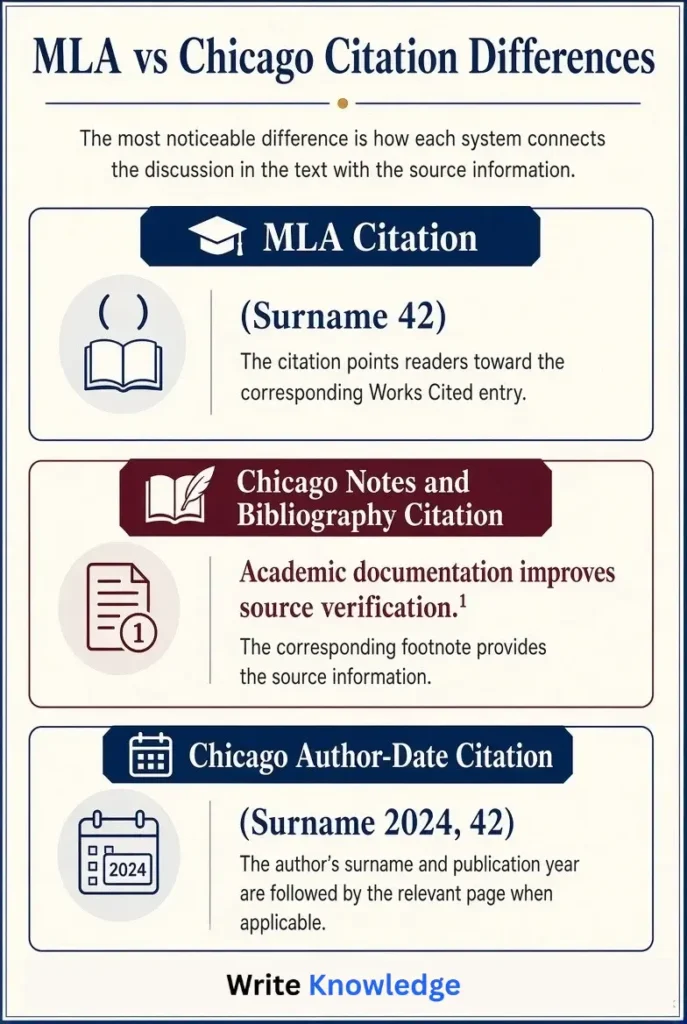
MLA Citation
A simplified MLA citation could look like:
(Yadav 42)
The citation points readers toward the corresponding Works Cited entry.
Chicago Notes and Bibliography Citation
A Chicago Notes and Bibliography citation uses a superscript number:
Academic documentation improves source verification.¹
The corresponding footnote provides the source information.
Chicago Author-Date Citation
Chicago Author-Date may look like:
(Yadav 2024, 42)
The author’s surname and publication year are followed by the relevant page when applicable.
The Key Difference
| Citation approach | Example |
| MLA | (Yadav 42) |
| Chicago Notes and Bibliography | ¹ Footnote |
| Chicago Author-Date | (Yadav 2024, 42) |
These examples are simplified to demonstrate the underlying structure. The exact citation changes according to the source type.
MLA vs Chicago Works Cited and Bibliography
The final source list is another important difference.
MLA Uses Works Cited
MLA calls its primary source list Works Cited. It identifies the sources cited in the writing. The MLA system builds entries using its core-element template.
MLA therefore creates a direct relationship between the sources mentioned in the text and the Works Cited list.
Chicago Uses Bibliography or Reference List
Chicago terminology depends on which documentation system you use.
Notes and Bibliography normally uses a bibliography.
Author-Date uses a reference list that corresponds to the parenthetical citations in the text.
This distinction matters because a bibliography and a reference list do not necessarily serve exactly the same purpose.
MLA vs Chicago Footnotes
Footnotes are one of the clearest differences between MLA and Chicago Notes and Bibliography.
MLA permits notes for particular purposes, but its standard source-documentation approach is based on in-text citations and a Works Cited list.
Chicago Notes and Bibliography, by contrast, makes numbered notes a central part of its citation system.
Chicago notes can be useful when a writer needs to provide detailed source information without interrupting the main text with longer parenthetical references.
For example, a history resource discussing archival material may use footnotes to identify a specific document, collection, page, or other source location.
MLA vs Chicago Formatting
Citation style should not be confused with the entire appearance of a document.
Both MLA and Chicago provide guidance related to document preparation, but the exact requirements can vary depending on the project.
MLA Formatting
MLA provides guidance for research-paper formatting, headings, page layout, citations, and Works Cited pages. The MLA Style Center also provides resources for formatting research papers and styling headings and subheadings.
The important point is consistency: once the required MLA structure is identified, apply it throughout the document.
Chicago Formatting
Chicago is used across many types of publications and research projects, so formatting requirements can vary according to the context.
A manuscript prepared for a publisher may have different requirements from an academic paper submitted to a university department.
For this reason, a writer should not assume that every Chicago document must look exactly the same.
MLA vs Chicago Headings and Subheadings
Both systems can accommodate headings and subheadings, but neither should be treated as a universal visual template for every type of document.
MLA emphasizes consistency among headings at the same level. Chicago can also support structured heading systems, with the exact presentation depending on the document and publishing context.
For a long research document, a consistent hierarchy makes the content easier to navigate regardless of the citation system.
MLA vs Chicago for Different Fields
The choice between MLA and Chicago often depends on the subject area and the requirements of the project.
Literature and Language
MLA is strongly associated with literature, language, and humanities research.
Its concise author-and-location citation structure can work particularly well when a writer frequently discusses specific passages, pages, or sections of literary works.
History and the Arts
Chicago Notes and Bibliography is widely associated with humanities fields, including history, literature, and the arts.
Its notes system can be useful when research contains extensive source documentation or explanatory notes.
Sciences and Social Sciences
Chicago Author-Date is commonly used in sciences and social sciences.
However, field conventions should not override explicit requirements. A journal, publisher, organization, or institution may specify a different style.
MLA vs Chicago Citation Examples
Using the same hypothetical book makes the difference easier to see.
Source:
Anita Yadav. Academic Writing and Research. Oxford University Press, 2024.
MLA Example
A simplified in-text citation:
(Yadav 42)
The corresponding Works Cited entry follows MLA’s source template.
Chicago Notes and Bibliography Example
A simplified note:
- Anita Yadav, Academic Writing and Research (Oxford University Press, 2024), 42.
Chicago’s official examples show full notes, shortened notes, and bibliography entries for different source types.
Chicago Author-Date Example
A simplified in-text citation:
(Yadav 2024, 42)
The corresponding reference-list entry places the publication year immediately after the author information.
The same source can therefore look quite different depending on whether you use MLA, Chicago Notes and Bibliography, or Chicago Author-Date.
MLA vs Chicago for Online Sources
Modern writing frequently involves websites, online journals, databases, digital books, videos, and other electronic sources.
MLA provides specific guidance for creating Works Cited entries for different formats and emphasizes documenting the particular source or page being cited rather than treating an entire website as one generic source.
Chicago also provides examples for web pages and other digital sources. Its Notes and Bibliography guide, for example, explains how web content can be cited formally when a citation is needed.
This makes it important to identify the actual source you used, rather than simply copying the homepage URL into a citation.
MLA vs Chicago: How Publication Date Is Used
Publication date has a different role in the two systems.
In a typical MLA in-text citation, the basic reference does not normally depend on the publication year. The citation is keyed to the Works Cited entry through information such as the author’s name or title and, when relevant, a location marker.
In Chicago Author-Date, the year is an important part of the in-text citation:
(Yadav 2024)
This makes the publication date immediately visible to readers.
Which Is Easier: MLA or Chicago?
There is no universal answer.
MLA may feel more straightforward when a project mainly requires concise in-text citations and a Works Cited list.
Chicago Notes and Bibliography may initially feel more involved because it requires numbered notes and usually a bibliography. However, the system can be useful when detailed source documentation is important.
Chicago Author-Date may feel familiar to anyone who has already worked with author-year documentation.
The practical approach is to learn the system required for the particular project rather than choosing a style simply because it appears easier.
Common MLA vs Chicago Mistakes
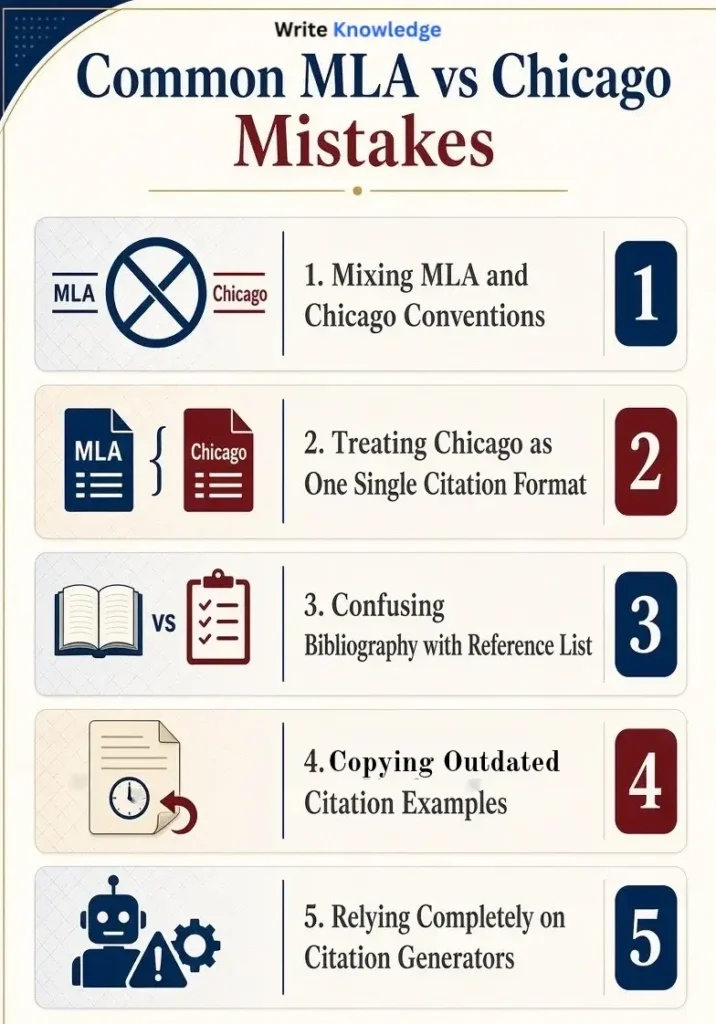
Mixing MLA and Chicago Conventions
A common mistake is using MLA in-text citations while formatting the final source list according to Chicago.
Pick the required system and apply it consistently.
Treating Chicago as One Single Citation Format
Chicago has two major documentation systems. Notes and Bibliography and Author-Date should not be treated as interchangeable.
Confusing Bibliography with Reference List
A bibliography and a reference list have different roles. In Chicago Author-Date, the reference list is designed to correspond with the parenthetical citations in the text.
Copying Outdated Citation Examples
Citation guidance evolves. MLA’s current handbook is the ninth edition, so older examples should be checked against current guidance before being reused.
Relying Completely on Citation Generators
Citation generators can speed up the process, but they do not eliminate the need for editorial checking. A generated citation can contain incorrect capitalization, missing information, incorrect source type classification, or formatting errors.
How to Choose Between MLA and Chicago
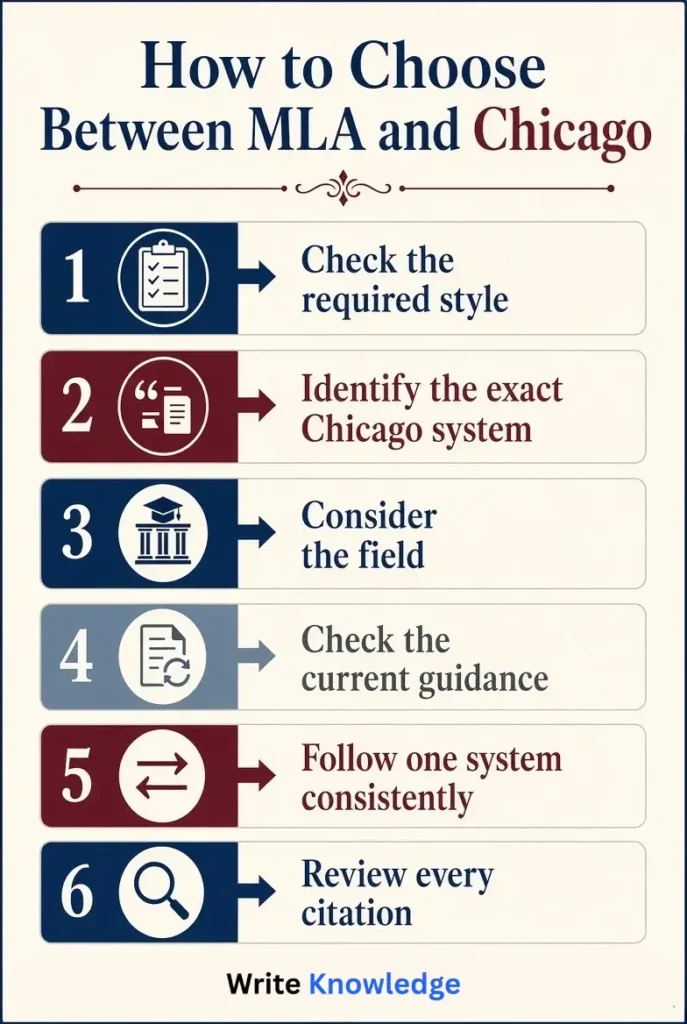
Use this simple process:
- Check the required style
Follow the requirements of the organization, publication, institution, editor, or project - Identify the exact Chicago system
If Chicago is required, determine whether it means Notes and Bibliography or Author-Date - Consider the field
Look at the documentation system commonly used in the relevant discipline, while still following the specific project requirements - Check the current guidance
Use the relevant current handbook or official style resource - Follow one system consistently
Do not combine conventions simply because individual features seem convenient - Review every citation
Check the in-text citation against the corresponding Works Cited, bibliography, or reference-list entry
For a broader overview of documentation systems, you can also explore the Writing Style Guides post.
If you are comparing MLA with another widely used system, our APA vs MLA resource provides a separate comparison.
How MLA and Chicago Fit into a Larger Writing Workflow
A citation style is only one part of producing reliable written work.
A strong research or professional writing process also involves choosing appropriate sources, organizing information, maintaining consistency, checking facts, and presenting information clearly.
That is why style guides should be treated as practical writing resources rather than simply lists of citation rules. The same principle applies when working with APA Style or AP Style.
The style system you choose should support the purpose of the document and make it easier for readers to understand and verify the information.
✅ Key Takeaways
- MLA generally uses concise in-text citations connected to a Works Cited list.
- Chicago provides two major systems: Notes and Bibliography and Author-Date.
- Chicago Notes and Bibliography uses numbered footnotes or endnotes and usually a bibliography.
- Chicago Author-Date uses parenthetical author-year citations and a reference list.
- MLA is strongly associated with language, literature, and humanities writing.
- Chicago Notes and Bibliography is widely used across humanities fields.
- Chicago Author-Date is commonly used in sciences and social sciences.
- The same source can look substantially different under MLA and Chicago.
- Online sources should be cited according to the specific source and style requirements.
- The correct choice depends on the requirements of the project, organization, publication, or field.
- Consistency is more important than mixing features from different style systems.
Conclusion
MLA and Chicago are both established approaches to documenting sources, but they are designed around different citation structures. MLA generally connects concise in-text references with a Works Cited list, while Chicago offers both a notes-based system and an author-date system.
Frequently Asked Questions
What is the main difference between MLA and Chicago?
MLA generally uses in-text citations connected to a Works Cited list. Chicago offers Notes and Bibliography, which uses numbered notes, and Author-Date, which uses parenthetical author-year citations.
Is MLA or Chicago better?
Neither is universally better. The appropriate choice depends on the requirements, discipline, publication, organization, or writing project.
Does Chicago always use footnotes?
No. Footnotes and endnotes are central to Chicago’s Notes and Bibliography system, but Chicago Author-Date uses parenthetical citations instead.
Does MLA use a bibliography?
MLA’s standard source list is called Works Cited. MLA explains that this list identifies the sources cited in the research project.
Can MLA and Chicago be used in the same document?
They can both appear in a document only when there is a specific reason and the requirements permit it. In normal circumstances, choose the required documentation system and apply it consistently rather than mixing MLA and Chicago conventions.

Sachin is a Postgraduate in Technical Writing in Business Management specializing in creating SEO-friendly, User-friendly, and Reader-focused website articles on Education, Tech, Sports, Games, and Entertainment.
Through Write Knowledge, he helps students, bloggers, editors, and professionals develop practical writing skills using clear explanations, real-world examples, and internationally recognized writing standards.