Some writing tells you what happened. Some writing explains why it happened. Creative writing makes you feel like you were there when it happened.
A quiet room can become a haunted house. A childhood memory can become a story. A few ordinary words can make a reader smell rain, hear a train leaving the station, or feel the tension between two characters who haven’t spoken for years.
That is the appeal of creative writing.
It gives writers room to experiment with language, imagination, voice, characters, emotions, and storytelling. But that freedom doesn’t mean creative writing has no structure. Good creative writing still depends on deliberate choices about what to say, how to say it, and what experience to create for the reader.
💡 Quick Answer: About Creative Writing
Creative writing uses imagination and literary craft to tell stories, express ideas or emotions, and create an experience for the reader.
It includes fiction, poetry, drama, and creative nonfiction. Unlike purely informative or instructional writing, it focuses on voice, imagery, character, and emotion.
Simply put: it’s not just what you write, but the experience your words create.
What Is Creative Writing?
Creative writing is writing that uses imagination, originality, and literary craft to express ideas, experiences, emotions, or stories in an engaging way.
It commonly includes fiction, poetry, drama, and creative nonfiction, although the exact boundaries of creative writing can vary.
Unlike writing whose primary purpose is to report, explain, or instruct, creative writing often places greater emphasis on storytelling, voice, imagery, character, emotion, and the reader’s experience.
In simple terms:
Creative writing isn’t just about what you write. It’s about the experience you create through your words.
What Makes Writing Creative?
If you thought that using different color pens, drawing illustrations, and writing something unusual is creative writing then … you are ABSOLUTELY …. WRONG!
Writing creatively doesn’t require different color pens, illustrations and unusual writing. It requires… keep reading below…
A piece can be imaginative but still feel flat if the writer hasn’t made deliberate choices about language, structure, characters, or perspective.
Creative writing commonly gives greater importance to elements such as:
- Imagination
- Originality
- Voice
- Character
- Setting
- Plot
- Dialogue
- Imagery
- Emotion
- Point of view
- Theme
- Language and style
These elements work together to create an experience rather than simply deliver information. Creative writing can explore fictional situations as well as real experiences through creative nonfiction.
For example, consider these two sentences:
Plain description:
“It started raining while Maya walked home.”
Creative approach:
“Maya had barely reached the corner when the sky opened, turning the dusty road into a silver blur.”
Both sentences communicate rain.
The second one, however, begins to create a scene.
That difference is central to creative writing.
What Are the Main Types of Creative Writing?
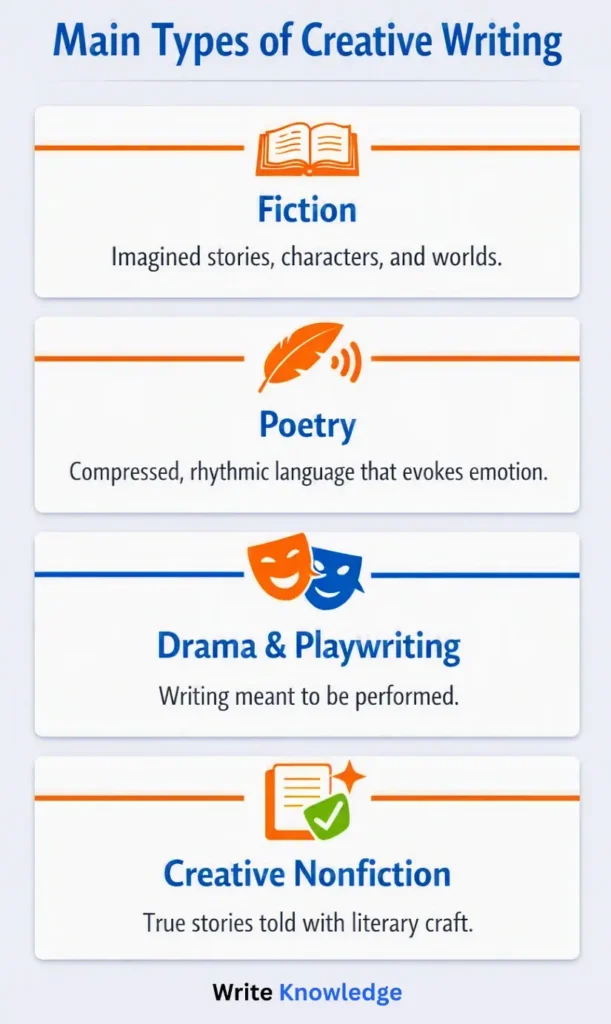
Creative writing covers a broad range of forms. The major categories include fiction, poetry, drama, and creative nonfiction, with each offering different ways to use language and structure.
Fiction
Fiction creates imagined stories, characters, situations, or worlds.
It can include:
- Novels
- Short stories
- Novellas
- Flash fiction
- Fairy tales
- Fantasy
- Mystery
- Romance
- Science fiction
Fiction doesn’t necessarily have to be completely disconnected from reality. Writers often borrow ideas, settings, emotions, or experiences from real life and transform them into imagined stories.
The key is that the writer is not required to remain strictly bound to factual events.
Poetry
Poetry uses language, structure, sound, rhythm, imagery, and compression to create meaning or evoke an emotional response.
Poetry can take many forms, including:
- Free verse
- Sonnets
- Haiku
- Narrative poetry
- Rhyming poetry
- Spoken-word poetry
Unlike prose, poetry often gives particular attention to the sound and arrangement of individual words.
A poet may choose a word not only because of what it means but also because of how it sounds, how long it is, or what image it creates.
Drama and Playwriting
Drama is written primarily to be performed.
It may include:
- Plays
- Stage scripts
- Dialogue
- Monologues
- Stage directions
Instead of explaining everything through narration, dramatic writing often relies heavily on dialogue, action, character interaction, and performance.
A playwright therefore has to think about what an audience can see and hear, not only what a reader can imagine.
Creative Nonfiction
Creative nonfiction uses real people, experiences, events, or information while applying creative techniques associated with literary writing.
Common forms include:
- Memoirs
- Personal essays
- Literary journalism
- Narrative nonfiction
- Travel writing
- Biographical writing
The events remain grounded in reality, but the writer may use scene, description, dialogue, voice, pacing, and narrative structure to make the experience more engaging.
This is an important distinction:
Creative nonfiction is creative in its presentation, but it is still grounded in real-life material.
What Are the Essential Elements of Creative Writing?
You don’t need every creative-writing technique in existence to write an effective story.
You do, however, need to understand the basic building blocks that help readers connect with your work.
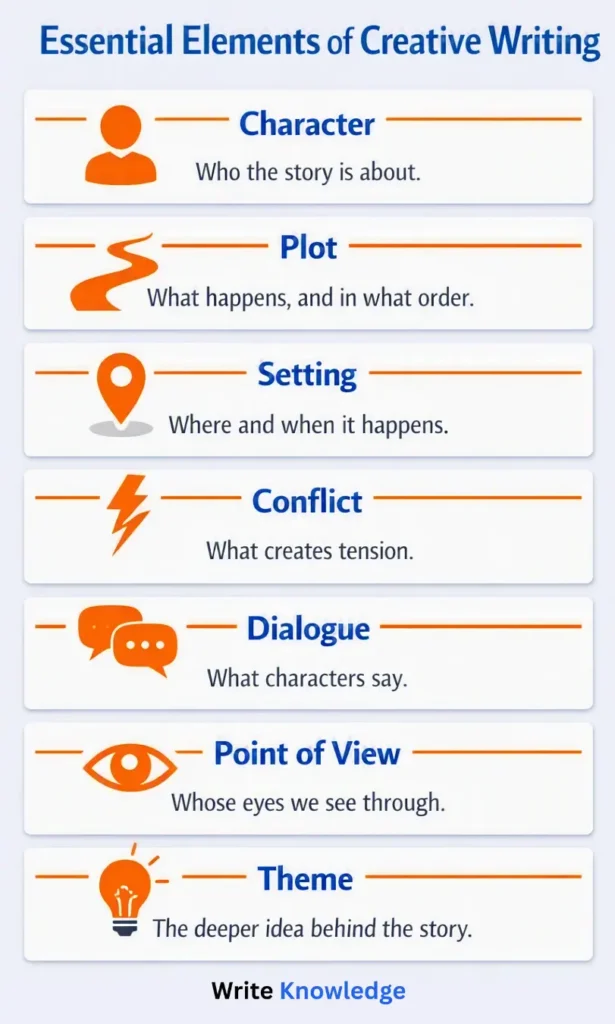
Character
Characters give readers someone to care about, understand, question, or follow.
A strong character usually has more than a name and appearance. They may have:
- Goals
- Fears
- Motivations
- Conflicts
- Strengths
- Weaknesses
- Contradictions
A character becomes more interesting when readers can understand what they want and what stands in their way.
Plot
The plot is the sequence of events that shapes a story.
A simple plot might involve:
Situation → Conflict → Development → Turning point → Resolution
Not every creative work follows this exact structure, but readers generally need some sense of movement, change, discovery, or development.
Setting
Setting establishes where and when the writing takes place.
It can influence the entire mood of a piece.
A conversation in a crowded railway station creates a very different experience from the same conversation taking place alone in an abandoned house.
Good setting doesn’t simply tell readers where the characters are.
It helps them experience the environment.
Conflict
Conflict creates tension.
It can come from:
- Character vs character
- Character vs self
- Character vs society
- Character vs nature
- Character vs circumstances
Without some form of tension or problem, a narrative can struggle to maintain momentum.
Dialogue
Dialogue is what characters say to each other.
Effective dialogue should do more than reproduce ordinary conversation. It can reveal personality, create tension, provide information, and move the story forward.
Compare:
“Are you angry with me?”
with:
“So that’s it? You’re just leaving?”
The second line gives the reader more room to infer what happened.
Point of View
Point of view determines whose perspective the reader experiences.
Common choices include:
- First person
- Second person
- Third-person limited
- Third-person omniscient
Choosing a point of view changes what the reader knows and how closely they experience the character’s thoughts.
Theme
A theme is a deeper idea or concern explored through the writing.
A story may deal with:
- Loss
- Friendship
- Identity
- Ambition
- Fear
- Family
- Freedom
- Belonging
The theme doesn’t have to be announced directly. Often, it becomes clear through the characters’ decisions and experiences.
How Is Creative Writing Structured?
Creative writing doesn’t have one universal structure.
A poem, short story, memoir, and stage play can all be structured differently.
However, many narrative works benefit from a basic progression:
Beginning
The beginning introduces enough information to give the reader a reason to continue.
This might establish:
- A character
- A situation
- A setting
- A problem
- A question
- A striking moment
You don’t necessarily have to explain everything immediately.
Development
The middle develops the situation.
Characters make decisions. Problems become more complicated. New information appears. Relationships change.
This is often where tension and curiosity grow.
Turning Point
A turning point changes the direction of the narrative.
It might be:
- A discovery
- A decision
- A confrontation
- A revelation
- A major failure
- An unexpected event
Resolution
The resolution brings the main movement of the story to a meaningful point.
It doesn’t always mean that everything ends happily.
A good resolution can leave the reader thinking, questioning, or reflecting.
What Are the Most Common Creative Writing Techniques?
Creative writing becomes more engaging when writers make deliberate use of language and storytelling techniques.
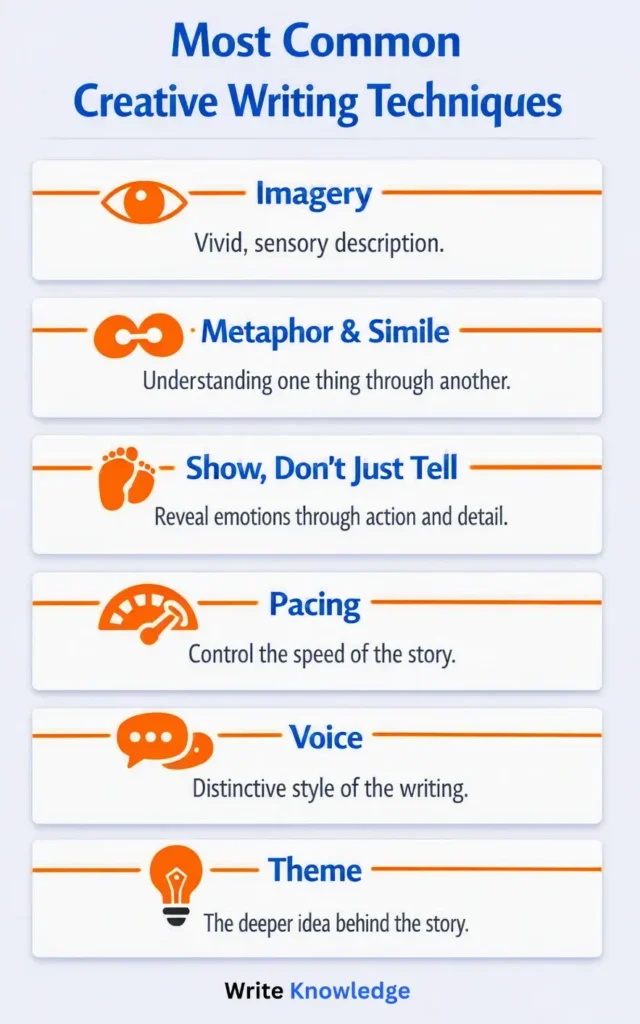
Imagery
Imagery uses descriptive language to help readers imagine an experience.
Instead of:
“The room was cold.”
you might write:
“Cold air slipped through the broken window and settled against her skin.”
The second version gives the reader something to experience.
Metaphor and Simile
Metaphors and similes help readers understand one thing through another.
Simile:
“His voice was as soft as falling snow.”
Metaphor:
“The city was a furnace by noon.”
These comparisons can make abstract ideas or ordinary descriptions more vivid.
Show, Don’t Just Tell
“Show, don’t tell” doesn’t mean that you should never tell the reader anything.
It means that important emotions and experiences can sometimes be more powerful when the reader sees evidence of them.
Instead of:
“Ravi was nervous.”
you could write:
“Ravi checked the clock for the fourth time and wiped his palms against his trousers.”
The second version lets the reader interpret the emotion.
Pacing
Pacing controls how quickly the writing appears to move.
Short sentences, quick actions, and limited description can increase tension.
Longer sentences and detailed descriptions can slow a scene down and give the reader time to observe or reflect.
Good pacing depends on the effect you want.
Voice
Voice is the distinctive quality of the writing.
Two writers can describe the same event but produce completely different pieces because their vocabulary, rhythm, perspective, attitude, and sentence patterns differ.
Voice is one reason creative writing can feel personal even when writers are working within the same genre.
📝 Example: How Does Creative Writing Change an Ordinary Idea?
Suppose the basic idea is:
“A boy waits for his father at a railway station.”
A straightforward version might say:
“Arjun arrived at the railway station at six o’clock. He waited near Platform 3 for his father, who was returning from Delhi.”
A more creative version might focus on atmosphere, emotion, and anticipation:
“At six, Arjun stood beneath the flickering Platform 3 sign, watching every arriving passenger. Each time the train doors opened, he straightened. Each time they closed again, he looked down at his watch.”
The second version gives the reader a scene and an emotional experience, rather than simply presenting information.
That is the kind of transformation creative writing makes possible.
How Is Creative Writing Different from Other Types of Writing?
The easiest way to understand creative writing is to compare its primary purpose with other forms.
| Type of Writing | Primary Purpose | Common Characteristics |
| Creative writing | Engage, express, explore, or tell a story | Imagination, voice, emotion, imagery |
| Expository writing | Explain or inform | Facts, explanation, logical organization |
| Persuasive writing | Influence or convince | Claims, reasoning, evidence |
| Academic writing | Present and analyze scholarly ideas | Evidence, formal structure, citations |
| Technical writing | Explain processes or information | Precision, clarity, instructions |
| Narrative writing | Tell a sequence of events | Characters, events, setting, perspective |
These categories can overlap.
A piece of writing can be narrative and creative, for example. Creative nonfiction can also contain factual information. Even academic and technical writers make creative choices about language and structure.
The difference is usually found in the dominant purpose and conventions of the writing.
If you want to understand these distinctions more broadly, explore our Types of Writing guide.
Where Is Creative Writing Used?
Creative writing isn’t limited to novels sitting on a bookshelf.
It appears in many forms of communication and entertainment, including:
- Books
- Short stories
- Poems
- Plays
- Screenplays
- Personal essays
- Memoirs
- Narrative nonfiction
- Children’s literature
- Spoken-word performances
- Some forms of literary journalism
Screenwriting and playwriting are sometimes taught as separate disciplines, although they are commonly considered part of the broader creative-writing field.
The techniques of creative writing can also influence other forms of content.
For example, a marketer may use storytelling to make a campaign more memorable, while a blogger may use narrative and imagery to make an ordinary experience more engaging.
That doesn’t automatically make the entire piece creative writing.
It simply shows that creative techniques can travel across writing forms.
How Can You Start Improving Creative Writing?
You don’t have to begin by writing a 300-page novel.
Start smaller.
Read Creative Work Regularly
Read short stories, novels, poetry, memoirs, and other forms of creative writing.
Pay attention to how the writer creates an effect.
Ask:
- Why does this opening work?
- How did the writer introduce the character?
- Which details made the scene vivid?
- Where did the tension increase?
- Why does this sentence sound memorable?
Reading like a writer teaches you to notice techniques that ordinary reading can hide.
Write From Simple Prompts
Take an ordinary situation and add a complication.
For example:
“A woman finds a wallet on the road.”
Now ask:
“What if the wallet contains a photograph of her?”
A simple situation can quickly become the beginning of a story.
Practise Description
Choose something familiar such as: a room, street, person, object, or memory, and describe it without simply listing its features.
Use the senses.
What can the character:
- See?
- Hear?
- Smell?
- Touch?
- Taste?
The goal is not to use complicated vocabulary.
It is to choose specific details that matter.
Rewrite Your First Draft
Your first version doesn’t need to be your final version.
After writing, look for:
- Unnecessary sentences
- Repeated words
- Weak descriptions
- Unclear character motivations
- Slow sections
- Dialogue that doesn’t add anything
- Sudden changes in tone or perspective
Revision is where many promising ideas become stronger pieces of writing.
✍️ Writing Tip
Don’t try to sound creative. Try to make the reader experience something.
Writers sometimes believe creative writing requires complicated vocabulary, unusual metaphors, or dramatic sentences.
It doesn’t.
A simple sentence can be powerful when the detail is specific and meaningful.
Instead of searching for the most impressive word, ask:
What would help my reader see, hear, feel, or understand this moment more clearly?
That question will usually lead to better creative choices.
What Skills Do You Need for Creative Writing?
Creative writing improves through practice, but certain skills make the process easier.
Observation
Good writers notice details that other people may overlook.
A writer might notice how someone pauses before answering a question, how a shopkeeper arranges coins, or how a street changes after rain.
Imagination
Imagination allows writers to explore possibilities beyond what is immediately visible.
It helps you ask:
What if?
That question can become the starting point for an entire story.
Vocabulary
A strong vocabulary gives you more choices, but more words do not automatically mean better writing.
The useful skill is knowing which word best communicates the intended meaning, mood, or image.
Empathy
Writers often need to understand perspectives different from their own.
Even when a character behaves badly, the writer needs to understand what the character believes, wants, fears, or misunderstands.
Revision
Creative writing rarely becomes strong through the first draft alone.
The ability to step back, identify weaknesses, and rewrite is one of the most valuable skills a developing writer can build.
⚠️ Common Mistake
Assuming that creative writing means using complicated language.
It doesn’t.
A paragraph filled with unusual vocabulary can still be boring if it doesn’t create a clear image, emotion, idea, or experience.
For example:
“The magnificent, resplendent, incandescent sun illuminated the picturesque landscape…”
This may sound “creative,” but it gives the reader several decorative words without much specific information.
A stronger description might focus on one meaningful detail:
“Sunlight spilled across the empty field, catching the dew on every blade of grass.”
The lesson is simple:
Creative writing comes from deliberate choices, not from making every sentence sound complicated.
Is Creative Writing Only Fiction?
No!
This is one of the easiest misconceptions to make.
Creative writing can include fiction, poetry, drama, and creative nonfiction.
A memoir, for example, can describe real experiences while using scene, voice, dialogue, description, and narrative structure.
So don’t define creative writing simply as:
“Writing made-up stories.”
A better definition is:
Writing that uses creative and literary techniques to express ideas, experiences, emotions, or stories.
Can Creative Writing Have Rules?
Yes. But they are better understood as conventions and craft choices rather than one universal rulebook.
A sonnet has different conventions from a short story.
A stage play works differently from a memoir.
A mystery novel creates different expectations from free verse.
Understanding the conventions of your chosen form helps you make intentional decisions and knowing when to break those conventions can also become part of the craft.
So creative freedom doesn’t mean “anything goes.”
It means the writer has more room to make artistic choices.
How Can You Practise Creative Writing?
A practical routine can be surprisingly simple.
Try this:
Read → Write → Revise → Read Again → Rewrite
For example, choose one short scene each day.
Write it in 200–300 words.
Then revise it by focusing on one element:
- Monday: Description
- Tuesday: Dialogue
- Wednesday: Character
- Thursday: Setting
- Friday: Pacing
- Saturday: Point of view
- Sunday: Full revision
This approach prevents you from trying to improve everything at once.
The more you practise making deliberate choices, the more naturally those choices begin to appear in your writing.
Also: If you’re interested in turning writing skills into professional opportunities, explore our Writing Careers guide.
✅ Key Takeaways
- Creative writing uses imagination, originality, and literary craft to create engaging experiences for readers.
- It commonly includes fiction, poetry, drama, and creative nonfiction.
- Creative writing can be fictional or grounded in real-life experiences.
- Important elements include character, plot, setting, conflict, dialogue, point of view, and theme.
- Techniques such as imagery, metaphor, showing rather than telling, pacing, and voice can make writing more engaging.
- Creative writing doesn’t have one universal structure; different forms have different conventions.
- Strong creative writing focuses on specific details and deliberate choices.
- Reading widely can help you recognize how experienced writers create effects.
- Regular writing and revision are essential for developing creative-writing skills.
- The most useful question isn’t “How can I sound creative?” but “What experience do I want to create for my reader?”
Conclusion
Creative writing gives you something that many other forms of writing don’t: room to explore.
You can build fictional worlds, turn memories into stories, use a few carefully chosen words to create an image, or explore an emotion that is difficult to explain directly. But creative freedom works best when it is supported by craft. Characters need motivation, scenes need purpose, language needs precision, and stories need movement.
Frequently Asked Questions
What is creative writing?
Creative writing is writing that uses imagination, originality, and literary techniques to express ideas, experiences, emotions, or stories in an engaging way.
What are the main types of creative writing?
The major forms commonly include fiction, poetry, drama, and creative nonfiction.
What are the elements of creative writing?
Common elements include character, plot, setting, conflict, dialogue, point of view, theme, voice, and imagery.
What skills are important for creative writing?
Observation, imagination, vocabulary, empathy, storytelling, and revision are useful skills for creative writers.
What is the difference between creative writing and expository writing?
Creative writing generally focuses more on expression, storytelling, imagination, and reader experience, while expository writing primarily aims to explain or inform.
Does creative writing have rules?
Different forms of creative writing have different conventions. Understanding those conventions helps writers make deliberate choices about structure, language, and presentation.
Do you need a degree to write creatively?
A degree can provide structured study and feedback, but creative-writing skill can also be developed through reading, practice, revision, workshops, and independent learning.
Can creative writing be based on real events?
Yes. Creative nonfiction uses real people, experiences, or events while applying creative and literary techniques.
Is creative writing the same as narrative writing?
Not exactly. Narrative writing focuses on telling events through a narrative, while creative writing is a broader category that can include narrative forms as well as poetry, drama, and creative nonfiction.

Sachin is a Postgraduate in Technical Writing in Business Management specializing in creating SEO-friendly, User-friendly, and Reader-focused website articles on Education, Tech, Sports, Games, and Entertainment.
Through Write Knowledge, he helps students, bloggers, editors, and professionals develop practical writing skills using clear explanations, real-world examples, and internationally recognized writing standards.