Journalistic writing is everywhere. You see it in breaking-news reports, newspaper stories, magazine features, interviews, investigative reports, reviews, and digital news publications. But journalistic writing is not simply “writing about news.” It follows a distinct approach to gathering, organizing, verifying, and presenting information for an audience.
Whether you are learning journalism, writing for a publication, building a writing portfolio, or simply trying to understand different types of writing, learning how journalistic writing works can help you write with greater clarity, accuracy, and purpose.
💡 Quick Answer
Journalistic writing is a form of writing used to report, explain, investigate, review, or comment on events, issues, people, and developments for a public audience. It emphasizes factual accuracy, clear language, relevant context, attribution, and audience needs.
Common forms include news reports, feature stories, interviews, investigative journalism, opinion columns, reviews, and other media-focused formats.
Good journalistic writing does more than present information. It helps readers understand what happened, who is involved, why it matters, and what they need to know.
What Is Journalistic Writing?
Journalistic writing is writing produced for journalism and related media contexts. Its purpose can vary depending on the format. A breaking-news report may focus on delivering essential facts quickly, while a feature story may spend more time developing background, context, characters, and narrative detail.
The central distinction is that journalistic writing is generally built around reporting and communicating information to an audience, rather than simply expressing the writer’s personal experience or presenting an academic argument.
A journalist may gather information through interviews, documents, public records, observations, data, official statements, and other sources. That information then needs to be assessed, organized, attributed, and presented in a form readers can understand.
Accuracy is especially important. The Society of Professional Journalists’ Code of Ethics encourages journalists to verify information before publication, use original sources when possible, provide context, identify sources clearly, and correct mistakes.
What Are the Main Types of Journalistic Writing?
Journalism includes several forms of writing. They can share principles such as accuracy and attribution while differing significantly in purpose, structure, tone, and depth.
News Writing
News writing reports a recent event or development by presenting the most important facts clearly and quickly.
A conventional news report generally prioritizes the most important information early in the story. The opening paragraphs may answer several of the basic questions readers have about an event, while later paragraphs provide additional details, quotations, context, and supporting information.
📝 Example
City Opens New Public Library in Downtown Area
The city opened a new public library on Monday, providing residents with access to more than 20,000 books, digital learning resources, and free internet services. The library will remain open seven days a week, according to city officials.
What this example shows: It focuses on what happened, provides essential facts early, and uses attribution where appropriate.
Feature Writing
Feature writing explores a subject in greater depth and often uses description, storytelling, personal experiences, and background information.
A feature may still be based on factual reporting, but it does not necessarily follow the same structure as a short breaking-news report. It may begin with an anecdote, scene, observation, question, or individual experience before developing the larger subject.
📝 Example
Before Sunrise, the Bakers of Old Market Begin Their Day
At 4:30 every morning, while most of the neighborhood is still asleep, 62-year-old Ramesh opens the shutters of his family’s bakery. The shop has been serving the Old Market for more than 40 years. Today, however, changing customer habits and rising ingredient costs are forcing the family to rethink how it does business.
What this example shows: Instead of immediately presenting only the basic facts, the story opens with a person and a scene before developing the larger issue.
Interview Writing
Interview writing presents information, experiences, or perspectives gathered through an interview with a person.
The final article may appear as a question-and-answer interview, a profile, or a reported story incorporating selected quotations.
Accuracy matters particularly when using direct quotations. A writer needs to preserve the speaker’s meaning and identify who provided important information.
📝 Example
Teacher Explains How Digital Tools Are Changing Her Classroom
When asked how technology has changed her teaching, science teacher Priya Mehta pointed to the way students now interact with difficult concepts.
“Students can see processes that were almost impossible to demonstrate before,” she said. “It gives them another way to understand the subject.”
What this example shows: The writer uses direct quotations and attribution to present the interviewee’s perspective.
Investigative Journalism
Investigative journalism examines a subject in depth, often using documents, data, interviews, records, and multiple sources to uncover or explain information that may not be immediately apparent.
An investigative report may take considerably longer to produce than a short news story because the journalist may need to examine records, verify claims, identify patterns, and give relevant subjects an opportunity to respond.
The core principle remains the same: important claims should be supported by reliable evidence rather than presented simply because they make a compelling story.
📝 Example
Where Does the City’s Recycling Waste Go?
The city reports that thousands of tonnes of recyclable waste are collected each year. An examination of municipal records, contractor documents, transport data, and interviews with workers, however, raises questions about how much of that material actually reaches recycling facilities.
What this example shows: The example introduces a question that requires deeper research and evidence rather than relying on a single statement or source.
Opinion and Editorial Writing
Opinion and editorial writing presents an argument or viewpoint on an issue. Unlike straight-news reporting, the writer’s position is part of the purpose of the piece.
The distinction between reporting and commentary should remain clear. The writer may use facts, evidence, examples, and expert perspectives to support an argument, but the article should make its opinion-based nature apparent.
📝 Example
Why Public Libraries Still Matter in a Digital Age
Public libraries should not be treated as outdated institutions simply because more information is available online. They provide free access to books, technology, learning spaces, and community programmes that many people cannot easily access elsewhere.
What this example shows: The writer is making an argument and should present the piece as opinion or commentary rather than straight-news reporting.
Review and Criticism
Reviews and criticism evaluate a subject such as a book, film, performance, restaurant, product, exhibition, or other work.
A useful review does not merely say that something is “good” or “bad.” It provides enough description and reasoning for readers to understand the basis of the evaluation.
📝 Example
A Thoughtful Film That Takes Its Time
The Last Journey follows an ageing photographer returning to his hometown after several decades away. The film moves slowly, but its measured pace allows the characters and setting to develop naturally. The performances are understated, although the second half occasionally feels longer than necessary.
What this example shows: The writer combines description with evaluation, giving readers reasons behind the review rather than simply saying whether the film is good or bad.
Quick Difference
| Type | What the example mainly does |
| News Writing | Reports what happened |
| Feature Writing | Explores a subject through depth and storytelling |
| Interview Writing | Presents information or perspectives from an interview |
| Investigative Journalism | Examines a subject through deeper research and evidence |
| Opinion and Editorial Writing | Presents an argument or viewpoint |
| Review and Criticism | Evaluates a subject and explains the reasoning |
What Are the Key Characteristics of Journalistic Writing?
Although different journalistic formats have different conventions, several characteristics commonly define effective journalistic writing.
Accuracy and Fact Verification
Accuracy is fundamental to credible journalism.
Writers should verify important information before publication, particularly names, dates, figures, quotations, locations, claims, and other details that could materially affect the story.
Clarity and Conciseness
Journalistic writing should be easy for the intended audience to understand.
That usually means choosing familiar words where appropriate, avoiding unnecessary jargon, keeping sentences manageable, and removing information that does not help the reader understand the subject.
Concise writing does not mean leaving out necessary context. It means making every important detail earn its place.
Fairness and Balance
Journalistic writing should represent relevant information fairly.
This does not mean every claim automatically deserves equal weight. It means writers should avoid deliberately distorting facts, misleading readers, or presenting a contested claim without appropriate context.
For stories involving allegations or significant disputes, journalists also need to consider relevant responses and evidence.
Attribution and Sourcing
Attribution tells readers where information came from.
For example:
The transport department said the new route will begin operating in October.
Here, the claim is attributed to the transport department rather than being presented as an unsupported fact.
Timeliness and Relevance
News writing often deals with events or developments that have current relevance.
However, timeliness does not mean that speed should automatically take priority over accuracy. The SPJ Code of Ethics explicitly emphasizes that neither speed nor format excuses inaccuracy.
Audience Awareness
Journalistic writing is written for a particular audience.
A local newspaper, business publication, sports website, science magazine, and national news organization may cover the same subject in very different ways because their readers have different needs and levels of background knowledge.
Strong Leads and Information Prioritization
Journalistic stories often need to communicate the main point quickly.
A strong lead gives readers a reason to continue while establishing important information. In news writing, the most significant facts are commonly placed near the beginning rather than being hidden several paragraphs into the story.
How Is a Journalistic Article Structured?
There is no single structure that every journalistic article must follow. A breaking-news story, feature, review, and investigative report can use very different structures.
However, many news stories contain several recognizable components.
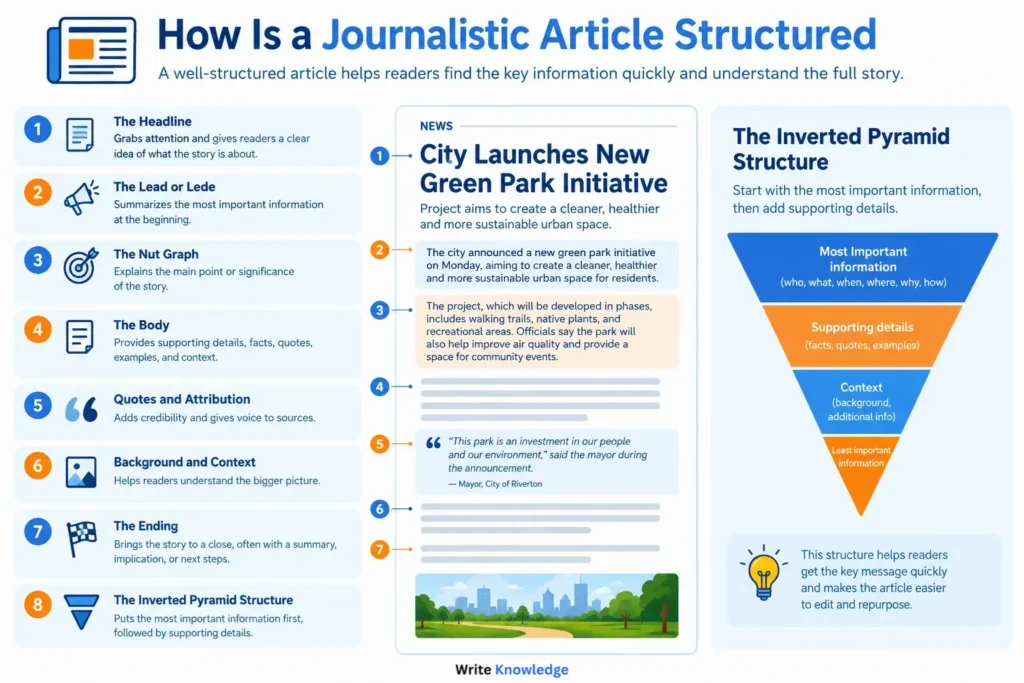
The Headline
The headline tells readers what the story is about and gives them a reason to continue.
A good headline should be accurate, clear, relevant, and appropriate for the publication.
The Lead or Lede
The lead, also spelled “lede” in journalism, is the opening section of a story.
In a straightforward news report, it often communicates the most important information quickly. In feature writing, the opening may instead use a scene, anecdote, description, or other storytelling device.
The Nut Graph
A nut graph is a paragraph that explains the central point or significance of a story.
It is especially useful in feature writing, where the opening may begin with a scene or anecdote before explaining why the story matters.
For example, a feature might begin with a shopkeeper opening an old market stall at dawn. The nut graph could then explain that the market is facing redevelopment after operating for more than a century.
The Body
The body develops the story with supporting facts, quotations, examples, evidence, background, and context.
Information should be organized in a way that makes the story easy to follow rather than simply presenting research in the order in which the writer found it.
Quotes and Attribution
Quotes can add evidence, expertise, personal experience, or human perspective.
They should have a clear purpose. A quotation should contribute something rather than merely repeat information that the writer has already explained.
Background and Context
Context helps readers understand why an event or issue matters.
For example, a report about a new government policy may need background information about the previous policy, the problem being addressed, or the people affected.
The Ending
The ending depends on the type of story.
A short news report may end after the most important supporting information has been provided. A feature may return to an earlier image or person. An opinion piece may end with a final argument or implication.
The Inverted Pyramid Structure
The inverted pyramid is a common structure in news writing.
It places the most important information near the beginning, followed by supporting details and then less essential information.
A simplified structure looks like this:
Most important information → Supporting details → Quotes/context → Additional details
This structure helps readers understand the essential point even if they do not read the entire story.
It also makes the story easier to edit when space or screen length is limited.
What Are the 5 Ws and 1 H in Journalism?
The 5 Ws and 1 H are a practical framework for identifying essential information:
- Who? Who is involved?
- What? What happened?
- When? When did it happen?
- Where? Where did it happen?
- Why? Why did it happen or why does it matter?
- How? How did it happen?
Not every story will answer all six questions in its opening paragraph. The framework is best treated as a reporting and information-gathering tool rather than a rigid formula.
For example, consider a fictional report:
A city library opened a new digital learning centre on Monday to provide free computer and online-learning facilities to local students.
This short lead already answers several questions:
- Who? The city library and local students
- What? A digital learning centre opened
- When? Monday
- Why? To provide free learning facilities
The rest of the article could explain where the centre is located and how students can use it.
What Techniques Are Used in Journalistic Writing?
Journalists use a combination of reporting and writing techniques to make information clear, useful, and engaging.
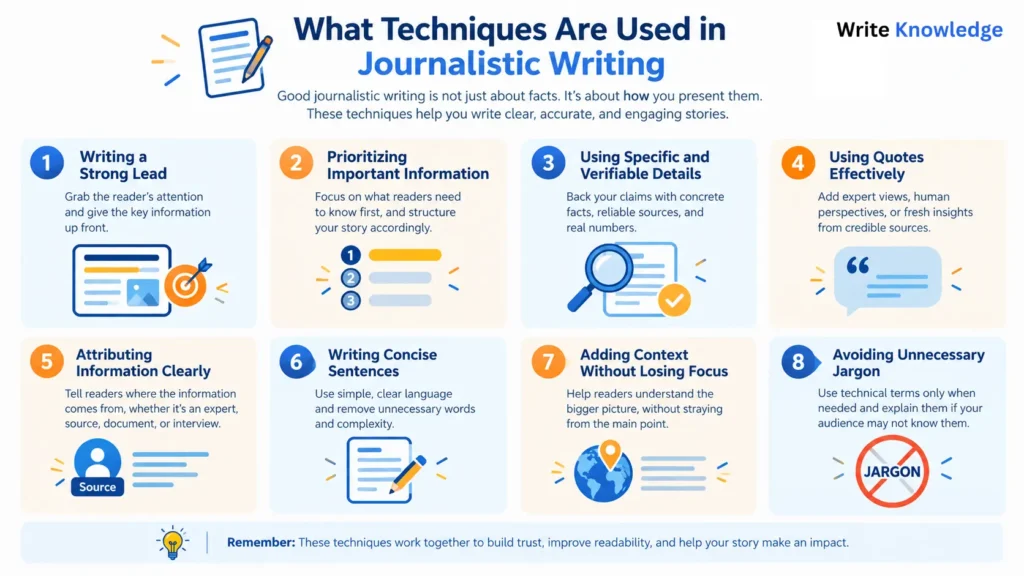
Writing a Strong Lead
Start with the information, detail, or angle that matters most to the intended reader.
Avoid spending several paragraphs on background before telling readers why the story is relevant.
Prioritizing Important Information
Decide what readers need to know first.
This is particularly important in news writing, where readers may scan rather than read every paragraph.
Using Specific and Verifiable Details
Specific details make stories more useful and credible.
Instead of writing:
The project will cost a lot of money.
A stronger version might identify the reported cost, the source of the figure, and what the money will fund.
Using Quotes Effectively
Choose quotations that provide information, expertise, reaction, or a human perspective.
Avoid using a quote merely because it exists.
Attributing Information Clearly
Tell readers whether information came from an official statement, interview, document, study, witness, public record, or another source.
Clear attribution is particularly important when information is disputed or when a source is making a claim.
Writing Concise Sentences
Remove unnecessary words without removing necessary meaning.
A sentence should help readers understand the subject rather than make them work through unnecessary complexity.
Adding Context Without Losing Focus
Context answers the reader’s next question.
If a company announces a major change, for example, readers may also need to know what the previous policy was and who will be affected.
Avoiding Unnecessary Jargon
Use specialized terminology when the subject requires it, but explain unfamiliar terms when they could prevent readers from understanding the story.
The goal is not to make every article simplistic. The goal is to make the information accessible to its intended audience.
Journalistic Writing Examples
The following examples are original illustrations of common journalistic formats.
Example of a Straight News Report
Local Library Opens Digital Learning Centre
The Central City Library opened a new digital learning centre on Monday, giving local students free access to computers, internet services, and online educational resources.
The centre will operate during regular library hours, according to library officials. Students can use the facilities for research, coursework, and digital skills training.
The example demonstrates how a news report can establish the main event quickly and then add supporting information and attribution.
Example of a Feature Story
Before the City Wakes, the Bakers of Market Street Begin Their Day
At 4:30 every morning, when most of Market Street is still quiet, Meera Sharma switches on the lights of her family’s bakery.
Her family has operated the shop for three generations. Today, however, the neighbourhood around it is changing rapidly.
A feature can begin with a person or scene and gradually expand into a broader story.
Example of an Interview-Based Article
How a School Teacher Uses Digital Tools in the Classroom
When asked what changed most after the school introduced digital learning tools, science teacher Arun Mehta pointed to the students’ ability to explore visual demonstrations.
“The biggest difference is that students can see processes that were difficult to demonstrate in a classroom.”
The article could then combine the teacher’s comments with information about the school’s programme, student experiences, and relevant background.
Example of an Investigative Report
Where Does the City’s Recycling Waste Go?
City records show that thousands of tonnes of recyclable material are collected each year. An examination of transport records, contractor documents, interviews, and facility data can reveal what happens to that material after collection.
An investigative story would require substantially more evidence and verification than this short example provides.
Example of an Opinion Column
Why Public Libraries Still Matter in a Digital Age
Libraries should not be viewed simply as places where people borrow books. They can also provide public access to information, technology, learning spaces, and community programmes.
This is an opinion-based argument. The writer should make that viewpoint clear rather than presenting it as an uncontested news fact.
Journalistic Writing vs Other Types of Writing
Journalistic writing overlaps with several other forms of writing, but the purpose and conventions are different.
| Writing Type | Main Purpose | Typical Audience | Common Approach |
| Journalistic Writing | Report, explain, investigate, review, or comment | Public or publication-specific audience | Fact-based, audience-focused, structured |
| Academic Writing | Explain, analyze, or argue within an academic context | Students, researchers, academics | Evidence-based and formally structured |
| Creative Writing | Create experiences, stories, characters, or imaginative works | General or literary audience | Imaginative, expressive, narrative |
| Business Writing | Communicate information and support workplace decisions | Employees, clients, managers, stakeholders | Clear, practical, action-oriented |
| Technical Writing | Explain specialized information or procedures | Users, professionals, technical audiences | Precise, instructional, structured |
| Digital Content Writing | Inform, educate, engage, or support online goals | Online audiences | Search- and audience-focused, scannable |
For a broader comparison of writing categories, navigate to Types of Writing.
Journalistic Writing vs News Writing: Are They the Same?
Not exactly.
Journalistic writing is the broader category, while news writing is one form of journalistic writing.
A journalist may write:
- A breaking-news report
- A feature story
- An interview
- An investigative report
- A review
- An opinion column
- An editorial
These formats can have different structures and purposes.
For example, a breaking-news report may prioritize the latest verified facts, while a feature may use narrative techniques to help readers understand the people and context behind an issue.
So, while news writing is journalistic writing, not all journalistic writing is straight news writing.
Which Style Guide Is Used in Journalistic Writing?
Style guides help writers and editors maintain consistency in areas such as spelling, punctuation, capitalization, usage, numbers, and other editorial decisions.
The Associated Press Stylebook is specifically described by AP as a writing style guide for journalists. AP also provides regularly updated online style guidance.
However, there is an important distinction:
Journalistic writing is a type or form of writing. AP Style is a style guide.
A publication may also have its own editorial style guide or house rules.
Publication-Specific Style Guides
News organizations may supplement a major style guide with their own editorial policies.
These internal guidelines can cover:
- Preferred terminology
- House spellings
- Editorial conventions
- Publication-specific formatting
- Sourcing practices
- Corrections
- Headline conventions
Therefore, a journalist should follow the publication’s requirements when they differ from general style-guide guidance.
Why Consistency Matters
A style guide gives writers and editors a shared reference point.
Consistency makes publications easier to read and edit because similar situations are handled in similar ways.
If you want to understand the differences between major writing standards, explore the Writing Style Guides post.
You can also explore AP vs APA and CMOS vs AP Style to understand why similarly named standards can serve very different purposes.
Common Mistakes in Journalistic Writing
Even a well-researched story can become ineffective if the writing process introduces avoidable problems.
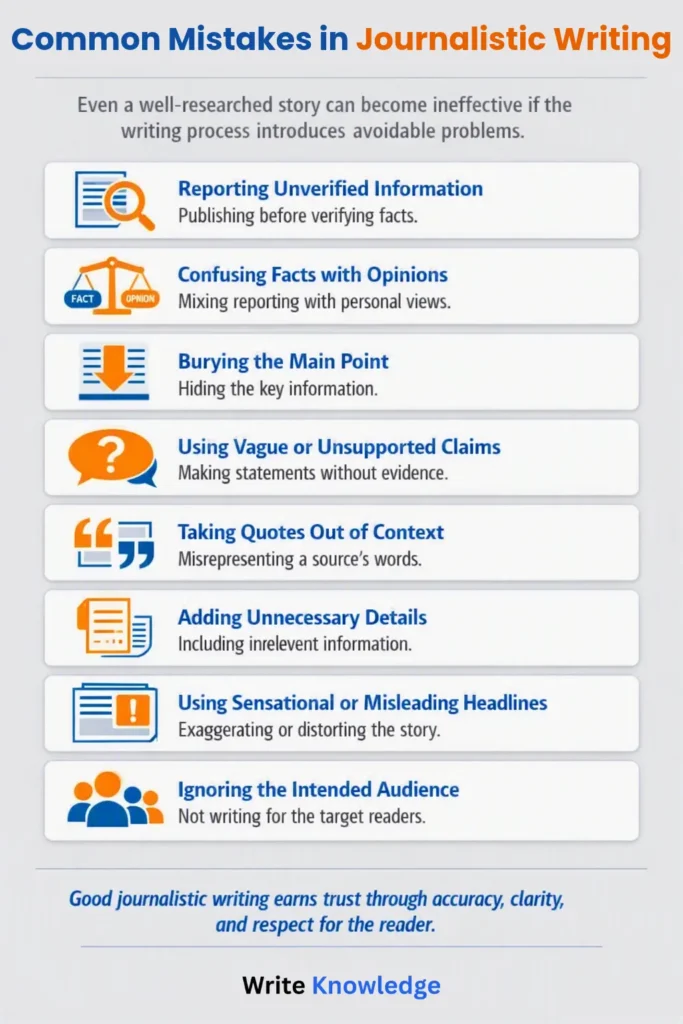
Reporting Unverified Information
Publishing information before verifying it can damage the credibility of both the story and the publication.
When possible, verify important claims against reliable or original sources before publication.
Confusing Facts with Opinions
A writer should distinguish reported information from personal interpretation or commentary.
If a statement represents an opinion, the article should make that clear through attribution, framing, or the appropriate article format.
Burying the Main Point
Readers should not have to read several paragraphs before discovering what the story is actually about.
For straight news, put essential information early.
Using Vague or Unsupported Claims
Statements such as “many people believe” or “experts say” are weak when the article does not identify who those people or experts are.
Specific attribution is more useful.
Taking Quotes Out of Context
A quotation can become misleading if surrounding context changes its meaning.
Writers should make sure selected quotations accurately represent what the source intended to communicate.
Adding Unnecessary Details
More information does not automatically make a story better.
Include details that help readers understand the event, issue, people, evidence, or significance.
Using Sensational or Misleading Headlines
A headline should attract attention without misrepresenting the story.
A dramatic headline that promises something the article does not deliver may gain a click but damage reader trust.
Ignoring the Intended Audience
A highly technical explanation may not work for a general news audience, while an oversimplified explanation may frustrate a specialist audience.
Good journalistic writing considers what readers already know and what they need to understand the subject.
How to Improve Your Journalistic Writing Skills
Journalistic writing improves through a combination of reading, reporting, writing, editing, and verification practice.
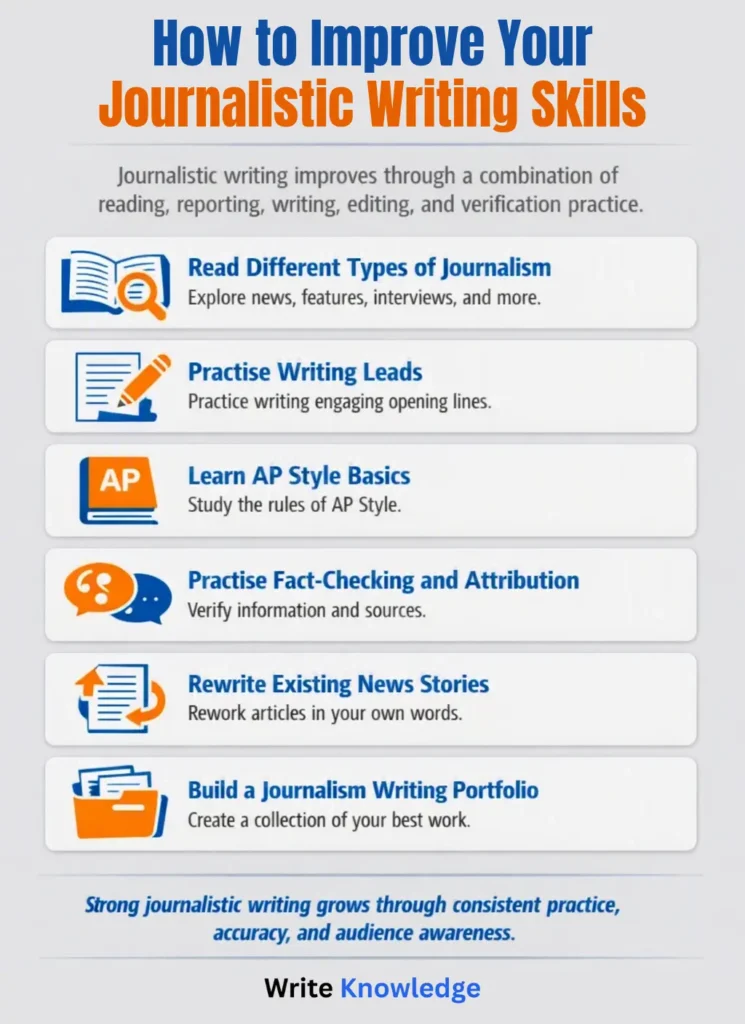
Read Different Types of Journalism
Read straight-news reports alongside features, interviews, investigations, reviews, and opinion pieces.
Pay attention to how each format starts, organizes information, uses sources, and ends.
Practise Writing Leads
Choose a fictional or real event and write several different leads for it.
Try a direct news lead, a feature-style lead, and a question-based opening. Then consider which one best suits the intended publication and audience.
Learn AP Style Basics
If you want to work with news-oriented publications, learning the fundamentals of AP Style can help you understand common editorial conventions.
AP provides both its Stylebook and learning resources for writers and editors.
Practise Fact-Checking and Attribution
Take a short news story and identify:
- The major factual claims
- The sources behind those claims
- Direct quotations
- Attributed statements
- Information that requires additional context
This exercise develops both reporting and editing skills.
Rewrite Existing News Stories
Take a published story and rewrite it in your own words without changing its factual meaning.
Focus on the lead, structure, sentence length, transitions, and information order.
Do not copy the original wording.
Build a Journalism Writing Portfolio
A beginner portfolio can include several original samples demonstrating different formats:
- A short news report
- A feature
- An interview-based article
- An investigative-style piece using public information
- An opinion column clearly labelled as commentary
For career-focused writing resources, you can also explore Writing Careers.
Who Uses Journalistic Writing?
Journalistic writing is used by a wide range of professionals working in news and media.
Journalists
Journalists research, report, and write stories for newspapers, magazines, websites, broadcasters, and other media organizations.
Reporters
Reporters often focus on gathering information and reporting events, developments, and issues.
Editors
Editors review stories for accuracy, clarity, structure, style, relevance, and publication requirements.
News Writers
News writers may specialize in preparing stories for print or digital news platforms.
Feature Writers
Feature writers often produce longer, more detailed stories that combine reporting with narrative structure and context.
Freelance Writers
Freelance journalists may write for multiple publications rather than working exclusively for one newsroom.
Magazine Writers
Magazine writers may produce features, profiles, reviews, interviews, and other long-form content.
Digital Journalists
Digital journalists work across websites and other online formats. Their work may combine written reporting with photographs, video, data, graphics, social content, or interactive elements.
Content Professionals Working with News and Media
PR, communications, and marketing professionals may also use journalistic conventions when creating press releases, corporate communications, or media-oriented content.
When Should You Use Journalistic Writing?
Journalistic writing is useful when the primary purpose is to communicate reported information clearly to an audience.
Consider using it when you are:
- Reporting an event that an audience needs to know about
- Explaining a current development with relevant facts and context
- Interviewing a person and presenting their knowledge or experience
- Investigating an issue that requires research and evidence
- Writing a feature that explores a subject in greater depth
- Reviewing a work or experience for an audience
- Presenting an informed opinion that is clearly identified as commentary
The important question is not simply whether the content appears online. Ask what the content is trying to accomplish.
If the purpose is to report, explain, investigate, review, or comment on a subject for an audience, journalistic conventions may be appropriate.
✅ Key Takeaways
- Journalistic writing communicates reported information, developments, issues, reviews, and viewpoints to an audience
- News writing is one form of journalistic writing, while features, interviews, investigations, reviews, and opinion pieces are other forms
- Accuracy, verification, attribution, clarity, context, and audience awareness are central to effective journalistic writing
- The 5 Ws and 1 H provide a useful framework for identifying essential information
- The inverted pyramid is a common structure for straight-news reporting, with the most important information presented early
- AP Style is a style guide, not a type of writing, and publications may also use their own editorial guidelines
Conclusion
Journalistic writing is fundamentally about helping an audience understand information clearly and responsibly. While different forms of journalism use different structures, they share an emphasis on accurate information, relevant context, clear attribution, and purposeful communication.
Learning journalistic writing can also strengthen broader writing skills. Writing a strong lead, organizing information, using evidence, interviewing sources, distinguishing fact from opinion, and editing for clarity are useful abilities well beyond the newsroom.
Frequently Asked Questions
What is journalistic writing?
Journalistic writing is writing used to report, explain, investigate, review, or comment on events, people, issues, and developments for an audience. It generally emphasizes accuracy, verification, attribution, clarity, and relevance.
What are the main types of journalistic writing?
Common forms include news writing, feature writing, interview writing, investigative journalism, opinion and editorial writing, and reviews or criticism.
What are the characteristics of good journalistic writing?
Good journalistic writing generally emphasizes accuracy, clarity, concise language, fair representation, source attribution, relevant context, audience awareness, and effective information organization. Professional journalism ethics also emphasize verification, transparency, accountability, and corrections.
What is the difference between journalistic writing and news writing?
News writing is one type of journalistic writing. Journalistic writing is the broader category and can include news reports, features, interviews, investigations, reviews, and opinion pieces.
Is AP Style used for journalistic writing?
AP Style is widely associated with journalism and is specifically described by the Associated Press as a writing style guide for journalists. However, individual publications may have their own editorial rules and style requirements.

Sachin is a Postgraduate in Technical Writing in Business Management specializing in creating SEO-friendly, User-friendly, and Reader-focused website articles on Education, Tech, Sports, Games, and Entertainment.
Through Write Knowledge, he helps students, bloggers, editors, and professionals develop practical writing skills using clear explanations, real-world examples, and internationally recognized writing standards.