Something happened. Then something else happened. Then it ended. Is that a story? Not necessarily.
Narrative writing is about more than putting events in order. It tells a story.
It may describe something that actually happened, create an entirely fictional world, or combine real experiences with storytelling techniques. Unlike writing that mainly explains or argues, narrative writing focuses on events, characters, experiences, and the way a story unfolds.
You encounter narrative writing in many forms, from personal essays and short stories to novels, memoirs, biographies, and even some journalism. Learning how narrative writing works can help you become a better storyteller and make your writing more engaging.
If you are new to different forms of writing, you can start with our complete guide to types of writing to understand how narrative writing compares with other major writing types.
💡 Quick Answer
Narrative writing is a type of writing that tells a story or recounts a sequence of events. It usually includes characters, a setting, a situation or conflict, and a clear progression of events. Narrative writing can be fictional or nonfictional and often uses description, dialogue, pacing, and point of view to keep readers engaged.
What is a Narrative Writing?
Narrative writing is a writing that presents events in a way that allows readers to experience a story rather than simply receive information.
A narrative can be based on something that happened in real life, such as a memorable school experience, or it can be completely fictional, such as a short story about a detective solving a mystery.
The central purpose is storytelling. The writer decides what happens, who experiences it, where and when it happens, and how the reader receives those events.
For example, compare these two sentences:
I missed the bus and arrived late at school.
This tells the reader what happened.
A narrative version might be:
I saw the bus pulling away just as I turned the corner. I ran toward the stop, waving one hand, but the driver disappeared into the morning traffic. By the time I reached school, the first bell had already rung.
The second version gives the event movement, setting, action, and a sense of experience. That is what makes it narrative writing.
What are the Main Characteristics of Narrative Writing?
Although narratives can look very different from one another, most effective narrative writing contains several common elements.
1. Characters
Characters are the people, animals, or fictional beings involved in the story. A narrative may have one central character or several important characters.
Good narrative writing does more than simply name characters. It gives readers clues about their personalities, motivations, relationships, and actions.
2. Setting
The setting tells readers where and when the story takes place.
A setting might be a crowded railway station in present-day Delhi, a small village decades ago, or an imaginary planet in the future. Details about the environment can help establish the mood and make the story feel more real.
3. Plot
The plot is the sequence of events that makes up the story.
A basic narrative often moves from an opening situation to a problem or conflict, through a series of events, and finally toward some form of resolution.
4. Conflict
Conflict creates tension and gives the story direction.
The conflict might involve:
- A character struggling against another person
- A difficult decision
- A personal fear
- A problem caused by circumstances
- A character trying to achieve a goal
However, be very-very clear that not every narrative needs a dramatic battle or major crisis. Even a small personal dilemma can provide enough conflict to move a story forward.
5. Point of View
Point of view determines who tells the story and how much the reader knows.
Common choices include first person and third person.
First person:
I opened the letter and immediately recognised the handwriting.
Third person:
Ravi opened the letter and immediately recognised the handwriting.
The choice affects how close the reader feels to the characters and how information is revealed.
6. Sequence of Events
Narrative writing generally has a sense of movement from one event to another. Writers often use words such as first, later, meanwhile, suddenly, eventually, and finally to help readers follow the story.
However, narratives do not always need to follow chronological order. Flashbacks and other structural techniques can also be used when they serve the story.
7. Description and Sensory Details
Description helps readers imagine the experience.
Instead of simply writing:
The room was old.
A writer might write:
Dust covered the wooden shelves, and the ceiling fan groaned each time it completed a turn.
Specific details allow readers to see, hear, smell, feel, or otherwise experience the scene.
What are the Types of Narrative Writing?
Since narrative writing can be in fiction and non-fiction, it includes some of these common types:
1. Personal Narrative
A personal narrative tells a story from the writer’s own experience.
📝 Example
I stood behind the classroom podium, holding my speech so tightly that the paper began to wrinkle. When my name was called, I walked to the front and looked at thirty faces staring back at me. For a few seconds, I couldn’t remember my first sentence. Then I took a breath and began.
This could be a personal narrative about giving a first public speech. The focus is not simply on what happened but also on the writer’s experience, emotions, and eventual growth.
Personal narratives often focus on experience, reflection, and personal growth.
2. Narrative Essay
A narrative essay uses storytelling techniques within an essay format. It often describes a particular experience while showing why that experience mattered.
📝 Example
“The Day I Learned to Ask for Help”
I had always thought asking for help meant admitting that I wasn’t capable. So when I struggled with my first major college assignment, I spent three nights trying to solve the problem alone. By the fourth morning, I was exhausted and still had very little to show for it. Finally, I asked my professor for guidance. The assignment became manageable and I realized that asking for help wasn’t a sign of weakness after all.
Here, the writer narrates an experience while reflecting on what it taught them, which makes it a narrative essay rather than simply a list of events.
3. Short Story
A short story is a fictional narrative that usually focuses on a limited number of characters and events.
📝 Example
Every evening at exactly 6:15, Mr. Rao placed a second cup of tea on the table. His wife had been gone for three years. He knew that. The empty chair knew that. Still, he couldn’t bring himself to stop making two cups.
One rainy evening, just as he was about to put the second cup away, someone knocked on the door.
It may explore a conflict, relationship, mystery, emotional experience, or other central idea within a relatively short space, and a reason to keep reading.
4. Novel
A novel is an extended fictional narrative. Because it has considerably more space than a short story, a novel can develop multiple characters, subplots, settings, and conflicts.
📝 Example
Maya left her small town believing she would never return. Ten years later, after losing her job and receiving a letter from her estranged father, she finds herself back in the same house she had spent years trying to forget. As she reconnects with old friends and uncovers secrets about her family’s past, she must decide whether home is something you escape from or something you eventually learn to understand.
This could serve as the central premise of a novel, with room for several characters, conflicts, relationships, settings, and subplots to develop over many chapters.
5. Memoir
A memoir is a nonfiction narrative based on the writer’s memories and experiences. Unlike a complete autobiography, a memoir usually focuses on particular periods, themes, or experiences from a person’s life.
📝 Example
When I think about my childhood, I don’t remember the house first. I remember the sound of my mother’s sewing machine late at night. She would sit beside the window, working long after everyone else had gone to sleep. Years later, when I learned why she had taken on so much work, I understood those nights differently.
This could be part of a memoir about childhood, family, sacrifice, or a particular period of the writer’s life.
6. Biography
A biography tells the story of another person’s life. Although biographies are nonfiction, they can use narrative techniques to present important events in an engaging sequence.
📝 Example
Dr. A. P. J. Abdul Kalam grew up in Rameswaram, Tamil Nadu, in a modest family. As a young boy, he helped support his family by selling newspapers while continuing his studies. His interest in science eventually led him to study aerospace engineering and pursue a career in India’s space and defence programs.
He later became one of the country’s most respected scientists and served as the 11th President of India from 2002 to 2007. His journey from a small-town childhood to the presidency became an enduring example of perseverance, education, and ambition.
This is a biographical narrative because it presents real events from another person’s life in chronological and meaningful sequence, rather than simply listing facts such as his birth date, education, career, and awards.
Narrative Writing Structure
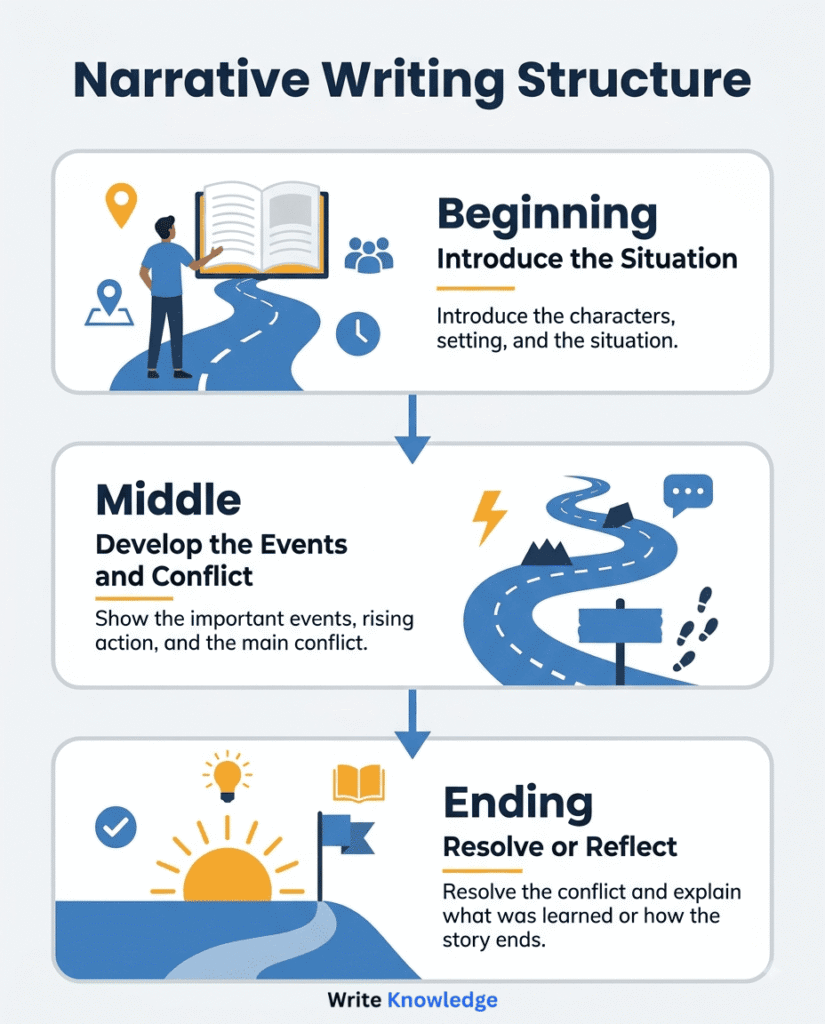
A narrative does not have to follow a rigid formula, but a simple structure can help you organise your ideas.
Beginning: Introduce the Situation
The opening should give readers enough information to understand the basic situation.
Introduce the relevant character, setting, or circumstances without explaining everything at once.
For example:
By seven in the morning, the railway station was already crowded. I stood beside Platform 3, holding the envelope my grandfather had asked me to deliver.
The reader immediately has a character, setting, time, and a reason to keep reading.
Middle: Develop the Events and Conflict
The middle section develops the main events.
Something should change, happen, or become more complicated. The character might encounter an obstacle, make a decision, discover something, or face a consequence.
This section should not feel like a list of unrelated events. Each event should contribute to the larger story.
Ending: Resolve or Reflect
The ending brings the narrative to a meaningful stopping point.
The conflict may be resolved, the character may make a discovery, or the experience may lead to a realisation.
For personal narratives, reflection can be especially useful.
I never found the courage to tell my grandfather that I had lost the envelope. But I learned something more valuable that morning: mistakes become easier to face once you stop trying to hide them.
The ending does not need to explain the lesson directly. Sometimes the events themselves make the meaning clear.
Narrative Writing Example
Here is a short example of narrative writing:
The electricity went out just as I reached the final page of my book. For a moment, I sat completely still, hoping the lights would return. They didn’t. Outside, rain struck the windows so loudly that I could barely hear my own thoughts. I found an old candle in the kitchen, lit it, and returned to my chair. The room looked different in the warm, flickering light. I finished the story that night without electricity, without my phone, and without realising how much I had missed being alone with a book.
Notice how this example does more than report that the electricity went out. It creates a setting, sequence of events, atmosphere, sensory detail, and a small personal change.
Narrative Writing vs Other Types of Writing
Narrative writing is easiest to understand when compared with other common writing types.
| Type of Writing | Main Purpose | Typical Question |
| Narrative | Tell a story or experience | What happened? |
| Descriptive | Create a vivid picture | What does it look, sound, or feel like? |
| Expository | Explain or inform | What is it and how does it work? |
| Persuasive | Influence the reader | Why should you believe or do this? |
These categories can overlap. A narrative may contain description, explanation, or persuasion, but its central purpose remains storytelling.
For a deeper explanation of descriptive writing, see our guide to Descriptive writing. You can also explore Expository writing and Persuasive writing to understand how their purposes differ from narrative writing.
How to Write a Narrative
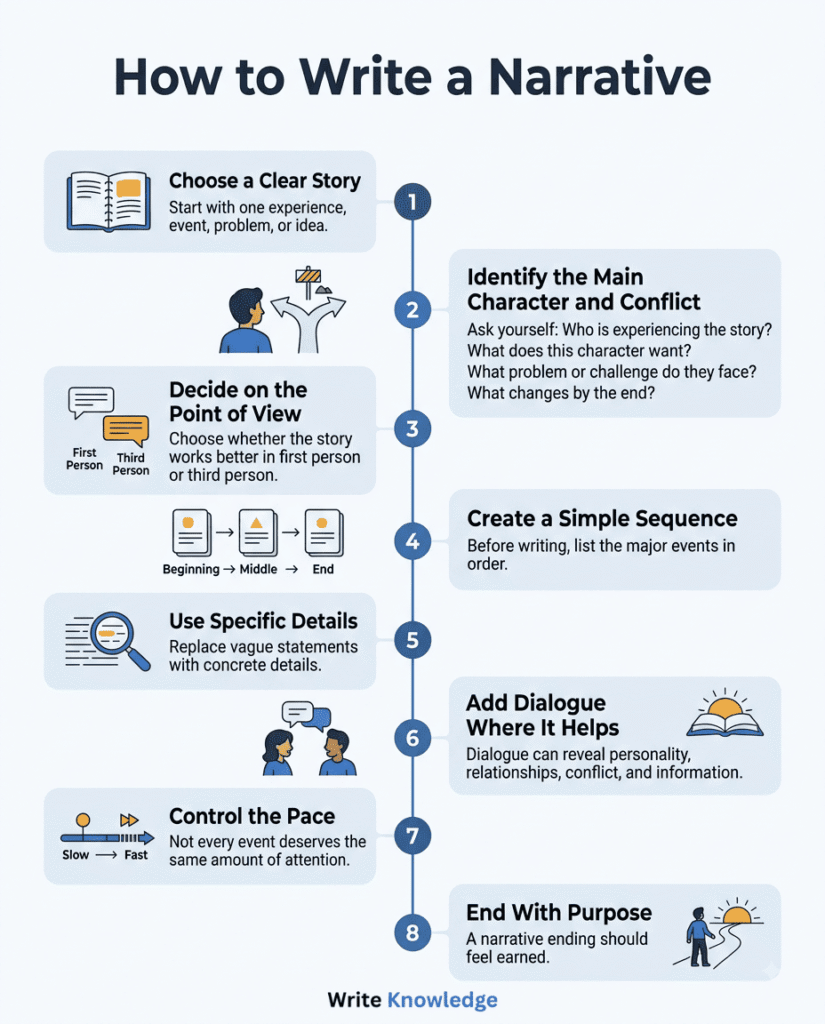
Writing a narrative becomes easier when you separate the storytelling process into manageable steps.
1. Choose a Clear Story
Start with one experience, event, problem, or idea.
Avoid trying to tell an entire year of your life in a short narrative. A focused event usually gives you more room for meaningful details.
2. Identify the Main Character and Conflict
Ask yourself:
- Who is experiencing the story?
- What does this character want?
- What problem or challenge do they face?
- What changes by the end?
These questions can give your narrative a clear direction.
3. Decide on the Point of View
Choose whether the story works better in first person or third person.
First person can create a more personal and immediate experience. Third person can provide greater flexibility when describing multiple characters or perspectives.
4. Create a Simple Sequence
Before writing, list the major events in order.
You do not need a detailed outline. A simple sequence of five or six important moments can prevent the narrative from becoming unfocused.
5. Use Specific Details
Replace vague statements with concrete details.
Instead of:
I was nervous.
Try:
My hands shook as I unfolded the paper, and I read the first sentence twice before looking up.
The second version allows readers to understand the nervousness through the character’s actions.
6. Add Dialogue Where It Helps
Dialogue can reveal personality, relationships, conflict, and information.
However, dialogue should have a purpose. Avoid adding conversations simply to make the story look more realistic.
7. Control the Pace
Not every event deserves the same amount of attention.
A few seconds of an important moment might deserve several paragraphs, while several hours of unimportant activity might be summarised in one sentence.
Good pacing helps readers know which moments matter.
8. End With Purpose
A narrative ending should feel earned.
Think about what the character has experienced and what has changed. The ending can resolve the conflict, reveal an important detail, or leave the reader with a meaningful thought.
Common Narrative Writing Mistakes
Even a promising story can become difficult to read when the narrative is poorly structured.
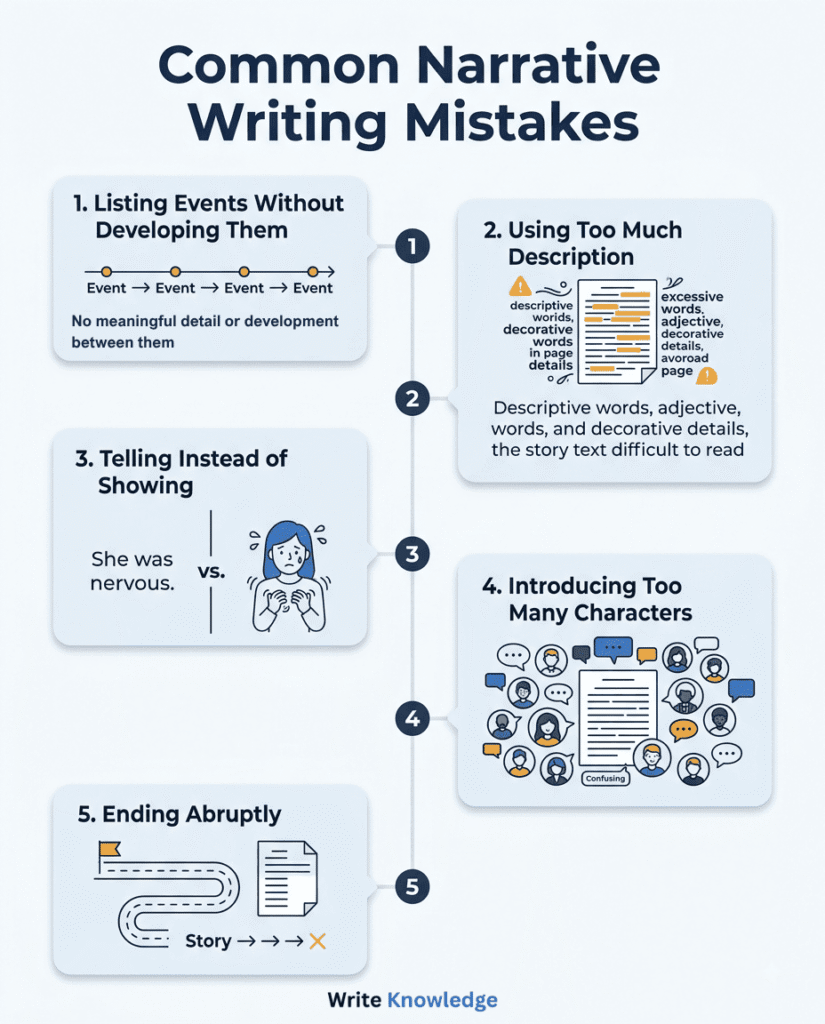
Listing Events Without Developing Them
Simply writing this happened, then this happened, then this happened creates a timeline rather than an engaging narrative.
Choose important moments and develop them with action, detail, and context.
Using Too Much Description
Description is useful, but too much can slow down the story.
Include details that contribute to the setting, mood, character, or situation rather than describing every object in a scene.
Telling Instead of Showing
Statements such as she was angry or he was scared can sometimes be useful, but relying on them too often removes the reader from the experience.
Where appropriate, show emotions through actions, expressions, dialogue, and physical reactions.
Introducing Too Many Characters
A short narrative rarely needs a large cast. Too many characters can make it difficult for readers to remember who is important.
Ending Abruptly
A narrative can be short without feeling incomplete. Give the ending enough space to resolve the central event or show what the experience means.
Tips to Improve Your Narrative Writing
To make your narratives more effective, focus on clarity, specificity, and reader experience.
Start as close to the important event as possible. Use details that reveal something rather than adding description simply for decoration. Let characters behave and speak in ways that reveal their personalities. Vary sentence length to control pacing, especially around moments of tension or surprise.
Read your draft from the reader’s perspective. Ask whether each event is easy to follow, whether the central conflict is clear, and whether the ending feels connected to everything that came before it.
Most importantly, do not confuse complexity with quality. A simple story told with precise details and a clear sense of purpose can be more effective than an elaborate story with too many characters, events, and unnecessary descriptions.
Narrative Writing Techniques to Try
Once you understand the basics, you can experiment with techniques that make narratives more engaging.
Foreshadowing gives readers subtle clues about something that may happen later.
Flashback takes the narrative temporarily into an earlier event to provide context.
Dialogue allows characters to communicate information and reveal personality.
Sensory description helps readers experience the setting through sight, sound, smell, taste, and touch.
Pacing controls how quickly or slowly the story moves.
Point of view determines whose perspective shapes the reader’s experience.
These techniques are tools, not requirements. Use them when they make the narrative clearer or more effective.
✅ Key Takeaways
- Narrative writing tells a story by presenting characters, events, conflict, and a setting in a meaningful sequence.
- The main elements of narrative writing include characters, setting, plot, conflict, point of view, and sequence of events.
- Narrative writing can be fiction or nonfiction, including short stories, personal narratives, memoirs, biographies, and narrative essays.
- A strong narrative usually has a clear beginning, middle, and ending, with events connected logically.
- Techniques such as dialogue, sensory details, description, pacing, and showing rather than telling can make a narrative more engaging.
- Good narrative writing does more than list events; it gives readers a reason to care about what happens and why it matters.
Conclusion
Narrative writing is fundamentally about telling a story in a meaningful and engaging way. Whether you are writing a personal experience, short story, memoir, biography, or narrative essay, the same foundations matter: characters, setting, events, conflict, point of view, and purposeful details.
The strongest narratives do not simply tell readers what happened. They help readers understand what the experience felt like and why it mattered. Once you become comfortable with narrative structure and storytelling techniques, you can use those skills across both creative and practical forms of writing.
Frequently Asked Questions
What is the main purpose of narrative writing?
Its main purpose is to tell a story or recount an experience. It can entertain, inform, explore an idea, or communicate a personal insight through a sequence of events.
What are the five elements of narrative writing?
Five commonly discussed elements are characters, setting, plot, conflict, and theme. Point of view and narrative style are also important parts of how a story is presented.
Can narrative writing be nonfiction?
Yes. Narrative writing can be fictional or nonfictional. Personal narratives, memoirs, biographies, and many feature articles use real events while presenting them through storytelling techniques.
What is the difference between narrative and descriptive writing?
Narrative writing focuses primarily on what happens, while descriptive writing focuses on what something is like. A narrative can use description extensively, but its main function is to tell or develop a story.

Sachin is a Postgraduate in Technical Writing in Business Management specializing in creating SEO-friendly, User-friendly, and Reader-focused website articles on Education, Tech, Sports, Games, and Entertainment.
Through Write Knowledge, he helps students, bloggers, editors, and professionals develop practical writing skills using clear explanations, real-world examples, and internationally recognized writing standards.