Writing isn’t just about expressing ideas. It is also about presenting them consistently. Readers expect professional writing to be clear, accurate, and easy to follow. That’s where writing style guides become essential.
Among the most widely used editorial standards, the Associated Press (AP) Style Guide has become the benchmark for journalism, news reporting, digital publishing, and many forms of business communication. Newspapers, magazines, news websites, public relations agencies, and marketing teams rely on AP Style to maintain consistency across thousands of articles every day.
Before choosing any editorial standard, it’s also helpful to understand the different types of writing and where each style guide is most commonly applied.
Ok, time to learn more deeply about AP style guide in this comprehensive post.
💡 Quick Answer
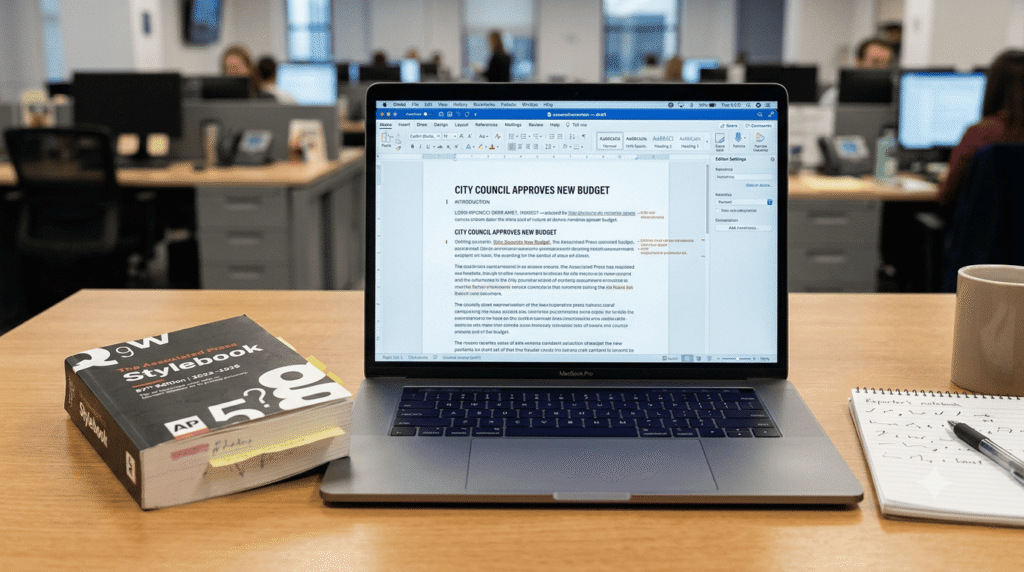
AP Style (Associated Press Style) is an editorial writing standard developed by the Associated Press for news and media publications. It provides consistent rules for grammar, punctuation, capitalization, abbreviations, numbers, dates, titles, and formatting to ensure clear, concise, and uniform writing.
What Is AP Style?
The Associated Press Style Guide, commonly called AP Style, is a collection of editorial standards designed to create consistent writing across newspapers, magazines, websites, broadcasts, and other media outlets.
Instead of allowing every writer to make personal formatting decisions, AP Style establishes a shared set of rules so that articles published by different writers maintain the same appearance and writing conventions.
For example, AP Style specifies:
- How numbers should be written
- When to abbreviate states
- How dates should appear
- Which words should be capitalized
- Proper punctuation usage
- Preferred spellings
- Formatting of titles and occupations
These seemingly small decisions improve readability and help readers focus on the information rather than inconsistent formatting.
Although AP Style originated in journalism, today it is used far beyond traditional newsrooms. Many companies adopt AP conventions for blogs, newsletters, press releases, corporate communications, and digital marketing content because of its clean, reader-friendly approach.
Why AP Style Matters
Consistent writing creates trust. When every article follows the same editorial standards, readers perceive the publication as professional and reliable.
Using AP Style helps writers:
- Maintain consistency across multiple articles
- Improve readability for general audiences
- Reduce editing time
- Avoid formatting disagreements
- Present information clearly and efficiently
For editors, AP Style acts as a common reference that simplifies reviewing and standardizing content written by different contributors.
For organizations, adopting a single editorial standard strengthens brand consistency and improves communication quality.
✍️ Writing Tip
Even if your organization doesn’t require AP Style, following one consistent style guide throughout your content produces a far more professional reading experience than mixing rules from multiple style guides.
Core Principles of AP Style
Although AP Style contains hundreds of detailed rules, most of them are built on a few fundamental principles.
Clarity
Readers should understand information immediately without unnecessary complexity.
Instead of writing lengthy or overly technical sentences, AP Style encourages straightforward language that communicates ideas efficiently.
Brevity
News writing often has limited space. AP Style favors concise wording without sacrificing meaning.
This doesn’t mean writing incomplete sentences … it means eliminating unnecessary words whenever possible.
Consistency
The same formatting rules should apply throughout every article.
For example, if dates follow one format at the beginning of an article, they should follow the same format throughout the rest of the content.
Accuracy
Names, quotations, facts, statistics, dates, and titles must be verified carefully.
Editorial consistency is valuable, but factual accuracy always comes first.
Readability
AP Style is written for general audiences rather than specialists.
The goal is communication that remains accessible to readers with varying levels of knowledge.
When Should You Use AP Style?
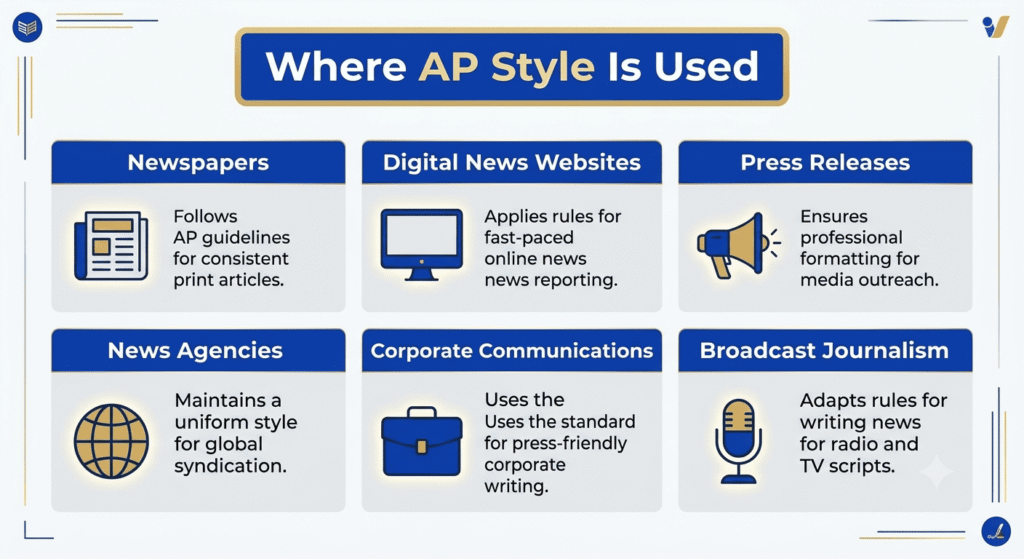
AP Style is especially appropriate for content intended for broad public audiences.
It is commonly used for:
- News articles
- Newspapers
- Online news websites
- Press releases
- Corporate communications
- Marketing articles
- Company blogs
- Media statements
- Newsletters
- Magazine writing
If you’re unsure which editorial standard fits your writing project, understanding the purpose of each style guide can help you choose the most appropriate one.
Essential AP Style Rules Every Writer Should Know
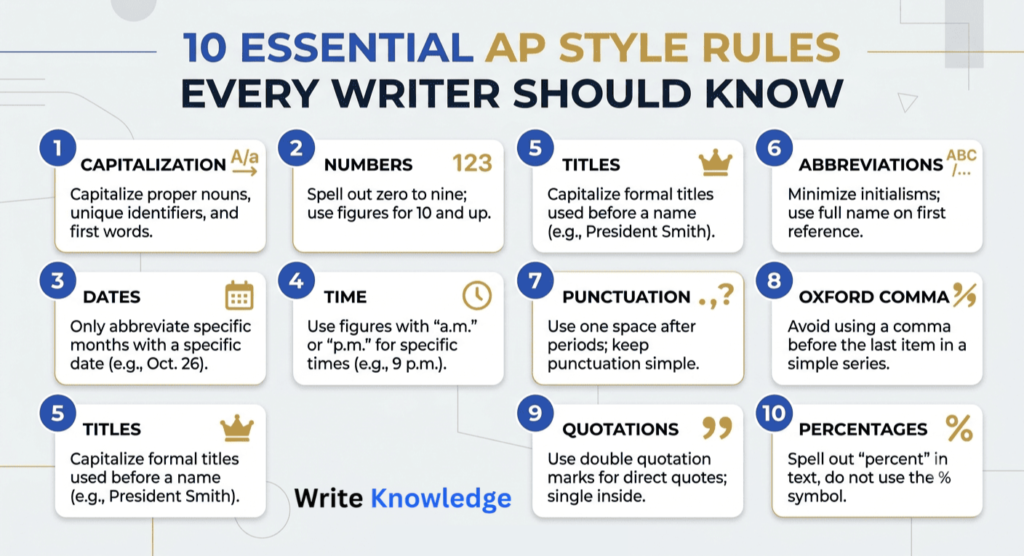
Learning AP Style becomes much easier when you understand its most commonly used rules. While the official AP Stylebook contains hundreds of recommendations, most writers regularly use a much smaller set in everyday writing.
Mastering these core conventions will help you produce clean, consistent, and publication-ready content.
Capitalization Rules
One of the most noticeable features of AP Style is its approach to capitalization. Words should only be capitalized when grammar or proper nouns require it.
For example:
Correct
- The president addressed the nation.
- President Maria Rodriguez spoke at the conference.
- The city council approved the proposal.
Incorrect
- The President addressed the nation.
- The City Council approved the proposal.
Notice that titles are generally lowercase unless they appear immediately before a person’s name.
Common Capitalization Examples
| Correct | Incorrect |
| Prime Minister John Smith | prime minister John Smith |
| the prime minister | the Prime Minister |
| New York City | new york city |
| World Health Organization | world health organization |
Common Mistake
Many writers capitalize job titles throughout an article. In AP Style, titles are capitalized only when they directly precede a person’s name.
Incorrect:
- The Editor reviewed the article before publication.
- The Marketing Manager approved the campaign yesterday.
Correct:
- The editor reviewed the article before publication.
- The marketing manager approved the campaign yesterday.
- Editor Sarah Mitchell reviewed the article before publication.
- Marketing Manager David Lee approved the campaign yesterday.
Remember: If the title comes before a person’s name, capitalize it. If it appears after the name or is used generically, use lowercase.
Numbers
Numbers are among the most frequently used and most frequently misunderstood areas of AP Style.
The basic rule is simple:
- Spell out numbers one through nine
- Use numerals for 10 and above
Examples:
- Three books
- Eight writers
- 15 articles
- 27 students
- 120 pages
However, several exceptions exist.
Always use numerals for:
- Ages
- Percentages
- Money
- Measurements
- Dates
- Time
- Statistics
Examples:
- 5 years old
- 8%
- $35
- 7 miles
- June 5
- 8:30 a.m.
These exceptions improve readability because readers process numerical information more quickly when presented as figures.
✍️ Writing Tip
Instead of memorizing dozens of separate rules, remember this principle:
General counting follows the one-through-nine rule, while factual data almost always uses numerals.
Dates
AP Style simplifies date formatting to improve consistency.
Examples:
- Jan. 12
- Feb. 28
- Aug. 5
Months with five letters or fewer are usually not abbreviated:
- March
- April
- May
- June
- July
Longer month names are abbreviated when used with a specific date:
- Sept.
- Oct.
- Nov.
- Dec.
Correct Examples
- Sept. 14, 2026
- Jan. 8
- May 21
Incorrect Examples
- September 14th, 2026
- January 08
- 14 September 2026
Notice that AP Style does not use ordinal endings such as st, nd, rd, or th.
Time
AP Style follows a straightforward approach to time formatting.
Examples:
- 8 a.m.
- 11:30 a.m.
- 2 p.m.
- 6:45 p.m.
Avoid unnecessary zeros.
Correct
- 8 a.m.
Incorrect
- 8:00 a.m.
Also avoid expressions like:
- 8:00 AM
- 8 AM
AP Style specifically uses lowercase a.m. and p.m. with periods.
Titles Before and After Names
Professional titles follow one of AP Style’s most recognizable conventions.
Before a Name
Capitalize the title.
Examples:
- Professor David Lee
- Mayor Sarah Collins
- Dr. Emily Carter
After a Name
Lowercase the title.
Examples:
- David Lee, professor
- Sarah Collins, mayor
- Emily Carter, doctor
Maintaining this distinction improves consistency throughout professional writing.
Abbreviations
AP Style prefers using abbreviations only when they improve readability.
Widely recognized abbreviations such as:
- FBI
- NASA
- CEO
- NBA
The above abbreviations can usually appear without explanation.
Less familiar abbreviations should be introduced carefully or avoided altogether.
Remember, write for readers rather than assuming specialized knowledge.
Punctuation
Punctuation rules vary across writing style guides, making this one of the most important sections to understand.
AP Style generally favors cleaner punctuation over heavier punctuation.
Some common practices include:
- Using one space after periods
- Avoiding unnecessary punctuation
- Using quotation marks consistently
- Keeping sentences concise
Because punctuation covers many individual rules, it deserves its own dedicated resource.
If you want to strengthen sentence clarity, punctuation mastery is just as important as grammar.
Headlines should be:
- Short
- Clear
- Accurate
- Reader-focused
Compare these examples.
Better
City Council Approves New Education Budget
Weaker
Big Changes Finally Arrive
Readers should immediately understand the topic without guessing.
AP Style Rules for Quotations
Quotations are a defining feature of journalism and media writing. AP Style provides clear rules to ensure quotations remain accurate, readable, and ethically presented.
Direct Quotations
Use quotation marks for a person’s exact words.
Correct
“Writing consistently improves credibility,” the editor said.
Incorrect
Writing consistently improves credibility, the editor said.
Partial Quotations
If only part of a statement is quoted, use quotation marks only around the quoted words.
Correct
The spokesperson described the proposal as “a major milestone.”
Long Quotations
Unlike APA or MLA, AP Style generally does not use block quotations. Even longer quotations usually remain within quotation marks.
✍️ Writing Tip
Always verify quotations against the original source. Editing grammar or changing wording inside quotations can alter meaning and reduce credibility.
AP Style Rules for Titles
AP Style treats titles differently depending on what they refer to.
Books
Use quotation marks.
“The Great Gatsby”
Movies
Use quotation marks.
“The Godfather”
Television Programs
Use quotation marks.
“Planet Earth”
Newspapers
Do not use quotation marks.
The New York Times
Magazines
Do not use quotation marks.
Time magazine
Websites
Usually written in plain text unless the publication has its own branding requirements.
Example
The article appeared on the Associated Press website.
AP Style and Oxford Comma
One of the most recognizable AP Style rules is the treatment of the serial (Oxford) comma.
AP Style generally does not use the Oxford comma.
Correct (AP Style)
The flag is red, white and blue.
Incorrect (AP Style)
The flag is red, white, and blue.
However, AP Style allows the Oxford comma whenever omitting it creates confusion.
Example
Without the comma:
I dedicate this book to my parents, Oprah Winfrey and Maya Angelou.
With the comma:
I dedicate this book to my parents, Oprah Winfrey, and Maya Angelou.
The second version clearly avoids ambiguity.
⚠️ Common Mistake
Some writers automatically remove every Oxford comma after learning AP Style. Remember that clarity always comes before rigid rule-following.
AP Style for Numbers and Measurements
Measurements always use numerals.
Examples:
- 6 feet
- 15 miles
- 12 kilograms
- 4 liters
- 3 acres
Percentages also use numerals.
Correct
- 7%
- 42%
Modern AP Style uses the percent sign (%) instead of spelling out “percent” in most situations.
Money also follows numeral formatting.
Examples:
- $5
- $25
- $1.5 million
AP Style for Addresses
Addresses are abbreviated only when accompanied by a specific address number.
Correct
- 1200 Main St.
- 45 Oak Ave.
- 9 First Blvd.
Without a street number, spell them out.
Correct
- Main Street
- Oak Avenue
AP Style for States
State names follow special abbreviation rules.
When standing alone:
Texas
California
When paired with a city:
Dallas, Texas
Los Angeles, California
AP Style uses its own state abbreviations, which differ from postal abbreviations.
For example:
- Calif.
- Ariz.
- Colo.
instead of
- CA
- AZ
- CO
Because the list is extensive, it is best referenced rather than memorized.
AP Style for Academic Degrees
Academic degrees follow lowercase formatting unless they are proper nouns.
Correct
- bachelor’s degree
- master’s degree
- doctorate
Capitalize only official degree names.
Correct
- Bachelor of Science
- Master of Arts
AP Style for Bulleted Lists
Bulleted lists should remain simple and easy to scan.
Use bullets when presenting:
- Features
- Steps
- Recommendations
- Key points
Each bullet should follow a consistent grammatical structure.
Example
Good:
- Verify facts
- Use clear language
- Maintain consistency
Poor:
- Fact verification
- Writing clearly improves communication
- Consistency
Consistency matters more than style preference.
AP Style in Digital Writing
Although AP Style originated in traditional journalism, it has adapted to digital publishing.
Today it works well for:
- News websites
- Blogs
- Press releases
- Corporate communication
- Content marketing
- Online magazines
Its emphasis on concise writing aligns naturally with modern web reading habits.
For SEO-focused articles, AP Style also supports:
- Shorter paragraphs
- Descriptive headings
- Reader-friendly language
- Scannable formatting
These characteristics improve both user experience and search visibility.
📝 Example
Instead of one large paragraph containing multiple ideas, divide information into smaller sections that readers can scan quickly.
AP Style vs Other Writing Style Guides
Choosing the correct writing style depends on your audience and purpose.
| Style Guide | Best Used For |
| AP Style | Journalism, news, media, blogs, press releases |
| APA Style | Psychology, education, social sciences |
| MLA Style | Literature, humanities, language studies |
| Chicago Manual of Style | Books, publishing, history, long-form writing |
While AP Style focuses on concise public communication, academic style guides place greater emphasis on citations and scholarly formatting.
If you’re unsure which guide to use, explore our complete resources on APA Style, MLA Style, and the Chicago Manual of Style. Each guide serves a different writing purpose, and understanding their differences helps you choose the right standard for every project.
Moreover, if you are venturing in the Technical field, then you ought to check out IEEE Style guide.
Conclusion
The Associated Press (AP) Style Guide is one of the most influential editorial standards in modern writing. Its emphasis on clarity, consistency, accuracy, and readability makes it the preferred choice for journalism, news reporting, corporate communication, public relations, and much of today’s digital content.
Although learning every AP rule takes time, most writers only need to master the core conventions including capitalization, numbers, dates, punctuation, abbreviations, quotations, and titles to produce professional, publication-ready content.
Remember that no style guide is universally “better” than another. The best style guide is the one that matches your audience, purpose, and publishing requirements.
✅ Key Takeaways
- AP Style is primarily designed for journalism, media, and public-facing communication.
- Consistency is more important than personal formatting preferences.
- Spell out numbers one through nine; use numerals for 10 and above, except for specific AP exceptions.
- Titles are capitalized only when they appear immediately before a person’s name.
- AP Style generally does not use the Oxford comma unless clarity requires it.
- Dates, times, percentages, and measurements follow specific formatting conventions.
- Clear, concise writing is one of AP Style’s defining characteristics.
- Use AP Style for news writing, blogs, press releases, and corporate communication … not for academic research papers.
- Understanding multiple writing style guides makes you a stronger and more versatile writer.
Frequently Asked Questions
What is AP Style?
AP Style is an editorial writing standard published by the Associated Press. It provides consistent rules for grammar, punctuation, capitalization, numbers, dates, abbreviations, and formatting used primarily in journalism, news writing, and public communication.
Who should use AP Style?
AP Style is ideal for:
- Journalists
- News writers
- Bloggers
- Content writers
- Editors
- Public relations professionals
- Corporate communication teams
- Marketing professionals
Is AP Style the same as APA Style?
No.
Although their names are similar, they serve completely different purposes.
- AP Style is used for journalism and media writing.
- APA Style is designed for academic writing in psychology, education, and social sciences.
Does AP Style use the Oxford comma?
Generally, no.
However, AP Style allows the Oxford comma whenever it prevents ambiguity or improves clarity.

Sachin is a Postgraduate in Technical Writing in Business Management specializing in creating SEO-friendly, User-friendly, and Reader-focused website articles on Education, Tech, Sports, Games, and Entertainment.
Through Write Knowledge, he helps students, bloggers, editors, and professionals develop practical writing skills using clear explanations, real-world examples, and internationally recognized writing standards.