You know that moment when you’re writing your fifth article on the same website and suddenly wonder:
“Who decides what we should write next?”
Not the headline. Not the word count. Not even the deadline.
The bigger question.
Why this topic? Why this audience? Why this format? Why now? And how does this article connect with everything else the company is publishing?
That’s where a Content Strategist comes in.
You may already be a writer. You may already understand SEO. You may even know how to edit and plan content. But content strategy asks you to step back from the individual article and look at the whole picture.
If that sounds interesting, a content strategy career could be a natural next step.
💡 Quick Answer
A content strategy career focuses on planning, organizing, creating, maintaining, and measuring content so that it serves a clear purpose.
A Content Strategist may decide:
- What topics should be covered
- Who the content is for
- Which format makes sense
- How different pieces should connect
- Where the content should be published
- How older content should be improved
- How success should be measured
A content strategist does not necessarily write every piece of content. In many organizations, they work with writers, editors, SEO professionals, designers, marketers, and other teams to make sure the content has direction.
So, while a content writer may ask “How should I write this?”, a strategist is often asking “Should we create this at all, and what should it accomplish?”
What is a Content Strategy Career?
A content strategy career focuses on deciding what content an organization should create, for whom, why, where, and how its effectiveness should be evaluated.
A content strategist may plan editorial calendars, research topics, conduct content audits, develop content plans, coordinate with content teams, and analyze performance. The exact responsibilities vary considerably by employer and specialization.
In simple terms:
Content writer: “What should I write?”
Content strategist: “What content should we create in the first place, and how does it support our goals?”
That distinction is important. A strategist may still write or edit, but the role generally operates at a broader level.
For example, imagine a company wants to attract people who are learning about personal finance.
A writer might be asked to create:
“How to Build an Emergency Fund”
A strategist may first decide:
- Who exactly should read this?
- What problem are they trying to solve?
- Where are they likely to discover the content?
- What related topics should the site cover?
- What should the content help the reader do next?
- How does this article fit into the larger content plan?
- How will we measure whether it performed well?
That broader thinking is at the heart of content strategy.
What is Content Strategy?
Imagine a website has 500 articles.
The problem isn’t necessarily that the website needs more articles.
Maybe it already has plenty.
The real questions might be:
- Are the right topics covered?
- Are important topics missing?
- Are several articles competing with each other?
- Can readers easily move from one topic to another?
- Which older articles need updating?
- Are writers creating content around actual audience needs?
- Is the content helping the website achieve its goals?
Content strategy deals with these questions.
It brings together research, planning, writing, organization, audience understanding, SEO, and measurement to create a useful content ecosystem.
Content Strategy is More Than a Content Calendar
A content calendar tells you when something will be published.
Content strategy asks a much bigger question:
Why should this content exist at all?
For example, a calendar might say:
Monday — Publish article about Narrative Writing.
A content strategy would ask:
Who needs this article? What question are they trying to answer? Where does it fit within the website? What related topics should we cover? Which existing pages should link to it? What should the reader do after reading it?
That difference is important.
What Does a Content Strategist Do?
There is no single version of the job.
A Content Strategist at a small company may research, plan, write, edit, publish, and analyze content. At a larger organization, those responsibilities may be divided among several specialists.
Still, most content strategy roles involve some combination of the following.
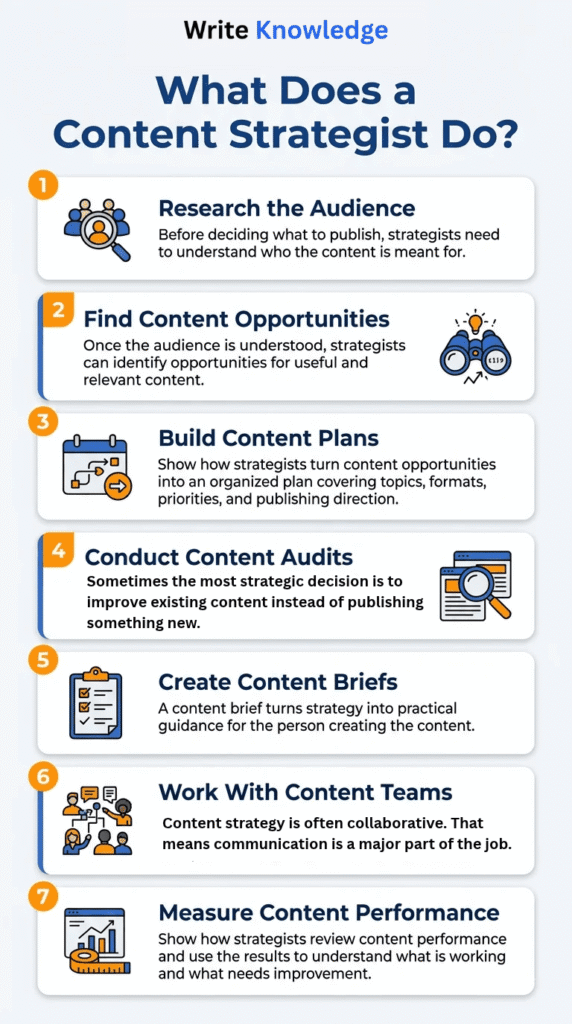
Research the Audience
Before deciding what to publish, strategists need to understand who the content is meant for.
They may research:
- Audience questions
- Customer problems
- Search behavior
- User feedback
- Industry trends
- Existing content
- Competitor content
The aim isn’t simply to collect information.
It’s to answer a more useful question:
What does this audience actually need from us?
Find Content Opportunities
Once the audience is understood, strategists can identify opportunities.
For example, they may discover that:
- A website has no beginner-friendly guide for an important topic
- Several existing articles cover almost the same thing
- A popular article is outdated
- Readers frequently ask a question the site never answers
- A larger topic needs to be divided into several connected resources
That is where content planning starts becoming more strategic.
Build Content Plans
A content strategist may create:
- Editorial calendars
- Topic clusters
- Content roadmaps
- Content briefs
- Campaign plans
- Content inventories
- Publishing priorities
The goal isn’t to produce the largest possible list of topics.
It’s to create the right list.
Conduct Content Audits
Sometimes the most strategic decision is to improve existing content instead of publishing something new.
A content audit can help identify pages that should be:
- Updated
- Expanded
- Combined
- Redirected
- Repurposed
- Removed
A strategist might, for example, find three pages targeting nearly the same search intent. Creating a fourth page would only make the situation worse.
Create Content Briefs
A content brief turns strategy into practical guidance for the person creating the content.
It may include:
- Audience
- Purpose
- Search intent
- Primary topic
- Supporting topics
- Suggested structure
- Internal-link opportunities
- Examples to include
- Tone or brand requirements
- The intended outcome
Work With Content Teams
Content strategy is often collaborative.
A strategist may work with:
- Content Writers
- Copywriters
- SEO Writers
- Editors
- Designers
- Social media specialists
- Marketers
- Developers
- Product teams
- Subject-matter experts
Measure Content Performance
Publishing is not the end.
Strategists may look at:
- Organic traffic
- Impressions
- Clicks
- Search rankings
- Engagement
- Conversions
- Leads
- Returning users
- Other business-specific metrics
The important part is not merely reporting numbers.
It’s deciding:
What do these numbers tell us, and what should we do next?
Content Strategists Think Beyond Individual Articles
A good strategist doesn’t just look at today’s assignment.
They may be thinking about:
Audience → Topic → Content Type → Search Intent → Structure → Distribution → Performance → Improvement
That’s why the role involves more than writing.
Content Strategists May Still Write
Don’t assume that becoming a Content Strategist means you will never write again.
Depending on the company, you may still:
- Write outlines
- Create content briefs
- Edit articles
- Write headlines
- Revise important pages
- Develop messaging
- Create strategy documents
The difference is that your responsibility usually expands beyond producing the final copy.
📝 Example
A Content Writer might be told to write “How to Become an SEO Writer.”
A Content Strategist might first notice that readers also need to understand what SEO writing is, what an SEO writer does, which skills are required, how the career differs from content writing, and what kind of portfolio they need.
Instead of treating those as unrelated articles, the strategist can turn them into a connected content journey.
That means communication is a major part of the job.
What Skills Do You Need for a Content Strategy Career?
Here’s the good news for writers: you probably already have some of these skills.
The catch?
You need to expand them.
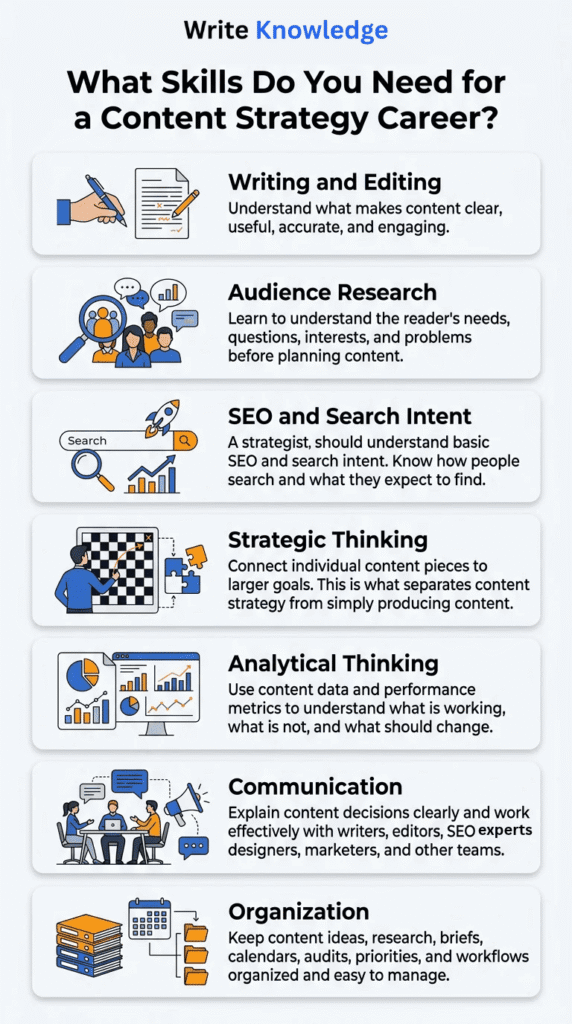
Writing and Editing
You don’t need to be the team’s most creative writer, but you should understand what good content looks like.
You should be able to spot:
- Weak openings
- Repetition
- Poor structure
- Unnecessary jargon
- Unclear explanations
- Weak calls to action
- Content that doesn’t match the audience
Audience Research
A strategist needs to think about the reader before thinking about the article.
Ask:
Who is this for?
What are they trying to accomplish?
What do they already know?
What information are they missing?
Those questions can change the entire content plan.
SEO and Search Intent
You don’t necessarily need to become a technical SEO expert, but SEO knowledge is extremely useful.
You should understand:
- Keyword research
- Search intent
- Topic relevance
- Content gaps
- Internal linking
- On-page optimization
- Organic performance
Your knowledge of SEO writing can become particularly useful here, because a strategist often needs to think about search before a writer starts drafting.
Strategic Thinking
This is the skill that separates content production from content strategy.
Instead of saying:
“We need five blog posts this month.”
A strategist asks:
“What are we trying to achieve, and what content is most likely to help us achieve it?”
Analytical Thinking
You should be comfortable interpreting data.
For example, imagine an article receives:
10,000 impressions
200 clicks
The numbers tell you something, but not everything.
You still have to ask:
- Is the ranking position good enough?
- Is the title attracting clicks?
- Is the page answering the right intent?
- Is another page competing for the same topic?
That interpretation is where strategy begins.
Communication
A strategist often has to explain decisions to people who think differently.
A writer may care about quality.
A marketer may care about conversions.
A designer may care about presentation.
A manager may care about business results.
The strategist needs to connect those priorities.
Organization
Content strategy involves a lot of moving parts.
You may need to manage:
- Briefs
- Deadlines
- Writers
- Editors
- Approvals
- Publication dates
- Content inventories
- Updates
If you enjoy organizing information, that can actually be a significant advantage.
📌 Remember
Content strategy does not mean leaving writing behind.
In many cases, a writing background is a useful foundation because you already understand how content is researched, structured, edited, and communicated.
The next step is learning how to decide what should be created, how it should connect, and what it should accomplish.
What Types of Content Strategy Careers Are Available?
“Content Strategist” is not the only role you may encounter.
Different organizations use different titles for related work.
Content Strategist
The broadest version of the role.
Responsibilities may include audience research, content planning, briefs, audits, editorial direction, and performance analysis.
Content Marketing Strategist
This role focuses more heavily on content as part of a marketing system.
The content may be designed to attract an audience, build trust, generate leads, support campaigns, or encourage conversions.
SEO Content Strategist
This specialization sits close to SEO and content.
You might work on:
- Keyword research
- Topic clusters
- Content briefs
- Internal links
- Search-intent analysis
- Organic performance
Editorial Strategist
An Editorial Strategist may focus more on:
- Editorial direction
- Publishing priorities
- Content standards
- Consistency
- Content quality
- Long-term editorial planning
Content Operations Specialist
Content operations focuses on how content gets produced and managed.
This can include workflows, publishing systems, governance, documentation, collaboration, and content management processes.
How is Content Strategy Different from Other Writing Careers?
If you’re considering a career move, this is the comparison that matters.
| Career | Main Question |
| Content Writer | What should I write? |
| SEO Writer | How can I create useful content that also satisfies search intent? |
| Copywriter | How can I persuade the reader to take action? |
| Content Strategist | What content should we create, why, and how should it work together? |
That doesn’t mean these careers never overlap.
A Content Writer may know SEO.
An SEO Writer may contribute to strategy.
A Copywriter may work within a content strategy.
And a Content Strategist may write.
But the main responsibility is different.
Can a Content Writer Become a Content Strategist?
Absolutely!
In fact, writing can give you a useful starting point.
Imagine you’ve spent several years writing articles. Eventually, you start noticing patterns.
You see which topics attract readers.
You notice when a brief is badly planned.
You recognize when two articles overlap.
You start suggesting missing topics.
You ask for better internal links.
You wonder why a piece was published in the first place.
That is strategic thinking.
The transition becomes easier when you deliberately add skills such as:
- SEO
- Analytics
- Audience research
- Content audits
- Topic mapping
- Content briefs
- Editorial planning
✍️ Writing Tip
If you’re trying to move from writing into strategy, start showing strategic thinking inside your existing writing work.
Don’t simply submit an article. Explain why the topic matters, who it is for, what search intent it addresses, which related topics should link to it, and what should happen next.
How to Start a Career in Content Strategy
You don’t need to wait until someone gives you the title “Content Strategist.”
You can start developing the skill set now.
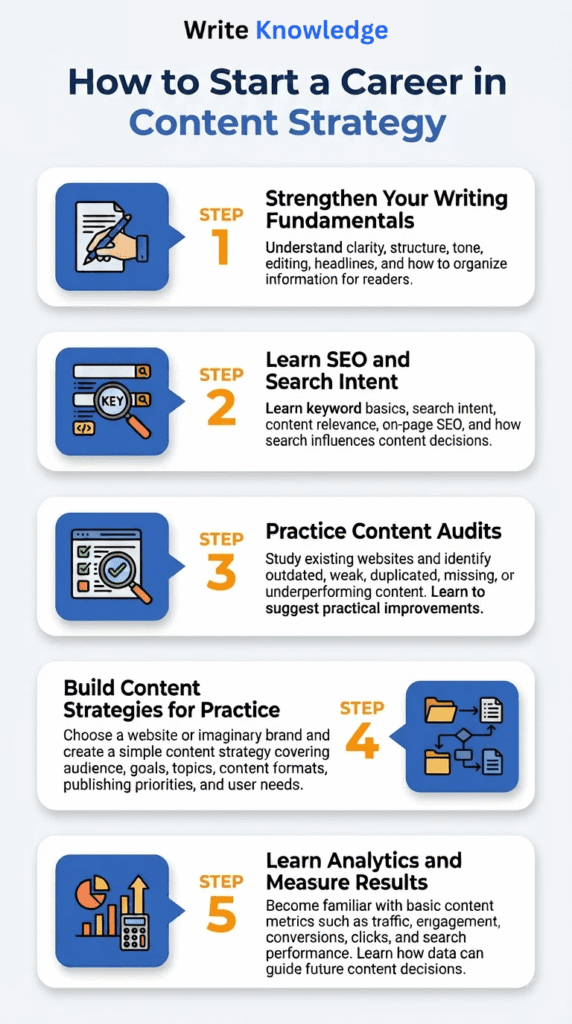
Strengthen Your Writing Fundamentals
A strategist needs to understand content before planning content.
Build your understanding of:
- Writing types
- Structure
- Tone
- Readability
- Editing
- Research
- Audience-focused writing
That’s also why having a working knowledge of writing style guides can be useful when you’re working with larger content teams that need consistency across multiple writers and editors.
Learn SEO
Learn the basics first.
You should know how to:
- Identify search intent
- Research keywords
- Assess competing pages
- Spot content gaps
- Structure internal links
- Evaluate organic performance
Practice Content Audits
Pick a website and ask yourself:
What’s working?
What’s outdated?
What’s missing?
What’s duplicated?
What should be consolidated?
What should be linked together?
Don’t worry about getting every decision right.
You’re training yourself to look at content as a system.
Create Content Strategies for Practice
Choose a topic and build a mini strategy.
For example:
Main article: Writing Careers
Sub articles:
- Content Writing Career
- SEO Writing Career
- Copywriting Career
- Content Strategy Career
Then decide:
- Who the audience is
- What each page should answer
- How the pages should interlink
- Which page should be the broadest resource
- What supporting content might come next
That exercise alone can become a portfolio project.
Learn Analytics
You don’t need to become a data scientist.
But you should understand what metrics such as impressions, clicks, CTR, traffic, engagement, and conversions can tell you.
More importantly, learn to turn those numbers into decisions.
⚠️ Common Mistake
One of the biggest mistakes aspiring Content Strategists make is thinking that more content automatically means a better content strategy.
It doesn’t.
Sometimes the smartest strategy is to publish less and improve what already exists.
What Should a Content Strategist Portfolio Include?
A writing portfolio answers:
“Can you write?”
A strategy portfolio needs to answer another question:
“Can you think?”
Content Audit
Show an existing website and identify:
- Strong pages
- Weak pages
- Outdated information
- Duplicated topics
- Content gaps
Content Cluster Map
Choose a broad topic and divide it into connected resources.
Show why those pages belong together.
Content Brief
Create a realistic brief for a writer.
Explain:
- Who the audience is
- What the intent is
- What the article should cover
- What related pages should be linked
- What outcome the article should support
Editorial Calendar
Create a sample publishing plan with:
- Topic
- Audience
- Content format
- Priority
- Publishing date
- Purpose
Before-and-After Content Improvement
Take an existing article and show:
What was wrong → What you would change → Why you would change it
That final part is essential.
The point isn’t to make changes for the sake of making changes.
It’s to demonstrate reasoning.
🔍 Did You Know?
Your portfolio doesn’t have to come from paid client work.
A carefully constructed hypothetical strategy project can still demonstrate useful skills, provided, you clearly explain the problem, your assumptions, your recommendations, and the reasoning behind them.
What Does a Content Strategist Do Every Day?
There isn’t one fixed routine.
On Monday, you might spend the morning researching content gaps.
On Tuesday, you might review an editorial calendar.
On Wednesday, you could be creating briefs for writers.
Later in the week, you might look at performance data, update a content audit, or meet with a marketing team.
A typical workflow might look like:
Research → Plan → Brief → Create → Publish → Measure → Improve
And then the cycle starts again.
That’s one of the interesting things about the career: the work changes as the content problem changes.
Is Content Strategy a Good Career for Writers?
It can be a very good fit, but not for every writer.
Content strategy may suit you if you enjoy:
- Research
- Planning
- SEO
- Organizing information
- Analytics
- Audience psychology
- Problem-solving
- Collaboration
- Deciding what should happen next
It may be less appealing if your favorite part of writing is simply sitting down alone and creating prose all day.
And that’s okay.
Not every writer needs to become a strategist.
The point is to find the writing career that fits how you like to work.
What Challenges Can You Expect in a Content Strategy Career?
The job sounds strategic and exciting, but it comes with its own challenges.
Balancing Audience and Business Needs
Readers want genuinely useful content.
Businesses also have goals.
Sometimes those goals pull in different directions.
A good strategist has to find the useful middle ground.
Working with Different Teams
You may have to explain the same strategy differently to a writer, designer, marketer, or manager.
Proving Content is Working
Traffic isn’t automatically success.
A page can get visitors and still fail its actual purpose.
That’s why the strategist needs to know what success means before measuring it.
Keeping Content Updated
Publishing is not the finish line.
Information changes.
Search behavior changes.
Audience expectations change.
A good content system therefore includes maintenance.
Content Strategy Career Path
There isn’t a single ladder everyone follows.
One possible path is:
Content Writer → Senior Content Writer → Content Strategist → Senior Content Strategist → Content Lead → Head of Content
Another person might enter through SEO, editing, marketing, journalism, technical communication, or another related field.
You might eventually specialize in:
- SEO content strategy
- Content marketing
- Editorial strategy
- Content operations
- Content design
- Content leadership
Your previous experience doesn’t disappear when you change roles.
It becomes part of the toolkit you bring into the next one.
Where Can Content Strategists Work?
Content strategy is useful wherever organizations depend on content to communicate.
You may find these roles in:
- Technology
- SaaS
- Education
- Publishing
- Media
- E-commerce
- Financial services
- Healthcare
- Marketing agencies
- Professional services
- Startups
And the actual content can be completely different.
One strategist might work on blog articles.
Another might plan website content.
Someone else might focus on product content, documentation, email, or content operations.
The common thread is strategic responsibility for content.
Is Content Strategy Right for You?
Here’s perhaps the simplest test.
If your main question is:
“How do I write this?”
You’re thinking like a writer.
If your question is:
“How do I get this page to perform better in search?”
You’re thinking more like an SEO Writer.
If you’re asking:
“How do I convince the reader to take action?”
You’re moving toward copywriting.
But if you’re asking:
“Why are we creating this page? Who needs it? What should come before it? What should come after it? And how will we know whether it worked?”
You’re thinking like a Content Strategist.
📚 Continue Learning
Content strategy is only one direction within the wider writing field. If you’re comparing career options, explore the broader writing career guide and then look at individual content writing paths.
Comparing these roles side by side can help you understand whether you prefer creating content, optimizing it for search, persuading readers, or planning the larger content system.
✅ Key Takeaways
- A Content Strategist thinks beyond individual pieces of content and focuses on the larger content system.
- The role can involve audience research, content planning, audits, briefs, SEO, analytics, editorial direction, and collaboration.
- A writing background can provide a strong foundation for moving into content strategy.
- Important skills include writing, research, SEO, strategic thinking, analysis, communication, and organization.
- Content strategy careers can include Content Strategist, Content Marketing Strategist, SEO Content Strategist, Editorial Strategist, and Content Operations roles.
- A strong portfolio should show how you make content decisions, not just how well you write.
- Content strategy can be a good career for writers who enjoy planning, research, systems, and problem-solving as much as writing itself.
Conclusion
Maybe you started out wanting to write.
Then, somewhere along the way, you started asking bigger questions.
Why this topic? Why this audience? Why this format? Why is this page performing better than that one? What should the website publish next?
Those questions are where content strategy begins.
You don’t need to stop being a writer to explore it. In fact, your writing experience can give you a useful head start. Learn SEO, study audiences, practice content audits, build topic clusters, work with analytics, and start explaining the reasoning behind your content decisions.
Because eventually, the job stops being only about writing the content.
It becomes about knowing what content is worth writing in the first place.
Frequently Asked Questions
What is a Content Strategist?
A Content Strategist plans and manages content around audience needs and organizational goals. The role can include research, content planning, briefs, audits, editorial direction, SEO collaboration, and performance analysis.
Can a Content Writer become a Content Strategist?
Yes. Content writing experience can provide a useful foundation. Writers can build toward strategy by learning SEO, analytics, audience research, content audits, topic mapping, and content planning.
What skills do Content Strategists need?
Key skills include writing and editing, audience research, SEO, strategic thinking, data analysis, communication, organization, and project management.
What should a Content Strategy portfolio include?
A strategy portfolio can include content audits, topic clusters, content briefs, editorial calendars, keyword research, internal-linking plans, and before-and-after content improvement projects.
What is the difference between a Content Strategist and a Content Writer?
A Content Writer mainly focuses on creating content, while a Content Strategist focuses on deciding what content should exist, who it is for, why it matters, and how different pieces should work together.
Is Content Strategy a good career for writers?
It can be a strong fit for writers who enjoy research, planning, SEO, analytics, audience understanding, organization, and solving content problems in addition to writing.

Sachin is a Postgraduate in Technical Writing in Business Management specializing in creating SEO-friendly, User-friendly, and Reader-focused website articles on Education, Tech, Sports, Games, and Entertainment.
Through Write Knowledge, he helps students, bloggers, editors, and professionals develop practical writing skills using clear explanations, real-world examples, and internationally recognized writing standards.