If you have ever opened a technical paper and wondered why the citations look like [1], why the references are numbered, or why figures, equations, and headings follow such a structured format, you have probably encountered IEEE Style.
For students, researchers, engineers, and technical writers, IEEE Style can look complicated at first. But once you understand the basic system, the logic becomes much easier: technical information should be presented clearly, consistently, and in a way that lets readers quickly connect claims to their sources.
Whether you are preparing an engineering assignment, writing a research paper, submitting a conference paper, or working on technical documentation, knowing the fundamentals of IEEE Style can help you produce a more professional document.
💡 Quick Answer
IEEE Style is an editorial and documentation system commonly used in engineering, computer science, electronics, telecommunications, and other technical and scientific fields. It provides guidance on areas such as headings, capitalization, punctuation, abbreviations, numbers, equations, figures, tables, citations, and references.
One of its most recognizable features is its numbered citation system. Sources are cited in the text using numbers in square brackets, such as [1], and those numbers correspond to numbered entries in the reference list.
For example:
In-text citation:
Consistent documentation improves technical communication [1].
Reference:
[1] S. King, On Writing: A Memoir of the Craft. New York, NY, USA: Scribner, 2000.
The important thing is that IEEE is more than a citation format. It also provides editorial guidance for presenting technical writing consistently.
What is IEEE Style?
IEEE Style is a set of editorial and documentation conventions associated with the Institute of Electrical and Electronics Engineers (IEEE).
It is particularly important in technical and scientific communication. IEEE’s own editorial resources cover areas including:
- Punctuation
- Capitalization
- Abbreviations
- Section headings
- Numbers
- Mathematical equations
- Footnotes
- Biographies
- References
That distinction matters.
You might think of IEEE as simply a way of writing citations such as [1] and [2]. In reality, citation formatting is only one part of a much larger editorial system.
What does IEEE Style Control?
Depending on the document and publication, IEEE guidance can affect how you present:
- Headings and sections
- Technical terminology
- Abbreviations
- Numbers and units
- Equations
- Figures and tables
- Citations
- Reference lists
- Footnotes
- Biographies;
- Other elements of a technical article
The exact requirements can vary by IEEE publication, so the journal, conference, or institution’s instructions should take priority when they specify a particular format.
Who Uses IEEE Style?
IEEE Style is most closely associated with technical and engineering communication.
You may encounter it when writing about:
- Electrical engineering
- Electronics
- Computer science
- Information technology
- Telecommunications
- Robotics
- Artificial intelligence
- Control systems
- Signal processing
- Computer networks
- Embedded systems
- Technical research; an
- Related scientific and engineering subjects
IEEE publications include journals, transactions, magazines, conference proceedings, and other technical material.
For a student in India, for example, IEEE Style may appear in an engineering or computer-science research assignment, project report, conference paper, dissertation-related work, or technical paper.
If you are unsure how IEEE differs from other major systems, our Writing Style Guides places IEEE alongside APA, MLA, Chicago, and AP and explains when each style is generally used.
Is IEEE Style the Same as IEEE Citation Style?
Not exactly.
This is one of the easiest things to misunderstand.
IEEE Style covers broader editorial and technical-writing conventions, while IEEE citation and reference style deals specifically with documenting sources.
IEEE itself provides an IEEE Reference Guide that covers how to cite different types of sources. It also provides tools such as the IEEE Reference Preparation Assistant for formatting references.
So if someone says:
“Use IEEE Style.”
they may be referring to the overall presentation of a technical paper.
If they say:
“Use IEEE citations.”
they are usually referring specifically to the numbered citation and reference system.
How does IEEE Citation Style Work?
IEEE uses a numeric citation system.
Instead of writing:
(Smith, 2025)
or:
(Smith 25)
you normally cite the source using a number in square brackets:
[1]
The first source you cite becomes [1]. The next new source becomes [2], and so on.
Basic IEEE In-Text Citation Example
Suppose you are discussing the importance of consistent technical documentation.
You could write:
Consistent documentation improves technical communication [1].
If you cite another source later:
Clear technical documentation can also improve collaboration among research and engineering teams [2].
The numbers correspond to entries in your reference list.
Citing the Same Source Again
If you refer to the same source later, you normally use the same reference number rather than assigning a new number.
For example:
Technical documentation should be written for its intended audience [1].
Later:
Audience awareness also affects the level of technical detail required [1].
Both citations refer to the same source.
Citing Multiple Sources
When several sources support the same statement, multiple reference numbers can be included:
Several studies have examined the reliability of the proposed approach [1], [3], [5].
The exact presentation of multiple citations can depend on the publication’s requirements, so check the relevant IEEE instructions when preparing a submission.
Citing a Specific Figure, Equation, or Section
IEEE’s editorial manual also provides conventions for referring to specific parts of a cited source.
For example:
The method described in [1, Fig. 2] demonstrates the proposed architecture.
or:
The derivation is discussed in [2, Sec. IV].
IEEE specifically recommends this type of cross-reference rather than phrasing such as “Fig. 2 of reference [1].”
How Do You Format IEEE References?
The IEEE reference list is numbered, and each number corresponds to an in-text citation.
A basic reference therefore looks like:
[1] S. King, On Writing: A Memoir of the Craft. New York, NY, USA: Scribner, 2000.
Notice several things:
- The reference begins with [1].
- The author’s name is presented using initials followed by the surname.
- The book title is italicized.
- Publication information follows.
- The location uses the city, state abbreviation, and country format in this example.
The precise structure changes depending on the source type. IEEE’s Reference Guide provides formats for different kinds of publications.
Common IEEE Reference Formats
The format you use depends on what you are citing.
Book
Basic pattern:
[#] A. A. Author, Title of Book. City, State/Country: Publisher, year.
Example:
[1] S. King, On Writing: A Memoir of the Craft. New York, NY, USA: Scribner, 2000.
Journal Article
A journal article generally requires information such as the author, article title, journal title, volume, issue, page range, and publication date or year, depending on the source and IEEE requirements.
Example structure:
[2] A. A. Author and B. B. Author, “Title of article,” Journal Title, vol. 10, no. 2, pp. 100–110, 2025.
The exact details should be taken from the source rather than guessed.
Conference Paper
A conference reference generally includes the author, paper title, conference title or proceedings information, location when applicable, and publication details.
Example structure:
[3] A. A. Author, “Title of conference paper,” in Proc. IEEE Conference Name, 2025, pp. 100–105.
Website
Web sources require information such as the author or organisation, page title, website information, and URL/access information as required by the applicable IEEE reference guidance.
Example structure:
[4] Organization Name, “Title of webpage.” [Online]. Available: URL
Do not simply copy a URL into your reference list and assume the citation is complete.
Technical Report
A technical report may require the author or organisation, report title, report number where applicable, institution, location, and date.
Because technical reports can vary significantly, use the IEEE Reference Guide’s relevant source category rather than forcing every report into a journal or website format.
IEEE Paper Formatting Basics
Citation formatting is only one part of preparing an IEEE-style document.
IEEE’s editorial resources also address the presentation of the article itself, including section headings, numbers, equations, abbreviations, punctuation, and other editorial matters.
However, do not assume that every IEEE publication uses exactly the same page layout.
An IEEE journal, conference, student assignment, and institutional template may have different requirements.
For an actual submission, the publication’s template and author instructions should take priority.
Title and Author Information
Technical papers normally begin with the paper title and author information.
The exact arrangement depends on the IEEE publication or template being used.
For this reason, it is better to download the specific IEEE template required for your journal or conference rather than manually recreating the layout.
Abstract
Technical papers commonly include an abstract that gives readers a concise overview of the work.
A useful abstract should help the reader understand:
- What problem was addressed
- What approach was used
- What was discovered or achieved
- Why the result matters
Keep the abstract focused. It should summarize the paper rather than introduce information that never appears in the main text.
Index Terms
IEEE papers may also include Index Terms to help classify and identify the subject of the article.
Choose terms that accurately represent the technical content rather than simply repeating every important word from the title.
How to Structure Headings in IEEE Style
IEEE provides guidance for section headings as part of its editorial style system.
A technical paper generally needs a clear hierarchy so readers can understand how the discussion is organized.
For example:
I. INTRODUCTION
The introduction establishes the problem and explains the purpose of the study.
II. METHODOLOGY
A. Data Collection
Explain how the data were obtained.
B. Experimental Setup
Describe the equipment, software, or procedure.
III. RESULTS
Present the findings.
IV. CONCLUSION
Summarize the main findings and implications.
The exact heading format should follow the template or publication instructions you are using.
How does IEEE Handle Numbers?
Numbers are especially important in technical writing because readers need to interpret measurements and results quickly.
IEEE editorial guidance includes rules concerning numbers and their presentation.
In technical writing, pay particular attention to:
- Numerical measurements
- Units
- Percentages
- Decimal values
- Ranges
- Dates
- Quantities in equations
- Numbers appearing in tables and figures
The key principle is consistency.
Do not randomly switch between different ways of presenting the same type of measurement.
For example, if your document reports a measurement using a particular unit convention, maintain that convention throughout unless there is a reason to change it.
How are Abbreviations Used in IEEE Style?
Technical writing often contains many abbreviations.
The first use should generally make the meaning clear to the reader before the abbreviation becomes the primary form.
For example:
Internet of Things (IoT)
After defining it, you can use:
IoT devices were connected to the proposed network.
Be careful with abbreviations that may have several meanings.
A technical reader should not have to guess what an abbreviation means from context.
How are Equations Presented in IEEE Style?
Equations are a major part of many IEEE papers, particularly in engineering, mathematics, computer science, and scientific research.
IEEE provides a dedicated Mathematics Guide explaining how equations should be rendered in technical articles.
For example:
E = mc2
In a technical paper, an equation may also be assigned a number when it needs to be referenced later:
E = mc2 (1)
You can then refer to it in the text as:
As shown in (1), the relationship between energy and mass is …
The important point is to keep equation formatting consistent and follow the mathematical conventions required by the specific IEEE publication.
How are Figures and Tables Cited in IEEE?
Figures and tables should be clearly numbered and referred to in the text.
IEEE’s editorial manual specifies that first citations of figures and tables should occur in numerical order. Figure references use the abbreviation “Fig.” followed by the number.
For example:
The proposed system architecture is shown in Fig. 1.
Then:
The experimental results are presented in Fig. 2.
Avoid introducing Fig. 3 before Fig. 2 has been mentioned if the publication requires sequential first citation.
Example Figure Reference
In text:
The network architecture is shown in Fig. 1.
Caption:
Fig. 1. Proposed network architecture.
The exact caption format can vary according to IEEE publication requirements, so use the applicable template.
Example Table Reference
In text:
The results are summarized in Table I.
Table heading:
TABLE I
PERFORMANCE COMPARISON OF THE PROPOSED METHODS
Again, follow the publication’s template for capitalization, numbering, spacing, and placement.
What is the IEEE Reference List?
The reference list is the numbered list of sources cited in the paper.
Unlike an alphabetical reference list, IEEE references are normally identified by citation number.
For example:
[1] A. Author, “Article title,” Journal Title, vol. 5, no. 2, pp. 10–20, 2025.
[2] B. Author, Book Title. City, Country: Publisher, 2024.
[3] Organization Name, “Webpage title.” [Online]. Available: URL
The numbering connects the references directly to the citations appearing throughout the document.
IEEE’s Reference Guide is the appropriate source for determining the format of specific source types.
IEEE Style Examples
Seeing the system in action is usually easier than memorizing rules.
Example 1: One Source
Sentence:
Clear technical documentation can improve communication between engineering teams [1].
Reference:
[1] S. King, On Writing: A Memoir of the Craft. New York, NY, USA: Scribner, 2000.
Example 2: Two Sources
Several studies have examined the effectiveness of automated documentation tools [1], [2].
References:
[1] A. A. Author, “Article title,” Journal Title, vol. 10, no. 2, pp. 20–30, 2025.
[2] B. B. Author, Book Title. London, U.K.: Publisher, 2024.
Example 3: Mentioning an Author
You can mention an author’s name in the sentence without changing the basic citation system.
King argues that writing improves through practice [1].
The citation still points to the numbered reference.
Example 4: Referring to a Figure in a Source
The architecture described in [2, Fig. 3] demonstrates how the system distributes network traffic.
IEEE specifically provides this kind of notation for referring to a particular figure within a cited source.
What is the Difference Between IEEE and APA Style?
IEEE and APA are both widely used academic styles, but their citation systems work differently.
| Feature | IEEE | APA |
| Citation system | Numeric | Author–date |
| Basic citation | [1] | (Author, Year) |
| Reference list | Numbered | Alphabetical |
| Common fields | Engineering, technology, computer science | Psychology, education, social sciences |
| Main emphasis | Technical and scientific communication | Research and scholarly communication |
For example:
IEEE:
Technical writing requires consistency [1].
APA:
Technical writing requires consistency (King, 2000).
Neither system is universally better. The correct choice depends on your discipline and the requirements of your institution, journal, publisher, or employer.
If you are also learning APA, our complete APA Style guide can help you understand the author–date system and its broader formatting conventions.
What is the Difference Between IEEE and MLA Style?
IEEE and MLA are designed for very different academic environments.
IEEE is strongly associated with technical and engineering communication.
MLA is commonly associated with literature, language, and humanities.
Their citation systems also differ:
IEEE:
[1]
MLA:
(King 45)
If you’re working across technical and humanities subjects, it is particularly important not to mix these systems.
Our complete MLA Style guide covers the MLA system in detail.
Common IEEE Style Mistakes
Learning IEEE Style becomes much easier when you know what to avoid.
Using Author–Date Citations
Writing:
(Smith, 2025)
when the assignment specifically requires IEEE Style is a common mistake.
Use the required numbered citation system instead:
[1]
Numbering the Same Source More Than Once
If the same source is cited repeatedly, don’t normally create a new reference number every time.
Keep the source associated with its original reference number.
Formatting References From Memory
Reference formats change depending on the source type.
A book, journal article, conference paper, website, patent, report, and other source types do not all follow the same pattern.
Use the IEEE Reference Guide when you are unsure.
Treating IEEE as Only a Citation Style
This is perhaps the biggest conceptual mistake.
IEEE editorial guidance also addresses:
- Punctuation
- Capitalization
- Abbreviations
- Headings
- Numbers
- Equations
- fFgures
- Tables
- Other aspects of technical presentation
Ignoring the Publication’s Own Instructions
An IEEE journal or conference may provide its own template and submission requirements.
Therefore, don’t assume that a generic IEEE example automatically satisfies every IEEE publication.
Use the specific publication’s instructions when they differ from general guidance.
How to Learn IEEE Style
You don’t need to memorize an entire editorial manual before you can use IEEE Style effectively.
A better approach is to learn the system progressively.
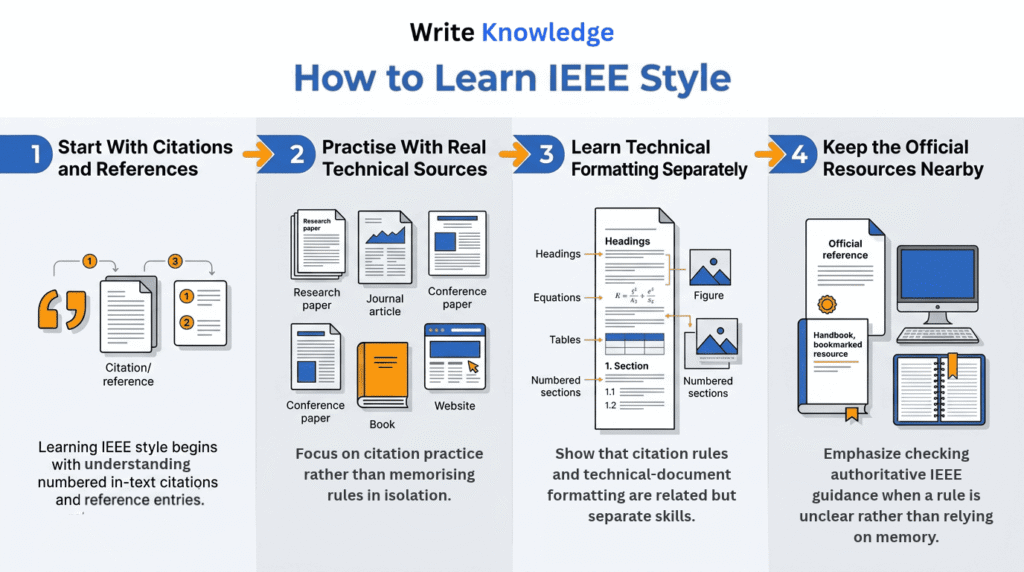
Start With Citations and References
First understand the basic relationship:
Source mentioned in text → numbered citation → numbered reference
Once that becomes natural, move on to more complicated reference types.
Practise With Real Technical Sources
Take a few sources from an engineering or computer-science topic and practise formatting:
- One book
- One journal article
- One conference paper
- One website
- One technical report
Compare your results against the official IEEE Reference Guide.
Learn Technical Formatting Separately
After understanding citations, work on:
- Headings
- Abbreviations
- Numbers
- Equations
- Figures
- Tables
- Captions
This prevents you from treating IEEE as merely a citation system.
Keep the Official Resources Nearby
Even experienced writers and editors do not memorize every editorial rule.
IEEE provides separate resources for its Editorial Style Manual, Mathematics Guide, and Reference Guide.
Use those resources when a question involves a specific technical or publication requirement.
A Practical IEEE Style Checklist
Before submitting an IEEE-style technical paper, check the following:
- Did you use the required IEEE template?
- Are the headings formatted consistently?
- Are abbreviations introduced clearly?
- Are numbers and units presented consistently?
- Are equations formatted correctly?
- Are equations numbered when necessary?
- Are figures cited in the correct numerical order?
- Are tables cited appropriately?
- Does every in-text citation correspond to a reference?
- Does every reference cited in the paper appear in the reference list?
- Are references numbered correctly?
- Did you use the correct reference format for each source type?
- Did you check the current instructions of the specific IEEE publication?
This last check is especially important. IEEE provides general editorial guidance, but individual publications can have additional requirements.
✅ Key Takeaways
- IEEE Style is more than a citation format. It also covers editorial conventions for technical writing.
- IEEE is commonly used in engineering, computer science, electronics, telecommunications, and related technical fields.
- IEEE uses a numbered citation system, with sources identified using numbers such as [1].
- The reference list is numbered to correspond with the citations in the text.
- Reference formatting changes depending on whether you are citing a book, journal article, conference paper, website, report, or another source type.
- IEEE also provides guidance on headings, abbreviations, numbers, equations, figures, tables, and other editorial elements.
- The exact requirements can vary between IEEE publications, so always check the current template and author instructions for your journal or conference.
Conclusion
IEEE Style can look intimidating when you first encounter numbered citations, technical headings, equations, figures, tables, and detailed reference formats. But the system becomes much easier once you understand the underlying principle: technical information should be presented consistently so readers can understand the work and trace its sources efficiently.
Frequently Asked Questions
What is IEEE Style?
IEEE Style is a set of editorial and documentation conventions used primarily in technical and scientific communication. It covers areas such as citations, references, headings, abbreviations, numbers, equations, figures, and tables.
What does an IEEE citation look like?
A basic IEEE in-text citation uses a number in square brackets, such as [1]. The number corresponds to the relevant entry in the numbered reference list.
Is IEEE Style the same as IEEE citation style?
No. IEEE citation and reference formatting is one component of the broader IEEE editorial style system. IEEE also provides guidance on areas such as punctuation, capitalization, abbreviations, headings, numbers, equations, figures, and biographies.
Who typically uses IEEE Style?
IEEE Style is commonly used in engineering, computer science, electronics, telecommunications, technical research, and related fields.
Where can I check an IEEE reference format?
IEEE’s official Reference Guide is the best place to check the format for a particular source type. IEEE also provides a Reference Preparation Assistant for formatting references.

Sachin is a Postgraduate in Technical Writing in Business Management specializing in creating SEO-friendly, User-friendly, and Reader-focused website articles on Education, Tech, Sports, Games, and Entertainment.
Through Write Knowledge, he helps students, bloggers, editors, and professionals develop practical writing skills using clear explanations, real-world examples, and internationally recognized writing standards.