Have you ever opened a user manual and thought, “Okay, but what am I actually supposed to do?”
Or searched for instructions online because the official documentation was so complicated that you gave up?
That is exactly where technical writing matters.
A good technical writer takes information that may be complicated, specialized, or unfamiliar and turns it into something a specific reader can understand and use. That could mean explaining how software works, showing someone how to configure a device, documenting an engineering process, or helping a developer use an API.
Technical writing isn’t necessarily about making a subject sound more technical. In many cases, it does the opposite: it makes technical information easier to understand.
💡 Quick Answer
Technical writing means explaining complex information in a clear, simple way so anyone can understand and use it. It’s the kind of writing found in user manuals, how‑to guides, or product instructions … helping readers learn how something works or how to do a task without needing expert knowledge.
What Is Technical Writing?
Technical writing is a type of writing used to explain specialized information clearly and accurately so a specific audience can understand something, complete a task, follow a process, or make an informed decision.
Technical writing is usually:
- Audience-focused
- Purpose-driven
- Clear and precise
- Logically organized
- Fact-based
- Practical
It can be used in technology, engineering, science, healthcare, business, manufacturing, software, education, and many other fields.
For example, a software company might need technical writing for an API reference, a setup guide, a troubleshooting article, or product documentation.
So, is there any format to follow technical writing?
Actually, the exact format changes depending on who will read the document and what they need to accomplish.
What Is Technical Writing Used For?
Technical writing is used whenever specialized information needs to be communicated in a practical and understandable form.
The purpose can vary. A document might be written to:
- Explain how something works
- Provide instructions
- Document a process
- Describe a system
- Communicate technical findings
- Present research
- Compare technical options
- Explain a product or service
- Help users solve a problem
So, technical writing isn’t limited to manuals.
A technical writer may produce content for a software product one day and documentation for an engineering project the next.
Who Reads Technical Writing?
The audience depends entirely on the document.
It may be intended for:
- Software developers
- Engineers
- Scientists
- Technicians
- Students
- Customers
- Employees
- Project managers
- Healthcare professionals
- General users
The writer therefore has to understand the reader’s existing knowledge.
Why Audience Matters in Technical Writing
Imagine you’re explaining the same software feature to two people.
Developer:
“Use the REST endpoint to retrieve the JSON response and pass the returned object to the authentication middleware.”
Beginner:
“Send a request to the service’s API. The service returns the requested information in JSON format, which your application can then process.”
The underlying information may be the same.
The writing is different because the audience is different.
Audience analysis is one of the central principles of technical communication because the reader’s role, existing knowledge, and purpose affect vocabulary, level of detail, organization, and explanation.
What Are the Types of Technical Writing?
Technical writing covers many different document types. The format depends on the purpose and audience.
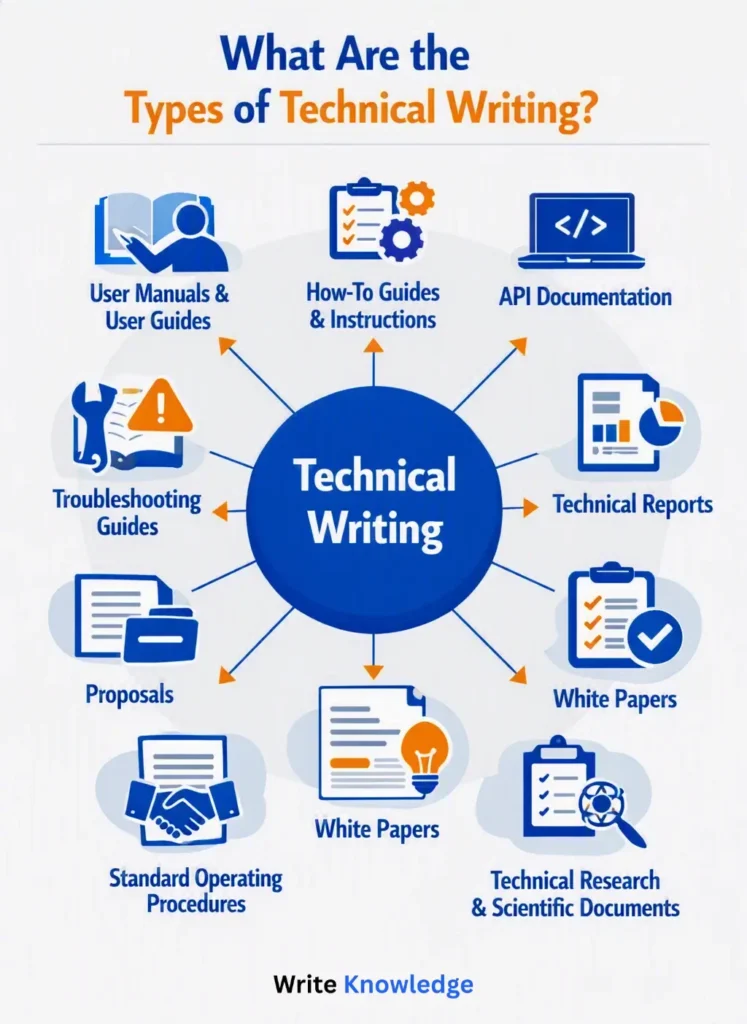
User Manuals and User Guides
User manuals explain how to use a product, device, application, or system.
For example, a software user guide might explain:
- How to create an account
- How to configure settings
- How to perform common tasks
- What to do when something goes wrong
How-To Guides and Instructions
How-to guides focus on helping readers complete a particular task.
For example:
How to Connect a Wireless Printer to Windows
The document might provide a sequence of steps, screenshots, warnings, and troubleshooting information.
This type of writing is highly action oriented.
API Documentation
API documentation explains how developers can interact with a software interface.
It may include:
- Endpoints
- Parameters
- Authentication requirements
- Request examples
- Response formats
- Error codes
- Sample code
API documentation needs to be particularly precise because developers may use the information directly in working software.
Troubleshooting Guides
Troubleshooting content helps users identify and resolve problems.
For example:
“Why is My Application not connecting to the Database?”
A troubleshooting guide might begin with the most common causes and then move through diagnostic steps.
Technical Reports
Technical reports communicate information about a technical investigation, experiment, project, system, or process.
Depending on the context, a report may contain:
- An introduction
- Objectives
- Methodology
- Findings
- Analysis
- Results
- Recommendations
- Conclusions
Proposals
Technical proposals explain a proposed project, solution, process, or system.
For example, an engineering company might prepare a proposal explaining how it plans to implement a new infrastructure system, including its approach, timeline, resources, and estimated cost.
White Papers
Technical white papers generally provide detailed information about a technical problem, technology, method, or proposed solution.
They are often written for professional or specialized audiences and may combine explanation, analysis, research, and persuasion.
Standard Operating Procedures
Standard Operating Procedures, or SOPs, explain how a recurring process should be performed.
They are common in environments where consistency matters, including:
- Manufacturing
- Laboratories
- Healthcare
- IT operations
- Quality control
- Corporate processes
Technical Research and Scientific Documents
Technical writing also appears in research and scientific communication.
Research papers, technical research reports, conference papers, and similar documents may communicate highly specialized findings to readers who already understand the field.
This type of writing usually requires careful handling of evidence, terminology, data, citations, figures, and technical formatting.
For example, IEEE Style is widely associated with engineering and computer science writing. If you’re working with technical research and numbered citations, see our complete IEEE style guide.
What Are the Characteristics of Technical Writing?
Technical writing may look different from one industry to another, but several characteristics appear repeatedly.
Clarity
The reader should understand what the document is saying without having to decode unnecessarily complicated language.
Clarity doesn’t mean removing all technical terminology. It means using terminology when it helps the intended audience and explaining unfamiliar terms when necessary.
Accuracy
Technical information must be correct.
A small factual error in an ordinary sentence may be inconvenient. An incorrect technical instruction can cause a system to fail, produce an incorrect result, or create a safety problem.
Conciseness
Technical writing generally avoids unnecessary words.
If a sentence can communicate the same information clearly in fewer words, the shorter version is often better.
📝 Example
Wordy:
“Due to the fact that the system is currently unavailable, users will not be able to access the dashboard.”
More concise:
“The system is unavailable, so users cannot access the dashboard.”
Logical Organization
Technical readers often don’t read every word from beginning to end.
They scan for the information they need.
That’s why technical documents commonly use:
- Descriptive headings
- Numbered steps
- Bullet lists
- Tables
- Warnings
- Examples
- Diagrams
- Clearly separated sections
Audience Awareness
Technical writing should match the reader’s knowledge.
A beginner may need definitions and background information.
An experienced engineer may need specifications, constraints, and precise technical details instead.
Objective and Practical Language
Technical writing usually prioritizes information over personality.
That doesn’t mean it has to sound cold or unnatural. It simply means that unnecessary emotional language, vague claims, and decorative wording should not get in the way of the information.
A useful principle is:
Write for what the reader needs to understand or do … not for what the writer wants to show off.
What Does Technical Writing Look Like?
Technical writing can take very different forms.
Consider a simple example involving a software application.
A marketing article might say:
“Our new dashboard makes managing your projects easier and faster.”
That’s promotional writing.
A technical document might say:
“Open the Projects menu and select New Project. Enter a project name, select a workspace, and click Create. The new project appears in the workspace dashboard.”
That’s technical writing because the purpose is to help the reader perform a task.
📝 Example
Suppose a company launches a new wireless router.
Different writers might describe the same product in very different ways.
Marketing writing:
“Experience faster and more reliable connectivity throughout your home.”
Technical writing:
“Connect the router to the modem using the included Ethernet cable. Connect the power adapter and wait approximately two minutes for the status light to turn solid blue.”
The first sentence is designed to promote the product.
The second is designed to help someone use it.
How Is Technical Writing Different From Other Types of Writing?
Technical writing overlaps with several other forms of writing, but its primary purpose is different.
| Type of Writing | Main Purpose | Typical Example |
| Narrative Writing | Tell a story | Personal narrative |
| Descriptive Writing | Create a vivid impression | Description of a place |
| Expository Writing | Explain or inform | Educational article |
| Persuasive Writing | Convince the reader | Argumentative article |
| Technical Writing | Help readers understand or perform something | User guide |
Technical writing can explain, which means it sometimes resembles expository writing.
But technical writing usually has a more specific practical context.
For example, an expository article might explain how solar panels generate electricity.
A technical document might explain how to install, configure, test, or maintain a particular solar panel system.
If you want to understand the broader category, start with our Types of Writing guide.
Technical Writing vs Expository Writing
These two are especially easy to confuse.
Both can explain information.
The difference is usually purpose, audience, and context.
Expository Writing
Expository writing generally explains a topic so the reader can understand it.
For example:
“Photosynthesis is the process through which plants convert light energy into chemical energy.”
The purpose is primarily educational.
You can also directly explore our Expository writing guide to see how explanation works as a broader writing purpose.
Technical Writing
Technical writing might explain how to perform a technical task:
“Place the sensor 10 cm from the light source. Connect the red lead to terminal A and the black lead to terminal B before starting the measurement.”
The reader isn’t simply trying to learn about a subject.
They are trying to do something correctly.
That distinction isn’t absolute. Technical documents can certainly explain concepts, but it is useful when deciding what kind of writing you’re producing.
How to Write a Technical Document
Writing technical content becomes much easier when you plan around the reader’s goal.
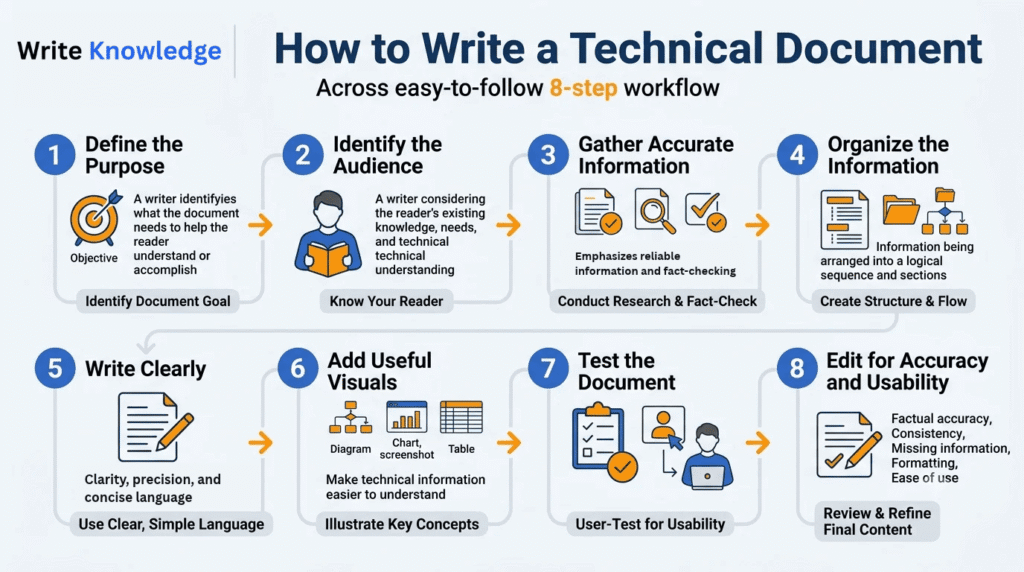
1. Define the Purpose
Before writing, ask:
What should this document help the reader understand or do?
A document with no clear purpose can quickly become overloaded with unnecessary information.
2. Identify the Audience
Determine:
- Who will read it?
- What do they already know?
- What do they need to know?
- What task are they trying to complete?
- What terminology will they understand?
3. Gather Accurate Information
Technical writing often requires research and collaboration with subject-matter experts.
Don’t guess when the information can be verified.
Check:
- Specifications
- Source documents
- Product information
- Research;
- Technical sandards
- Expert input
- Current documentation
4. Organize the Information
Create a logical structure before writing the full document.
Depending on the format, you might use:
Overview → Requirements → Procedure → Example → Troubleshooting
or:
Problem → Method → Findings → Analysis → Recommendation
The structure should follow the reader’s needs.
5. Write Clearly
Prefer specific language over vague statements.
Vague:
“Make sure the device is properly connected.”
Specific:
“Connect the blue cable to Port 2 until the connector clicks into place.”
The second sentence gives the reader something they can actually verify.
6. Add Useful Visuals
Technical information isn’t limited to paragraphs.
Use:
- Diagrams
- Screenshots
- Tables
- Flowcharts
- Graphs
- Labeled illustrations
- Example
when they make the information easier to understand.
Visuals are particularly useful when readers need to understand a process, relationship, structure, or sequence.
7. Test the Document
This step is especially important for instructional writing.
If you’ve written a procedure, ask someone from the intended audience to follow it.
If they cannot complete the task, the document may need revision.
In other words:
Don’t only proofread the instructions. Test them.
8. Edit for Accuracy and Usability
Finally, review the document for:
- Factual errors
- Unclear instructions
- Inconsistent terminology
- Missing steps
- Unnecessary information
- Formatting problems
- Broken links
- Incorrect figures or tables
- Audience-appropriate language
Common Technical Writing Mistakes
Technical writing can become ineffective even when the underlying information is correct.
Using Too Much Jargon
Technical terminology is useful when the audience understands it.
Unexplained jargon creates unnecessary barriers for beginners and non-specialist readers.
Writing for Yourself Instead of the Reader
The writer may understand the system perfectly and therefore skip steps that seem obvious.
The reader may not.
This is sometimes called the curse of knowledge: knowing a subject so well that you forget what it feels like to encounter it for the first time.
Giving Vague Instructions
Instructions such as:
“Configure the settings appropriately.”
don’t tell the reader what to do.
Good technical writing gives the reader enough information to act.
Including Information That Doesn’t Help the Task
More information doesn’t automatically make a technical document better.
If a detail doesn’t help the reader understand the subject or accomplish the intended task, ask whether it belongs in the document at all.
Ignoring Document Structure
Long blocks of uninterrupted text make technical information harder to scan.
Use headings, lists, tables, examples, and other structural elements where they genuinely improve usability.
What Skills are Important for Technical Writing?
Technical writing requires more than good grammar.
A strong technical writer needs a combination of writing, research, analytical, and communication skills.
Important skills include:
- Writing and editing: You need to express complicated information clearly.
- Research: Technical information often needs verification from reliable sources.
- Audience analysis: You need to adjust the document to the reader’s knowledge.
- Information organization: Complex information needs a logical structure.
- Critical thinking: You must identify gaps, contradictions, and unclear explanations.
- Technical understanding: You don’t always need to be the subject-matter expert, but you need enough understanding to communicate the subject accurately.
- Attention to detail: Small errors can matter significantly in technical documents.
- Communication: Technical writers frequently work with engineers, developers, researchers, designers, and other subject-matter experts.
This is one reason technical writing can be a strong career path for people who enjoy explaining difficult subjects rather than simply writing creatively.
Is Technical Writing a Good Type of Writing to Learn?
Yes!
Particularly if you enjoy structured, practical writing.
This writing can be useful if you like:
- Explaining complicated ideas
- Organizing information
- Researching unfamiliar subjects
- Solving communication problems
- Working with technology
- Writing instructions
- Making information easier for other people to use
You also don’t necessarily have to become an expert in every technical subject you write about.
A technical writer often works with subject-matter experts and transforms their knowledge into documentation that the intended audience can actually use.
Where Is Technical Writing Used?
It appears across a wide range of industries.
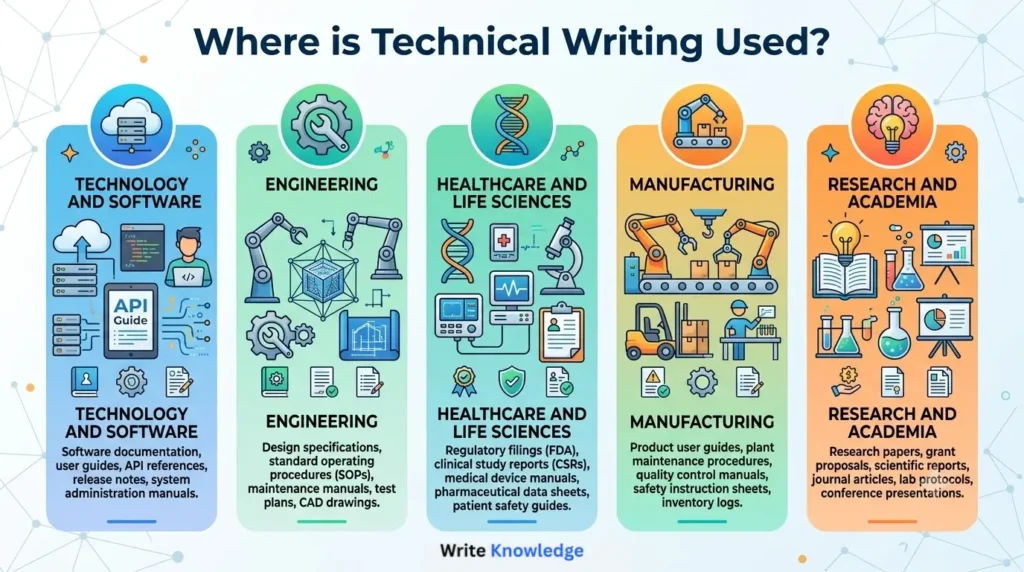
Technology and Software
Such as:
- API documentation
- Software documentation
- User guides
- Knowledge bases
- Troubleshooting articles
- Installation guides
- Developer documentation
Engineering
Engineers and technical communicators may produce:
- Technical reports
- Specifications
- Operating procedures
- Project documentation
- Maintenance manuals
- Safety documentation
Healthcare and Life Sciences
Technical and scientific communication may include:
- Medical documentation
- Research reports
- Operating procedures
- Clinical documentation
- Equipment instructions
- Educational materials
Manufacturing
Manufacturing organizations may need documentation for:
- Equipment operation
- Maintenance
- Quality control
- Safety procedures
- Production processes
- Training
Research and Academia
Technical writing is also common in:
- Research papers
- Laboratory reports
- Dissertations
- Conference papers
- Technical proposals
- Research documentation
Technical Writing as a Career
If you enjoy this type of writing, technical writing can also become a professional specialization.
Technical writers may work in:
- Software companies
- Engineering firms
- Technology companies
- Research organizations
- Manufacturing
- Healthcare
- Finance
- Telecommunications
- Other specialized industries
The work can range from creating documentation to editing existing technical material and working directly with subject-matter experts.
Want to turn this skill into a career? See our complete guide to Technical Writing career.
You can also explore our broader Writing Careers page for in-depth writing career options.
How Can You Start Learning Technical Writing?
You don’t need to begin with a complicated technical subject.
Start with something you already understand.
For example, write a short guide explaining:
How to Create a Gmail Filter
Then review it.
Could someone unfamiliar with the process follow your instructions without asking you questions?
If not, revise it.
You can gradually move into more complex subjects such as:
- Software
- API documentation
- Engineering
- Data
- Scientific research
- Product documentation
❌The goal isn’t to make the writing sound technical.
✅The goal is to make technical information usable.
✅ Key Takeaways
- Technical writing communicates specialized information to a specific audience for a practical purpose.
- It can explain, instruct, document, evaluate, or communicate technical information.
- Common examples include user manuals, how-to guides, API documentation, troubleshooting guides, technical reports, proposals, SOPs, and research documents.
- Good technical writing prioritizes clarity, accuracy, conciseness, logical organization, and audience awareness.
- Technical writing can overlap with expository writing, but it usually has a more specific practical purpose and audience.
- Technical writers need more than language skills; research, organization, critical thinking, technical understanding, and communication are also important.
- This type of writing is used across software, engineering, healthcare, manufacturing, research, and many other industries.
- The best technical writing isn’t the writing that sounds the most complicated. It’s the writing that helps the reader understand or do something correctly.
Conclusion
Technical writing is often misunderstood as writing that is simply “about technical subjects.” In reality, its defining feature is the way it communicates specialized information to a particular audience for a particular purpose.
A good technical document doesn’t try to impress readers with complicated language. It gives them the information they need, organizes it logically, explains unfamiliar concepts when necessary, and makes the next step clear.
Whether you’re writing a user guide, API documentation, engineering report, research document, or troubleshooting article, the same principle applies: understand the reader, understand the purpose, and make the information usable.
Frequently Asked Questions
What is technical writing in simple words?
Technical writing is a writing that explains specialized information in a clear and practical way. It helps a specific audience understand a subject, complete a task, follow a process, or use a product or system.
What are some examples of technical writing?
Common examples include user manuals, how-to guides, API documentation, troubleshooting guides, technical reports, proposals, standard operating procedures, and technical research documents.
What is the difference between technical writing and expository writing?
Both can explain information, but technical writing usually has a specific practical purpose and defined audience. Expository writing is broader and primarily focuses on explaining or informing.
Do technical writers need to be technical experts?
Not always. Technical writers need enough subject knowledge to understand and communicate the information accurately, but they often work with subject-matter experts who provide specialized knowledge.
Is technical writing difficult to learn?
It can take practice because technical writing combines language skills with research, organization, audience analysis, and subject understanding. However, beginners can start with simple how-to guides and gradually work toward more complex technical documents.

Sachin is a Postgraduate in Technical Writing in Business Management specializing in creating SEO-friendly, User-friendly, and Reader-focused website articles on Education, Tech, Sports, Games, and Entertainment.
Through Write Knowledge, he helps students, bloggers, editors, and professionals develop practical writing skills using clear explanations, real-world examples, and internationally recognized writing standards.