If you enjoy writing but find yourself noticing the things behind the writing: the awkward sentence, the unnecessary paragraph, the missing source, the inconsistent heading, or the headline that could be much better … you may be better suited to editorial work than you think.
An editorial career is not simply about correcting grammar.
Editors help shape content before it reaches readers. Depending on the role, they may evaluate ideas, work with writers, improve structure, check facts, apply style rules, manage editorial schedules, coordinate freelancers, or make final decisions about what gets published.
If you’re exploring different paths in writing, this makes editorial work an important career to understand alongside other writing careers covered in the writing careers guide.
💡 Quick Answer: What is an Editorial Career?
An editorial career involves reviewing, improving, coordinating, and sometimes commissioning written content for publication.
The exact work depends on the role. A copy editor may concentrate on grammar, punctuation, consistency, facts, and house style, while a commissioning editor may evaluate ideas, work with authors, acquire projects, and guide them through publication. Managing editors may focus more heavily on schedules, workflows, quality control, and coordination.
A career in editorial work can therefore suit people who enjoy language, critical thinking, research, organisation, communication, and improving other people’s writing.
Who is an Editor?
An editor is a professional who reviews and improves content before or during publication.
That sounds simple, but the job can involve very different responsibilities.
An editor might:
- Correct grammar, spelling, and punctuation
- Improve clarity and readability
- Check facts, dates, figures, and sources
- Assess whether a piece suits its intended audience
- Suggest changes to structure and wording
- Work with writers on revisions
- Apply a publication’s house style
- Evaluate submissions
- Manage editorial schedules
- Coordinate other editors, freelancers, designers, and production teams
So when someone says, “I’m an editor,” that does not necessarily tell you what they do all day.
The role could be highly language-focused, highly strategic, highly operational, or a combination of all three.
What Does an Editor Do?
There is no single daily routine for every editor.
A copy editor working on an article may spend much of the day examining sentences, checking facts, and applying style rules. A commissioning editor at a publishing house may spend more time reading submissions, communicating with authors and agents, developing projects, and coordinating with other departments.
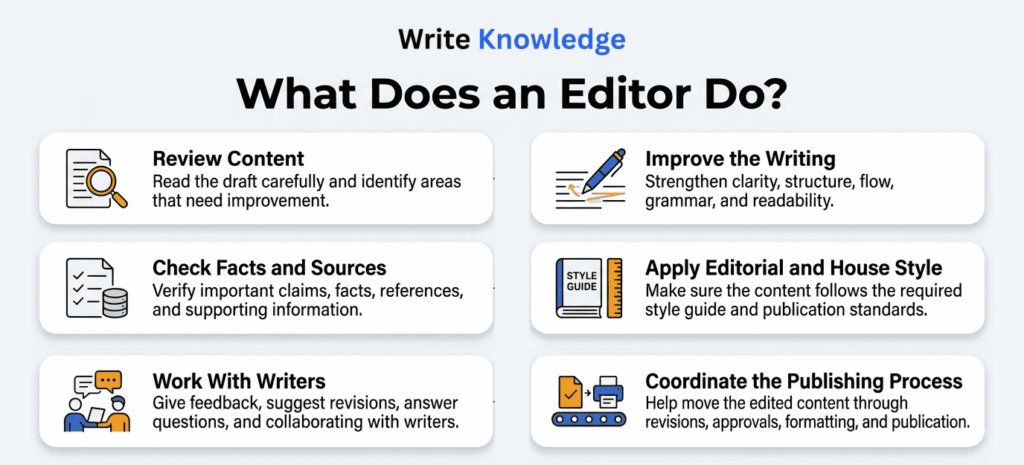
Review Content
Editors read manuscripts, articles, reports, web pages, books, or other material and determine what needs improvement.
They may look at:
- Clarity
- Structure
- Relevance
- Accuracy
- Tone
- Consistency
- Readability
- Suitability for the intended audience
Improve the Writing
Editors don’t simply identify problems.
They often suggest solutions.
A sentence may be grammatically correct but unnecessarily complicated. A paragraph may contain useful information but appear in the wrong place. A section may need to be shortened because it repeats something explained earlier.
An editor’s job is often to make those decisions.
Check Facts and Sources
Fact-checking can be an important part of editorial work.
Editors may verify names, dates, statistics, quotations, sources, and other factual information before publication.
Apply Editorial and House Style
Publications often have their own editorial preferences.
These may determine things such as:
- Capitalization
- Spelling
- Punctuation
- Numbers
- Dates
- Headings
- Terminology
- Abbreviations
- Formatting
This is where knowledge of writing style guides can become especially useful.
Work With Writers
Editors frequently communicate directly with writers.
That can mean:
- Giving revision notes
- Explaining editorial decisions
- Suggesting structural changes
- Requesting additional information
- Clarifying sources
- Helping a writer strengthen an idea
The editor therefore needs to know not only what is wrong, but also how to explain the problem constructively.
Coordinate the Publishing Process
Some editorial positions involve considerably more than editing words.
Editors may coordinate with:
- Writers
- Proofreaders
- Designers
- Production teams
- Marketing teams
- Publishers
- Agents
- Freelancers
This is especially common in senior and managing editorial roles.
What are the Main Types of Editorial Careers?
“Editor” is an umbrella term. Editorial careers can differ considerably depending on the type of content and the stage of the publishing process.
Copy Editor
A copy editor focuses closely on the text.
Typical responsibilities include checking:
- Grammar
- Spelling
- Punctuation
- Consistency
- Readability
- Facts
- Sources
- Adherence to editorial policy
Copy editing is a good fit if you naturally notice small errors and enjoy improving sentences.
Developmental Editor
A developmental editor works at a broader level.
Instead of concentrating mainly on individual sentences, they may examine:
- Overall structure
- Organisation
- Argument
- Pacing
- Audience
- Missing sections
- Whether the content achieves its intended purpose
This type of editing is particularly important for books, long-form projects, and substantial manuscripts.
Line Editor
A line editor looks closely at how the writing works from sentence to sentence.
They may improve:
- Flow
- Tone
- Word choice
- Clarity
- Rhythm
- Overall readability
Line editing sits somewhere between broad structural thinking and detailed copy editing, although terminology can vary between publishers and editorial businesses.
Proofreader
Proofreading generally happens closer to the final publication stage.
The proofreader looks for remaining errors in the final or near-final version, including:
- Typographical errors
- Punctuation
- Spelling
- Formatting inconsistencies
- Problems introduced during production
Proofreading requires patience because the goal is often to catch small problems that earlier editing stages have missed.
Commissioning Editor
A commissioning editor is involved in deciding what projects a publisher should acquire and develop.
The role can involve reading submissions, working with agents and authors, negotiating deals, editing manuscripts, developing publishing projects, and collaborating with design, marketing, publicity, and sales teams.
This role combines editorial judgment with communication, commercial awareness, and project management.
Managing Editor
A managing editor is generally more concerned with the day-to-day operation of an editorial or publishing process.
Depending on the organisation, this can involve:
- Scheduling
- Workflow management
- Assigning projects
- Coordinating freelancers
- Quality control
- Overseeing copy editing and proofreading
- Ensuring material moves through production on time
The title can mean different things in different organisations, so always read the actual job description rather than relying on the title alone.
Content Editor
A content editor may work on digital content such as:
- Websites
- Blogs
- Online publications
- Branded content
- Newsletters
- Editorial resources
The role can combine traditional editing with audience awareness, content planning, SEO, content quality, and digital publishing.
This is one area where an editorial career can overlap with content writing and SEO writing.
Editor-in-Chief
An editor-in-chief is generally a senior editorial position with responsibility for the publication’s overall editorial direction.
Depending on the organisation, the role may involve:
- Setting editorial standards
- Deciding what gets published
- Supervising editors
- Shaping editorial strategy
- Managing contributors
- Representing the publication’s editorial voice
It is usually a leadership position rather than an entry-level editing job.
Where Do Editors Work?
Editorial careers exist across much more than newspapers and traditional publishing.
Editors can work in:
- Book publishing
- Newspapers
- Magazines
- Digital media
- Websites
- Academic publishing
- Educational publishing
- Corporate communications
- Advertising and public relations
- Professional organisations
- Research organisations
- Freelance editorial businesses
The growth of digital publishing has also expanded the range of material that editors work on.
An editor today might edit a book manuscript in the morning and review web content, newsletters, or digital publications later in the day.
What Skills Do You Need for an Editorial Career?
You do not need to be the most creative writer in the room to become a good editor.
You do, however, need to understand what makes writing clear, accurate, consistent, useful, and appropriate for its audience.
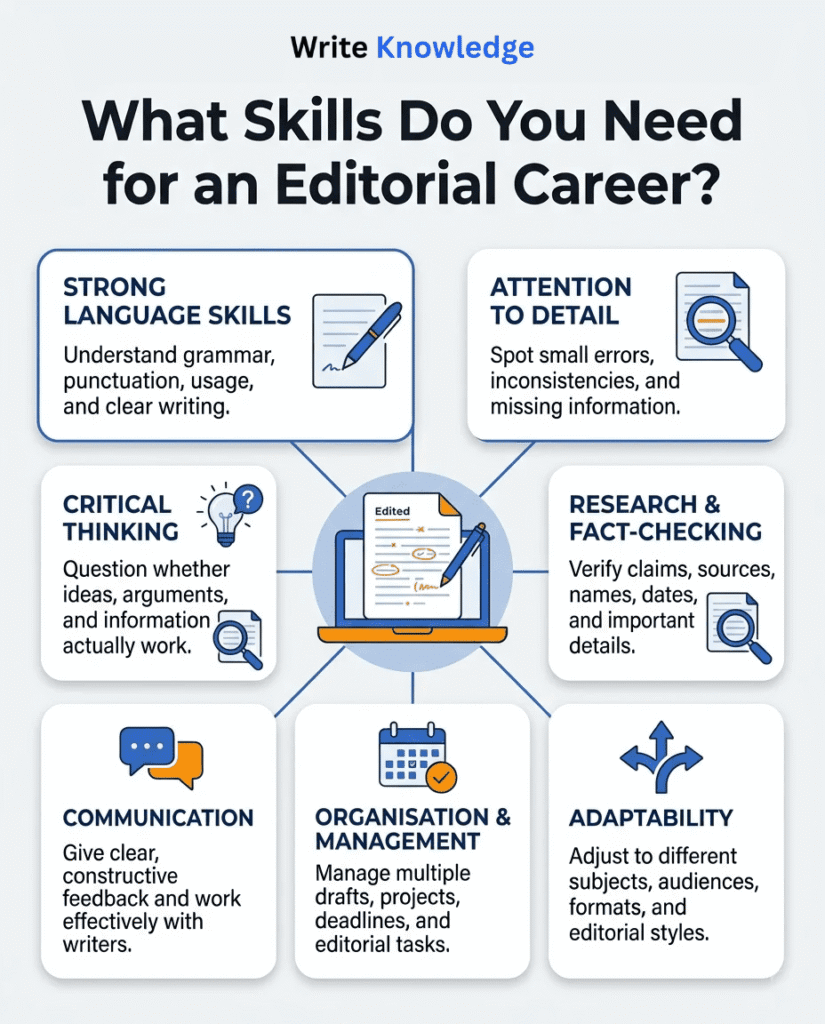
Strong Language Skills
You need a solid understanding of:
- Grammar
- Punctuation
- Spelling
- Sentence structure
- Word choice
- Usage
You should be able to recognise both obvious mistakes and sentences that are technically correct but poorly written.
Attention to Detail
Editorial work can involve hundreds or thousands of small decisions.
A missing comma, inconsistent spelling, incorrect date, broken reference, or repeated word may seem minor individually. Across an entire publication, however, small inconsistencies can undermine quality.
Critical Thinking
Editors need to question what they read.
Ask:
Does this claim make sense?
Is the evidence sufficient?
Does this paragraph actually support the point?
Is anything missing?
Critical thinking is what separates editing from simply proofreading.
Research and Fact-Checking
Editors may need to research unfamiliar subjects and verify information before publication.
This is especially important when editing nonfiction, journalism, technical material, or online content.
Communication
Editors regularly have to explain changes to writers and other members of a publishing team.
That requires diplomacy.
“Rewrite this” is rarely useful feedback.
A better editor can explain what isn’t working, why it isn’t working, and what direction might improve it.
Organisation and Time Management
Editorial work often involves multiple projects and deadlines.
Senior editorial positions can involve coordinating numerous books or projects simultaneously.
Being organised is therefore not an optional extra. It is part of doing the job well.
Adaptability
Different clients, publishers, publications, and industries can have different expectations.
An editor needs to adapt to:
- Different audiences
- Different subject areas
- Different style guides
- Different content formats
- Different editorial workflows
The Chartered Institute of Editing and Proofreading also frames editorial competence as developing progressively—from exploring the profession through emerging, established, and expert levels.
Do You Need a Degree to Become an Editor?
If you’re thinking about becoming an editor in India, you may be wondering whether you need a specific degree first.
The short answer is: a degree can help, but there isn’t one mandatory degree that applies to every editorial job. Requirements vary depending on whether you want to work in publishing, journalism, academic publishing, digital media, corporate content, or another area.
Relevant Degrees for an Editorial Career in India
Depending on the type of editing you want to pursue, useful educational backgrounds can include:
- English or English Literature
- Journalism
- Mass Communication
- Journalism and Mass Communication
- Communications
- Linguistics
- Publishing
- Literature
- Media Studies
- A subject-specific degree relevant to the content you want to edit
Current Indian job listings also show that some employers accept a bachelor’s degree in any discipline when combined with relevant editing experience and skills.
However, qualifications vary considerably by employer, country, industry, and role.
A degree can help, but practical editorial experience, strong language skills, subject knowledge, and a portfolio can also matter significantly.
In other words, you don’t necessarily need to have studied “Editing” as a degree to become an editor in India. A relevant degree can make the entry point easier, but strong editorial skills and real-world experience can be equally important—especially as you move beyond entry-level roles.
How to Start an Editorial Career
You don’t have to begin by aiming for an editor-in-chief position.
Editorial careers are often built gradually.
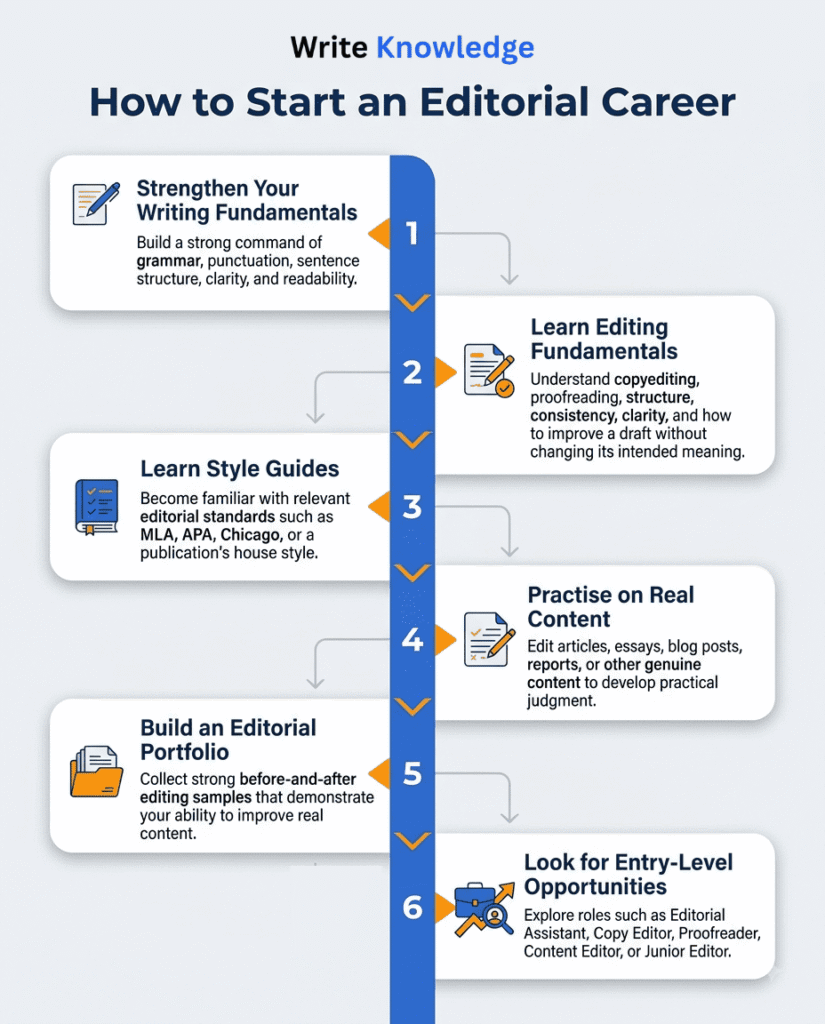
Strengthen Your Writing Fundamentals
Before you can confidently edit other people’s writing, you need to understand good writing yourself.
Work on:
- Grammar
- Punctuation
- Sentence construction
- Paragraph structure
- Tone
- Clarity
- Different types of writing
Understanding types of writing can help you recognise how editorial decisions change according to purpose and audience.
Learn Editing Fundamentals
Learn the difference between:
- Proofreading
- Copy editing
- Line editing
- Developmental editing
- Substantive editing
This helps you understand what kind of editorial work you actually want to pursue.
Learn Style Guides
Editors frequently work with formal or organisational style rules.
Start by learning the style guide relevant to your target field.
For example, you may encounter:
Practise on Real Content
Take an existing article and edit it.
Look for:
- Unnecessary words
- Unclear sentences
- Weak transitions
- Factual claims
- Inconsistent terminology
- Punctuation errors
- Structural problems
Then compare your edited version with the original.
Build an Editorial Portfolio
An editorial portfolio does not have to consist only of paid work.
You can include:
- Before-and-after editing samples
- Proofreading samples
- Sample copy edits
- Rewritten paragraphs
- Style-guide exercises
- Content audits
- Volunteer or internship projects
The important thing is to show how you improve content, not merely that you can identify spelling mistakes.
Look for Entry-Level Opportunities
Possible starting points include:
- Editorial assistant
- Junior editor
- Copy editor
- Proofreader
- Publishing assistant
- Content editor
- Editorial intern
Editorial assistants, for example, can support the editorial process through manuscript reading, author communication, proof handling, file organisation, desk editing, and copy editing.
What is the Career Progression for an Editor?
There is no universal editorial career ladder, but one possible progression is:
Editorial Assistant → Junior Editor → Editor → Senior Editor → Managing Editor / Editorial Manager → Editorial Director / Editor-in-Chief
The exact titles differ across industries.
A publishing house may use one set of titles, while a digital media company may use another.
You can also move sideways into related areas such as:
- Content strategy
- Content management
- Publishing
- Communications
- Copywriting
- Technical writing
- Freelance editing
This is one reason an editorial career can be useful for writers who want to keep several career options open.
Freelance Editorial Career
Not every editor works as a full-time employee.
Freelance editors work directly with clients, agencies, publishers, authors, organisations, or other businesses.
What Can Freelance Editors Offer?
A freelance editor may specialise in:
- Copy editing
- Proofreading
- Developmental editing
- Academic editing
- Book editing
- Website editing
- Business content
- Technical content
- Specialist subject editing
What Makes Freelancing Different?
Freelancing means that editing is only part of the work.
You may also need to handle:
- Finding clients
- Pitching
- Pricing
- Contracts
- Scheduling
- Invoices
- Client communication
- Workload management
That means a successful freelance editorial career requires both editorial ability and basic business skills.
Editorial Career vs Writing Career
An editor and a writer may work closely together, but their primary responsibilities are different.
| Career | Main Focus |
| Writer | Creates the content |
| Copywriter | Creates persuasive or marketing-focused content |
| Content Writer | Creates informative or audience-focused content |
| Editor | Reviews and improves content |
| Proofreader | Checks the near-final text for errors |
| Content Strategist | Decides what content should be created and why |
Is an Editorial Career Right for You?
Editorial work may suit you if you genuinely enjoy reading and improving things.
You may be a good fit if you often:
- Notice grammar or punctuation errors
- Rewrite sentences in your head
- Enjoy organising information
- Question whether claims are properly supported
- Like giving constructive feedback
- Prefer improving existing work to starting from a blank page
- Enjoy working with language
- Feel satisfied when a messy piece of writing becomes clear
On the other hand, editorial work may frustrate you if you dislike detailed review, repetitive checking, deadlines, or giving and receiving revision feedback.
You don’t have to be someone who corrects every grammatical mistake in casual conversation.
You do need to enjoy careful attention to language and content.
What is the Salary of an Editor?
Editor salaries vary substantially by country, industry, experience, specialisation, employer, and seniority, so there is no single figure that accurately represents every editorial career.
The average base salary for an editor is about ₹18,000 per month.
However, this average should be treated as a broad benchmark, not a standard salary for every editor. There is also a substantial difference between seniority levels. For Junior Editors, the average salary is approximately ₹12,600 per month, while Senior Editors average around ₹6.8 lakh per year.
Location can also make a significant difference. The average figure is higher for editors in cities such as Mumbai, Noida, New Delhi, Hyderabad, and Bengaluru.
What Can Affect an Editor’s Salary in India?
Your earning potential may depend on factors such as:
- Experience: Editors with several years of specialised experience can generally target more senior roles.
- Editorial specialisation: Academic, scientific, technical, publishing, journalism, and digital editorial roles can have different pay structures.
- Location: Salaries can vary considerably between cities and remote positions.
- Industry: Publishing houses, media organisations, education companies, technology companies, and corporate teams may offer different compensation.
- Seniority: Junior, associate, senior, commissioning, managing, and executive editorial roles have different responsibilities and salary levels.
- Subject knowledge: Editors with expertise in specialised fields may qualify for roles requiring more than general language skills.
- Technical skills: Knowledge of content-management systems, digital publishing tools, SEO, style guides, and editorial software can strengthen your profile.
So, rather than asking “How much does an editor earn?”, a more useful question is “How much does someone with my experience and editorial specialisation earn in my location and industry?”
When researching editorial jobs in India, compare current vacancies and salary data for the specific editor role you’re targeting rather than relying on a single nationwide average.
Common Challenges in an Editorial Career
Editorial work can be rewarding, but it isn’t always easy.
Tight Deadlines
Editors often work according to publication or production schedules. Deadline pressure can become intense, particularly when several projects overlap.
Difficult Editorial Decisions
Sometimes there is no perfect solution.
You may need to decide whether to:
- Cut a writer’s favourite paragraph
- Restructure a section
- Reject a submission
- Request another revision
- Publish a piece that is good but not perfect
Working with Different Personalities
Editors work with writers, designers, publishers, reviewers, and managers.
Not everyone will agree with an editorial decision.
Being able to explain your reasoning without turning every disagreement into a conflict is an important professional skill.
Balancing Detail with the Bigger Picture
An editor can spend ten minutes fixing one sentence and still miss a much larger structural problem.
Good editors learn to move between the micro level: words, punctuation, grammar. And the macro level: purpose, structure, audience, and publication goals.
Tips for Building a Strong Editorial Career
If you’re serious about entering editorial work, focus on building judgment rather than simply collecting editing certificates.
Read Widely
Read different kinds of writing.
Study how good editors and publications handle:
- Structure
- Headlines
- Transitions
- Tone
- Quotations
- Evidence
- Reader expectations
Edit With a Reason
Don’t change a sentence simply because you would write it differently.
Ask:
What problem am I solving?
An editorial change should ideally improve clarity, accuracy, consistency, structure, tone, or reader experience.
Learn to Use Style References
Professional editors don’t need to memorise every rule.
They need to know where to look when a question comes up.
Keep the relevant style guide and reliable editorial references accessible.
Develop Subject Knowledge
Specialisation can make you more valuable.
An editor who understands a particular field may be better positioned to identify:
- Incorrect terminology
- Weak explanations
- Missing context
- Questionable claims
- Inappropriate assumptions
Learn Digital Tools
Modern editorial work may involve content-management systems, document collaboration tools, spreadsheets, editorial calendars, proofreading software, and AI-assisted tools.
The tools will vary, but the underlying skill remains the same:
Use technology to improve the workflow without giving up editorial judgment.
✅ Key Takeaways
- An editorial career is much broader than correcting grammar.
- Editors may review, rewrite, fact-check, structure, commission, coordinate, and manage content.
- Copy editors, proofreaders, developmental editors, commissioning editors, managing editors, and content editors perform different kinds of work.
- Strong language skills and attention to detail are essential, but critical thinking and communication are equally important.
- Learning relevant writing style guides can strengthen your editorial skills.
- An editorial portfolio should demonstrate how you improve real content.
- Entry-level roles such as editorial assistant, junior editor, copy editor, and proofreader can provide a route into the profession.
- Editorial professionals can later move into senior editing, management, publishing, content strategy, communications, or freelance work.
- The best editors do not simply correct writing, they help make content clearer, stronger, more accurate, and more useful.
Conclusion
An editorial career can be a strong choice for people who love language but don’t necessarily want their entire career to revolve around producing first drafts. Editors work at the point where writing, judgment, research, communication, and publishing come together.
And there is no single way to become an editor. You can start through an editorial assistant role, build experience through content and proofreading projects, develop specialist knowledge, create an editing portfolio, or move into editorial work after gaining experience as a writer.
If you enjoy looking at a piece of writing and thinking “This could be clearer”, an editorial career may be worth exploring.
Frequently Asked Questions
What does an editor do?
An editor reviews and improves content for publication. Depending on the role, this can include correcting language, improving clarity and structure, checking facts, applying style rules, working with writers, evaluating submissions, and coordinating the publishing process.
Is editing a good career for writers?
Yes. Writing experience can provide a useful foundation for editorial work because editors need strong language skills and an understanding of how effective writing works.
What is the difference between an editor and a proofreader?
An editor may make substantial changes to content, structure, clarity, tone, and accuracy. A proofreader generally works closer to publication and focuses on catching remaining errors and inconsistencies in the final or near-final text.
Can content writers move into editorial careers?
Yes. Content writing can provide useful experience with research, audience awareness, structure, grammar, and digital publishing. The transition becomes easier when you add deliberate editing practice, style-guide knowledge, proofreading skills, and an editorial portfolio.
Is an editorial career still relevant with AI?
Yes. AI can assist with some repetitive editorial tasks, but editors still need to evaluate accuracy, context, audience suitability, sources, structure, tone, and overall quality. The value of editorial judgment is therefore likely to remain important even as workflows become more AI-assisted.

Sachin is a Postgraduate in Technical Writing in Business Management specializing in creating SEO-friendly, User-friendly, and Reader-focused website articles on Education, Tech, Sports, Games, and Entertainment.
Through Write Knowledge, he helps students, bloggers, editors, and professionals develop practical writing skills using clear explanations, real-world examples, and internationally recognized writing standards.