If you write, edit, proofread, publish, or manage content, you will eventually encounter CMOS and AP Style. Both are major style guides, but they were developed with different publishing needs in mind.
The confusion becomes greater because writers often encounter APA at the same time. However, AP and APA are not the same thing. AP means Associated Press, while APA means American Psychological Association. CMOS refers to The Chicago Manual of Style.
This guide compares CMOS vs AP Style so you can understand where they differ, when to use each, and why choosing the right style guide matters.
💡 Quick Answer
CMOS and AP Style are both editorial style guides, but they serve different writing environments.
CMOS is strongly associated with books, publishing, scholarly work, humanities, and detailed editorial production.
AP Style is primarily designed for journalism and news-oriented writing, with an emphasis on clarity, consistency, brevity, and current usage.
The best choice is usually determined by the publisher, employer, client, publication, academic institution, or project requirements rather than personal preference. CMOS itself covers publishing, editing, grammar, punctuation, numbers, abbreviations, quotations, and source citations, while AP describes its Stylebook as a reference for spelling, language, punctuation, usage, and journalistic style.
CMOS vs AP Style: What Is the Difference?
At the simplest level, the difference is about purpose and editorial environment.
What Is CMOS?
CMOS stands for The Chicago Manual of Style. It is published by the University of Chicago Press and is a comprehensive reference for style, usage, grammar, publishing, editing, proofreading, and source citations.
CMOS is particularly relevant to:
- Book publishing
- Scholarly publishing
- Humanities
- History
- Literature
- Academic and professional editing
- Long-form nonfiction
- Publishing production
If you are new to Chicago style, our guide to the Chicago Manual of Style provides a more focused introduction.
What Is AP Style?
AP Style refers to the style guidance developed by the Associated Press. The AP Stylebook is primarily associated with journalism and provides guidance on spelling, language, punctuation, usage, numerals, and journalistic style. AP describes it as a reference for journalists as well as writers, editors, students, and professionals.
AP Style is especially common in:
- News writing
- Newspapers
- News websites
- Press releases
- Public relations
- Media communications
- Some corporate communications
- Digital publishing
Unlike a static set of rules that never changes, AP continuously develops its guidance as language and journalistic practices evolve.
Here is the complete AP Style guide to satisfy your knowledge hunger.
Why Are CMOS and AP Style Different?
They are designed around different publishing priorities.
CMOS generally provides extensive editorial guidance for long-form and published works, while AP Style emphasizes concise, consistent communication for journalism and news-oriented content.
Neither is universally “better.” The correct choice depends on the publication and its editorial requirements.
CMOS vs AP Style at a Glance
| Area | CMOS | AP Style |
| Full name | The Chicago Manual of Style | The Associated Press Stylebook |
| Primary environment | Publishing, books, scholarly and humanities writing | Journalism and news writing |
| Editorial approach | Comprehensive and detailed | Concise and newsroom-oriented |
| Citations | Formal citation systems | Attribution-focused journalism |
| Footnotes/endnotes | Extensive guidance | Not the primary focus |
| Numbers | More context-dependent | Strong preference for readability and consistency in news |
| Dates | Detailed publishing guidance | News-oriented date conventions |
| Serial comma | Generally preferred | Usually omitted when meaning remains clear |
| Headlines | Publishing-oriented guidance | Strong headline/news conventions |
| Updates | Major edition revisions | Regular online updates and new guidance |
The important point is that these are different editorial systems, not two versions of the same guide.
CMOS vs AP Style: Key Differences
The differences become easier to understand when you look at specific writing decisions.
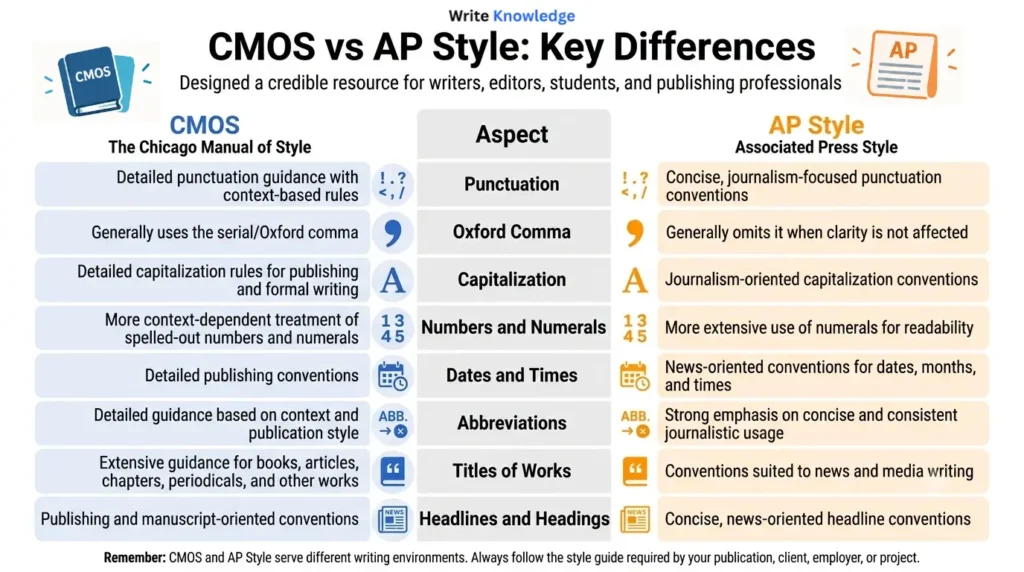
Punctuation
Both guides provide punctuation guidance, but their editorial priorities can produce different results.
CMOS generally provides extensive punctuation guidance because it addresses books, manuscripts, publishing, and different types of prose. AP also provides punctuation rules, but its approach is strongly shaped by journalistic readability and economy.
This means you should not assume that a punctuation rule from one guide automatically applies when using the other.
Oxford Comma
One of the best-known differences involves the serial comma, commonly called the Oxford comma.
Chicago style generally recommends the serial comma for consistency and clarity. CMOS explicitly describes it as Chicago style.
AP generally omits the final comma in a simple series when it is not necessary for clarity. However, AP has clarified that it does not ban the Oxford comma and requires one when leaving it out could create confusion.
For example:
CMOS:
Writers, editors, and publishers
Typical AP:
Writers, editors and publishers
The difference is small, but it illustrates an important principle: do not mix style systems simply because both versions look acceptable.
Capitalization
CMOS and AP both provide detailed capitalization guidance, but the rules can differ depending on the term, title, profession, organization, or context.
AP’s guidance also changes as language and usage evolve. For example, AP has updated capitalization guidance for terms such as Black and Indigenous in specific contexts.
When editing professionally, always check the applicable guide rather than relying on a remembered rule.
Numbers and Numerals
Numbers are another area where CMOS and AP can produce visibly different results.
Chicago generally allows numbers to be spelled out in many nontechnical contexts, while also providing numerous exceptions for measurements, percentages, page numbers, dates, and other situations. CMOS explains that its number rules depend on context rather than simply applying one universal “spell out everything below 10” rule.
AP uses numerals more extensively in journalism, particularly where figures improve speed and readability.
This matters when writing:
- Ages
- Measurements
- Percentages
- Money
- Statistics
- Dates
- Time
- Quantities
- Headlines
For example, AP’s current guidance uses figures for many time expressions and has specific rules for dates and months.
Dates and Times
Date formatting is another area where the guides can differ.
AP commonly abbreviates certain months when they appear with a specific date:
Jan. 5
Feb. 14
Oct. 10
AP also uses forms such as:
7 p.m.
3:30 p.m.
Its current guidance specifically addresses abbreviations for months, commas with dates, and time formatting.
CMOS also has detailed date and time guidance, but its recommendations are developed within the broader context of publishing and prose. For example, Chicago generally does not use ordinal endings such as “th” in dates.
Abbreviations
AP Style has extensive guidance on abbreviations and acronyms because journalists need consistent and efficient ways to identify organizations, locations, titles, and other frequently used terms.
For example, AP’s current guidance discusses when to use periods in abbreviations and when acronyms generally omit them.
CMOS also provides detailed abbreviation guidance, but its recommendations are designed for a broader publishing environment.
Titles of Works
CMOS provides extensive guidance for treating titles of books, periodicals, chapters, articles, websites, and other works. Its current table of contents includes a dedicated chapter on names, terms, and titles of works.
This is particularly useful for editors and publishers handling long-form manuscripts containing many different types of sources and works.
AP also has rules for titles, but its conventions are shaped more heavily by journalistic writing and news production.
Headlines and Headings
Headlines are especially important in AP-style environments because journalism depends heavily on concise, immediately understandable headlines.
AP has specific guidance for headlines, including rules affecting numerals and ordinals.
CMOS approaches headings and titles within the broader framework of manuscript preparation, publishing, and book production. The current CMOS contents include guidance for manuscript formatting, subheads, and chapter titles.
CMOS vs AP Style for Citations and References
This is one of the most important areas where writers should not treat the two systems as interchangeable.
How CMOS Handles Citations
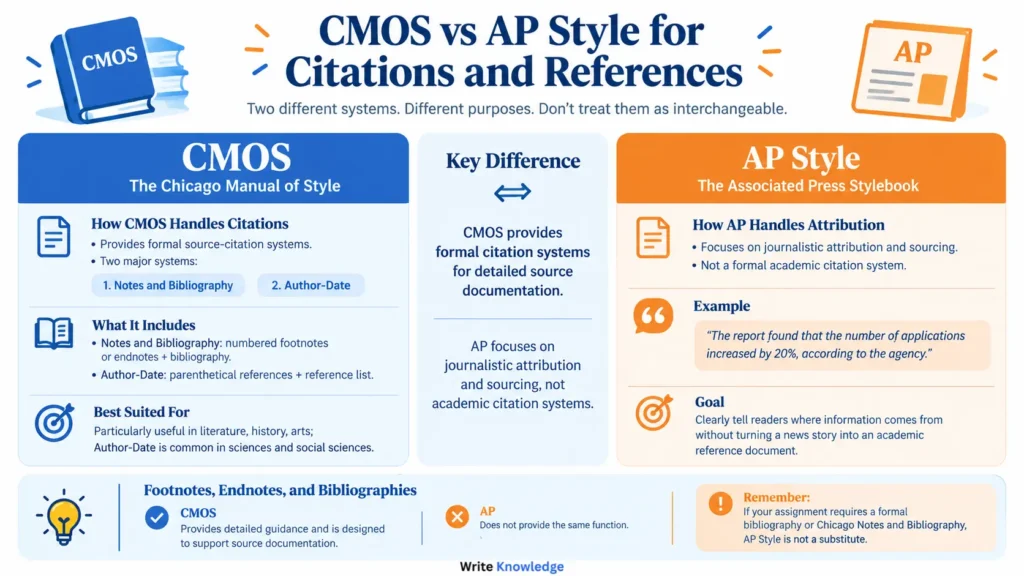
CMOS provides formal source-citation systems.
Its two major citation systems are:
- Notes and Bibliography
- Author-Date
The Notes and Bibliography system uses numbered footnotes or endnotes and usually includes a bibliography. The Author-Date system uses parenthetical references connected to a reference list.
Chicago notes that Notes and Bibliography is particularly useful in areas such as literature, history, and the arts, while Author-Date is commonly preferred in many sciences and social sciences.
How AP Style Handles Attribution
AP Style is primarily concerned with journalistic attribution and sourcing, rather than providing a formal academic citation system comparable to Chicago’s Notes and Bibliography or Author-Date systems.
A news article might identify a source directly in the text:
The report found that the number of applications increased by 20%, according to the agency.
The goal is to clearly tell readers where information comes from without turning a news story into an academic reference document.
Footnotes, Endnotes, and Bibliographies
CMOS provides extensive guidance for footnotes, endnotes, bibliographies, and reference lists. Its citation system is designed to support detailed source documentation.
AP does not serve the same function.
Therefore, if an assignment asks you to produce a formal bibliography or use Chicago Notes and Bibliography, AP Style is not a substitute.
And if you are writing a news report that requires clear attribution, simply applying a formal Chicago citation system may not produce the expected journalistic format.
📌 Remember
Don’t Confuse CMOS vs AP With CMOS vs APA.
AP and APA are completely different style systems.
- CMOS = The Chicago Manual of Style
- AP = Associated Press
- APA = American Psychological Association
So, CMOS vs AP is not the same comparison as CMOS vs APA.
If you are specifically looking for the differences between Chicago style and APA style, see our separate CMOS vs APA comparison.
That comparison addresses a different question and should not be used as a substitute for an AP Style comparison.
This distinction is particularly important for students because APA is widely associated with academic and social-science writing, while AP is primarily associated with journalism.
CMOS vs AP Style Examples
The easiest way to understand the difference is to compare common editorial decisions.
Punctuation Example
CMOS-style tendency:
The writer interviewed editors, publishers, and researchers.
Typical AP-style treatment:
The writer interviewed editors, publishers and researchers.
The exact application can depend on context, but the example demonstrates the different default approaches to a serial comma. Chicago generally favors the comma, while AP generally omits it unless clarity requires it.
Numbers Example
A sentence involving numbers may be treated differently depending on the context and guide.
CMOS has detailed rules for when to spell out numbers and when to use figures, with numerous exceptions. AP uses figures more extensively in journalistic contexts.
The important lesson is not to memorize one isolated difference. Check the complete style system you are working under.
Dates Example
AP style:
The conference begins Oct. 10 at 7 p.m.
AP’s current guidance abbreviates certain months when they appear with a specific date. (
Chicago has its own conventions for dates, including avoiding ordinal endings such as “th” in dates.
Attribution Example
A news-style sentence might read:
The company reported a 12% increase in revenue, according to its annual report.
That kind of direct attribution fits naturally within journalistic writing.
CMOS, meanwhile, offers formal systems for documenting the source, depending on the publication’s requirements.
Style Decision Example
Suppose you are editing the same subject for two different clients.
A book publisher may require Chicago style.
A news organization may require AP Style.
The underlying facts do not change. The editorial treatment changes because the publication’s style system changes.
When Should You Use CMOS?
CMOS is a strong choice when the writing belongs to a publishing or scholarly environment that uses Chicago style.
CMOS for Books and Publishing
CMOS is deeply connected with book and journal publishing. Its current structure includes manuscript preparation, editing, proofreading, publishing production, style and usage, and source citations.
This makes it especially useful for:
- Authors
- Book editors
- Copyeditors
- Proofreaders
- Publishers
- Academic publishers
- Long-form writers
If you’re exploring writing jobs, a strong understanding of style guides can also support a copy editing career because copyeditors frequently work with consistency, grammar, punctuation, usage, and house style.
CMOS for Academic and Scholarly Writing
Chicago style is used in many academic and scholarly environments, particularly in fields where Notes and Bibliography is useful.
However, do not assume every academic assignment requires CMOS. The instructor, institution, journal, or publisher may require another guide.
For example, an academic writing project may require APA rather than Chicago. That is why it is important to identify the required guide before formatting the document.
CMOS for History and Humanities
Chicago’s Notes and Bibliography system is particularly well suited to many humanities disciplines because it supports detailed notes and a wide range of source types.
This can make it useful for:
- History
- Literature
- Arts
- Cultural studies
- Book-length research
- Archival research
CMOS for Editing and Long-Form Content
CMOS is also valuable when the task involves more than correcting obvious grammar mistakes.
An editor may need to make decisions about:
- Punctuation
- Capitalization
- Numbers
- Abbreviations
- Titles
- Quotations
- Manuscript formatting
- Citations
- Bibliographies
The current CMOS contents reflect this broad editorial scope.
When Should You Use AP Style?
AP Style is most appropriate when the publication or client follows Associated Press conventions.
AP Style for Journalism and News Writing
AP explicitly describes its Stylebook as a guide for journalists and journalistic style.
It is commonly relevant to:
- News reports
- Newspapers
- News websites
- Wire-style content
- Breaking news
- Feature journalism
- Media organizations
AP Style for Digital Media
Digital publishers may also use AP Style when their editorial model is journalism-oriented.
The emphasis on concise language, current usage, clear attribution, and readable presentation can work well in fast-moving digital publishing environments.
AP Style for Public Relations
Press releases and media communications often benefit from AP conventions because the content may be intended for journalists or news organizations.
A PR writer therefore needs to understand not only persuasive writing but also the editorial conventions expected by the intended media audience.
AP Style for Corporate Communications
Some organizations use AP Style for company communications, websites, press materials, and public-facing content.
However, a company’s house style always takes priority when one exists.
A business may use AP Style as its foundation while adding its own terminology, capitalization preferences, brand language, and formatting rules.
CMOS vs AP Style: Which One Should You Choose?
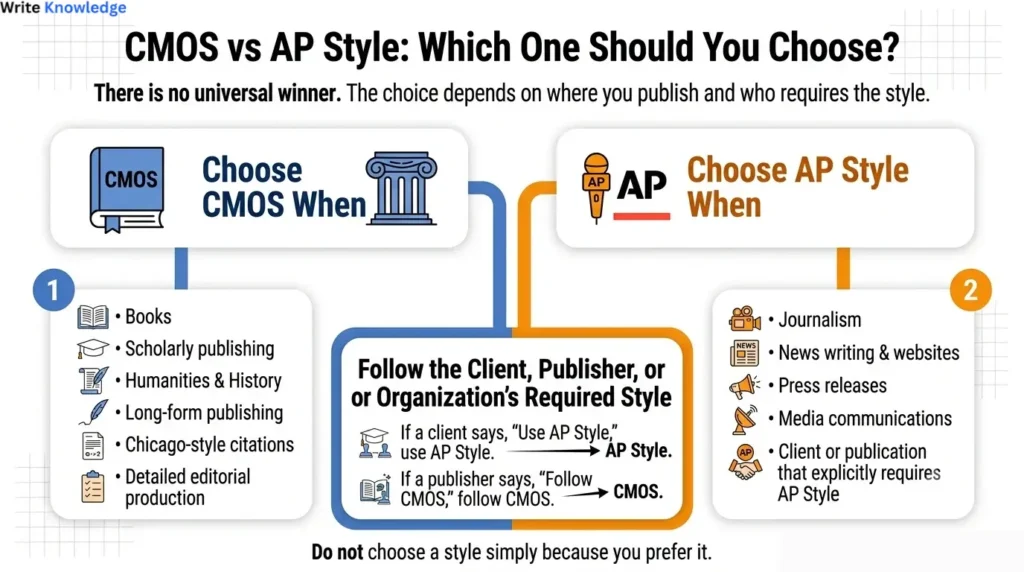
There is no universal winner.
The right choice depends on where the content will be published and who requires the style.
Choose CMOS When
Choose CMOS when the project involves:
- Books
- Scholarly publishing
- Humanities
- History
- Long-form publishing
- Chicago-style citations
- Detailed editorial production
Choose AP Style When
Choose AP Style when the project involves:
- Journalism
- News writing
- News websites
- Press releases
- Media communications
- A client or publication that explicitly requires AP Style
Follow the Client, Publisher, or Organization’s Required Style
This is the most important rule.
If a client says, “Use AP Style,” use AP Style.
If a publisher’s editorial guidelines say, “Follow CMOS,” follow CMOS.
If a company has a house style guide, follow the house style alongside the required external guide.
Do not choose a style guide simply because you personally prefer it.
Common Mistakes When Switching Between CMOS and AP Style
Switching between style guides can be surprisingly difficult because many differences are small.
Mixing Rules from Both Style Guides
A writer may use Chicago’s serial comma but AP’s date conventions, then apply a third guide’s citation rules.
The result may be grammatically understandable but editorially inconsistent.
When working on a new project, identify the primary style guide before you begin editing.
Assuming One Style Is Always Better
CMOS is not “more correct” simply because it is more detailed.
AP is not “better” because it is more concise.
They solve different editorial problems.
Confusing Editorial Style with Citation Style
A style guide can influence grammar, punctuation, numbers, capitalization, and usage while also providing source-citation guidance.
But editorial style and citation style are not always the same thing.
This is particularly important when working with academic content. Before formatting an academic resource, check whether the assignment requires APA Style, MLA, Chicago, or another system.
Confusing AP With APA
This is one of the easiest mistakes to make.
AP = Associated Press
APA = American Psychological Association
They are not interchangeable.
Here is the good comparison of AP vs APA Style that should clear your doubt.
Using Outdated Style Rules
Style guides change.
CMOS 18, for example, introduced and clarified a range of guidance compared with earlier editions.
AP also updates its guidance regularly and adds or changes recommendations as usage develops.
For professional work, avoid relying entirely on rules you memorized years ago.
✅ Key Takeaways
- CMOS means The Chicago Manual of Style
- AP means Associated Press Style
- APA means American Psychological Association and is a different guide from AP
- CMOS is strongly associated with books, publishing, scholarly work, and humanities
- AP Style is primarily associated with journalism and news writing
- CMOS provides formal Notes and Bibliography and Author-Date citation systems
- AP focuses more heavily on journalistic style, attribution, clarity, and concise presentation
- Both guides cover areas such as punctuation, capitalization, numbers, abbreviations, and usage
- The correct guide depends on the publication, client, employer, instructor, or publisher
- Do not combine rules from multiple style guides without a clear reason
- Always check the current edition or online guidance when a rule matters
Conclusion
CMOS vs AP Style is not really a question of which guide is better. It is a question of which guide fits the writing environment. CMOS is particularly valuable for publishing, scholarly and humanities-oriented work, while AP Style is built around journalism and news-oriented communication.
For writers and editors, learning both can be useful because different clients and employers may expect different conventions. The key skill is not memorizing every rule. It is knowing which style applies, where to verify a rule, and how to apply that style consistently throughout a piece of content.
For a broader introduction to style systems, continue with Writing Style Guides.
Frequently Asked Questions
Is CMOS the same as AP Style?
No. CMOS is The Chicago Manual of Style, while AP Style refers to the Associated Press Stylebook. They serve different editorial environments.
Is CMOS or AP Style better?
Neither is universally better. CMOS is often more suitable for books, publishing, scholarly work, and humanities, while AP Style is primarily designed for journalism and news writing.
Can you use CMOS and AP Style in the same document?
You generally should not mix them arbitrarily. If a project requires one guide, follow it consistently. A publication may also have a house style that modifies or supplements an external guide.
Is AP Style the same as APA?
No. AP and APA are completely different. AP stands for Associated Press, while APA stands for American Psychological Association. Their purposes and conventions differ.
Should content writers learn both CMOS and AP Style?
Learning both can be useful, especially for freelance writers, editors, and professionals who work with different clients. However, you do not need to memorize every rule. The important skill is knowing how to identify the required style and find the correct rule when needed.

Sachin is a Postgraduate in Technical Writing in Business Management specializing in creating SEO-friendly, User-friendly, and Reader-focused website articles on Education, Tech, Sports, Games, and Entertainment.
Through Write Knowledge, he helps students, bloggers, editors, and professionals develop practical writing skills using clear explanations, real-world examples, and internationally recognized writing standards.