A website landing page, an Instagram caption, a product description, a blog post, an email newsletter, and a long-form guide may look like completely different forms of writing. Yet they all share one important characteristic: they are created to be read, viewed, or acted on through digital channels.
That is where digital content writing comes in.
Digital content writing is the practice of creating written content for websites, search engines, social media, email, apps, online publications, and other digital platforms. Unlike writing intended primarily for print, digital writing has to consider how people actually consume information online. Readers often scan rather than read every word, move between devices, search for specific answers, and decide within seconds whether a page is worth their attention.
For writers in India, this field covers a particularly broad range of opportunities. A writer in Bengaluru might create SaaS website content, while another in Jaipur might write travel content, a writer in Kolkata might work on digital news, and someone in Kochi might create healthcare or education content.
The format changes, but the underlying goal remains the same: communicate useful information clearly through a digital medium.
💡 Quick Answer
Digital content writing is the practice of researching, planning, writing, and editing text specifically for online consumption such as websites, blogs, social media platforms, email newsletters, and landing pages. Unlike print writing, it is optimized for digital screens, short attention spans, and search engine algorithms.
What Is Digital Content Writing?
Digital content writing is the creation of written material for online platforms such as websites, blogs, search engines, social media, emails, digital publications, and apps.
It combines writing, research, audience understanding, editing, and often SEO or digital marketing knowledge. Depending on the project, digital content can be designed to inform, educate, entertain, persuade, generate leads, support a product, or encourage an action.
What Does a Digital Content Writer Do?
A digital content writer does much more than simply type words.
The work can involve researching a topic, understanding the intended audience, developing an outline, writing the content, checking facts, editing the draft, optimizing it for search, and adapting it to a particular brand voice.
The digital content writers are the professionals who create material for websites, blogs, social media and other digital platforms, while also researching information and aligning content with business requirements.
A typical assignment might involve:
- Researching a topic and credible sources
- Understanding the target audience
- Creating an outline
- Writing the first draft
- Editing for clarity and flow
- Checking facts and references
- Optimizing relevant content for search
- Adding headings and links
- Writing titles and meta descriptions when required
- Adapting content to a brand’s tone
- Collaborating with editors, designers, marketers, or subject-matter experts
- Revising the content based on feedback
The exact responsibilities depend on the role and organization.
Main Types of Digital Content Writing
Digital content writing is an umbrella category rather than one specific form of writing.
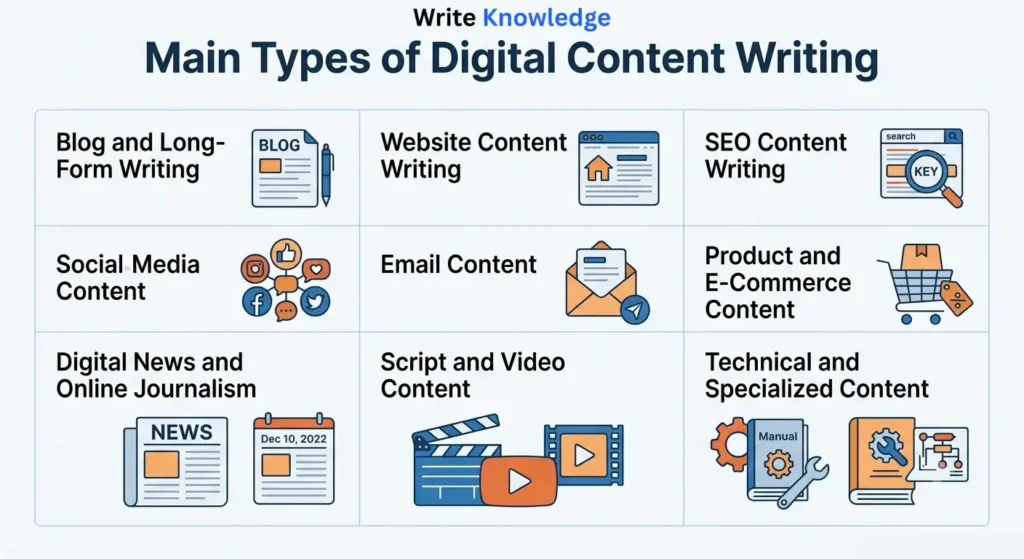
Blog and Long-Form Writing
Blog posts and long-form resources explain topics in greater depth. They can educate readers, answer search queries, establish expertise, and support a website’s broader content strategy.
Examples include:
- How-to guides
- Tutorials
- Explainers
- Comparison resources
- Industry guides
- Research-based articles
- Educational resources
A resource such as a guide to MLA vs Chicago or an explanation of descriptive writing is a good example of educational digital content.
Website Content Writing
Website content includes the written material found on pages such as:
- Home pages
- About pages
- Service pages
- Product pages
- Landing pages
- Category pages
- FAQ pages
Website writing has to communicate information quickly. Visitors should be able to understand what a page offers without working through unnecessary paragraphs.
SEO Content Writing
SEO content writing combines useful information with search-focused optimization.
A writer may research search terms, understand search intent, structure headings around relevant questions, write descriptive title text, improve internal linking, and make the content easier for both readers and search engines to understand.
However, SEO should support the content rather than control it. Google explicitly recommends helpful, reliable, people-first content and warns against creating content primarily to manipulate search rankings.
Read here to know more about SEO Writing career.
Social Media Content
Social media writing is usually shorter and more immediate.
It can include:
- Captions
- Short posts
- Promotional messages
- Educational posts
- Video descriptions
- Social campaigns
- Community updates
A social media writer needs to understand the platform, audience expectations, brand voice, and purpose of the post.
Email Content
Digital writers also create:
- Newsletters
- Promotional emails
- Product announcements
- Welcome emails
- Educational email sequences
- Event invitations
- Customer communication
Email writing often requires concise messaging and a clear next action.
Product and E-Commerce Content
Online stores rely heavily on written content.
This can include:
- Product descriptions
- Category descriptions
- Buying guides
- Product comparisons
- Feature explanations
- FAQs
For example, an e-commerce writer might explain the differences between two smartphones without turning the product description into a list of technical specifications.
Digital News and Online Journalism
News websites and digital publications need writers who can research, verify, structure, and publish information quickly.
Digital journalism can involve breaking news, explainers, interviews, features, updates, and multimedia-supported stories.
This is also where writing needs to be particularly careful about attribution and factual accuracy.
Script and Video Content
Digital writing is not limited to text displayed on a webpage.
Writers may create:
- YouTube scripts
- Short-video scripts
- Podcast scripts
- Video narration
- Explainer-video scripts
- Webinar scripts
The writing has to sound natural when spoken rather than simply look good on a page.
Technical and Specialized Content
Digital platforms also require writers who can explain specialized subjects.
Technical writers, for example, may create documentation, software guides, product explanations, knowledge-base resources, and technical website content. Current Indian job listings show demand for writers who can simplify technical subjects while combining research, editing, SEO, and audience awareness.
If you are interested in this area, our resource on Technical Writing provides a useful introduction to the type of writing involved.
What Skills Do You Need for Digital Content Writing?
Good digital writing requires more than strong grammar.
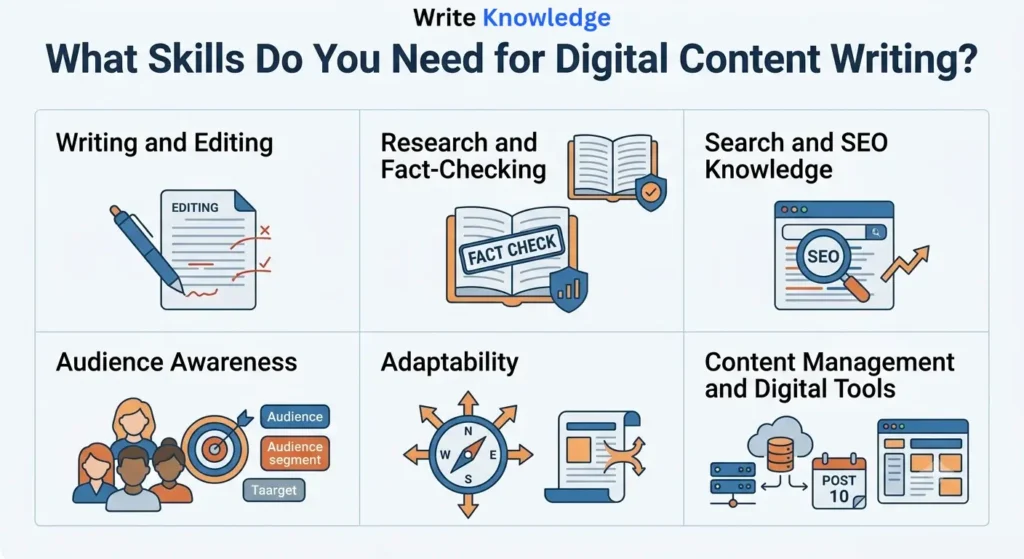
Writing and Editing
The foundation is the ability to communicate ideas clearly.
A digital writer should know how to:
- Write concise sentences
- Organize information logically
- Maintain a consistent tone
- Remove unnecessary repetition
- Edit awkward passages
- Proofread carefully
Writing, editing, communication, research, organization, and SEO are among relevant skills for content writers.
Research and Fact-Checking
A digital writer may work on unfamiliar topics every week.
Research skills therefore matter enormously. A writer should know how to find credible sources, compare information, identify unsupported claims, and distinguish evidence from opinion.
This becomes especially important for health, finance, technology, education, and other subjects where inaccurate information can mislead readers.
Search and SEO Knowledge
A digital writer does not necessarily need to become an SEO specialist, but understanding basic SEO is increasingly useful.
Important concepts include:
- Search intent
- Keyword research
- Internal linking
- Search-friendly headings
- Title tags
- Meta descriptions
- Content structure
- Readability
- Search result snippets
Google recommends using the words people are likely to search for in prominent and descriptive locations while keeping the content helpful and natural.
Audience Awareness
The same subject can require completely different writing depending on the audience.
For example, a guide about UPI security could be written differently for:
- A first-time smartphone user in Lucknow
- A business owner in Mumbai
- A finance professional in Bengaluru
- A college researcher in Delhi
The underlying information may be similar, but the vocabulary, examples, depth, and tone can change.
Adaptability
Digital writers often work across industries and formats.
One assignment may require a formal white paper, while the next involves a short Instagram caption or a conversational blog post.
Being able to adjust tone and structure is therefore a valuable professional skill.
Content Management and Digital Tools
Writers may work with tools such as:
- WordPress (or company provided Content Management System)
- Google Docs
- Microsoft Word
- Content management systems
- SEO platforms
- Analytics tools
- Collaboration software
- Image and design tools
- AI-assisted writing and research tools
Current Indian content-writing roles commonly mention CMS familiarity, SEO, research, editing, digital tools, and collaboration as useful or preferred skills.
Digital Content Writing vs Content Writing
The terms content writing and digital content writing are often used interchangeably, but there is a useful distinction.
Content writing is the broader category. It can include material created for both digital and traditional channels.
Digital content writing focuses specifically on content intended for digital platforms.
| Content Writing | Digital Content Writing |
| Broader writing category | Digital-focused subset |
| Can include print and digital content | Primarily created for online channels |
| May include traditional publications | Includes websites, blogs, email, social media and apps |
| Audience may consume content offline or online | Usually designed for screen-based consumption |
| Digital optimization may not be necessary | SEO, usability and digital distribution may matter |
In practice, however, job descriptions may use the terms differently. Always read the actual responsibilities rather than relying only on the job title.
Digital Content Writing and SEO: What Is the Connection?
SEO can help useful content become discoverable, but effective digital writing should not become a collection of keywords.
A strong workflow starts with the reader’s need.
For example, suppose someone searches:
“How to become a content writer in India”
A useful resource should actually explain the skills, portfolio requirements, learning options, job-search process, and realistic next steps rather than simply repeating the keyword throughout the page.
Google’s guidance emphasizes people-first content that provides substantial value, original information, research, or analysis instead of simply rewriting existing pages.
That principle is useful beyond Google. Clear answers also make content easier for other search and AI-driven systems to understand.
How to Write Effective Digital Content
Start With the Reader’s Purpose
Before writing, ask:
What does the reader want to accomplish?
Someone searching for “best laptops for video editing” has a different need from someone searching for “what is video editing?”
The first query may involve comparison and purchase research. The second is primarily informational.
Put the Main Answer Early
Online readers often want the answer quickly.
A useful introduction should establish the subject and direction of the resource without forcing the reader through unnecessary background information.
For question-based searches, answering the central question near the beginning can also improve the overall search experience.
Use Descriptive Headings
Headings help readers understand the structure before they read every paragraph.
Instead of writing the Heading:
Important Things
Write the Heading in this way:
Skills Needed for Digital Content Writing
The second heading tells the reader exactly what to expect.
Google also recommends descriptive page titles and clear main headings because title links and prominent page text help users understand the relevance of a result.
Keep Paragraphs Easy to Scan
Digital writing generally benefits from:
- Shorter paragraphs
- Descriptive subheadings
- Lists where appropriate
- Tables for genuine comparisons
- Clear transitions
- Useful examples
- Adequate whitespace
The goal is not to make every paragraph artificially short. The goal is to make the information easy to navigate.
Add Contextual Internal Links
Internal links can help readers move naturally from one useful resource to another.
For example, someone reading about digital content writing may next want to understand a particular type of writing, learn about technical writing, or explore a writing career.
That is why this resource belongs naturally under the Types of Writing pillar rather than existing as an isolated page.
Examples of Digital Content Writing
Consider how a single topic can be adapted into different digital formats.
| Format | Example |
| Blog | “How to Build a Writing Portfolio” |
| Website page | “Our Content Writing Services” |
| Social media post | “5 Ways to Improve Your Headlines” |
| “Your Weekly Writing Tips” | |
| Product description | “Lightweight Laptop for Remote Writers” |
| YouTube script | “How SEO Actually Works” |
| Newsletter | “Three Writing Trends to Watch” |
| FAQ | “What Is Digital Content Writing?” |
| Landing page | “Download the Free Writing Guide” |
| Case study | “How a Content Strategy Improved Organic Traffic” |
The format changes the writing approach. A YouTube script needs to sound natural when spoken, while a product description needs to communicate benefits efficiently.
Digital Content Writing Examples in India
Digital writing in India reflects the country’s diverse industries, languages, audiences, and markets.
For example:
Education: A writer may create an English-language guide explaining a competitive-exam topic for readers across Maharashtra, Karnataka, or Uttar Pradesh.
E-commerce: A writer working with a Mumbai-based fashion brand may create product descriptions and buying guides for customers across India.
Travel: A content team could develop a guide comparing weekend destinations near Bengaluru, Kolkata, Ahmedabad, or Guwahati.
Healthcare: A writer may prepare patient-friendly health information for a hospital serving audiences in Chennai, Pune, or Bhubaneswar.
Technology: A Bengaluru or Hyderabad technology company may need website pages, SaaS explainers, case studies, and technical blogs.
Regional-language content: Digital publications and businesses may also require Hindi, Tamil, Bengali, Marathi, Malayalam, Telugu, Kannada, Gujarati, or other regional-language content. Current Indian job listings, for example, include Hindi digital and news-content roles in locations such as Noida, Lucknow, and Bhilwara.
These examples show why digital content writing is not one narrowly defined profession.
How to Start Digital Content Writing
You do not need to begin with a large portfolio or a highly specialized niche.
A practical starting process is:
- Strengthen your writing fundamentals
- Learn how digital audiences read
- Understand basic SEO
- Practise different content formats
- Choose a few subjects to write about
- Create useful writing samples
- Learn a CMS such as WordPress
- Study published content critically
- Build a portfolio
- Apply for relevant roles or approach freelance clients
- Review feedback and improve
- Continue learning new digital formats
It is recommended to develop relevant skills, create work samples, apply for opportunities, and consider freelance work when starting a content-writing career.
You can also explore the broader Writing Careers post to understand how digital content writing connects with different professional writing paths.
Digital Content Writing as a Career
Digital content writing can lead to several different roles rather than one fixed career path.
Possible roles include:
- Content Writer
- Web Content Writer
- SEO Content Writer
- Blog Writer
- Copywriter
- Technical Content Writer
- Content Strategist
- Content Editor
- Social Media Writer
- Script Writer
- Freelance Writer
- Editorial Writer
Current Indian job listings demonstrate this variety. For example, recent listings include content-writing roles involving websites, blogs, social media, marketing material, SEO, research, editing, WordPress, and collaboration with marketing or design teams.
As experience grows, a writer may move toward editing, content strategy, specialized writing, team leadership, or independent consulting.
Digital Content Writing and AI
AI tools are increasingly part of digital content workflows, but using them effectively requires editorial judgment.
AI can assist with:
- Brainstorming
- Topic exploration
- Outlining
- Rewriting
- Summarization
- Content repurposing
- Basic editing
- Research organization
However, writers remain responsible for accuracy, originality, relevance, tone, and final quality.
Google’s current guidance says AI-assisted content should still meet Search Essentials and spam policies, and emphasizes that content should be useful, reliable, people-first, and created to benefit visitors rather than primarily manipulate search rankings.
For digital writers, the most useful approach is therefore AI assistance plus human editorial control, not simply generating and publishing text without review.
E-E-A-T in Digital Content Writing
E-E-A-T stands for Experience, Expertise, Authoritativeness, and Trustworthiness.
For digital content, these principles become particularly important when the subject requires accuracy or professional knowledge.
A credible resource should:
- Identify the author where appropriate
- Use trustworthy sources
- Explain information accurately
- Avoid unsupported claims
- Update information when necessary
- Distinguish fact from opinion
- Provide useful original analysis
- Maintain consistent editorial standards
Google specifically encourages clear authorship and information that helps readers understand who created the content and why they can trust it.
Common Digital Content Writing Mistakes
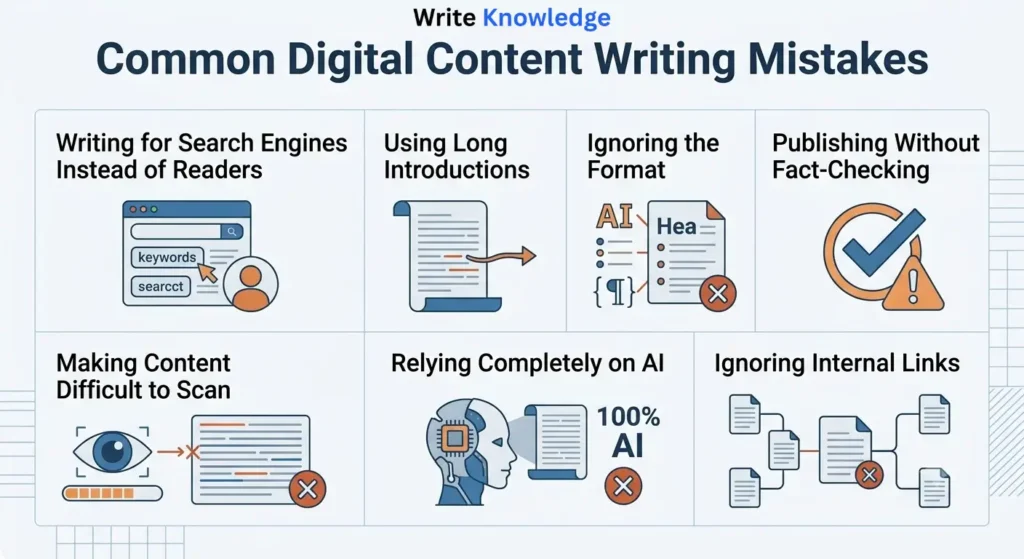
Writing for Search Engines Instead of Readers
Repeating a keyword does not automatically make content useful.
Search optimization should support the reader’s purpose.
Using Long Introductions
Readers should not have to pass through several paragraphs before reaching the basic answer.
Start with context, establish the topic, and move into useful information.
Ignoring the Format
A blog post, email, social media caption, product description, and video script have different requirements.
Do not write all digital content as though it were a traditional essay.
Publishing Without Fact-Checking
Even seemingly simple content can contain incorrect dates, figures, names, statistics, or product information.
Review factual claims before publishing.
Making Content Difficult to Scan
Large blocks of text, vague headings, unnecessary jargon, and poor organization can make useful information difficult to consume.
Relying Completely on AI
AI can accelerate parts of the workflow, but it cannot replace editorial responsibility for accuracy, originality, context, and usefulness.
Ignoring Internal Links
A strong digital resource should help readers continue their research naturally.
Internal links also help search engines discover other pages on a site. Google explicitly recommends making links crawlable so Google can find other pages through them.
Digital Content Writing vs Copywriting
Digital content writing and copywriting overlap, but their primary purposes can differ.
Content writing often focuses on informing, educating, explaining, or building an audience.
Copywriting is generally more directly focused on persuasion and action, such as encouraging a purchase, registration, download, enquiry, or subscription.
For example:
Content writing: “How to Choose the Right Running Shoes for Indian Weather”
Copywriting: “Find Your Perfect Running Shoes—Shop the Collection”
A writer may work across both areas, particularly in digital marketing.
Digital Content Writing vs Creative Writing
Creative writing primarily emphasizes imagination, storytelling, artistic expression, characters, settings, and narrative techniques.
Digital content writing usually has a more practical communication objective.
However, creative techniques can make digital content stronger. Storytelling, imagery, dialogue, descriptive details, and compelling openings can all improve reader engagement when used appropriately.
How to Improve Your Digital Content Writing
Improvement comes from deliberate practice rather than simply producing more words.
Try this process:
Read: Study high-quality websites, newsletters, publications, and brand content.
Analyse: Notice how strong writers structure introductions, headings, examples, transitions, and conclusions.
Rewrite: Take an existing paragraph and rewrite it for a different audience.
Practise formats: Write a blog introduction, product description, email, social caption, and video script on the same topic.
Edit: Return to your work after a break and remove repetition, vague wording, and unnecessary sentences.
Measure: Where possible, use reader feedback and relevant performance data to understand whether the content is achieving its purpose.
Learn continuously: Digital publishing changes, so writers need to keep improving their research, SEO, editing, CMS, and content-strategy skills.
Indexability and Search-Friendly Publishing
Good writing cannot perform in search if search engines cannot properly discover and process the page.
For a digital content resource, check the basics:
- Use one clear H1
- Give the page a descriptive title
- Write a useful meta description
- Keep the URL descriptive and stable
- Link to the page from relevant existing resources
- Make internal links crawlable
- Avoid accidental noindex
- Check canonical settings
- Include the page in the appropriate sitemap
- Make sure important content is visible to users
- Test the published URL in Google Search Console
✅ Key Takeaways
- Digital content writing creates written material for online platforms.
- It includes blogs, websites, social media, email, product content, digital journalism, scripts, and specialized content.
- Strong digital writers combine writing, research, editing, audience awareness, and digital skills.
- SEO is useful, but the content should remain focused on the reader’s purpose.
- Different digital formats require different writing approaches.
- Indian digital content writing spans industries, languages, regions, and audiences.
- AI can support the writing workflow, but human review remains important for accuracy and quality.
- E-E-A-T principles can strengthen the credibility of useful, research-based content.
- Internal linking can improve both navigation and discoverability.
- Search-friendly publishing should consider indexability as well as content quality.
Conclusion
Digital content writing is a broad and evolving form of writing that connects communication skills with the way people consume information online. From a detailed website guide to a short social media caption, the format changes, but effective digital writing remains clear, useful, accurate, and appropriate for its audience.
For writers in India, the field offers opportunities across education, technology, healthcare, e-commerce, media, travel, finance, marketing, and many other industries. Building strong writing fundamentals first, then adding research, SEO, digital tools, editing, and audience-awareness skills, creates a practical foundation for working across these different formats.
Frequently Asked Questions
What is digital content writing?
Digital content writing is the creation of written content for online platforms such as websites, blogs, social media, emails, digital publications, and apps.
What are the main types of digital content writing?
Common types include blog writing, website content, SEO content, social media writing, email content, product descriptions, digital journalism, video scripts, and specialized or technical content.
Is SEO necessary for digital content writing?
SEO knowledge is useful for many digital writing roles, particularly website and search-focused content. However, effective content should prioritize usefulness and reader intent rather than keyword repetition.
Can digital content writing be a career?
Yes. Digital writing can lead to roles such as content writer, SEO writer, web content writer, copywriter, technical content writer, editor, content strategist, script writer, or freelance writer. Current Indian job listings show opportunities across several of these areas.
Can AI replace digital content writers?
AI can assist with research, ideation, outlining, editing, and other parts of the workflow, but digital content still requires human judgment for accuracy, originality, audience understanding, context, and final editorial decisions. Google also emphasizes the importance of helpful, reliable, people-first content when AI is used in content creation.
Do digital content writers need a specific degree?
There is no single mandatory degree for all digital content-writing roles. Requirements vary by employer and specialization. Relevant backgrounds can include English, journalism, communications, marketing, literature, or other fields, while a strong portfolio and demonstrated writing ability can also matter.

Sachin is a Postgraduate in Technical Writing in Business Management specializing in creating SEO-friendly, User-friendly, and Reader-focused website articles on Education, Tech, Sports, Games, and Entertainment.
Through Write Knowledge, he helps students, bloggers, editors, and professionals develop practical writing skills using clear explanations, real-world examples, and internationally recognized writing standards.