The Chicago Manual of Style (CMOS) is one of the world’s most respected writing style guides. Used by publishers, researchers, historians, editors, and academic institutions, it provides detailed standards for formatting, citations, punctuation, grammar, and editorial consistency.
Whether you’re writing a university research paper, editing a book manuscript, preparing historical research, or entering professional publishing, understanding the Chicago Manual of Style Guide helps you produce polished, credible, and professionally formatted documents.
Unlike many style guides that focus primarily on citations, Chicago offers comprehensive guidance for the entire writing process. It covers everything from manuscript formatting and reference styles to capitalization, abbreviations, tables, figures, and editorial conventions.
💡 Quick Answer
The Chicago Manual of Style (CMOS) is a comprehensive writing and editorial style guide published by the University of Chicago Press. It offers two citation systems: Notes and Bibliography and Author-Date. It also provides detailed guidance on formatting, citations, grammar, punctuation, and professional publishing standards.
What is the Chicago Manual of Style?
The Chicago Manual of Style, often abbreviated as CMOS or simply Chicago Style, is an editorial style guide first published in 1906 by the University of Chicago Press.
Originally developed to standardise publishing practices for books and scholarly works, it has evolved into one of the most comprehensive writing references available today.
Unlike style guides that primarily focus on citations, Chicago also provides recommendations for:
- Document formatting
- Manuscript preparation
- Punctuation
- Capitalization
- Abbreviations
- Grammar
- Tables and figures
- Editorial style
- Source documentation
Because of its broad scope, Chicago is frequently regarded as the publishing industry’s reference manual rather than merely a citation guide.
Why is the Chicago Manual of Style Important?
Consistent formatting makes writing easier to read, easier to edit, and more credible.
Imagine reading a book where every chapter follows different punctuation rules, citation formats, and heading styles. Even excellent research would appear disorganised.
The Chicago Manual of Style Guide solves this problem by creating a consistent editorial framework.
It ensures that:
- Sources are properly credited
- Formatting remains consistent
- Readers can easily locate references
- Editors follow uniform conventions
- Published work maintains professional quality
📌 Remember
Writing style guides do not change what you write. They standardize how you present your writing so readers can focus on the content rather than inconsistent formatting.
Who Uses the Chicago Manual of Style?
Although Chicago originated in academic publishing, it is now used across numerous professional fields.
Common users include:
- Historians
- Researchers
- University students
- Book authors
- Editors
- Publishers
- Copy editors
- Proofreaders
- Academic journals
- University presses
It is especially common in disciplines where detailed source documentation is essential.
These include:
- History
- Literature
- Fine Arts
- Philosophy
- Theology
- Cultural Studies
When Should You Use Chicago Style?
The correct writing style guide depends on your subject area, institution, employer, or publisher.
You should generally use the Chicago Manual of Style when:
- Your instructor specifically requests Chicago Style
- You’re writing historical research
- You’re preparing humanities publications
- You’re publishing books or long-form manuscripts
- You’re submitting work to publishers that follow CMOS
Many writers first compare several style guides before deciding which one applies to their work.
If you’re still exploring your options, our complete Writing Style Guides resource explains how Chicago compares with other major editorial systems and when each guide should be used.
The Two Chicago Citation Systems
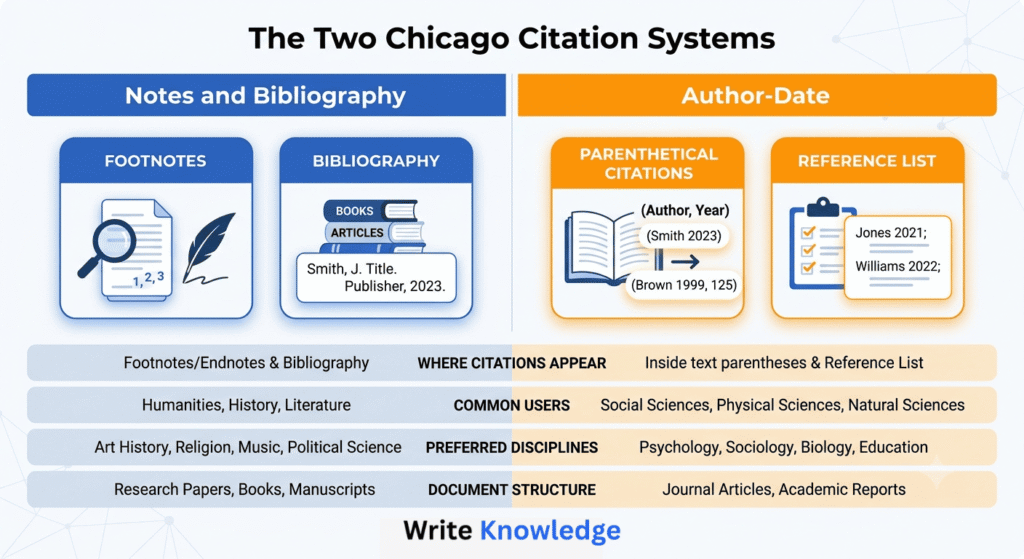
One of the features that distinguishes the Chicago Manual of Style Guide from most other Writing Style Guides is that it offers two separate citation systems.
Instead of requiring every writer to follow a single documentation method, Chicago allows authors to choose the system that best fits their discipline, audience, or publisher’s requirements.
The two systems are:
- Notes and Bibliography (NB)
- Author-Date
Although both acknowledge sources correctly, they differ significantly in how citations appear within the document and how readers access reference information.
Notes and Bibliography (NB)
The Notes and Bibliography system is the traditional Chicago citation method and is widely used in the humanities.
Instead of placing source information inside parentheses, writers insert a superscript number in the text. The corresponding citation appears as either a footnote at the bottom of the page or an endnote at the end of the document.
Readers who need additional information simply refer to the note, making the main text cleaner and easier to read.
A complete list of sources is then provided in a Bibliography at the end of the document.
This system is particularly suitable for subjects where writers frequently cite books, archival materials, manuscripts, and historical documents.
Common Disciplines
- History
- Literature
- Philosophy
- Theology
- Fine Arts
- Cultural Studies
📝 Example
A sentence using the Notes and Bibliography system might appear like this:
Chicago Style has become one of the most influential editorial systems in academic publishing.¹
The superscript ¹ directs readers to a footnote containing the complete source information.
📌 Remember
In the Notes and Bibliography system, citations appear in footnotes or endnotes, while a complete Bibliography lists every source consulted.
Author-Date
The Author-Date system works differently.
Instead of using footnotes, source information appears directly within the sentence using parenthetical citations.
A typical citation includes:
- Author’s surname
- Publication year
- Page number (when necessary)
For example:
(Smith 2024, 115)
The complete source information is then listed alphabetically in a Reference List.
Because this method allows readers to identify sources immediately without leaving the paragraph, it is especially popular in research that frequently cites journal articles and recent publications.
Common Disciplines
- Social Sciences
- Environmental Studies
- Business
- Public Policy
- Some interdisciplinary research
Although the Author-Date system resembles APA Style, it follows different formatting conventions for citations, references, punctuation, and capitalization.
If you’re still deciding which documentation system best suits your subject, our complete APA Style Guide explains how APA differs from Chicago’s Author-Date format.
📝 Example
A sentence using the Author-Date system may appear like this:
Consistent citation practices improve academic credibility (Johnson 2025, 42).
The complete publication information is then included in the document’s Reference List.
Notes and Bibliography vs Author-Date
Although both systems belong to the Chicago Manual of Style, they are designed for different writing environments.
| Feature | Notes and Bibliography | Author-Date |
| Citation Style | Footnotes or Endnotes | Parenthetical Citations |
| Reference Section | Bibliography | Reference List |
| Best For | Humanities | Social Sciences |
| Reader Experience | Minimal interruption to reading | Immediate source identification |
| Typical Sources | Books and historical documents | Journal articles and research papers |
The choice between the two is rarely a personal preference.
Instead, writers should follow the documentation style required by:
- Their university
- Instructor
- Publisher
- Journal
- Organisation
✍️ Writing Tip
Before starting any academic paper, confirm whether your instructor requires Chicago Notes and Bibliography or Chicago Author-Date. Both belong to Chicago Style, but mixing them within the same document creates inconsistent citations.
Which Chicago Citation System Should You Choose?
If you’re writing historical research, literary analysis, or book-based scholarship, Notes and Bibliography will usually be the correct choice.
If you’re writing research that relies heavily on recent journal articles, statistical studies, or scientific publications, Author-Date may be preferred.
Ultimately, the decision depends on your institution or publisher rather than personal preference.
Chicago Manual of Style Formatting Rules
In addition to citations, the CMOS provides detailed recommendations for document formatting. These standards ensure that academic papers, books, manuscripts, and professional publications maintain a consistent appearance.
Although publishers and universities sometimes introduce their own formatting requirements, the following guidelines represent the standard Chicago format used in most situations.
Standard Page Layout
A Chicago-style paper generally follows these formatting standards:
| Element | Standard Recommendation |
| Paper Size | Letter or A4 (institution dependent) |
| Margins | 1 inch (2.54 cm) on all sides |
| Font | Times New Roman 12 pt (or equivalent readable serif font) |
| Line Spacing | Double-spaced |
| Paragraph Indentation | First line indented 0.5 inch |
| Page Numbers | Upper-right corner |
| Text Alignment | Left aligned |
Title Page
Whether a separate title page is required depends on your instructor, institution, or publisher.
When used, a Chicago title page typically includes:
- Paper title
- Student or author name
- Course information
- Instructor name
- Date
📌 Remember
Always follow your instructor’s or publisher’s formatting requirements if they differ from the general Chicago recommendations.
Headings and Document Structure
Chicago encourages writers to organise long documents with logical headings and subheadings.
Clear headings improve:
- Readability
- Navigation
- Organisation
- Reader comprehension
Long research papers often contain several heading levels, allowing readers to understand the structure of the document before reading individual sections.
Unlike AP Style, which prioritises concise journalistic presentation, Chicago supports more detailed document organisation for academic and scholarly writing.
Page Numbers
Most Chicago documents include page numbers beginning with the first page of the main text.
Common practice is:
- Upper-right corner
- Arabic numerals
- Consistent placement throughout the document
Footnotes
One of the defining characteristics of the Notes and Bibliography system is the use of footnotes.
Instead of interrupting the reader with parenthetical citations, a superscript number appears in the text.
For example:
Historical writing often relies heavily on archival evidence.¹
The complete citation then appears at the bottom of the same page.
Footnotes allow writers to:
- Cite sources
- Include brief explanatory comments
- Avoid cluttering the main text
This is one reason historians and book publishers continue to favour Chicago Style.
📝 Example
Example of a footnote:
¹ John Smith, History of Modern Europe (New York: Academic Press, 2024), 118.
Endnotes
Some publishers prefer endnotes instead of footnotes.
Endnotes work in exactly the same way, except all notes appear together at the end of the document rather than at the bottom of each page.
The choice between footnotes and endnotes is usually determined by the publisher.
Bibliography
Every source cited using the Notes and Bibliography system should also appear in the Bibliography.
The bibliography:
- Appears at the end of the document
- Lists sources alphabetically
- Provides complete publication information
- Allows readers to locate the original sources
Reference List
When using the Author-Date system, Chicago replaces the bibliography with a Reference List.
Although similar in purpose, the formatting differs because the reference list corresponds directly with the parenthetical citations used throughout the paper.
Understanding this distinction is essential for anyone learning Chicago Manual of Style citation examples.
✍️ Writing Tip
Many beginners confuse the Bibliography and the Reference List.
- Notes and Bibliography → Bibliography
- Author-Date → Reference List
The names are not interchangeable.
Chicago Manual of Style Citation Examples
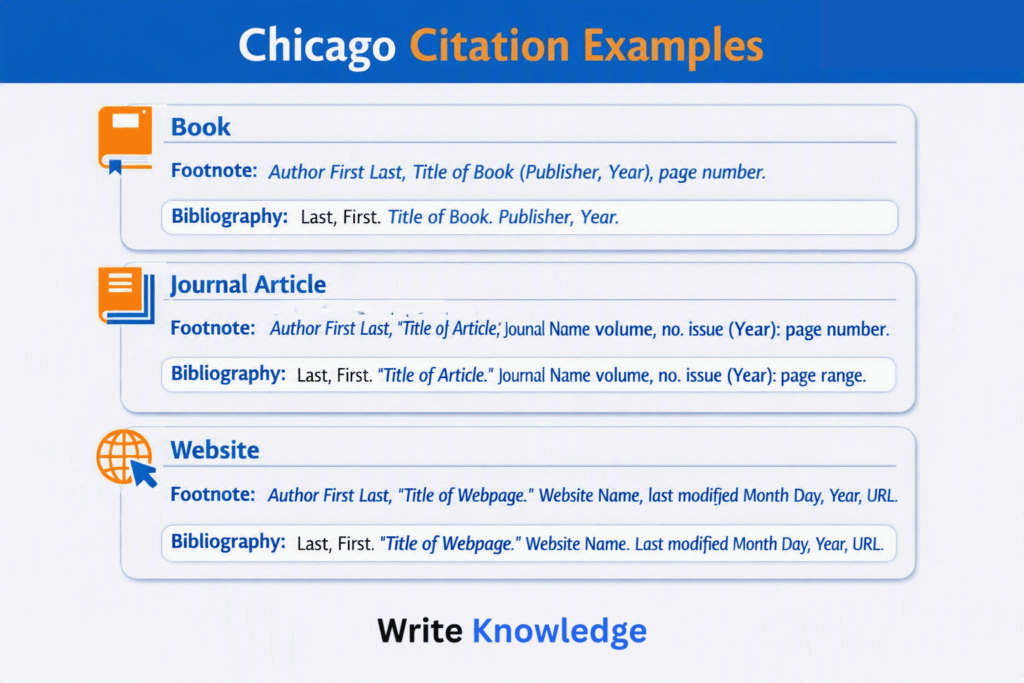
Understanding formatting rules is important, but learning how to cite sources is what most writers struggle with.
The following Chicago Manual of Style citation examples illustrate how the Notes and Bibliography system typically documents different source types.
Note: Citation formats may vary slightly depending on the edition of the Chicago Manual of Style and your institution’s requirements.
Book Citation
Footnote
John Smith, History of Modern Europe (New York: Academic Press, 2024), 118.
Bibliography
Smith, John. History of Modern Europe. New York: Academic Press, 2024.
Journal Article
Footnote
Sarah Johnson, “Writing for Digital Audiences,” Journal of Professional Writing 18, no. 2 (2025): 44–56.
Bibliography
Johnson, Sarah. “Writing for Digital Audiences.” Journal of Professional Writing 18, no. 2 (2025): 44–56.
Website Citation
Footnote
Write Knowledge, “Writing Style Guides,” accessed July 25, 2026, https://writeknowledge.com/writing-style-guides/.
Bibliography
Write Knowledge. “Writing Style Guides.” Accessed July 25, 2026. https://writeknowledge.com/writing-style-guides/.
⚠️ Common Mistakes
Even experienced writers occasionally make mistakes when working with the CMOS.
The most common errors include:
- Mixing Notes and Bibliography with Author-Date in the same document.
- Forgetting to include a Bibliography or Reference List.
- Formatting footnotes inconsistently.
- Using incorrect punctuation in citations.
- Applying formatting rules from another writing style guide.
Avoiding these mistakes becomes much easier once you understand the purpose of each citation system.
✍️ Writing Tip
Never combine formatting rules from different writing style guides in a single document.
For example, don’t use APA-style parenthetical citations together with Chicago footnotes.
Chicago Style vs Other Writing Style Guides
Many writers compare Chicago with other major style guides before selecting the correct documentation system.
Each guide was developed for a different publishing environment and audience.
| Style Guide | Primary Use | Citation Method |
| Chicago Manual of Style | Publishing, Humanities | Notes & Bibliography or Author-Date |
| APA Style | Social Sciences | Parenthetical citations |
| MLA Style | Literature & Humanities | Parenthetical citations |
| AP Style | Journalism & News | Editorial style, limited source citations |
| IEEE Style | Engineering & Technical Writing | Numbered citations |
If you’re unsure which guide applies to your work, our complete writing style guides article explains the purpose and use of each major editorial standard.
Should You Learn Chicago Style?
If your goal is to work in:
- Academic publishing
- Book publishing
- Historical research
- Editorial services
- Copy editing
- Professional proofreading
Then learning the Chicago Manual of Style Guide is an excellent investment.
✅ Key Takeaways
- The Chicago Manual of Style (CMOS) is one of the world’s most comprehensive editorial style guides.
- Chicago provides two citation systems: Notes and Bibliography and Author-Date.
- The Notes and Bibliography system is commonly used in the humanities, while Author-Date is often preferred for certain research disciplines.
- Chicago covers much more than citations, including formatting, grammar, punctuation, manuscript preparation, and editorial standards.
📚 Continue Learning
To explore related topics, read our guides on Types of Writing and Writing Careers.
Conclusion
The Chicago Manual of Style remains one of the most respected writing and editorial references in the world. Its flexibility, comprehensive formatting guidance, and dual citation systems make it suitable for academic writing, publishing, and professional editing alike.
Whether you’re preparing your first research paper or pursuing a career in publishing, learning Chicago Style helps you write with greater consistency, credibility, and professionalism.
Frequently Asked Questions
What is the Chicago Manual of Style?
The Chicago Manual of Style (CMOS) is an editorial style guide published by the University of Chicago Press that provides rules for formatting, citations, grammar, punctuation, and professional publishing.
What are the two Chicago citation systems?
Chicago offers Notes and Bibliography for humanities writing and Author-Date for certain research disciplines. Both document sources correctly but use different citation methods.
Who should use Chicago Style?
Chicago Style is commonly used by historians, researchers, book publishers, editors, university students, and academic institutions.
Is Chicago Style the same as APA or MLA?
No. Although all three are recognized style guides, they differ in citation methods, formatting rules, and the academic disciplines they primarily support.

Sachin is a Postgraduate in Technical Writing in Business Management specializing in creating SEO-friendly, User-friendly, and Reader-focused website articles on Education, Tech, Sports, Games, and Entertainment.
Through Write Knowledge, he helps students, bloggers, editors, and professionals develop practical writing skills using clear explanations, real-world examples, and internationally recognized writing standards.