Search engines have transformed how people discover information, products, and services. Behind every well-ranked blog, landing page, product description, or business website is an SEO writer who understands both writing and search behavior.
Unlike traditional writing roles that focus only on creativity or grammar, SEO writing combines strong writing skills with keyword research, search intent, user experience, and content optimization. The goal is not simply to write articles … it is to create content that answers readers’ questions while making it easier for search engines to understand and rank the page.
Whether you plan to work as a full-time SEO content writer, freelance for multiple clients, or eventually move into digital marketing and content strategy, understanding how SEO writing works is the first step toward building a rewarding writing career.
💡 Quick Answer
An SEO writing career involves creating content that is optimized for search engines while remaining valuable, accurate, and engaging for readers. SEO writers produce blog posts, web pages, product descriptions, service pages, and other digital content that helps websites improve their visibility in search results and attract organic traffic.
What is an SEO Writing Career?

SEO (Search Engine Optimization) writing is the practice of creating content that helps websites appear higher in search engine results without sacrificing readability or user experience.
An SEO writer understands how readers search for information, what questions they ask, and how to structure content so that both people and search engines can understand it easily.
A typical SEO writer may create:
- Blog articles
- Website pages
- Service pages
- Product descriptions
- Category pages
- Buying guides
- Landing pages
- FAQ pages
Unlike many people assume, SEO writing is not about stuffing keywords into an article. Modern SEO focuses on creating genuinely helpful content that satisfies search intent, demonstrates expertise, and provides a positive reading experience.
If you’re still exploring the broader profession, our complete guide to content writing career explains how SEO writing fits within the wider content writing industry and how writers can gradually specialize in this growing field.
Why SEO Writing is One of the Fastest-Growing Writing Careers
As companies compete for online visibility, they need high-quality content that can consistently attract visitors from search engines. Paid advertising stops generating traffic when the budget ends, but well-written SEO content can continue bringing readers for months or even years.
Several factors contribute to the increasing demand for SEO writers:
- Businesses invest heavily in content marketing.
- E-commerce websites require optimized product and category pages.
- Blogs remain one of the strongest channels for attracting organic traffic.
- AI-generated content still requires skilled human writers to ensure quality, originality, and accuracy.
- Google’s growing emphasis on Experience, Expertise, Authoritativeness, and Trustworthiness (E-E-A-T) makes knowledgeable writers more valuable than ever.
Who Should Consider an SEO Writing Career?
SEO writing is suitable for individuals who enjoy researching topics, organizing information, and solving readers’ problems through clear and structured content. You don’t need a journalism degree or a marketing background to begin, but curiosity, consistency, and a willingness to learn are essential.
This career is particularly well suited for:
- Students looking for flexible freelance opportunities
- Bloggers who want to improve their search visibility
- Content writers planning to specialize in SEO
- Freelancers seeking long-term client work
- Small business owners creating their own website content
Many successful SEO writers begin with general content writing before developing specialized SEO knowledge.
✅ Key Takeaways
- SEO writing combines content creation with search engine optimization.
- The primary objective is to create content that satisfies both readers and search engines.
- Modern SEO writing emphasizes search intent, quality, and user experience rather than keyword repetition.
- Businesses across nearly every industry actively hire SEO writers.
- SEO writing offers strong opportunities for freelance work, remote employment, and long-term career growth.
Types of SEO Writing Jobs
One of the biggest advantages of choosing an SEO writing career is the variety of roles available. While many people associate SEO writing only with blogging, businesses require search-optimized content across websites, online stores, software platforms, media publications, and digital marketing campaigns.
Blog SEO Writer
Blog SEO writers create informative articles that answer users’ questions and help websites rank for informational search queries.
Typical projects include:
- How-to guides
- Beginner tutorials
- Listicles
- Evergreen articles
- Industry updates
- Educational resources
Many writers begin their careers in blog writing because it develops research, writing, and SEO fundamentals simultaneously.
Website SEO Writer
Website SEO writers optimize business websites to improve visibility in search results while helping visitors understand products and services.
Typical content includes:
- Home pages
- About pages
- Service pages
- Landing pages
- Location pages
Unlike blog writing, website copy often targets commercial search intent and conversion goals.
NOTE: There is very thin-line difference between the Blog SEO Writer and Website SEO Writer. The work usually overlap with each other.
eCommerce SEO Writer
Online stores require thousands of search-optimized pages.
SEO writers working in eCommerce typically create:
- Product descriptions
- Category pages
- Buying guides
- Product comparison articles
- Brand pages
Strong product research and persuasive yet informative writing are especially valuable in this role.
Technical SEO Writer
Technical SEO writers produce content for software companies, SaaS businesses, engineering firms, and technology brands.
Projects often include:
- Product documentation
- Knowledge base articles
- API documentation
- Software tutorials
- User guides
- Technical blogs
If you enjoy explaining complex topics in simple language, technical SEO writing can become a highly rewarding specialization.
Local SEO Writer
Local businesses depend on location-based search visibility.
Local SEO writers create:
- City landing pages
- Local service pages
- Business location content
- Google Business Profile content
- Area-specific guides
These writers understand how people search for businesses within specific cities or regions.
Healthcare SEO Writer
Healthcare content requires accuracy, trustworthiness, and responsible research.
Typical projects include:
- Medical blogs
- Patient education articles
- Hospital websites
- Healthcare resource pages
- Wellness content
Because healthcare falls under Your Money or Your Life (YMYL) topics, Google expects exceptionally high-quality content.
Finance SEO Writer
Financial websites require writers who can simplify complex financial concepts while maintaining accuracy.
Examples include:
- Banking
- Insurance
- Investing
- Personal finance
- Taxation
- Loans
Experienced finance SEO writers often command higher rates because of the expertise required. This also falls under Your Money or Your Life (YMYL) topic.
B2B SEO Writer
Business-to-business companies rely heavily on organic search to generate qualified leads.
B2B SEO writers create:
- White papers
- Industry reports
- Solution pages
- Case studies
- Product comparisons
- Decision-making guides
These projects often require deeper research and collaboration with subject matter experts.
📝 Example
A SaaS company may hire an SEO writer to create a 3,000-word guide explaining project management software, while an online fashion retailer may hire another SEO writer to optimize hundreds of product category pages. Although both professionals are SEO writers, their daily responsibilities differ significantly.
Where SEO Writers Work
One of the reasons SEO writing attracts so many professionals is its flexibility. Writers can choose between traditional employment, freelancing, agency work, or even building their own independent businesses.
Below are the top employers for the SEO writers:
Digital Marketing Agencies
Many beginners start at agencies because they gain exposure to multiple industries and learn SEO processes quickly.
Agency writers often work on:
- Client blogs
- Website content
- Landing pages
- SEO campaigns
In-House Marketing Teams
Large companies employ dedicated SEO writers to manage content for a single brand.
Advantages include:
- Consistent workflow
- Stable income
- Long-term projects
- Collaboration with designers, marketers, and SEO specialists
Publishing Companies
Online magazines, educational platforms, media websites, and niche publications frequently hire SEO writers to produce search-friendly editorial content.
SaaS Companies
Software companies invest heavily in content marketing.
SEO writers here often produce:
- Educational blogs
- Product tutorials
- Feature comparisons
- Industry resources
Startups
Early-stage businesses often need versatile SEO writers who can create:
- Website copy
- Blog content
- Email content
- Knowledge base articles
- Marketing assets
This environment helps writers develop a broad skill set quickly.
Freelancing
And of course, you work for yourself!
Freelance SEO writing remains one of the fastest-growing career options.
Benefits include:
- Flexible schedules
- Multiple clients
- Higher income potential
- Complete location independence
However, freelancers are also responsible for finding clients, negotiating contracts, and managing their own business operations.
Essential Skills Every SEO Writer Needs
Successful SEO writers combine excellent writing ability with analytical thinking and a strong understanding of search behavior.
Strong Writing Skills
Good grammar, clarity, organization, and readability remain the foundation of every successful SEO article.
Even perfectly optimized content cannot perform well if readers struggle to understand it. Strengthening your grammar, punctuation, and overall writing style is just as important as learning keyword research or search optimization techniques.
Keyword Research
SEO writers should understand:
- Primary keywords
- Secondary keywords
- Long-tail keywords
- Semantic keywords
- Topic clusters
Rather than inserting keywords repeatedly, modern SEO focuses on covering a topic comprehensively.
Search Intent Analysis
Understanding why someone performs a search is one of the most valuable SEO skills.
For example:
| Search Query | Search Intent |
| What is SEO writing? | Informational |
| Best SEO writing course | Commercial Investigation |
| Hire SEO writer | Transactional |
| SEO writing examples | Informational |
Writers who understand search intent create content that satisfies readers instead of simply matching keywords.
Research Skills
SEO writers regularly research:
- Industry trends
- Reliable sources
- Statistics
- Government publications
- Academic references
- Subject matter expert insights
Accurate research improves both reader trust and search quality signals.
Content Organization
Long-form SEO articles rely on logical structure.
Professional writers use:
- Clear headings
- Tables
- Lists
- Examples
- Comparisons
- Callout boxes
This improves both readability and user experience.
Basic On-Page SEO
Every SEO writer should know how to optimize:
- Page titles
- Meta descriptions
- Heading hierarchy
- Internal linking
- External citations
- Image alt text
- URL structure
These elements help search engines understand page content while improving navigation for readers.
✍️ Writing Tip
Instead of asking, “How can I use this keyword?”, ask:
“What information is the reader trying to find?”
Modern SEO rewards writers who solve problems rather than simply targeting keywords.
⚠️ Common Mistake
Many beginners believe that repeating the same keyword throughout an article improves rankings.
In reality, excessive keyword repetition (known as keyword stuffing) reduces readability and may negatively affect both user experience and search performance.
A natural, comprehensive discussion of the topic almost always performs better than forcing the same phrase into every paragraph.
Educational Qualifications: Do You Need a Degree to Become an SEO Writer?
One of the most common questions beginners ask is whether they need a journalism, English, marketing, or communications degree to build a successful SEO writing career.
The short answer is no.
Unlike many traditional professions, SEO writing is a skill-based career. While a relevant degree can certainly help strengthen your communication, research, and analytical abilities, employers and clients are far more interested in whether you can produce content that performs well in search engines and provides genuine value to readers.
Today, many successful SEO writers come from diverse educational backgrounds, including engineering, commerce, science, humanities, law, and even completely unrelated fields.
Degrees That Can Be Helpful
Although not mandatory, the following educational backgrounds may provide an advantage:
- English Literature
- Journalism
- Mass Communication
- Marketing
- Digital Marketing
- Business Administration
- Public Relations
Self-Learning Is Equally Valuable
Because search engine optimization evolves continuously, many professional SEO writers rely more on continuous learning than on formal education.
Successful writers regularly study:
- Search engine algorithms
- Content marketing
- Keyword research
- User behaviour
- AI-assisted content creation
- Search quality guidelines
As a result, many employers evaluate portfolios and practical writing ability more heavily than academic qualifications.
Professional Certifications That Strengthen Your Resume
Although certifications cannot replace practical experience, they demonstrate initiative and help beginners understand industry best practices.
Some widely recognized certifications include:
Google Digital Marketing & E-commerce Professional Certificate
Provides a strong foundation in:
- Search engines
- Content marketing
- Analytics
- Digital marketing
HubSpot Content Marketing Certification
Excellent for learning:
- Content strategy
- Content planning
- Blogging
- Content promotion
Semrush SEO Fundamentals
Introduces topics such as:
- Keyword research
- Technical SEO
- On-page SEO
- Competitive analysis
Ahrefs SEO Course
Useful for understanding:
- Search intent
- Link building
- Keyword research
- Organic traffic
Yoast SEO Academy
Focuses on practical content optimization and WordPress SEO.
📝 Example
A beginner with no formal marketing degree but who has completed Google Digital Marketing, HubSpot Content Marketing, and Semrush SEO Fundamentals certifications, and built a strong portfolio, often stands out more than someone with only a degree but no practical SEO experience.
SEO Tools Every SEO Writer Should Learn
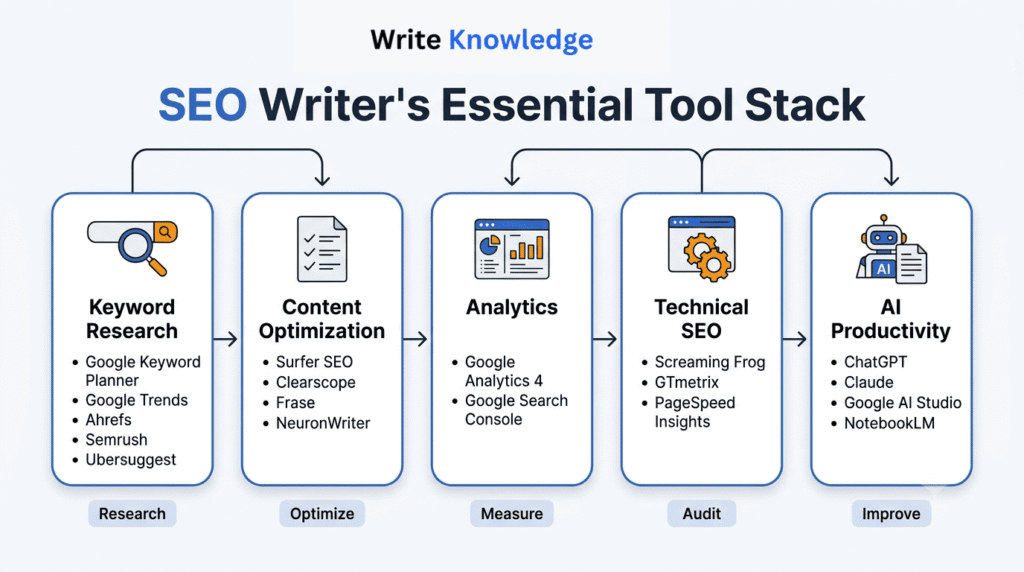
Professional SEO writers don’t rely only on writing skills. They also use specialized tools to research keywords, analyze competitors, measure performance, and optimize content.
Fortunately, beginners don’t need expensive software immediately. Many tools offer free versions or generous learning resources.
Keyword Research Tools
These help identify what people are searching for.
Popular tools include:
- Google Keyword Planner
- Google Trends
- Ahrefs Keywords Explorer
- Semrush Keyword Magic Tool
- Ubersuggest
Content Optimization Tools
These assist writers in improving content quality and topical relevance.
Examples include:
- Surfer SEO
- Clearscope
- Frase
- NeuronWriter
Website Analytics
Understanding content performance is essential.
Important tools include:
- Google Analytics 4 (GA4)
- Google Search Console
These help writers answer questions such as:
- Which pages receive organic traffic?
- Which keywords generate clicks?
- Which articles need updating?
Technical SEO Tools
Although writers don’t need to become technical SEO specialists, basic familiarity is valuable.
Useful tools include:
- Screaming Frog
- PageSpeed Insights
- GTmetrix
AI Productivity Tools
Modern SEO writers increasingly use AI to improve efficiency, not replace expertise.
Examples include:
- ChatGPT
- Claude
- Google AI Studio
- NotebookLM
These tools can assist with:
- Brainstorming
- Research
- Outline generation
- Content refinement
- Fact organization
However, experienced writers always verify information and add original insights before publishing.
How SEO Writers Use SEO Tools During Content Creation
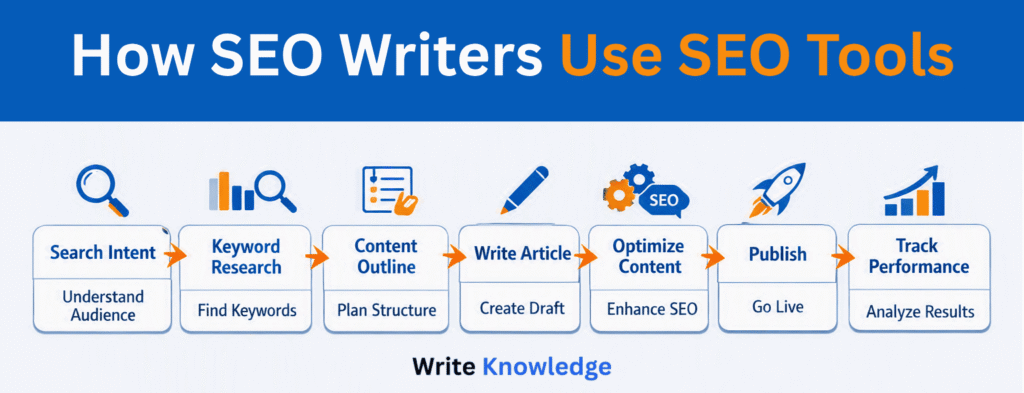
Although SEO tools serve different purposes, professional SEO writers typically use them in a structured workflow rather than all at once.
Each tool supports a specific stage of the content creation process, from identifying opportunities to measuring long-term performance.
A typical SEO writing workflow looks like this:
1. Understand Search Intent
Before writing begins, SEO writers first identify why users are searching for a topic. Understanding search intent helps determine whether readers are looking for information, comparisons, product recommendations, or solutions to a problem.
2. Conduct Keyword Research
Once the search intent is clear, writers use keyword research tools to discover the primary keyword, related search terms, and commonly asked questions. This research forms the foundation of the article and ensures it addresses topics that readers are actively searching for.
3. Create a Content Outline
Using the collected keyword data, writers organise the article into a logical structure with headings, subheadings, and supporting sections. A well-planned outline improves readability while ensuring all important search topics are covered.
4. Write the First Draft
The article is then written with the reader as the primary focus. During this stage, writers prioritise clarity, accuracy, and helpful information rather than trying to force keywords into every paragraph.
5. Optimise the Content
After the draft is complete, optimisation tools help evaluate keyword coverage, topical relevance, readability, heading structure, and internal linking opportunities. This stage refines the article without sacrificing its natural writing style.
6. Publish the Content
Once the article has been reviewed and edited, it is published with an SEO-friendly title, meta description, URL, featured image, and appropriate internal links.
7. Monitor Performance
Publishing is not the end of the process. Successful SEO writers regularly monitor their content using analytics tools to identify traffic trends, keyword rankings, click-through rates, and opportunities to update older articles.
📝 Example
An SEO writer publishing an article about Technical Writing might begin by researching search intent, identify related keywords such as “technical writer” and “technical writing examples,” create an outline, write the article, optimise it using an SEO tool, publish it, and later monitor its performance through Google Search Console to improve rankings over time.
How to Build an SEO Writing Portfolio
One of the biggest challenges beginners face is the classic dilemma:
“I need experience to get work … but I need work to gain experience.”
Fortunately, SEO writing offers an excellent solution: build your own portfolio.
A portfolio doesn’t need paid client work initially. It simply needs to demonstrate your ability to create high-quality, search-optimized content.
Your portfolio may include:
- Personal blog articles
- Practice SEO articles
- Website landing pages
- Product descriptions
- Content briefs
- Topic clusters
- SEO case studies
Publishing articles on your own website is one of the best ways to showcase your writing while learning practical SEO.
✍️ Writing Tip
Don’t wait for your first client before building your portfolio.
Publishing ten well-researched, professionally formatted SEO articles on your own website creates stronger evidence of your abilities than simply listing “SEO Writing” as a skill on your résumé.
⚠️ Common Mistake
Many beginners fill their portfolios with articles written only for search engines.
Employers, however, look for writers who can balance:
- Readability
- Search optimization
- User experience
- Accuracy, and
- Helpfulness
A portfolio that demonstrates problem-solving and audience understanding is far more impressive than one focused solely on keyword density.
Salary Expectations for SEO Writers
One of the biggest reasons writers choose SEO as a specialization is its strong earning potential. As businesses continue investing in content marketing and organic search, experienced SEO writers are often paid more than general content writers because they contribute directly to website traffic, lead generation, and business growth.
Salary varies depending on several factors:
- Experience level
- Industry specialization
- Writing quality
- SEO knowledge
- Portfolio
- Location
- Employment type (full-time or freelance)
Unlike many traditional writing careers, SEO writing also provides excellent opportunities to increase income through niche specialization and long-term client relationships.
SEO Writer Salary by Experience
The figures below are approximate and may vary depending on the company, location, and skill level.
| Experience | Typical Annual Salary (India) |
| Beginner (0–1 year) | ₹2.5–4 LPA |
| Junior SEO Writer (1–3 years) | ₹4–6 LPA |
| Mid-Level SEO Writer (3–5 years) | ₹6–10 LPA |
| Senior SEO Writer (5+ years) | ₹10–18 LPA |
| Content Strategist / SEO Manager | ₹15–30+ LPA |
For international freelance projects, compensation is often based on article length, expertise, or hourly rates rather than annual salary.
Freelance SEO Writing Rates
Freelancers typically charge using one of the following models:
- Per word
- Per article
- Per hour
- Monthly retainer
Approximate rates:
| Experience | Typical Rate |
| Beginner | ₹0.75–₹2 per word |
| Intermediate | ₹2–₹5 per word |
| Experienced Specialist | ₹5–₹15+ per word |
Freelance vs Full-Time SEO Writing
Both career paths offer unique advantages.
| Freelance SEO Writer | Full-Time SEO Writer |
| Flexible schedule | Stable salary |
| Choose your clients | Employee benefits |
| Higher income potential | Structured career growth |
| Work from anywhere | Team collaboration |
| Business ownership | Less client acquisition effort |
There is no universally “better” option. Many writers begin with full-time employment to build experience before moving into freelancing.
Career Progression in SEO Writing
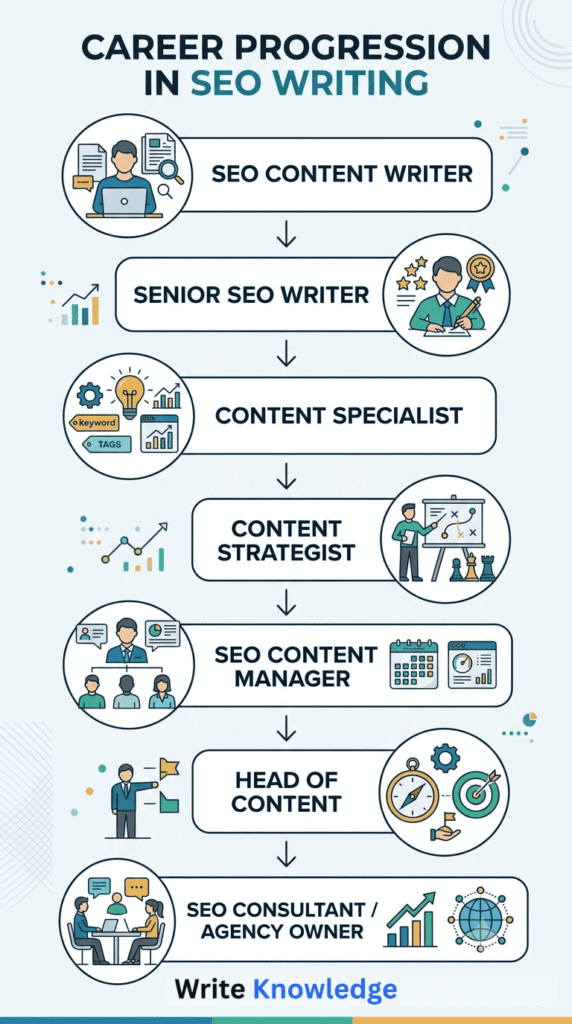
SEO writing offers far more growth opportunities than many beginners realize. As your experience increases, your responsibilities expand beyond writing into planning, optimization, and strategy.
A typical progression may look like:
- SEO Content Writer
- Senior SEO Writer
- Content Specialist
- Content Strategist
- SEO Content Manager
- Head of Content
- SEO Consultant or Agency Owner
Each stage introduces additional responsibilities, including editorial planning, keyword strategy, team management, and performance analysis.
Future of SEO Writing
Despite rapid advancements in AI, the demand for skilled SEO writers continues to grow.
Modern search engines increasingly reward content that demonstrates:
- Experience
- Expertise
- Authoritativeness
- Trustworthiness
Businesses also recognize that AI-generated content still requires human writers to ensure factual accuracy, originality, clarity, and strategic optimization.
The role of an SEO writer is evolving rather than disappearing. Writers who combine strong writing skills with research, critical thinking, and SEO knowledge will remain valuable across industries.
🔍 Did You Know?
Many experienced SEO writers eventually transition into broader roles such as Content Strategist, SEO Consultant, or Digital Marketing Manager because they already understand both content creation and organic search strategy.
Conclusion
SEO writing is much more than placing keywords into an article. It combines research, clear communication, search intent, and content strategy to create resources that genuinely help readers while improving a website’s visibility in search engines.
Whether you’re starting your writing journey or transitioning from general content writing, SEO writing offers excellent opportunities for long-term career growth.
By continuously improving your writing skills, learning SEO fundamentals, building a strong portfolio, and staying updated with evolving search trends, you can develop a rewarding career that remains valuable across industries.
✅ Key Takeaways
- SEO writing is one of the fastest-growing writing careers.
- Formal degrees are helpful but not mandatory.
- Strong writing, research, and SEO fundamentals matter more than academic background.
- Learning industry tools and building a portfolio significantly improves employability.
- Freelancing and full-time employment both offer excellent career opportunities.
- Specializing in industries such as SaaS, healthcare, finance, or technology can substantially increase earning potential.
- Continuous learning is essential because search algorithms and user behavior continue to evolve.
Frequently Asked Questions
Is SEO writing a good career?
Yes. SEO writing remains one of the strongest writing careers because businesses continue investing in organic search, content marketing, and educational resources that attract long-term traffic.
Can I become an SEO writer without experience?
Absolutely! Many beginners start by learning SEO fundamentals, publishing practice articles, and building a portfolio before applying for freelance or entry-level positions.
Do SEO writers need coding knowledge?
No. Basic knowledge of HTML is helpful but not essential. Most SEO writers focus on writing, keyword research, and content optimization rather than programming.
What’s the difference between a content writer and an SEO writer?
A content writer focuses primarily on creating useful content, while an SEO writer combines writing with keyword research, search intent analysis, on-page optimization, and organic search best practices.

Sachin is a Postgraduate in Technical Writing in Business Management specializing in creating SEO-friendly, User-friendly, and Reader-focused website articles on Education, Tech, Sports, Games, and Entertainment.
Through Write Knowledge, he helps students, bloggers, editors, and professionals develop practical writing skills using clear explanations, real-world examples, and internationally recognized writing standards.