If you’ve ever seen AP and APA mentioned in the same conversation about writing, you may have wondered whether they’re two versions of the same thing.
They aren’t.
The abbreviations look almost identical, but the two styles were created for very different writing environments. One is closely associated with journalism and news communication; the other is designed for scholarly communication and academic research.
And that difference becomes much clearer once you look at who uses each style, how sources are documented, and what the writer is actually trying to achieve.
💡 Quick Answer: AP vs APA
The difference between AP and APA lies in their purpose and usage:
- AP Style (Associated Press) is a set of writing and editing guidelines widely used in journalism, news media, digital media, and professional communications. It helps writers maintain clarity, consistency, and journalistic style.
- APA Style (American Psychological Association) is a set of guidelines for scholarly communication, including academic writing, formatting, in-text citations, and references. It is widely used in psychology, education, social sciences, and many other disciplines.
👉 In short: AP = journalism and professional communication, while APA = academic and scholarly communication.
What is the Difference Between AP and APA?
AP Style refers to the style guidance associated with the Associated Press, primarily used in journalism, news, digital media, public relations, and other professional communications. The AP Stylebook provides guidance on spelling, language, punctuation, usage, and journalistic style.
APA Style refers to the documentation and writing system developed by the American Psychological Association. It is widely used for scholarly communication, student papers, dissertations, theses, and research writing, particularly in psychology, social sciences, education, and related disciplines.
In simple terms:
| AP Style | APA Style |
| Journalism and professional communication | Academic and scholarly communication |
| Associated with Associated Press | Developed by American Psychological Association |
| Focuses strongly on clear, consistent communication for news audiences | Provides detailed conventions for scholarly writing and source documentation |
| Uses attribution rather than an APA-style reference system | Commonly uses author-date in-text citations and a References list |
| Common in newsrooms, digital media, and PR | Common in universities and research settings |
The key point: AP and APA are not competing versions of the same style. They solve different writing and communication needs.
Still feeling heavy with the difference???
Well…
the easiest way to understand AP vs APA is to stop looking at the abbreviations and look at their purpose.
AP Style was developed for journalism and is maintained through the Associated Press Stylebook.
APA Style, meanwhile, is designed for scholarly communication. The American Psychological Association describes it as a set of guidelines for presenting ideas clearly, precisely, and inclusively, and the system covers everything from paper setup and headings to citations, references, punctuation, grammar, tables, and figures.
So the fundamental distinction is:
AP helps writers communicate information effectively to general audiences, particularly in journalism and related professional communication. APA helps writers communicate and document scholarly work.
That difference affects almost everything that follows.
AP vs APA at a Glance
Before getting into individual rules, here’s the comparison in one place:
| Feature | AP Style | APA Style |
| Full name | Associated Press Stylebook / AP Style | American Psychological Association Style |
| Primary environment | Journalism and professional communication | Academic and scholarly communication |
| Typical readers | General/public audiences | Students, researchers, academics, and scholarly readers |
| Main emphasis | Clarity, consistency, concise communication, journalistic conventions | Clear scholarly communication, attribution, documentation, and academic presentation |
| Source attribution | Often integrated naturally into the writing | Formal in-text citation and reference system |
| Basic citation approach | No APA-style author-date citation system | Author-date |
| End source list | Not a standard requirement of AP Style itself | References |
| Common fields | Journalism, digital media, PR, corporate communication | Psychology, social sciences, education, research, and many other disciplines |
| Current major reference | AP Stylebook, 58th edition (2026–2028) | Publication Manual of the American Psychological Association, 7th edition |
The table gives you the answer quickly. But there’s a more important question:
Why were these two systems designed so differently in the first place?
So, let’s answer that.
What is AP Style?
AP Style is the editorial style associated with the Associated Press and is primarily intended for journalism and news communication.
The AP Stylebook provides guidance on areas such as spelling, punctuation, language usage, numbers, capitalization, abbreviations, titles, and other journalistic conventions. AP describes the Stylebook as a reference for writers, editors, students, and professionals.
Where is AP Style Commonly Used?
You are most likely to encounter AP Style in:
- Newspapers
- News websites
- Magazine and digital media
- Broadcast journalism
- Public relations
- Press releases
- Corporate communications
- Other journalism-related content
The reason is practical.
A news organization may have dozens or hundreds of writers producing content for the same audience. Without shared editorial conventions, small decisions about numbers, capitalization, abbreviations, names, and punctuation could vary from one article to another.
AP Style gives those writers a common standard.
What Does AP Style Focus On?
AP Style is not simply a collection of grammar rules.
It is concerned with how information should be presented in a journalistic environment.
That includes decisions such as:
- How numbers are written
- How dates and times are presented
- How titles and names are handled
- How abbreviations are used
- How current terminology is treated
- How information is attributed
This is why AP Style is particularly useful when speed, clarity, consistency, and accessibility matter.
What is APA Style?
APA Style is a writing and documentation system developed by the American Psychological Association.
It is widely used for scholarly communication and academic work. APA states that the system is used for manuscripts, student papers, dissertations, and theses, and is used across psychology, social sciences, and many other disciplines.
Where is APA Style Commonly Used?
APA is commonly associated with:
- Psychology
- Education
- Social sciences
- Behavioral sciences
- Research
- University assignments
- Theses and dissertations
- Scholarly publishing
However, APA is not limited to psychology. The current APA guidance and related publications cover a broad range of academic subjects and types of scholarly work.
What Does APA Style Focus On?
APA goes beyond citations.
It provides guidance for:
- Academic paper formatting
- Headings
- In-text citations
- References
- Tables and figures
- Quotations
- Punctuation
- Capitalization
- Numbers
- Abbreviations
- Grammar and writing style
- Bias-free language
Why Do AP and APA Sound So Similar?
This is probably the reason you landed here.
AP and APA look similar because their abbreviations contain the same two letters.
But the similarity ends there.
AP refers to the Associated Press, while APA refers to the American Psychological Association.
They are separate organizations, separate style systems, and separate writing environments.
Think of it this way:
AP → Newsroom
APA → Academic paper
Once you make that connection, the distinction becomes much easier to remember.
AP vs APA: How Are Citations Different?
This is where the difference becomes especially noticeable.
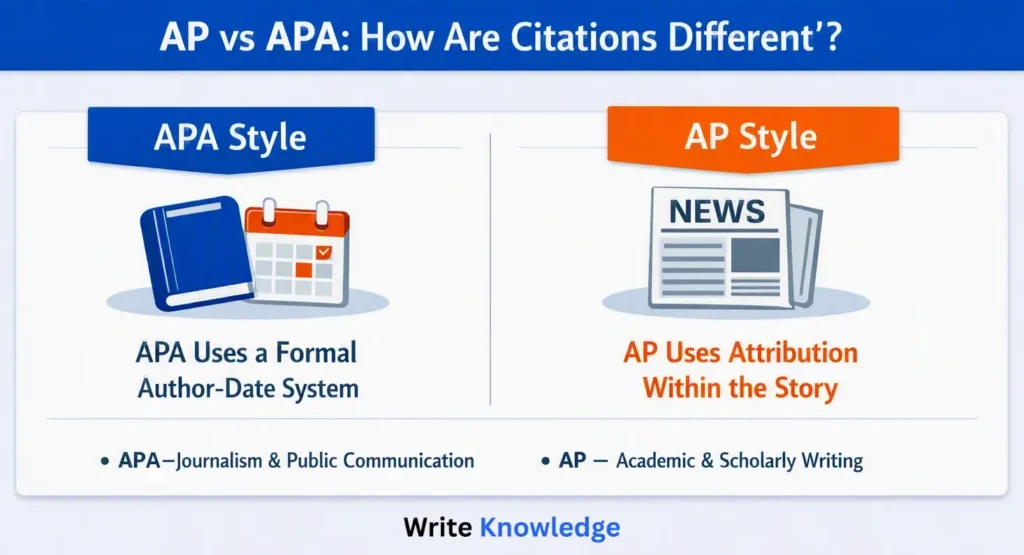
APA has a formal citation system designed to connect information in the text with a corresponding entry in the References list.
For example:
(Patel, 2025)
A reader can use that citation to identify the corresponding source in the References section.
AP Style works differently.
Journalistic writing generally relies on attribution within the story rather than using the formal author-date citation structure associated with APA.
For example:
According to a 2025 report from the World Health Organization, …
The source becomes part of the sentence itself.
APA Uses a Formal Author-Date System
APA commonly identifies the author and publication year in an in-text citation:
(Patel, 2025)
For a direct quotation from a paginated source, the citation can include the page number:
(Patel, 2025, p. 42)
The exact format depends on the source and the type of material being cited.
AP Uses Attribution Within the Story
AP-style journalism commonly identifies the source naturally:
“Patel said the new research could change how students approach academic writing.”
The reader doesn’t normally expect to find an APA-style References page at the end of an ordinary news article.
This difference reflects the two systems’ different purposes.
APA needs a formal documentation system because scholarly readers may need to trace an idea back to its source.
News readers generally need the source identified clearly within the story without interrupting the flow of the article.
AP vs APA: What Happens to the Reference List?
This is another major difference.
APA Uses a References List
APA papers normally include a References section containing the sources cited in the document.
The reference entries follow APA’s prescribed format, allowing readers to identify and locate the works used by the writer. APA provides extensive guidance and templates for different source types.
AP Does Not Use an APA-Style References Page
AP Style itself is not built around a formal academic reference-list system.
A journalist may identify sources through:
- Direct attribution
- Quotations
- Named reports
- Organizations
- Official statements
- Links in digital publications, where appropriate
That doesn’t mean journalism doesn’t care about sources.
It means source attribution works differently.
This is an important distinction because a common beginner mistake is assuming that every style guide must have an equivalent of an APA References page.
It doesn’t.
AP vs APA: How is the Writing Style Different?
The differences aren’t limited to citations.
The intended audience changes how the writing itself is presented.
AP Prioritizes Direct and Accessible Communication
Journalistic writing needs to communicate information quickly.
Readers may know little about the subject, so writers generally need to:
- Get to the point
- Use understandable language
- Avoid unnecessary complexity
- Present important information clearly
- Maintain consistency throughout the publication
AP Style provides editorial conventions that support this kind of communication.
APA Supports Scholarly Communication
Academic writing has a different job.
The writer may need to:
- Present a research question
- Explain existing evidence
- Analyze findings
- Develop an argument
- Acknowledge previous research
- Document sources
- Help readers evaluate the evidence
APA therefore provides a much broader framework for scholarly papers, including organization, citations, references, tables, figures, and academic language.
📝 Example
Imagine you want to report the findings of a new study.
AP-oriented approach:
“A new study published Tuesday found that students who regularly practice writing performed better on writing assessments.”
The emphasis is on communicating the finding efficiently.
APA-oriented approach:
“Students who engaged in deliberate writing practice demonstrated improved performance on writing assessments (Patel, 2025).”
The second example is simplified, but the difference in purpose is important: the academic version needs to connect the claim formally to its source.
AP vs APA: What About Numbers and Dates?
Both AP and APA provide guidance for numbers and dates, but you shouldn’t assume that a rule from one automatically applies to the other.
AP Style has detailed guidance for journalistic treatment of numbers, dates, times, and related conventions.
APA also provides extensive guidance for numbers and other formatting decisions within scholarly writing.
This matters because writers often make a subtle mistake:
They learn one style’s rule and begin applying it everywhere.
That defeats the purpose of a style guide.
A rule is useful within the system it belongs to.
AP vs APA: How are Headings and Formatting Different?
Formatting is another area where the two systems shouldn’t be treated as interchangeable.
APA provides a defined system for organizing scholarly papers, including heading levels and paper elements.
AP Style, on the other hand, is primarily an editorial system for journalism and related communication rather than a complete academic paper-formatting system.
That means you shouldn’t take an APA academic-paper template and simply replace its citations with AP-style attribution.
You’re changing more than the citations.
You’re changing the communication environment.
AP vs APA: Which Subjects and Industries Use Each?
The distinction becomes easier when you connect each style to its typical users.
| AP Style | APA Style |
| Journalism | Psychology |
| News reporting | Education |
| Digital media | Social sciences |
| Newspapers | Behavioral sciences |
| Magazines | Academic research |
| Public relations | University assignments |
| Press releases | Theses and dissertations |
| Corporate communications | Scholarly publishing |
These are common associations, not absolute rules.
An institution, employer, publisher, instructor, or department can require a particular style regardless of the general subject.
For example, a university journalism course might require AP Style, while a communications course might require APA.
Always check the actual requirement before choosing a style.
When Should You Use AP and APA?
Now we can answer the practical question.
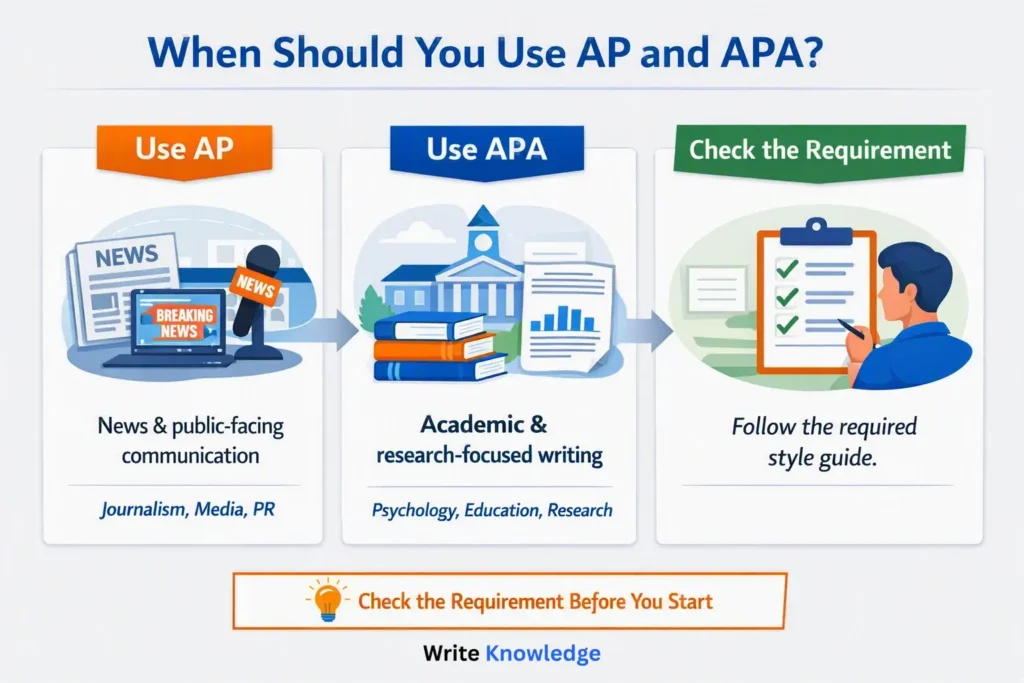
Choose AP for News and Public-Facing Professional Communication
AP is generally appropriate when you’re writing for:
- A newsroom
- A news website
- A magazine
- A digital media organization
- A PR agency
- A corporate communications team
- A publication following AP conventions
The goal is usually to communicate information clearly and consistently to a broad audience.
Choose APA for Academic and Research-Focused Work
APA is generally appropriate when you’re preparing:
- A psychology assignment
- A social science paper
- An education research paper
- A thesis or dissertation
- A scholarly manuscript
- Other academic work where APA is specified
The goal is not simply to make the writing look formal.
It is to present scholarly ideas and evidence using a consistent documentation system.
Check the Requirement Before You Start
This is the part worth remembering.
Don’t decide:
“APA looks more academic, so I’ll use APA.”
And don’t decide:
“AP looks simpler, so I’ll use AP.”
Instead, check:
- Your assignment instructions
- Your instructor’s requirements
- Your department’s guidelines
- Your employer’s editorial policy
- Your publisher’s requirements
- The conventions of your field
If the requirement isn’t clear, ask before formatting the entire document.
⚠️ Common Mistake
Confusing AP with APA because the abbreviations look similar.
AP and APA are not two versions of the same writing system. AP is associated with the Associated Press and journalism, while APA is associated with the American Psychological Association and scholarly communication.
Another common mistake is assuming that AP can replace APA citations simply because the writing is intended for a general audience.
The two systems have different purposes. Choose the style based on the writing environment and requirements, not the similarity of the abbreviations.
AP vs APA: Which One is Better?
Ah! This is what you were actually looking for!
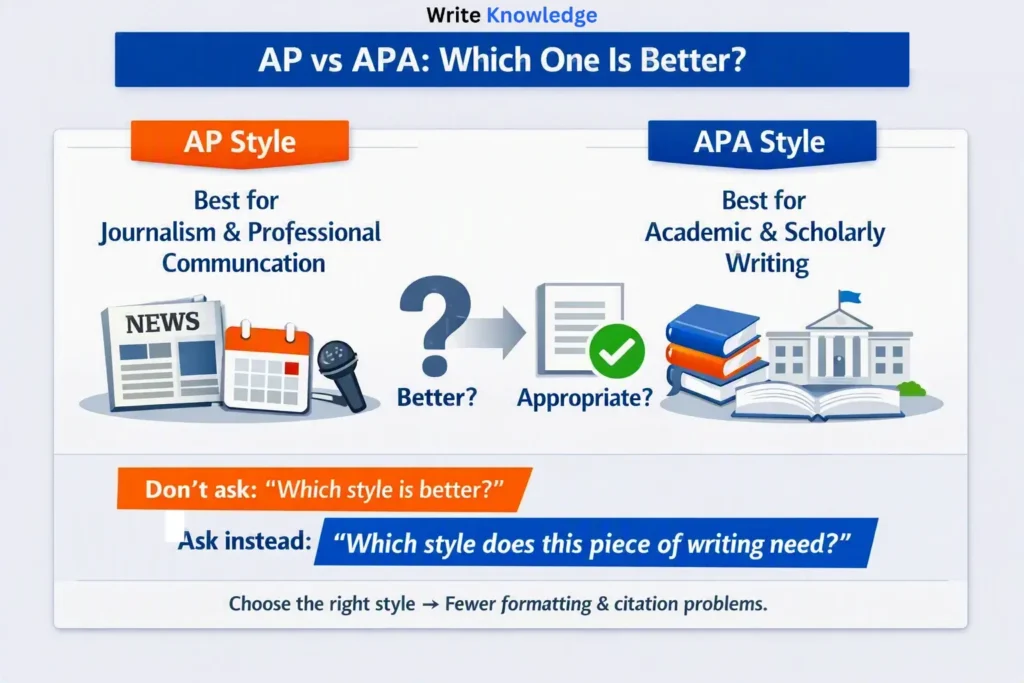
The answer is – Neither one is universally better.
They were designed for different situations.
AP is the more appropriate choice for journalism and related professional communication when AP conventions are required or expected.
APA is the more appropriate choice for academic and scholarly writing when APA is required or expected.
So the better question isn’t:
“Which style is better?”
It’s:
“Which style does this piece of writing need?”
That small change in thinking can prevent a surprisingly large number of formatting and citation problems.
✍️ Writing Tip
Before you start writing, identify where your document is going.
If it is going to a newsroom, publication, or media organization, check whether AP Style is required. If it is going to a university, research journal, or academic setting, check whether APA or another academic style is required.
Choosing the style before you write is much easier than correcting an entire document afterward.
AP vs APA: Is One Easier to Learn?
That depends on what you’re trying to write.
AP may feel more straightforward if you’re working with short, public-facing articles and mainly need to make consistent decisions about language, numbers, punctuation, dates, and journalistic conventions.
APA can feel more involved because academic writing may require paper formatting, in-text citations, References entries, headings, quotations, tables, figures, and other conventions.
But complexity shouldn’t determine your choice.
If your professor requires APA, learning APA is more useful than trying to find an easier alternative.
Likewise, if a newsroom requires AP, knowing APA doesn’t make your news article correctly formatted.
AP vs APA: Can You Use Both?
You can encounter both styles in the same professional or academic environment, but that doesn’t mean you should randomly mix their rules in one document.
For example, a writer might work for a university communications department and encounter AP conventions for public-facing news releases while also preparing academic work that follows APA.
The important thing is to understand which document is governed by which system.
When a single document has a specified style, follow that style consistently unless the relevant institution, publisher, or editor gives you different instructions.
How Can You Remember the Difference Between AP and APA?
Here’s a simple memory trick:
AP → Associated Press → Public/news communication
APA → American Psychological Association → Academic/scholarly communication
You can also remember the difference through the source system:
AP → Attribution
APA → Author + Date + References
That isn’t a complete description of either style, but it gives you a useful starting point when you’re trying to remember which one you’re dealing with.
AP vs APA: Key Differences You Should Remember
If you’re revising quickly, these are the differences worth keeping in mind:
| Area | AP | APA |
| Organization | Associated Press | American Psychological Association |
| Main environment | Journalism and professional communication | Academic and scholarly communication |
| Typical audience | General/public readers | Academic and research audiences |
| Source approach | Attribution within the content | Formal author-date documentation |
| End source list | No standard APA-style References requirement | References list |
| Typical fields | Journalism, news, media, PR | Psychology, education, social sciences, research |
| Paper format | Editorial/journalistic conventions | Detailed scholarly paper conventions |
| Current major reference | 58th edition, 2026–2028 | 7th edition |
| Main question | How should this information be communicated clearly? | How should scholarly ideas and sources be presented and documented? |
The most important difference isn’t actually a punctuation rule or a citation format.
It’s purpose.
AP and APA are built around different audiences, different communication environments, and different documentation needs.
📚 Continue Learning
Now that you know the difference between AP and APA, the next step is to learn the system you’ll actually use.
For a broader understanding of how AP, APA, MLA, Chicago, IEEE, and other systems fit together, return to our writing style guides post.
And if you’re still figuring out how academic writing differs from other forms of writing, our academic writing guide.
Also, check out our complete APA vs MLA comparison here.
✅ Key Takeaways
- AP and APA are completely different writing and documentation systems.
- AP Style is associated with the Associated Press and is primarily used in journalism and related professional communication.
- APA Style was developed by the American Psychological Association for scholarly communication and academic writing.
- AP relies heavily on source attribution within journalistic content, while APA uses a formal author-date citation system.
- APA papers commonly include a References section.
- AP and APA differ in more than citations; they also address different writing environments, audiences, formatting needs, and editorial conventions.
- AP is commonly associated with journalism, news, media, PR, and corporate communication.
- APA is commonly associated with psychology, education, social sciences, and academic research.
- Neither style is universally better.
- Your assignment, institution, employer, publisher, or discipline should determine which style you use.
Conclusion
AP and APA may look almost identical when written on a page, but they belong to very different writing worlds.
AP Style is built around journalism and professional communication, where information needs to be clear, consistent, and accessible to a broad audience. APA Style is built around scholarly communication, where writers need to present academic ideas and document their sources systematically.
So, if you remember only one thing from this AP vs APA comparison, remember this: don’t choose between them because one name sounds more familiar. Choose the system your writing actually requires.
Frequently Asked Questions
What is the main difference between AP and APA?
AP Style is associated with journalism and professional communication, while APA Style is designed for academic and scholarly communication. Their purposes, audiences, citation systems, and formatting conventions are different.
Is AP the same as APA?
No. AP refers to the Associated Press, while APA refers to the American Psychological Association. They are separate organizations with different style systems.
Is AP Style used for academic writing?
AP Style can be used in some academic contexts, particularly when an assignment or course specifically requires journalistic writing conventions. However, AP is primarily associated with journalism and professional communication.
Is APA Style used for journalism?
APA can appear in journalism-related academic or research settings, but ordinary journalism generally does not use APA as its primary editorial style. The required style depends on the publication or assignment.
Does AP Style use citations?
AP-style journalism generally uses source attribution within the story rather than the formal author-date citation and References system associated with APA.
Does APA require a References page?
APA papers generally include a References section containing the works cited in the document. The exact requirements depend on the type of APA document.
Which is better, AP or APA?
Neither is universally better. AP is appropriate for contexts that require AP’s journalistic conventions, while APA is appropriate for contexts requiring APA’s scholarly documentation system.
When should I use AP Style?
Use AP Style when your newsroom, publication, employer, client, course, or other relevant authority requires or expects AP conventions.
When should I use APA Style?
Use APA Style when your university, instructor, research journal, publisher, or other relevant authority requires APA, particularly in academic and research-focused work.
Can I mix AP and APA rules?
You shouldn’t mix their rules arbitrarily in a document that has a specified style. Follow the style required for that particular writing context and apply it consistently.

Sachin is a Postgraduate in Technical Writing in Business Management specializing in creating SEO-friendly, User-friendly, and Reader-focused website articles on Education, Tech, Sports, Games, and Entertainment.
Through Write Knowledge, he helps students, bloggers, editors, and professionals develop practical writing skills using clear explanations, real-world examples, and internationally recognized writing standards.