Have you ever spent twenty minutes trying to decode a confusing, jargon-heavy workplace email, only to realize you still had no idea what your manager wanted you to do? If you have ever felt frustrated by confusion reports or endless back-and-forth messages that lead nowhere, you aren’t alone.
And this is where Business Writing lends the helping hand to … everyone.
💡 Quick Answer: Defining Business Writing
At its core, business writing is workplace communication designed for action. Whether it’s an email, memo, report, proposal, or executive update, the goal is always the same: deliver information clearly so decisions can be made quickly. Unlike academic or creative writing, it strips away flourish and focuses on clarity, precision, and purpose, ensuring readers grasp the message and respond without unnecessary back‑and‑forth.
What Is Business Writing?
Business writing is purposeful, professional communication used in workplaces to inform, instruct, persuade, or record decisions. It includes emails, memos, reports, proposals, procedures, meeting notes, customer notices, and executive updates.
Unlike academic or creative writing, business writing prioritizes clarity and action over eloquence. Its job is to help readers understand quickly and act confidently with minimal back-and-forth.
Why Business Writing Matters in the Workplace
Strong business writing directly affects productivity, credibility, and career growth.
- Reduces ambiguity and rework: Clear messages prevent misunderstandings and repeated clarifications.
- Speeds up decisions: Well-structured reports and proposals help leaders decide faster.
- Builds professional reputation: Your emails and documents act as a “written résumé” that signals competence.
- Supports remote and hybrid work: In distributed teams, written updates and documentation replace many meetings.
In 2026, with AI tools generating drafts, the human edge is precision, judgment, and audience-aware editing.
Four Main Types of Business Writing
Most business documents fit into four purpose-based types.
| Type | Purpose | Common Examples |
| Instructional | Tell someone how to do something | SOPs, user manuals, training guides, onboarding docs, process memos |
| Informational | Share facts, status, or analysis | Reports, meeting minutes, financial statements, technical documentation, status updates |
| Persuasive | Convince readers to agree or act | Proposals, pitches, recommendation memos, sales emails, press releases |
| Transactional | Complete routine exchanges | Request emails, confirmations, invoices, announcements, basic agreements |
Note: Type is the purpose; format is the container (email, memo, report, slide deck, etc.).
Common Business Writing Formats and When to Use Them
Different situations call for different document types.
| Document | Best Used For | Minimum Useful Content |
| Focused request, update, confirmation, reply | Context, main point, action, timing | |
| Memo | Internal policy, decision, analysis, or record | Purpose, background, decision, implications |
| Status Update | Progress, risks, dependencies, next steps | Current state, change, blocker, owner, date |
| Report | Findings needing evidence and interpretation | Scope, method, results, limits, recommendation |
| Proposal | Recommended future action or investment | Problem, option, value, cost, risk, next step |
| Procedure (SOP) | Task that must be performed consistently | Prerequisites, steps, checks, recovery |
| Meeting Record | Decisions and assigned follow-ups | Decision, owner, due date, unresolved issue |
| Customer Notice | Change affecting use, cost, access, or timing | Impact, effective date, required action, help |
Use this table to choose the right format before you start writing.
Core Principles of Effective Business Writing
Effective business writing follows a small set of repeatable principles.[
Clarity and Conciseness
- Clarity: Your meaning should be immediately understandable.
- Example: “Submit the report by Friday” is clearer than “It would be good to have the report soon.”
- Conciseness: Use only the words necessary to convey your message.
- Example: “We need approval” instead of “We are writing to request that you provide approval.”
Cut filler words like “just,” “very,” “really,” and “in order to.”
Audience Awareness and Purpose
- Identify who will read this and what they need to do or know.
- Start with a clear lead and get to the main point quickly.
- If there is an ask, place it early, not buried at the end.
Structure and Scannability
- Put one main idea per paragraph.
- Use subheadings to break up long content and make it skimmable.
- Use active voice where possible: “The team sent the file” is clearer than “The file was sent by the team.”
Correctness and Tone
- Maintain grammatical accuracy and consistent style (e.g., follow a style guide like CMOS or AP where relevant).
- Keep tone respectful, professional, and situation-appropriate.
These principles align with the classic 7 C’s of business writing: clarity, conciseness, completeness, consideration, concreteness, courtesy, and correctness.
Business Writing Skills Every Professional Should Develop
To build strong business writing ability, focus on these practical skills.
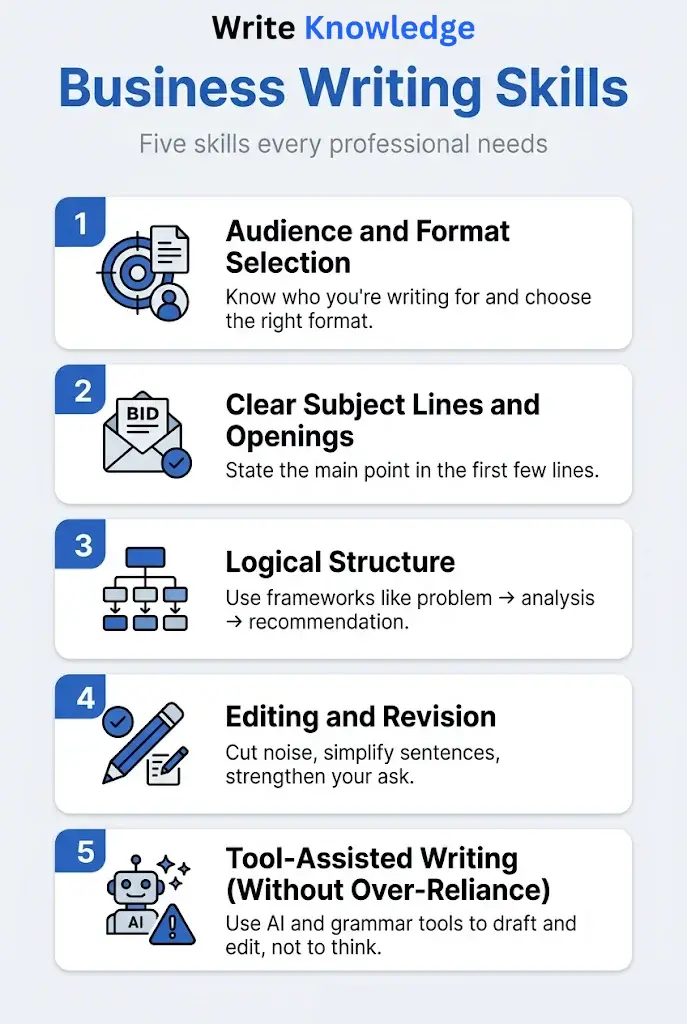
1. Audience and Format Selection
- Decide who you’re writing for and what format fits (email, memo, report, etc.).
- Match depth and tone to the reader’s role and time pressure.
2. Clear Subject Lines and Openings
- Write subject lines that state topic + urgency or action.
- Open messages with the core point in the first 1–2 sentences.
3. Logical Structure
Use simple frameworks such as:
- Problem → Analysis → Options → Recommendation for reports and proposals.
- Context → Main Point → Action → Timing for emails and updates.
4. Editing and Revision
- Read drafts aloud to catch awkward phrasing.
- Ask a colleague: “What did you understand from this?” and adjust accordingly.
- Use a checklist (e.g., CLEAR: Core message, Logical flow, Essential detail, Action, Reader-friendly).
5. Tool-Assisted Writing (Without Over-Reliance)
- Use grammar and tone tools (e.g., Grammarly, LanguageTool) for editing, not thinking.
- Use AI (e.g., ChatGPT, Claude) for drafting and brainstorming, then heavily edit for accuracy and voice.
Business Writing Examples: Email, Report, and Proposal
Example 1 – Email to a busy manager (fast decision needed)
- Audience: Department head with very little time.
- Format: Short email.
- Tone: Direct, action-oriented.
Subject: Approval Needed: Q4 Training Budget by Fri, 12 Sep
Hi Neha,
I need your approval on the Q4 training budget (₹4.2L) before we lock vendors on Monday.
Key points:
- 15% increase vs Q3 due to two new hires
- Expected impact: 20% faster onboarding
- Risk: Delay may push start dates by 2 weeks
Action: Please approve or suggest changes by Friday, 12 Sep, 3 PM.
Thanks,
Rohan
Example 2 – Memo to all team leads (policy change)
- Audience: Team leads who need to implement a new rule.
- Format: Internal memo.
- Tone: Clear, explanatory, slightly formal.
To: All Team Leads
From: Operations Head
Date: 10 Sep 2026
Subject: New Weekly Status Update Format (Effective 16 Sep)
Starting 16 Sep, all weekly status updates must follow the new template in the shared drive. This change reduces meeting time and improves visibility on blockers.
What changes:
- One-page format with sections: Progress, Risks, Next Week’s Plan
- Submission every Friday by 4 PM
Action required: Review the template and use it from the week of 16 Sep. Reach out if you need clarification.
Example 3 – Email requesting quick feedback
Subject: Feedback Needed: Client Proposal Draft by Thu, 4 PM
Hi Priya,
I need your feedback on the attached client proposal draft by Thursday, 4 PM so we can submit it on Friday.
The proposal outlines a 3‑month pilot for their Mumbai office, with an estimated ROI of 2.8x. I’ve highlighted the sections where your input is most critical (pages 3–5).
Please share comments in tracked changes or a quick summary email.
Thanks,
Arjun
Example 4 – Update to stakeholders
Subject: Update: Website Migration Completed, Minor Issues Being Fixed
Team,
The website migration to the new server is complete; we are now resolving minor display issues on the pricing page.
Current status:
- Core site live since 2:15 PM
- Pricing page showing outdated plans for some users
- Fix expected by 6 PM today
We’ll send a confirmation once everything is stable.
Example 5 – Report excerpt (Problem → Analysis → Options → Recommendation)
Problem:
Customer onboarding currently takes 10–14 days, causing delayed revenue recognition and higher churn risk in the first quarter.
Analysis:
- Average onboarding time: 12 days (target: 7 days)
- Main delays: manual document collection (4 days), unclear ownership of tasks (3 days), weekend gaps (2 days)
- Impact: 8% of new clients cancel within 60 days, citing “slow setup” as a reason
Options:
- Keep current process; absorb delays as “normal”.
- Introduce a standard checklist and assign an onboarding manager.
- Automate document collection and add weekend support coverage.
Recommendation:
Implement Option 2 immediately (checklist + onboarding manager) and pilot Option 3 for high-value clients in Q1 next year. Expected outcome: reduce onboarding time to 6–8 days and improve 90‑day retention by 5–7%.
Example 6 – Email update (Context → Main Point → Action → Timing)
Subject: Action Required: Confirm Q4 Campaign Budget by Wed
Hi team,
Context: We are finalising Q4 campaign plans and need locked budgets to book ad inventory at current rates.
Main point: Please confirm your Q4 campaign budget allocation by Wednesday, 5 PM.
Action: Reply with your approved budget figure or mark any changes in the shared sheet.
Timing: If we don’t receive confirmation by Wednesday, we will hold your current Q3 allocation and adjust in Q1 next year.
Example 7: Informational Report Excerpt
Title: Customer Support Response Time – August 2026
Scope: Email and chat tickets across Tier 1 and Tier 2 support, 1–31 Aug 2026.
Key findings:
- Average first response time: 2h 14m (target: 2h)
- 68% of tickets resolved within SLA; 22% exceeded by <4h
- Main delay driver: staffing gap on weekend shifts
Recommendation: Add two weekend agents and pilot a callback option for non-urgent tickets.
This structure (scope → findings → recommendation) supports quick decision-making.
Example 8: Persuasive Proposal Summary
Problem: Onboarding new clients currently takes 10–14 days, causing revenue delay and churn risk.
Proposed solution: Implement a standardized onboarding workflow with automated checklists and a dedicated onboarding manager.
Value:
- Reduce onboarding time to 5–7 days
- Improve 90-day retention by an estimated 8–10%
- Free up 15–20 hours/month for account managers
Investment: ₹6.2L one-time setup + ₹90K/month operational cost.
Next step: Approval to run a 60-day pilot with 10 new clients starting October.
This follows the problem → solution → value → cost → next step pattern for persuasive writing.
How to Improve Your Business Writing Skills
Use these actionable steps to level up quickly.
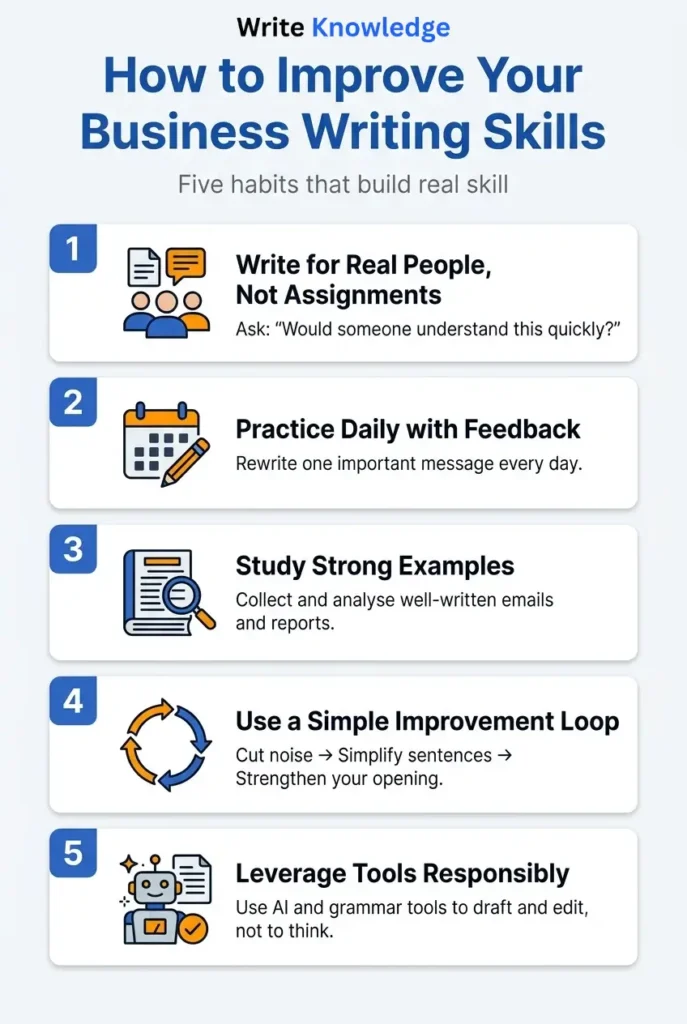
1. Write for Real People, Not Assignments
- Ask: “Would someone understand this if they read it quickly?”
- Simplify language and remove unnecessary jargon.
2. Practice Daily with Feedback
- Rewrite one important email or message each day with a specific focus (e.g., shorter subject lines, clearer calls to action).
- Track improvements: fewer follow-up questions, faster approvals, clearer responses.
3. Study Strong Examples
- Collect well-written internal memos, reports, and client emails from your organization.
- Note structure, tone, and how actions are requested.
4. Use a Simple Improvement Loop
- Step 1: Cut noise (remove anything that doesn’t help the reader decide or act).
- Step 2: Simplify sentences (split long sentences, replace abstract words with plain language).
- Step 3: Strengthen your opening (make the main point clear in the first few lines).
- Step 4: Check your ask (ensure the desired action is unmissable).
5. Leverage Tools Responsibly
- Use AI for drafting and idea generation, not final output.
- Use grammar and style tools to catch errors and improve tone, not to replace judgment.
Business Writing Careers and Opportunities (Especially in India)
Business writing skills open multiple career paths, both full-time and freelance.
Common Roles
- Content Writer / Business Content Specialist – creates blogs, guides, case studies, and website copy for B2B brands.
- Technical Writer / Documentation Specialist – writes user guides, API docs, and internal SOPs.
- Proposal Writer / Bid Manager – crafts RFP responses, client proposals, and business cases.
- Internal Communications Specialist – drafts memos, newsletters, and leadership updates.
- Email Marketing Copywriter – writes promotional and lifecycle emails for SaaS and e-commerce.
Skills That Increase Employability
- Strong command of English plus domain knowledge (e.g., SaaS, finance, healthcare).
- Ability to turn complex information into simple, structured documents.
- Familiarity with style guides (CMOS, AP) and basic SEO for web content.
- Comfort with AI tools for drafting and editing, plus human-level quality control.
In India, these roles exist in IT services, product companies, BPO/KPO firms, consulting, and remote-first global teams. Building a portfolio of sample emails, reports, and proposals can significantly improve hiring chances.
📚 Continue Learning
If you want to learn more types of writing and want to go deeper, then explore these related guides:
- Types of Writing – Complete Overview – Understand all major writing types and where business writing fits in the bigger picture.
- Technical Writing – Learn how to create clear user guides, documentation, and process manuals for complex products and services.
- Academic Writing – Explore the conventions of research papers, essays, and scholarly communication, and how they differ from business writing.
- Creative Writing – Discover how to craft stories, poems, and imaginative works that emphasize originality, emotion, and artistic expression.
- Descriptive Writing – Learn techniques to paint vivid pictures with words, focusing on sensory detail and atmosphere.
- Persuasive Writing – Master the art of influencing readers through arguments, evidence, and compelling language.
Start with the Types of Writing post to map your learning path, then dive into the specific writing type that matches your goals.
✅ Key Takeaways
- Business writing is purpose-driven professional communication used to inform, instruct, persuade, or record decisions at work.
- There are four main types: instructional, informational, persuasive, and transactional, each with distinct goals and examples.
- Effective business writing follows core principles: clarity, conciseness, audience awareness, strong structure, and correctness (the 7 C’s).
- You can improve quickly by writing daily, studying strong examples, using simple frameworks, and editing ruthlessly.
- In 2026, the best approach combines human judgment with AI and grammar tools for drafting and polishing.
- Strong business writing skills unlock careers in content, technical writing, proposals, internal comms, and email marketing, including remote opportunities for Indian professionals.
Conclusion
Business writing is not about sounding impressive; it’s about being clear, useful, and action-oriented. By understanding the four types of business writing, applying core principles like clarity and conciseness, and practicing with real workplace documents, you can significantly improve your professional communication.
Frequently Asked Questions
What is business writing in simple words?
Business writing is professional communication used at work to inform, instruct, persuade, or record decisions. It includes emails, reports, proposals, memos, and procedures, with a focus on clarity and action.
What are the 4 types of business writing?
The four main types are:
- Instructional (how-to guides, SOPs)
- Informational (reports, minutes, summaries)
- Persuasive (proposals, pitches, sales emails)
- Transactional (requests, confirmations, invoices)
Why is business writing important?
Good business writing reduces misunderstandings, speeds up decisions, improves collaboration, and builds your professional reputation. In remote and hybrid workplaces, it often replaces many meetings.
How can I improve my business writing skills quickly?
- Write daily and focus on one skill at a time (e.g., subject lines, clarity).
- Study strong examples from your organization.
- Use simple frameworks (e.g., context → main point → action → timing).
- Edit ruthlessly and ask for feedback.
Is business writing a good career option in India?
Yes. Roles like content writer, technical writer, proposal writer, internal communications specialist, and email copywriter exist in IT, product, consulting, and remote global teams. Strong samples and domain knowledge improve employability.

Sachin is a Postgraduate in Technical Writing in Business Management specializing in creating SEO-friendly, User-friendly, and Reader-focused website articles on Education, Tech, Sports, Games, and Entertainment.
Through Write Knowledge, he helps students, bloggers, editors, and professionals develop practical writing skills using clear explanations, real-world examples, and internationally recognized writing standards.