Have you ever wondered why some articles stay with you long after reading them, while others are forgotten within minutes?
No need to wonder anymore. This IS the storytelling in writing.
This guide explains what storytelling is, why it matters, its core elements, popular story structures, practical techniques, real examples, common mistakes, and ways to improve your storytelling skills.
💡 Quick Answer about Storytelling in Writing
Storytelling in writing is the technique of presenting ideas through characters, events, conflict, emotion, and meaningful structure. It helps readers connect with information, making content more engaging, persuasive, and memorable across creative, academic, business, and digital writing.
What Is Storytelling in Writing?
Storytelling in writing means purposefully choosing narrative parts to share an idea, a message, a feeling, or a takeaway. Rather than listing facts one after another, storytelling puts events in a clear order.
A reader can picture what happens and connect to it in an emotional way.
A story is not necessarily always a fiction. A journalist could write a story about a community that has just dealt with flooding. A marketer may write a story about a solution that a small business has discovered. A researcher may tell a story as a beginning to a report about a study done. The purpose of stories is to inform people and provide clarity on a certain topic using real-life events.
Storytelling is the technique of turning information into a story by combining people, situations, emotions, and purpose.
Storytelling vs Ordinary Information Writing
| Ordinary writing | Storytelling in writing |
| Presents facts directly | Presents facts through narrative |
| Focuses on explanation | Focuses on experience and meaning |
| Often follows logical order | Follows emotional and narrative flow |
| Readers understand | Readers understand and remember |
| Suitable for manuals and reports | Suitable for articles, speeches, blogs, campaigns, and features |
Notice that both approaches are valuable. Storytelling is a technique not a replacement for informative writing.
For example, compare these two openings:
| Without storytelling | With storytelling |
| Water conservation is important in Rajasthan. | Twelve-year-old Meera from Jaisalmer woke up before sunrise every day to walk two kilometres for water until her village built a rainwater harvesting system. |
Both communicate the same topic, but the second creates curiosity and emotional engagement.
Why Storytelling is More than Just Fiction
Many people believe storytelling belongs only to novels or short stories. In reality, it’s one of the most versatile writing techniques.
Storytelling appears in:
- Blog articles
- News features
- Brand campaigns
- Academic case studies
- Business presentations
- Educational lessons
- Personal essays
- Social media content
The goal isn’t always entertainment. Sometimes the purpose is to explain, persuade, educate, or inspire action.
What Are the Core Elements of Storytelling?
Every effective story, whether it’s 200 words or 20,000, is built on a few essential components.
Characters
Characters are the people readers follow. They don’t always need dramatic personalities—they simply need believable goals.
Examples:
- Ananya, a medical student in Delhi
- Vikram, a café owner in Ahmedabad
- Priya, an HR professional in Chennai
- Tenzin, a travel guide in Ladakh
Well-developed characters make abstract ideas feel human.
Setting
Setting tells readers where and when the story happens.
A story set during Mumbai’s monsoon creates a different atmosphere than one set in the tea gardens of Darjeeling. Specific settings improve authenticity and help readers visualise the scene.
Conflict
Conflict is the challenge that drives the narrative forward. Without conflict, there’s little reason for readers to continue.
Common types include:
- Personal challenge
- Business problem
- Social issue
- Educational obstacle
- Professional decision
Conflict doesn’t require tragedy. Even choosing between two career paths creates narrative tension.
Plot
Plot is the sequence of events connecting the beginning, middle, and end. A clear progression helps readers follow the journey naturally.
A weak plot jumps between ideas. A strong plot moves logically from problem to action to outcome.
Resolution
Resolution answers the reader’s biggest question: What happened?
It doesn’t always need a happy ending. It simply needs a satisfying conclusion that delivers the purpose of the story.
📌 Remember
Storytelling is a technique, not a writing type. These five elements strengthen blogs, journalism, marketing, business writing, and educational content alike.
What Are the Different Story Structures Writers Use?
Different situations require different narrative frameworks. Here are four practical structures every writer should know.
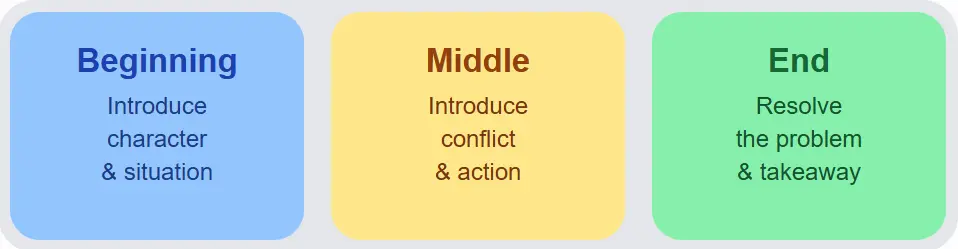
Beginning, middle, and end
The simplest and most universal structure.
This works particularly well for blogs and educational writing because readers immediately understand the flow.
The three-act structure
Widely used in films and long-form narratives, the three-act model divides the story into:
- Setup: Introduce the world and characters
- Confrontation: Present obstacles and rising tension
- Resolution: Solve the conflict and conclude
For example, a startup founder from Pune launches an eco-friendly product, struggles to find customers, and eventually succeeds after refining the business model.
Problem–solution storytelling
This is one of the strongest structures for content writing and business communication.
| Stage | Example |
| Problem | A Jaipur handicraft store isn’t getting online sales |
| Challenge | Low visibility and limited customer trust |
| Solution | Improved website, storytelling, and local SEO |
| Result | Increased enquiries and repeat customers |
Because readers often search for solutions, this framework aligns naturally with informational search intent.
Hero’s journey (brief introduction)
The Hero’s Journey is a classic storytelling model where an ordinary person faces challenges, grows through experience, and returns transformed.
In practical writing, you don’t need all its literary stages. The underlying idea is enough:
Ordinary life → Challenge → Growth → Outcome
This structure works well in motivational writing and customer success stories.
Storytelling Techniques Every Writer Should Know
Great stories are rarely accidental. They rely on deliberate writing techniques that improve clarity and engagement.
Start with a compelling hook
The first few sentences determine whether readers continue.
Instead of writing:
India's cities are becoming hotter every year.
Try:
At 6 a.m., Hyderabad was already 34°C. Street vendors hadn't even opened their shops, yet the heat had begun shaping everyone's day.
A strong hook creates curiosity before delivering information.
Show, don’t tell
One of the most valuable storytelling principles is showing readers the experience instead of explaining the emotion directly.
| Telling | Showing |
| Ravi was nervous. | Ravi checked his watch for the fifth time and wiped his palms before entering the interview room. |
Showing encourages readers to experience the moment rather than being told what to feel.
Use meaningful dialogue
Dialogue reveals personality and advances the story.
Example
"Will anyone actually buy handmade notebooks online?" Neha asked.
Her grandmother smiled. "Start with one customer. Stories spread faster than advertisements."
Notice how the dialogue communicates optimism without becoming unrealistic.
Build suspense through pacing
Pacing controls how quickly information is revealed.
Fast pacing suits action and news reporting. Slower pacing works when building emotional moments.
For example, describing every detail of a cricket final before revealing the last-ball result creates suspense. Revealing it immediately removes narrative tension.
Continue reading: Pacing in Writing and Suspense in Writing
Use sensory details and imagery
Sensory writing helps readers visualise scenes.
Instead of saying:
The market was crowded.
Write:
The aroma of masala chai mixed with fresh jasmine flowers as cyclists weaved through the busy lanes of Mysuru's morning market.
Readers can almost experience the environment themselves.
Continue reading: Imagery in Writing
End with a satisfying resolution
Every story should reward the reader.
A satisfying ending might include:
- A lesson learned
- A solved problem
- A practical takeaway
- A meaningful transformation
Avoid endings that feel abrupt or unrelated to the opening.
Where Is Storytelling Used?
Storytelling in writing is surprisingly versatile because different industries use it for different purposes.
| Field | How storytelling is used |
| Journalism | Human-interest reporting and feature stories |
| Marketing | Customer success stories and brand narratives |
| Education | Explaining difficult concepts through examples |
| Business | Case studies and company journeys |
| Healthcare | Patient awareness and public communication |
| Nonprofits | Social impact and fundraising campaigns |
| Digital Content | Blogs, newsletters, podcasts, and videos |
If you’re exploring different writing formats, our Types of Writing guide explains where storytelling overlaps with narrative, descriptive, persuasive, and journalistic writing.
Storytelling Examples Across Different Types of Writing
The same storytelling technique looks different depending on the writing format.
Blog article example
A travel blog about Meghalaya becomes stronger when it begins with a traveller’s experience crossing the Living Root Bridges instead of immediately listing tourist attractions.
The story creates emotional investment before providing practical travel information.
Journalistic writing example
A newspaper feature on flooding in Assam may begin with the daily routine of a local family rather than rainfall statistics.
The statistics remain important, but the human story gives them meaning.
Brand storytelling example
A sustainable clothing brand in Surat could introduce its founder’s journey from textile waste to eco-friendly fashion instead of only discussing product quality.
Readers connect with purpose before products.
Educational writing example
A science lesson explaining renewable energy becomes easier when students follow Aisha’s school project in Bhopal, where she builds a simple solar-powered model to solve a real community problem.
The concept becomes concrete through narrative.
Common Mistakes in Storytelling
Many writers assume more drama automatically creates better stories. The opposite is often true.
Beginning too slowly
Long introductions delay the actual story.
Readers should understand the situation within the first few paragraphs.
Adding unnecessary details
Every description should serve the narrative.
If removing a sentence changes nothing, it probably isn’t necessary.
Making the story unrealistic
Authenticity matters more than dramatic exaggeration.
Real experiences usually feel more persuasive than overly perfect stories.
Weak or unrealistic dialogue
Dialogue should sound natural.
People rarely speak in long explanatory paragraphs. Read dialogue aloud to check whether it feels believable.
Forgetting the reader’s purpose
A beautiful story still fails if readers never understand the main idea.
Always connect narrative with information.
Overusing descriptive language
Description adds atmosphere, but excessive detail slows pacing.
Choose specific, meaningful details instead of describing everything equally.
⚠️ Storytelling in Writing: Common Mistake
Many beginners confuse storytelling with adding drama. Effective storytelling is not about making every situation emotional, it’s about making ideas meaningful and relevant to the reader’s purpose.
Don’t add a story simply because storytelling is popular. If the narrative doesn’t improve clarity, credibility, or engagement, it becomes a distraction rather than a technique.
How Can You Improve Your Storytelling Skills?
Storytelling is a learnable skill. Consistent practice matters more than natural talent.
Read stories analytically
Don’t just enjoy good writing … study it.
Ask yourself:
- How did the introduction create curiosity?
- Where was the conflict introduced?
- Why did the ending feel satisfying?
Reading like a writer improves your own storytelling instincts.
Rewrite ordinary events as narratives
Choose everyday experiences.
Examples include:
- Missing a train in Mumbai
- Visiting Durga Puja in Kolkata
- Attending a family wedding in Jaipur
- Taking a ferry in Kochi
Practise turning simple events into engaging stories with a clear beginning, middle, and end.
Observe real conversations
Natural dialogue comes from listening.
Pay attention to pauses, interruptions, humour, and regional expressions without stereotyping speakers. Authentic conversations improve character credibility.
Practise writing short scenes
Instead of writing complete stories, write 200-word scenes.
Focus separately on:
- Dialogue
- Setting
- Conflict
- Description
- Emotional moments
Short practice sessions build stronger storytelling habits.
Get feedback and revise
First drafts rarely become excellent stories.
Ask readers questions like:
- Which part felt most engaging?
- Where did your attention drop?
- Was the ending satisfying?
- Did anything feel confusing?
Revision is where storytelling becomes clearer and more impactful.
Storytelling vs Narrative Writing: What’s the Difference?
Many writers use these terms interchangeably, but they are not the same.
| Storytelling | Narrative writing |
| A writing technique | A type of writing |
| Used across many writing formats | One of the major writing categories |
| Focuses on engagement and emotional connection | Focuses on telling events in sequence |
| Can appear in blogs, marketing, journalism, and business writing | Common in essays, memoirs, and fiction |
In simple words, narrative writing is what you write, while storytelling is how you write it.
If you’re new to this distinction, continue learning with Narrative Writing.
✅ Key Takeaways
- Storytelling is a writing technique, not a writing type.
- It strengthens many forms of writing rather than replacing them.
- Strong stories combine characters, conflict, structure, and purpose.
- These elements create clarity and emotional engagement.
- Storytelling works in blogs, journalism, marketing, education, and business writing.
- Its value extends far beyond fiction.
- Hooks, dialogue, pacing, and imagery improve reader engagement.
- These practical techniques make content more memorable.
- The best storytelling always serves the reader’s purpose.
- A story should clarify the message, not distract from it.
Conclusion
Storytelling in writing is a skill every writer should have. It is an important part of developing the ability to write effectively. Stories are able to create connections between people and concepts; something facts will never be able to do.
As such, whether you are developing materials for use in education, SEO blog posts, business writing, or reporting on current events, stories provide a way for your audience to relate to your concepts and ideas in ways that facts alone do not.
Frequently Asked Questions
What is storytelling in writing?
Storytelling in writing is the technique of communicating ideas through characters, setting, conflict, and resolution to create an engaging and memorable reading experience.
Is storytelling only used in fiction?
No. Storytelling is widely used in blogs, journalism, marketing, business writing, education, and even technical communication to make information more relatable.
What’s the difference between storytelling and narrative writing?
Narrative writing is a type of writing, while storytelling is a technique that can strengthen many different writing formats.
How can beginners improve storytelling skills?
Read stories analytically, practise writing short scenes, observe real conversations, rewrite everyday experiences, and revise based on feedback.
Why is storytelling important in writing?
It increases reader engagement, improves information retention, creates emotional connection, and helps explain complex ideas more effectively.
Can storytelling be used in business writing?
Yes. Business writing often uses storytelling in customer success stories, case studies, founder journeys, presentations, and brand communication.
What are the most effective storytelling techniques?
Some of the strongest techniques include writing compelling hooks, showing instead of telling, using meaningful dialogue, controlling pacing, and adding sensory details.
How do hooks improve storytelling?
A hook captures attention within the opening sentences, creates curiosity, and encourages readers to continue reading.
Does every article need a story?
No. Storytelling should support the reader’s purpose. Informational articles benefit from short, relevant stories, but unnecessary narratives can reduce clarity.
Which writing technique should I learn after storytelling?
A natural next step is learning Show, Don’t Tell, followed by Dialogue in Writing, Pacing in Writing, and Writing Hooks, as these techniques work closely with effective storytelling.

Sachin is a Postgraduate in Technical Writing in Business Management specializing in creating SEO-friendly, User-friendly, and Reader-focused website articles on Education, Tech, Sports, Games, and Entertainment.
Through Write Knowledge, he helps students, bloggers, editors, and professionals develop practical writing skills using clear explanations, real-world examples, and internationally recognized writing standards.