Copywriting is one of the most widely recognised writing careers, but it is also one of the most misunderstood.
Many people assume that copywriting simply means writing advertisements. In reality, professional copywriters create words designed to influence decisions, generate interest, and encourage specific actions.
A copywriter may write a short social media advertisement in the morning, a product landing page in the afternoon, and an email campaign the next day. The formats may change, but the underlying goal remains similar: use language strategically to move the reader toward an intended response.
This makes copywriting different from many other forms of professional writing. It combines writing ability with audience understanding, psychology, research, marketing, creativity, and strategy.
💡 Quick Answer
Copywriting is a professional writing career focused on creating persuasive written content that encourages a reader to take a specific action, such as buying a product, signing up for a service, clicking an advertisement, subscribing to an email list, or contacting a business.
Copywriters may create advertisements, sales pages, website copy, email campaigns, product descriptions, social media advertisements, brochures, slogans, and other marketing materials.
What Is Copywriting?
Copywriting is the practice of writing persuasive content for marketing, advertising, sales, and promotional communication.
The word “copy” refers to the written words used in marketing and advertising.
Unlike writing that primarily aims to explain or inform, copywriting is usually created with a specific response or action in mind.
For example, a copywriter might write:
Discover a faster way to organise your team’s projects.
The sentence isn’t simply providing information. It is positioning a product as a solution to a problem and encouraging the reader to become interested.
A copywriter therefore has to think beyond grammar and sentence construction.
They need to ask:
- Who is the audience?
- What does the audience want?
- What problem are they facing?
- What motivates them?
- What makes the product or service valuable?
- What objection might prevent action?
- What should the reader do next?
That combination of writing and strategic thinking is what makes copywriting a distinct professional skill.
What Does a Copywriter Do?
The exact responsibilities of a copywriter depend on their specialisation and workplace.
However, a professional copywriter may be responsible for:
- Researching an audience
- Understanding a product or service
- Studying competitors
- Developing marketing messages
- Writing advertising copy
- Creating headlines
- Writing website copy
- Creating email campaigns
- Writing product descriptions
- Developing calls to action
- Revising copy based on feedback
- Testing different versions of copy
A copywriter may also work closely with SEO specialists, designers, marketing managers, sales teams, product teams, and business owners.
This means copywriting is rarely an isolated writing activity.
It is often part of a larger marketing and communication process.
📝 A Simple Copywriting Example
Imagine an online store selling running shoes.
A basic product statement might say:
Lightweight running shoes with breathable mesh.
A copywriter could turn the same information into:
Run lighter and stay comfortable mile after mile with breathable shoes designed to keep your feet feeling fresh.
The second version still communicates the product’s features, but it connects those features to a potential benefit for the customer.
That is one of the fundamental principles of copywriting: features explain what something has; benefits explain why the reader should care.
Why Choose Copywriting as a Career?
Copywriting can be an attractive career for people who enjoy writing but also want to work in marketing, advertising, business, or digital communication.
High Demand Across Industries
Almost every organisation needs marketing communication.
Businesses need copy for:
- Websites
- Advertisements
- Product launches
- Email campaigns
- Social media
- E-commerce stores
- Brochures
- Sales materials
- Landing pages
- Promotional campaigns
This means copywriters can work across industries rather than being limited to a single sector.
Multiple Specialisations
Copywriting is not one single job.
A writer might specialise in:
- Advertising copy
- Website copy
- Email copywriting
- E-commerce copywriting
- SEO copywriting
- Technical copywriting
- Social media copy
- B2B copywriting
- Direct-response copywriting
- Product copywriting
This variety allows writers to gradually develop expertise in an area that matches their interests.
Freelance and Remote Opportunities
Copywriting can also be suitable for freelance work.
A freelance copywriter may work with several clients instead of being employed by one organisation.
Depending on the client and role, copywriting jobs can also be performed remotely.
Is Copywriting a Good Career for Beginners?
Copywriting can be a promising career for beginners, particularly those willing to develop both writing and marketing skills.
You don’t have to begin by writing major advertising campaigns for large brands.
A beginner can start by practising:
- Headlines
- Product descriptions
- Social media advertisements
- Email subject lines
- Landing-page sections
- Calls to action
- Short promotional messages
The important thing is to understand why a piece of copy works, rather than simply copying the surface style of successful advertisements.
A beginner who understands audience needs, benefits, clarity, persuasion, and calls to action can gradually take on more complex projects.
Do You Need a Degree to Become a Copywriter?
No specific degree is universally required to become a copywriter.
Degrees in areas such as English, journalism, marketing, advertising, communications, business, or media can be useful, but they aren’t the only routes into the profession.
A copywriting career is strongly portfolio-driven.
Employers and clients generally want evidence that you can write effectively for a specific audience and achieve a particular communication objective.
Your portfolio can therefore become more important than simply listing a qualification on your résumé.
Essential Copywriter Skills
Successful copywriting requires more than good grammar.
A copywriter needs to understand both language and people.
Strong Writing Skills
Clear writing is the foundation of copywriting.
Copywriters need to communicate ideas efficiently without making the reader work unnecessarily hard to understand the message.
This includes:
- Sentence construction
- Grammar
- Punctuation
- Clarity
- Conciseness
- Vocabulary
- Tone
- Structure
A copywriter may have only a few seconds to capture someone’s attention, particularly in digital advertising.
Audience Awareness
Copywriting always starts with the audience.
A copywriter needs to understand:
- Who the reader is
- What the reader wants
- What problem they have
- What motivates them
- What objections they may have
- What language they naturally use
A message aimed at university students will not necessarily work for senior business executives.
The copy needs to reflect the audience.
Persuasion
Persuasion is at the centre of copywriting.
Copywriters use different approaches to communicate value and encourage action.
These may include:
- Benefits
- Emotional appeals
- Social proof
- Authority
- Urgency
- Specificity
- Problem-solution framing
- Calls to action
Persuasion should not mean making unsupported claims or manipulating readers. Effective copy should communicate genuine value clearly.
Research Skills
Copywriters frequently write about products, services, industries, and audiences they don’t know deeply.
Research helps them understand:
- Products
- Competitors
- Customers
- Industry terminology
- Market positioning
- Customer concerns
- Existing marketing messages
Strong research makes copy more credible and specific.
Editing and Proofreading
First drafts are rarely final drafts.
Copywriters regularly revise their work to remove:
- Repetition
- Weak phrases
- Unnecessary words
- Confusing sentences
- Unsupported claims
- Inconsistent messaging
Editing is particularly important in copywriting because even a small change in wording can affect clarity and persuasion.
Brand Voice
A copywriter must learn how a brand communicates.
One company may use a professional and authoritative tone, while another may use casual, humorous language.
Maintaining a consistent voice across websites, advertisements, emails, and social media helps create a recognisable brand identity.
This is also where familiarity with Writing Style Guides becomes useful. Formal guides and internal brand style guides are not the same thing, but both help writers maintain consistency in language, presentation, and editorial decisions.
Types of Copywriting Career/Jobs
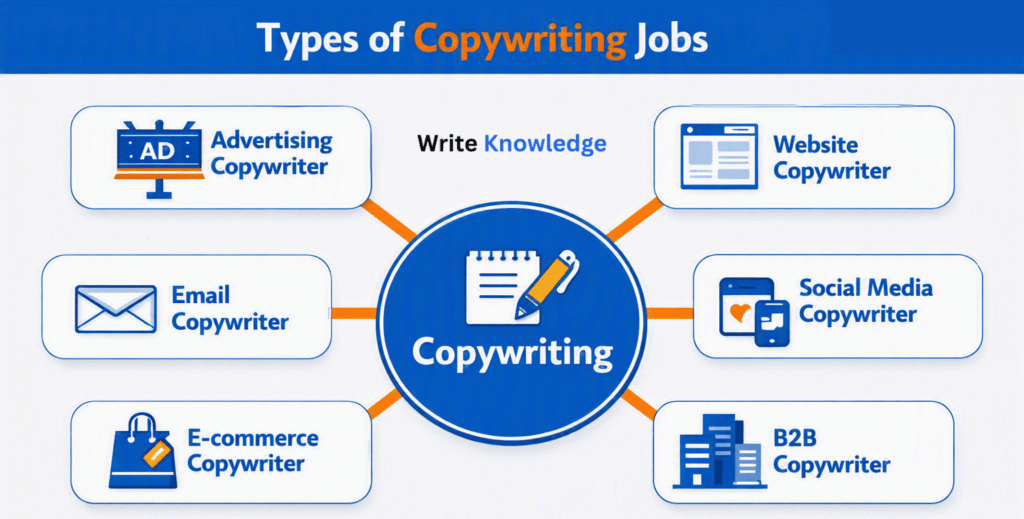
There are many different types of copywriting jobs, and each requires a slightly different combination of skills.
Advertising Copywriter
Advertising copywriters create words for advertising campaigns.
They may write:
- Digital advertisements
- Print advertisements
- Billboard copy
- Video advertisement scripts
- Radio advertisements
- Campaign slogans
- Headlines
Their work is often highly concise because advertising space and audience attention are limited.
Website Copywriter
Website copywriters create persuasive content for websites.
They may write:
- Home pages
- About pages
- Service pages
- Landing pages
- Product pages
- Calls to action
- Conversion-focused sections
The goal is often to help visitors understand the business while encouraging them to take the next step.
Email Copywriter
Email copywriters create promotional and relationship-building email campaigns.
Their work may include:
- Subject lines
- Promotional emails
- Product launch emails
- Welcome sequences
- Sales sequences
- Newsletter copy
- Calls to action
Email copywriting requires particularly strong understanding of audience attention because readers can ignore or delete a message instantly.
E-commerce Copywriter
E-commerce copywriters create copy designed to help online stores sell products.
Typical projects include:
- Product descriptions
- Category pages
- Product comparison copy
- Promotional campaigns
- Buying guides
- Product advertisements
The writer must communicate product features while helping customers understand the benefits and reasons to purchase.
B2B Copywriter
B2B copywriters create marketing communication for businesses selling products or services to other businesses.
They may write:
- Business websites
- Case studies
- White papers
- Lead-generation landing pages
- Sales emails
- Product pages
- Industry reports
B2B copywriting often requires deeper research because products and purchasing decisions can be complex.
Social Media Copywriter
Social media copywriters create short-form marketing messages for platforms such as LinkedIn, Instagram, Facebook, and other social networks.
They need to understand:
- Audience behaviour
- Platform conventions
- Short-form writing
- Brand voice
- Engagement
- Calls to action
Social media copy is often brief, but that doesn’t mean it is easy to write. The writer has to communicate the intended message within a very limited space.
Copywriting vs Content Writing
Copywriting and content writing are closely related, but their primary purposes are different.
Content writing generally focuses on informing, educating, engaging, or providing useful information to readers.
Copywriting generally focuses on persuasion and encouraging an action.
For example, a content writer may create an article explaining how running shoes differ, while a copywriter may create the product page designed to convince the reader to purchase a particular pair.
The distinction is not always absolute. Modern writers often work across both areas, and the two professions overlap in digital marketing.
If you want to understand the broader responsibilities, specialisations, tools, and career progression of content writers, our Content Writing Career guide provides a detailed look at that profession.
Copywriting vs SEO Writing
Copywriting and SEO writing can also overlap, especially when writers create website pages, product pages, or search-focused commercial content.
The main distinction is their primary objective.
SEO writing focuses heavily on search visibility, search intent, organic traffic, and creating content that satisfies both users and search engines.
Copywriting focuses more heavily on persuasion, conversion, and motivating the reader to act.
A writer can therefore develop skills in both fields.
For example, an SEO writer may help a business attract visitors through search, while a copywriter may turn those visitors into customers through persuasive landing-page copy.
If you’re interested in the search-focused side of the profession, our SEO Writing Career guide explains the skills, job types, tools, portfolio requirements, salary considerations, and career progression associated with SEO writing.
Copywriting and Other Types of Writing
Copywriting is one part of the much broader writing field.
Understanding different types of writing helps aspiring copywriters recognize how purpose changes the way a message is constructed. For example, persuasive writing is closely connected to copywriting because both aim to influence the reader, while descriptive writing can help a copywriter make a product or experience easier to imagine.
A copywriter may therefore use techniques associated with several writing types while keeping persuasion as the central objective.
Copywriting Portfolio: What Should You Include?
A copywriting portfolio demonstrates what you can actually do.
Beginners often worry about not having client work. Fortunately, you can create speculative or practice copywriting samples to demonstrate your skills.
A beginner portfolio could include:
- A product description
- A landing page
- An email campaign
- A social media advertisement
- A Google-style advertisement
- A homepage
- A promotional campaign
- A product launch concept
- A B2B service page
Quality matters more than quantity.
Five strong, carefully edited samples are usually more useful than twenty weak examples.
How to Build a Copywriting Portfolio Without Experience
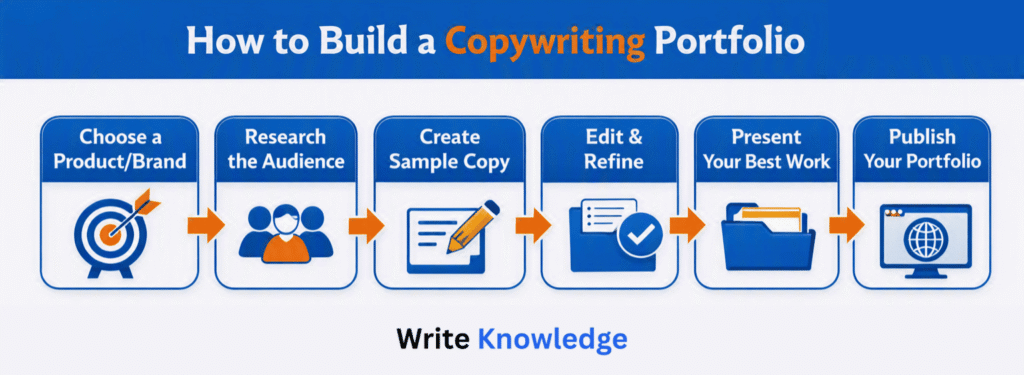
You can create fictional projects based on real-world products or businesses.
For example, choose a fictional coffee brand and create:
- A homepage headline
- A product description
- A promotional email
- A social media advertisement
- A landing page
This gives prospective employers or clients evidence of how you approach different copywriting formats.
Copywriting Tools Every Beginner Should Know
Copywriters use a variety of tools depending on their role.
Writing and Editing Tools
Common tools include:
- Microsoft Word
- Google Docs
- Grammarly
- LanguageTool
- Hemingway Editor
These can help with drafting, editing, grammar, readability, and collaboration.
Research Tools
Copywriters may also use:
- Google Search
- Google Trends
- Industry publications
- Customer reviews
- Competitor websites
- Social media platforms
Research helps copywriters understand what customers actually care about.
SEO and Analytics Tools
Copywriters who work on digital marketing projects can benefit from basic SEO knowledge and tools.
Depending on the role, this might include:
- Google Search Console
- Google Trends
- Ahrefs
- Semrush
- Rank Math
Not every copywriter needs advanced SEO knowledge, but understanding search behaviour can expand career opportunities.
AI Productivity Tools
AI tools can assist copywriters with brainstorming, idea generation, alternative headlines, outlining, and editing.
However, AI should support rather than replace professional judgment.
A copywriter still needs to verify claims, understand the audience, maintain brand voice, and make the final editorial decisions.
Copywriting Career Progression
Copywriting careers can develop in several directions.
A possible progression might look like:
Copywriting Intern → Junior Copywriter → Copywriter → Senior Copywriter → Copy Lead → Creative Director
However, not every writer follows this exact path.
Some move into:
- Content strategy
- Brand strategy
- Marketing
- Creative direction
- SEO
- Content management
- Freelancing
- Consulting
Freelance vs Full-Time Copywriting
Both career paths have advantages.
| Freelance Copywriting | Full-Time Copywriting |
| Flexible schedule | Stable employment |
| Multiple clients | One primary employer |
| Choose projects | Structured workflow |
| Potential for higher rates | Employee benefits |
| Location flexibility | Team collaboration |
| Requires client acquisition | Less responsibility for finding work |
Freelancing provides independence, but it also turns the writer into a business operator.
You need to manage clients, proposals, contracts, payments, deadlines, revisions, and workload.
Full-time employment can provide mentorship, teamwork, and structured career development.
Neither path is automatically better.
The right choice depends on your personality, financial priorities, career goals, and preferred working environment.
Copywriter Salary and Earning Potential
One of the most common questions about a copywriting career is:
How much does a copywriter earn?
There is no universal salary because compensation varies considerably according to:
- Experience
- Location
- Industry
- Specialisation
- Portfolio quality
- Employer
- Employment type
- Client base
- Ability to generate business results
Entry-level writers typically focus on developing their skills and portfolio.
As writers gain experience, they may specialise in areas such as B2B, technology, finance, healthcare, e-commerce, or direct-response copywriting.
Specialisation can increase earning potential because clients may be willing to pay more for writers who understand both copywriting and the industry they serve.
Freelancers may charge:
- Per word
- Per project
- Per page
- Per campaign
- Hourly
- Monthly retainer
Experienced freelancers often move away from purely word-based pricing and instead price projects according to complexity, strategic value, and expected deliverables.
How to Start a Copywriting Career
If you’re wondering how to become a copywriter, you don’t need to master everything at once.
Step 1: Learn the Fundamentals
Develop strong foundations in:
- Grammar
- Sentence construction
- Punctuation
- Clarity
- Conciseness
- Tone
- Editing
Step 2: Study Good Copy
Read advertisements, landing pages, emails, product pages, and campaigns.
Ask yourself:
Why did the writer choose these words?
What benefit is being communicated?
Who is the intended audience?
What action is the reader expected to take?
Step 3: Practise Different Formats
Write practice samples across several formats.
Try creating:
- Headlines
- Product descriptions
- Landing pages
- Emails
- Advertisements
- Social media copy
Step 4: Build a Portfolio
Choose your strongest samples and present them professionally.
Don’t wait for a client before building evidence of your abilities.
Step 5: Choose a Specialization
Once you understand the basics, consider specialising in an area such as:
- Technology
- Finance
- Healthcare
- E-commerce
- SaaS
- B2B
- Advertising
- SEO
Step 6: Look for Opportunities
Beginners can explore:
- Internships
- Junior copywriting jobs
- Freelance projects
- Agency positions
- Contract roles
- Direct outreach to businesses
Every genuine project can help strengthen your portfolio and professional experience.
Common Mistakes New Copywriters Make
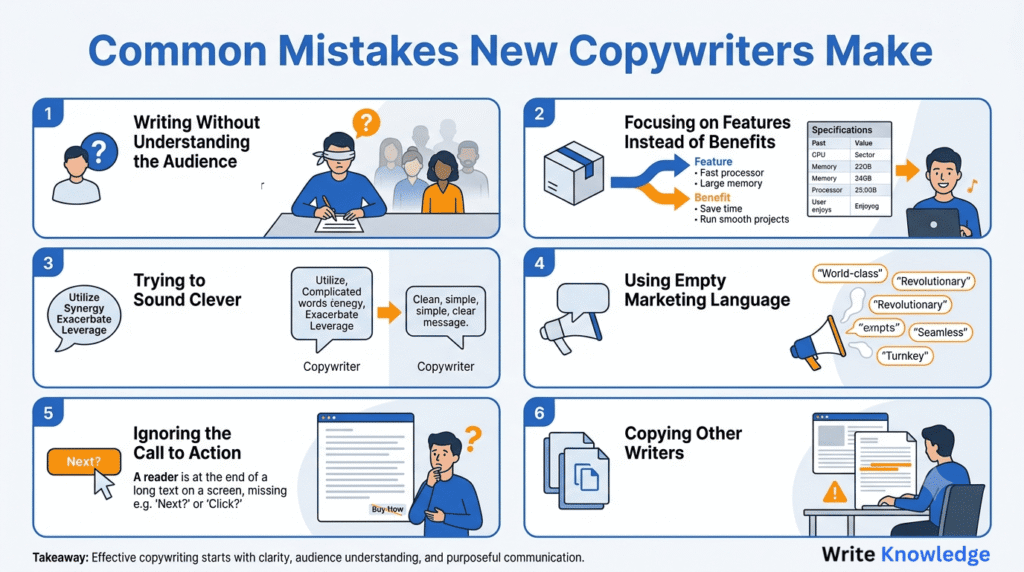
Writing Without Understanding the Audience
A copywriter cannot persuade an audience they don’t understand.
Always research the target customer before writing.
Focusing on Features Instead of Benefits
Features tell readers what a product has.
Benefits explain why that feature matters.
Good copy often connects the two.
Trying to Sound Clever
Complex vocabulary and clever phrases don’t automatically make copy persuasive.
Clarity usually wins.
Using Empty Marketing Language
Phrases such as best-in-class, revolutionary, world-class, and cutting-edge can become meaningless when unsupported.
Specific claims are generally more credible.
Ignoring the Call to Action
Readers should understand what they are expected to do next.
Depending on the context, the CTA might be:
- Buy now
- Sign up
- Download
- Contact us
- Request a demo
- Learn more
Copying Other Writers
Studying successful copy is useful.
Copying it is not.
Learn the underlying principles and develop your own ability to communicate.
What Is the Future of Copywriting?
Copywriting is changing alongside digital marketing and artificial intelligence.
AI tools can generate drafts, variations, headlines, product descriptions, and other forms of marketing copy quickly.
That does not mean human copywriters have become unnecessary.
Businesses still need people who can:
- Understand audiences
- Develop messaging strategies
- Research customers
- Recognise weak claims
- Understand brand identity
- Make editorial decisions
- Evaluate AI-generated material
- Connect writing with business objectives
The future copywriter may therefore work alongside AI rather than compete directly with it.
✅ Key Takeaways
- Copywriting is a professional writing career focused primarily on persuasion and action.
- Copywriters work across advertising, websites, email, e-commerce, social media, and business communication.
- Strong writing ability alone is not enough; audience awareness and marketing knowledge are equally important.
- A specific degree is not universally required to become a copywriter.
- A strong portfolio can be particularly valuable when applying for copywriting jobs.
- Copywriters can specialise in areas such as advertising, e-commerce, B2B, email, website, social media, or SEO-related copy.
- Both freelance and full-time copywriting careers offer opportunities for professional growth.
- Understanding other writing disciplines can make copywriters more versatile.
- Basic knowledge of Writing Style Guides can help writers maintain consistency in professional environments.
- AI is changing copywriting, but human creativity, strategy, research, judgment, and audience understanding remain important.
📚 Continue Learning
Copywriting is only one part of the wider writing profession. If you’re exploring other professional paths, our Writing Careers resources cover additional opportunities.
Conclusion
Copywriting combines writing with persuasion, audience understanding, marketing, and strategy. It can lead to opportunities across advertising, e-commerce, digital marketing, publishing, technology, and many other industries.
A copywriting career does not require you to know everything from the beginning. What matters is the willingness to keep learning, understand the audience, improve your work, and develop the ability to turn words into meaningful action.
Frequently Asked Questions
What does a copywriter do?
A copywriter creates persuasive written content for advertising, marketing, sales, websites, email campaigns, product pages, social media, and other promotional communication.
How do I become a copywriter?
Start by learning writing fundamentals, studying effective copy, practising different formats, building a portfolio, developing marketing knowledge, and applying for entry-level or freelance opportunities.
Can I become a copywriter without a degree?
Yes. There is no universally required degree for copywriting. Writing ability, marketing knowledge, practical experience, and portfolio quality can be more important when employers or clients evaluate copywriters.
Is copywriting a good career for beginners?
Copywriting can be a suitable career for beginners who enjoy writing, research, persuasion, marketing, and understanding audiences. Beginners can start by creating practice samples before seeking paid work.

Sachin is a Postgraduate in Technical Writing in Business Management specializing in creating SEO-friendly, User-friendly, and Reader-focused website articles on Education, Tech, Sports, Games, and Entertainment.
Through Write Knowledge, he helps students, bloggers, editors, and professionals develop practical writing skills using clear explanations, real-world examples, and internationally recognized writing standards.