The demand for quality content has grown dramatically over the last decade. Every website, business, online publication, educational platform, and digital brand needs well-written content to educate readers, build trust, improve search visibility, and communicate effectively.
As a result, content writing has evolved from a niche profession into one of the fastest-growing writing careers. Today, content writers work across industries including technology, healthcare, finance, education, e-commerce, travel, media, and countless others.
However, content writing is much more than simply writing blog posts. Modern content writers create articles, website copy, product descriptions, email campaigns, landing pages, white papers, case studies, scripts, documentation, and much more. Each specialization requires a different combination of writing skills, research ability, industry knowledge, and creativity.
Let’s look the details to get the clear picture of content writing career.
💡 Quick Answer
Content writing is a professional writing career focused on creating valuable, informative, engaging, and search-friendly content for websites, businesses, publications, and digital platforms. Content writers may specialize in areas such as SEO writing, technical writing, copywriting, blogging, UX writing, documentation, or marketing content.
What Is Content Writing?

In a nutshell, content writing is the process of planning, researching, writing, editing, and optimizing written material for a specific audience and purpose.
A content writer may produce:
- Blog articles
- Website pages
- Product descriptions
- Landing pages
- News articles
- Technical documentation
- White papers
- Case studies
- Email newsletters
- Social media captions
- Video scripts
- Knowledge base articles
Although the formats vary, the goal remains the same: communicate information clearly and effectively.
Why Choose Content Writing as a Career?
Content writing appeals to many aspiring writers because it combines creativity with practical communication. It offers opportunities across diverse industries, flexible work arrangements, and continuous learning.
Some of the reasons to choose content writing as a career include:
High Demand Across Industries
Nearly every organization with an online presence needs content. Businesses regularly publish blogs, update websites, launch products, create documentation, and communicate with customers through digital channels.
This creates steady demand for skilled writers across multiple sectors.
Multiple Career Paths
Content writing is not limited to one job title. As writers gain experience, they often specialize in areas such as SEO, technical writing, UX writing, healthcare content, finance writing, or content strategy.
These specializations open doors to higher-paying and more specialized roles.
Flexible Work Opportunities
Many content writers work remotely or as freelancers. Others choose full-time employment, contract work, or hybrid roles.
This flexibility makes content writing attractive for professionals seeking location-independent careers.
✍️ Writing Tip
Curiosity is one of the strongest qualities a content writer can develop. Strong writing begins with asking better questions and finding reliable answers.
Is Content Writing the Right Career for You?
Content writing is rewarding, but it also requires discipline, consistency, and continuous improvement.
You may enjoy content writing if you:
- Like explaining complex ideas in simple language
- Enjoy reading and researching new topics
- Pay attention to grammar and clarity
- Can organize information logically
- Are comfortable learning new tools and technologies
- Can adapt your writing style for different audiences
On the other hand, content writing may feel challenging if you strongly dislike research, deadlines, revisions, or writing on unfamiliar subjects.
Understanding your own strengths will help you choose the writing career that best matches your interests and long-term goals.
Types of Content Writing Careers
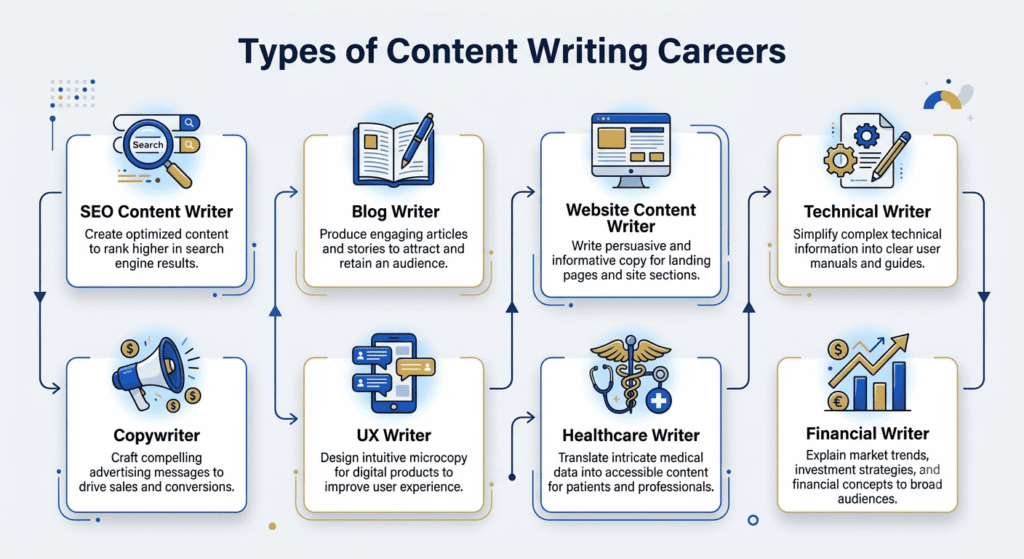
One of the biggest advantages of this profession is its variety. Content writers rarely follow a single career path throughout their working lives. Instead, many gradually specialize in areas that align with their interests, expertise, or industry experience.
Below are some of the most common content writing careers.
SEO Content Writer
SEO content writers create articles and web pages designed to answer readers’ questions while improving a website’s visibility in search engines.
Their responsibilities often include:
- Keyword research
- Search intent analysis
- Content structure
- Internal linking
- On-page optimization
- Readability improvements
SEO writers balance writing for people and search engines without sacrificing quality.
Blog Writer
Blog writers focus on educational, informative, and engaging articles that help organizations build authority, attract readers, and answer customer questions.
Blogs remain one of the most widely used content marketing formats.
Website Content Writer
Website writers create content for:
- Home pages
- About pages
- Service pages
- Product pages
- Landing pages
- FAQ pages
Unlike blogs, website content is often more concise and conversion-focused.
NOTE: SEO content writer, blog writer, and website content writer can also be considered as a single entity. Because their work almost overlaps with each other.
Technical Content Writer
Technical writers explain products, software, systems, or procedures using clear, structured language.
They commonly create:
- User manuals
- Documentation
- API guides
- Installation instructions
- Knowledge base articles
Technical writing requires strong organization and the ability to simplify complex information.
Copywriter
Although often confused with content writing, copywriting focuses primarily on persuasion.
Copywriters create:
- Advertisements
- Sales pages
- Email campaigns
- Product launches
- Marketing campaigns
Their goal is encouraging readers to take action.
📚 Continue Learning
If you’re unsure how content writing differs from other writing disciplines, explore our complete guide on Types of Writing to understand where different writing types fit within the broader writing profession.
Skills Every Content Writer Needs
Successful content writing career is not built on writing ability alone. Employers and clients increasingly look for writers who can research effectively, understand their audience, optimize content for digital platforms, and communicate ideas with clarity.
The following skills form the foundation of a successful content writing career.
Strong Writing Skills
Every content writer must be able to communicate ideas clearly, logically, and accurately.
This includes:
- Writing concise sentences
- Organizing ideas effectively
- Maintaining consistent tone
- Eliminating unnecessary words
- Producing error-free content
Clear writing always outperforms complicated writing.
📝 Example
Instead of writing:
“The implementation of this strategy may potentially facilitate enhanced outcomes.”
Write:
“This strategy can improve results.”
Simple language makes content easier to understand.
Research Skills
Content writers regularly work on topics they have never written about before. Strong research skills help them produce accurate, trustworthy, and valuable content.
Good research involves:
- Identifying reliable sources
- Comparing multiple references
- Verifying facts before publishing
- Understanding complex subjects quickly
- Organizing information logically
Audience Understanding
Great writers always write for readers … not themselves.
Before writing, ask:
- Who is reading this?
- What problems are they trying to solve?
- How much prior knowledge do they have?
- What questions might they ask?
The answers influence vocabulary, structure, examples, and tone.
For instance, an article written for beginners should explain technical concepts that an article for industry professionals may not need to define.
Grammar and Language Skills
Grammar remains one of the strongest indicators of professionalism.
Even outstanding ideas lose credibility if they’re presented with frequent grammatical mistakes.
Content writers should understand:
- Sentence structure
- Subject-verb agreement
- Tenses
- Articles
- Pronouns
- Punctuation
- Word choice
While writing tools can identify many errors, they cannot replace a solid understanding of grammar.
Editing and Proofreading
Writing and editing are two different skills.
Strong writers spend considerable time improving their first drafts by:
- Removing repetition
- Simplifying sentences
- Improving transitions
- Correcting grammar
- Checking consistency
- Verifying facts
Editing transforms a draft into a polished, reader-friendly article.
Time Management
Professional writers frequently manage multiple projects simultaneously.
Good time management helps writers:
- Meet deadlines
- Handle revisions
- Balance research with writing
- Maintain quality under pressure
Planning your writing schedule is often just as important as writing itself.
Adaptability
Content writers rarely write about only one topic.
One week may involve healthcare.
The next may focus on finance, education, technology, or travel.
Being adaptable allows writers to transition between industries while maintaining quality and accuracy.
Basic SEO Knowledge
Modern content writers should understand the fundamentals of search engine optimization.
Although SEO specialists often handle technical optimization, writers benefit from understanding concepts such as:
- Search intent
- Keyword placement
- Heading hierarchy
- Internal linking
- Readability
- Meta descriptions
- Featured snippets
SEO helps readers discover high-quality content.
📌 Remember
Good SEO supports good writing … it should never replace it.
Educational Qualifications
One of the most common questions aspiring writers ask is whether they need a specific degree to become a content writer.
The answer is straightforward:
No formal degree is mandatory.
Many successful content writers come from diverse educational backgrounds, including:
- English
- Journalism
- Marketing
- Mass Communication
- Computer Science
- Business
- Engineering
- Medicine
- Law
Industry expertise can often become a valuable specialization.
For example:
- A software engineer may become a technical writer.
- A doctor may write healthcare content.
- A lawyer may specialize in legal writing.
- A finance graduate may create investment content.
What matters most is your ability to communicate clearly and learn continuously.
Certifications That Can Help
Although certifications cannot replace experience, they demonstrate commitment to professional development.
Useful certifications include:
- SEO Fundamentals
- Content Marketing
- Technical Writing
- Digital Marketing
- UX Writing
- AI Writing Tools
- Editing and Proofreading
Choose certifications that align with your intended specialization rather than collecting certificates without practical application.
Essential Tools Used by Content Writers
Modern content writing involves much more than a word processor.
Professional writers regularly use tools for writing, editing, collaboration, research, optimization, and project management.
Some commonly used categories include:
Writing Tools
- Microsoft Word
- Google Docs
- LibreOffice
Grammar and Editing Tools
- Grammarly
- LanguageTool
- Hemingway Editor
SEO Tools
- Google Search Console
- Google Trends
- Ahrefs
- Semrush
- Rank Math
- Yoast SEO
AI-Assisted Writing Tools
Many writers now use AI to improve productivity while maintaining human oversight.
Examples include:
- ChatGPT
- Claude
- Google Gemini
- Microsoft Copilot
These tools assist with brainstorming, outlining, summarizing, editing, and improving readability, but they should never replace critical thinking, original research, or editorial judgment.
Career Progression in Content Writing
Content writing offers several opportunities for long-term career growth.
A typical progression may look like this:
| Experience Level | Common Role |
| Beginner | Content Writing Intern |
| Entry Level | Junior Content Writer |
| Intermediate | Content Writer |
| Experienced | Senior Content Writer |
| Advanced | Content Editor |
| Leadership | Content Manager |
| Strategic | Content Strategist |
| Executive | Head of Content |
Career progression depends on:
- Writing quality
- Industry expertise
- Communication skills
- Leadership ability
- Business understanding
- Continuous learning
Freelance vs Full-Time Content Writing
One of the biggest career decisions content writers face is choosing between freelancing and traditional employment.
Both paths offer unique advantages.
Freelance Content Writing
Freelancers work independently with multiple clients.
Advantages include:
- Flexible schedules
- Remote work opportunities
- Multiple income sources
- Choice of projects
- Greater independence
Challenges include:
- Finding clients
- Income fluctuations
- Managing taxes and contracts
- Handling revisions and negotiations independently
Full-Time Content Writing
Full-time writers work as employees within organizations or agencies.
Advantages include:
- Stable income
- Structured career progression
- Employee benefits
- Team collaboration
- Professional mentoring
Challenges may include:
- Fixed working hours
- Less project flexibility
- Organizational processes and approvals
There is no universally “better” option. Many writers begin with full-time employment to build experience before transitioning into freelancing later in their careers or combine both through part-time freelance work.
📚 Continue Learning
Interested in exploring more writing opportunities beyond content writing? Our dedicated Writing Careers section introduces a wide range of professional writing paths, including copywriting, technical writing, UX writing, editing, proofreading, and more.
Salary Expectations in Content Writing Career
One of the most common questions aspiring writers ask is:
How much can a content writer earn?
The answer depends on several factors, including experience, specialization, industry, location, writing quality, portfolio strength, and whether you work as a freelancer or a full-time employee.
Unlike many professions with standardized salary structures, content writing offers significant earning potential as your expertise grows.
Entry-Level Content Writers
Writers beginning their careers typically focus on building practical experience, improving writing quality, and understanding editorial workflows.
At this stage, employers generally evaluate:
- Writing ability
- Grammar and language skills
- Research capability
- Learning attitude
- Portfolio quality
Although entry-level salaries vary by region and company size, gaining experience is usually more valuable than maximizing income during the first few years.
Mid-Level Content Writers
After gaining practical experience, writers often become more productive and begin handling:
- Long-form articles
- Website content
- SEO projects
- Client communication
- Content planning
- Editing responsibilities
Writers at this stage usually specialize in one or more industries.
Specialization often leads to better opportunities because businesses value subject-matter expertise alongside writing skills.
Senior Content Writers
Senior writers contribute beyond writing itself.
Their responsibilities may include:
- Mentoring junior writers
- Editing content
- Planning content strategies
- Managing editorial calendars
- Maintaining content quality
- Collaborating with SEO and marketing teams
Specialized Writers Often Earn More
General content writing offers numerous opportunities, but specialization frequently leads to higher compensation.
Some well-paying specializations include:
- Technical Writing
- Medical Writing
- Legal Writing
- Financial Writing
- SaaS Writing
- Cybersecurity Writing
- UX Writing
- AI Content Writing
These roles require industry knowledge in addition to writing expertise.
Freelance Content Writing Income
Freelance writers have greater flexibility in determining how they work and what they charge.
Income depends on factors such as:
- Number of clients
- Project complexity
- Industry specialization
- Experience
- Reputation
- Portfolio quality
- Client retention
Freelancers may charge:
- Per word
- Per article
- Per project
- Hourly
- Monthly retainer
There is no universal pricing model.
Successful freelancers gradually increase their rates as their experience and portfolio grow.
✍️ Writing Tip
Instead of trying to become an expert in every industry, develop deep expertise in one or two areas. Specialists are often easier for employers to trust and are more likely to command higher rates.
Factors That Influence Salary
Two writers with the same job title may earn very different incomes.
Some major factors include:
Experience
Writers with proven experience generally command higher salaries than beginners.
Portfolio Quality
A strong portfolio often influences hiring decisions more than academic qualifications.
Well-written published samples demonstrate practical ability.
Industry Expertise
Specialized knowledge makes writers more valuable.
For example:
- Healthcare
- Finance
- Technology
- Education
- Legal
- SaaS
SEO Knowledge
Many organizations expect writers to understand:
- Search intent
- Keyword optimization
- Heading structure
- Internal linking
- Readability
- Content optimization
Combining strong writing with SEO skills significantly improves employability.
Communication Skills
Professional communication affects client relationships, revisions, teamwork, and long-term career growth.
Strong communication often leads to repeat clients and leadership opportunities.
Industries Hiring Content Writers
Content writers work across almost every modern industry.
Some of the largest employers include:
Technology
Technology companies publish:
- Product documentation
- Blog articles
- Tutorials
- User guides
- Knowledge bases
Technical accuracy is particularly important in this field.
Healthcare
Healthcare organizations require writers for:
- Medical blogs
- Patient education
- Healthcare websites
- Research summaries
- Wellness articles
Writers must communicate complex information clearly while maintaining accuracy.
Finance
Financial content includes:
- Investment blogs
- Banking websites
- Insurance articles
- Tax information
- Business reports
Strong research and accuracy are essential.
Education
Educational organizations publish:
- Study resources
- Learning guides
- Course descriptions
- Academic support materials
Content writers help simplify learning for students.
E-commerce
Online stores require:
- Product descriptions
- Category pages
- Buying guides
- Email campaigns
- Landing pages
Content supports both customer experience and search visibility.
Marketing Agencies
Agencies often manage multiple clients across different industries.
Writers gain exposure to diverse topics while building adaptable writing skills.
Media and Publishing
Traditional and digital publications continue to hire writers for:
- News
- Features
- Reviews
- Opinion pieces
- Industry analysis
These roles frequently follow editorial standards such as AP Style.
How to Become a Content Writer
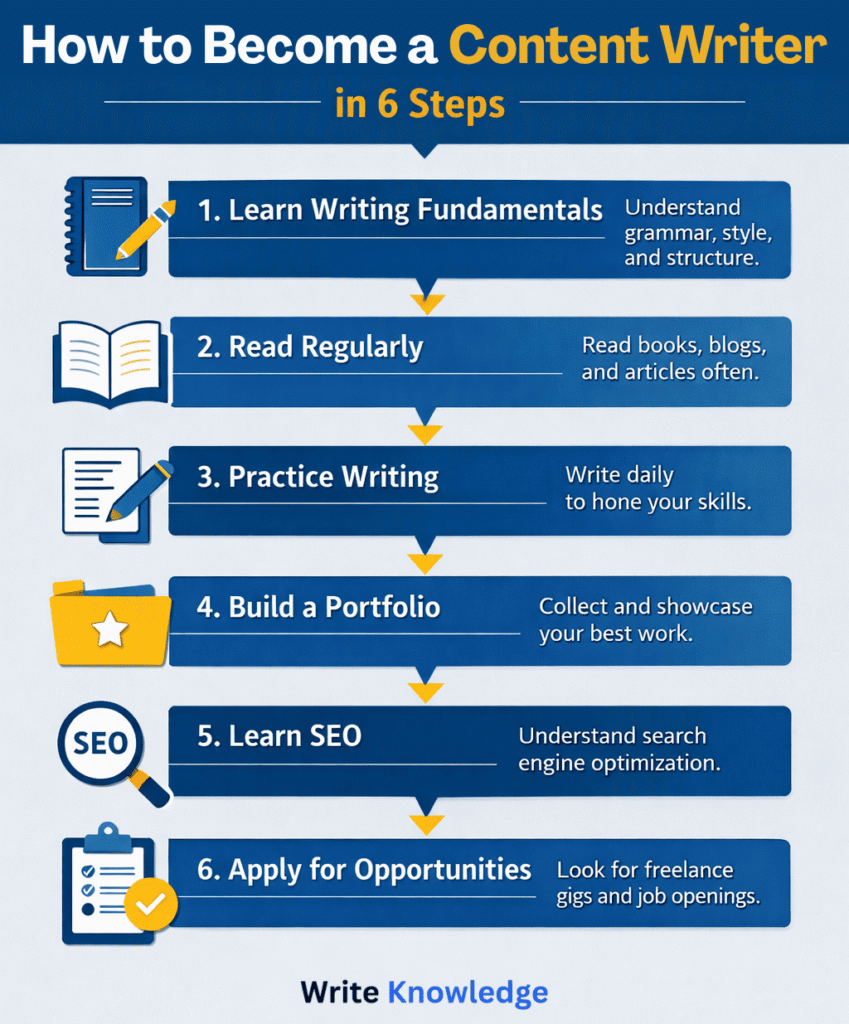
There is no single path into content writing, but the following roadmap works well for most beginners.
Step 1: Learn the Fundamentals
Develop a strong understanding of:
- Grammar
- Punctuation
- Sentence structure
- Readability
- Writing style
Building a strong foundation makes advanced skills much easier to learn later.
Step 2: Read Regularly
Reading exposes writers to:
- Better vocabulary
- Different writing styles
- Article structures
- Professional formatting
- Editorial tone
Writers who read consistently often improve faster.
Step 3: Practice Writing
The fastest way to improve is by writing regularly.
Practice creating:
- Blog posts
- Website pages
- Product descriptions
- Informational articles
- Tutorials
Every article improves both confidence and skill.
Step 4: Build a Portfolio
A portfolio demonstrates your writing ability.
Include samples across different formats whenever possible.
Even self-published articles can showcase your writing during the early stages of your career.
Step 5: Learn SEO
Modern employers increasingly expect writers to understand basic search optimization.
Learning SEO expands your opportunities significantly.
Step 6: Apply for Opportunities
Look for:
- Internships
- Freelance projects
- Agency positions
- Junior content writer roles
Every project strengthens both your experience and your portfolio.
📌 Remember
No writer begins as an expert. Consistent practice, feedback, and continuous learning are what gradually build a successful writing career.
⚠️ Mistakes New Content Writers Make
Many beginners slow their progress by repeating the same avoidable mistakes.
Some of the most common include:
- Writing without understanding the target audience.
- Copying competitors instead of developing original ideas.
- Ignoring grammar and proofreading.
- Keyword stuffing for SEO.
- Publishing without fact-checking.
- Writing overly long sentences.
- Focusing on word count instead of reader value.
- Neglecting formatting and readability.
Avoiding these habits early makes long-term improvement much easier.
Conclusion
Content writing is one of the most accessible and versatile writing careers available today. It offers opportunities across industries, supports both freelance and full-time work, and provides clear pathways for long-term professional growth.
Whether you want to write blogs, optimize content for search engines, create technical documentation, produce website content, or eventually move into content strategy, content writing offers a wide range of career possibilities.
If you’re willing to develop your writing ability, strengthen your research skills, understand your audience, and build a strong portfolio, content writing can become a rewarding and sustainable profession.
✅ Key Takeaways
- Content writing is a professional writing career focused on creating valuable digital content.
- Content writers work across industries such as technology, healthcare, finance, education, media, and e-commerce.
- Strong writing, research, editing, grammar, and communication skills are essential.
- Formal degrees can help, but practical skills and portfolio quality often matter more.
- SEO knowledge significantly improves career opportunities.
- Writers can choose between freelance and full-time career paths.
- Specializations such as technical writing, UX writing, healthcare writing, and finance writing often lead to higher earning potential.
- Building a portfolio is one of the most important steps for beginners.
- Continuous learning is essential for long-term career growth.
- Content writing can evolve into advanced roles such as editor, content manager, strategist, or head of content.
Frequently Asked Questions
What does a content writer do?
A content writer creates written material for websites, blogs, businesses, publications, and digital platforms. This may include articles, website pages, product descriptions, guides, newsletters, documentation, and marketing content.
Do I need a degree to become a content writer?
No.
Many successful content writers come from diverse educational backgrounds. Strong writing skills, research ability, and a quality portfolio are often more important than a specific degree.
What skills are most important for content writers?
The most important skills include:
- Writing
- Research
- Editing
- Grammar
- Audience understanding
- SEO fundamentals
- Communication
- Time management
Can content writers work remotely?
Yes. Content writing is one of the most remote-friendly professions. Many writers work as freelancers, contractors, or remote employees from anywhere with a reliable internet connection.

Sachin is a Postgraduate in Technical Writing in Business Management specializing in creating SEO-friendly, User-friendly, and Reader-focused website articles on Education, Tech, Sports, Games, and Entertainment.
Through Write Knowledge, he helps students, bloggers, editors, and professionals develop practical writing skills using clear explanations, real-world examples, and internationally recognized writing standards.