APA Style is one of the most widely recognised systems for organising, formatting, and documenting academic and research writing.
Students may encounter it while writing essays, research papers, literature reviews, reports, dissertations, and other academic assignments. Researchers, editors, educators, and professional writers may also work with APA Style when preparing scholarly or research-based content.
However, APA Style is about more than putting a citation inside parentheses.
It provides conventions for paper formatting, headings, in-text citations, reference lists, quotations, paraphrasing, tables, figures, numbers, abbreviations, and academic language.
💡 Quick Answer
APA Style is a writing, formatting, and citation system developed by the American Psychological Association and widely used in academic and research writing.
It helps writers:
- Structure academic documents
- Organise headings and sections
- Cite sources within the text
- Create reference lists
- Present quotations and paraphrases
- Format tables and figures
- Maintain consistency in numbers and abbreviations
- Communicate research clearly and responsibly
The basic principle is simple:
When you use information, ideas, words, or evidence from another source, acknowledge that source appropriately and provide enough information for readers to identify it.
What is APA Style?
APA Style is a set of conventions used to present academic and scholarly writing consistently.
The American Psychological Association developed the system, but its use extends well beyond psychology.
APA Style is commonly associated with:
- Psychology
- Education
- Sociology
- Social work
- Behavioural sciences
- Communication
- Nursing
- Public health
- Other research-oriented disciplines
One of APA’s most recognisable features is its author-date citation system.
📝 Example
Regular reading can improve vocabulary development (Martin, 2024).
The citation tells the reader that the statement is connected to a source by Martin published in 2024.
The complete source information can then be found in the reference list.
This relationship between in-text citations and references is central to APA Style.
When Should You Use APA Style?
APA Style should be used when your instructor, institution, journal, publisher, or organisation requires it.
It is especially common in academic and research environments.
For example, a psychology professor may require students to use APA because research studies and publication dates are important to the discipline.
A student shouldn’t choose APA simply because it is popular.
The appropriate writing style guide depends on factors such as:
- Subject
- Discipline
- Audience
- Institution
- Publisher
- Type of document
For example, a psychology research paper and a newspaper article may discuss the same subject but require completely different editorial and citation conventions.
APA Style and Other Writing Style Guides
APA is only one of several major writing style guides.
Other systems include MLA, Chicago, and AP each designed for different writing environments.
| Style Guide | Commonly Associated With | Main Purpose |
| APA Style | Psychology, education, social sciences, research | Academic formatting and author-date citations |
| MLA Style | Literature, languages, humanities | Academic writing and source documentation |
| Chicago Manual of Style | Books, publishing, humanities, scholarly writing | Editorial style, documentation, and publishing |
| AP Style | Journalism, news, media | News and public-facing editorial conventions |
The differences aren’t limited to citation punctuation.
They can affect:
- How sources are cited
- Whether publication dates are prominent
- How references are organised
- How headings are structured
- How numbers are presented
- How technical information is documented
- How quotations and attribution are handled
Understanding these differences becomes particularly important when writers move between academic disciplines or professional environments.
APA vs MLA
APA and MLA are two of the first academic writing styles many students encounter.
Both provide systems for citations and document organisation, but they are associated with different academic traditions.
APA generally emphasises author and publication year.
MLA commonly emphasises author and page number when page information is available.
Compare:
APA: (Smith, 2024)
with:
MLA: (Smith 27)
The difference reflects the priorities of the two systems.
Publication dates can be particularly important in research-oriented APA writing because readers may need to assess how current a source is.
MLA’s author-page approach is particularly useful when analysing specific passages in literary or humanities texts.
APA vs Chicago Style
APA and Chicago Style can both be used for academic work, but they have different systems and traditions.
APA generally uses author-date citations.
Chicago offers multiple documentation systems, including Notes and Bibliography and Author-Date.
For example, a Chicago Notes and Bibliography paper may use a footnote to document a source rather than placing the author’s name and year directly in parentheses.
This difference becomes especially important for students who switch between disciplines.
A rule that is correct in Chicago is not automatically correct in APA.
APA vs AP Style
APA and AP Style are designed for very different writing environments.
APA is strongly associated with academic and research writing.
AP Style is commonly associated with journalism, news reporting, media, and public-facing communication.
Consider a writer reporting on a new research study.
An academic paper might discuss the study using an APA citation:
Recent research found a significant relationship between sleep and academic performance (Johnson, 2025).
A news article would generally approach the same information differently, focusing on clear attribution and concise reporting rather than an academic reference list.
This distinction helps explain why professional writers need to understand not just individual style rules but also the environments in which those rules are used.
Basic APA Style Paper Format
APA formatting gives academic papers a consistent structure.
A typical student paper may contain:
- Title page
- Main text
- References
Depending on the assignment, additional sections may include:
- Abstract
- Tables
- Figures
- Appendices
Your instructor’s instructions should always take priority if they provide specific formatting requirements.
General APA Formatting
Common formatting considerations include:
- Consistent margins
- Readable typography
- Double spacing
- Page numbers
- Clear paragraphs
- Organised headings
- Consistent alignment
- Proper citation formatting
The goal is readability and consistency rather than visual decoration.
Example of a Basic APA Paper Structure
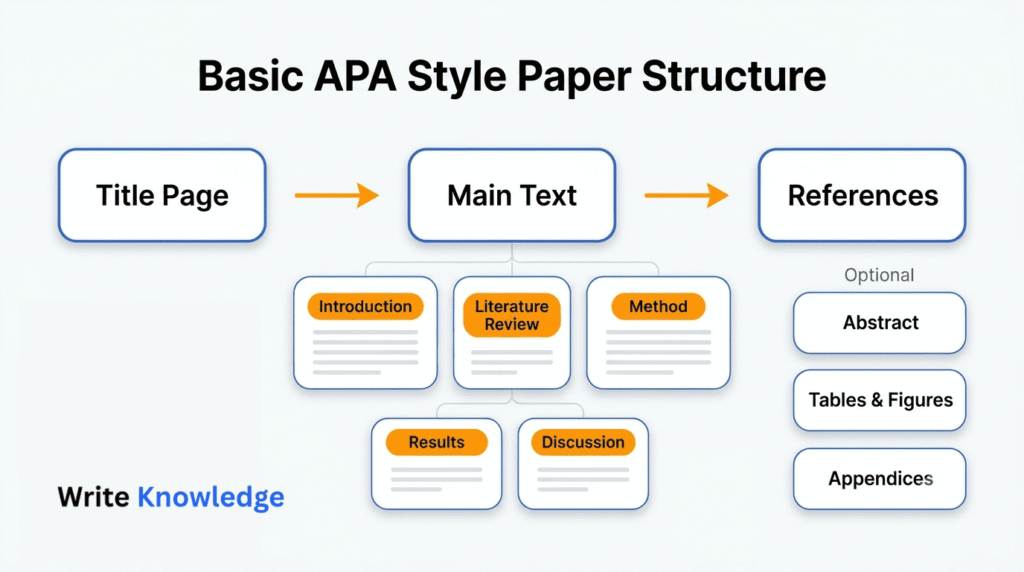
Imagine a student writing a research paper about the effects of social media on sleep.
A simplified structure could look like:
Title Page
Social Media Use and Sleep Patterns Among University Students
Main Text
Introduction
Literature Review
Method
Results
Discussion
References
The headings help readers understand how the research progresses from the problem to the evidence and conclusions.
APA Title Page
The title page identifies the paper and provides essential information about the assignment.
Depending on the type of paper and institutional requirements, it may contain:
- Paper title
- Author name
- Institutional affiliation
- Course information
- Instructor name
- Assignment due date
- Page number
The title should clearly communicate the subject of the paper.
For example:
Weak title:
Social Media
More informative title:
Social Media Use and Sleep Quality Among University Students
The second title gives readers a much clearer idea of what the paper examines.
APA Headings and Subheadings
Headings organise an academic paper into sections and subsections.
APA provides a hierarchy of five heading levels.
You don’t necessarily need all five levels in every paper.
A short essay may require only one or two levels, while a long research paper may need more.
Why APA Headings Matter
Headings help readers understand the relationship between different sections.
For example:
Research Methods
could contain:
Participants
and:
Data Collection
The second-level headings are therefore subordinate to the broader research methods section.
Good headings should describe the content that follows rather than simply making the page look organised.
APA In-Text Citations
In-text citations identify sources within the body of an academic paper.
APA generally uses the author’s surname and publication year.
For example:
Regular physical activity may contribute to improved sleep quality (Patel, 2024).
The reader can then look for Patel (2024) in the reference list.
Parenthetical Citation
A parenthetical citation places the source information in parentheses.
Writing practice can improve communication skills (Brown, 2023).
Narrative Citation
A narrative citation incorporates the author’s name into the sentence.
Brown (2023) found that writing practice can improve communication skills.
Both examples document the same source.
The choice depends on how you want the citation to function within the sentence.
Narrative citations can be especially useful when the identity of the researcher is relevant to your discussion.
APA Citation Examples for Common Sources
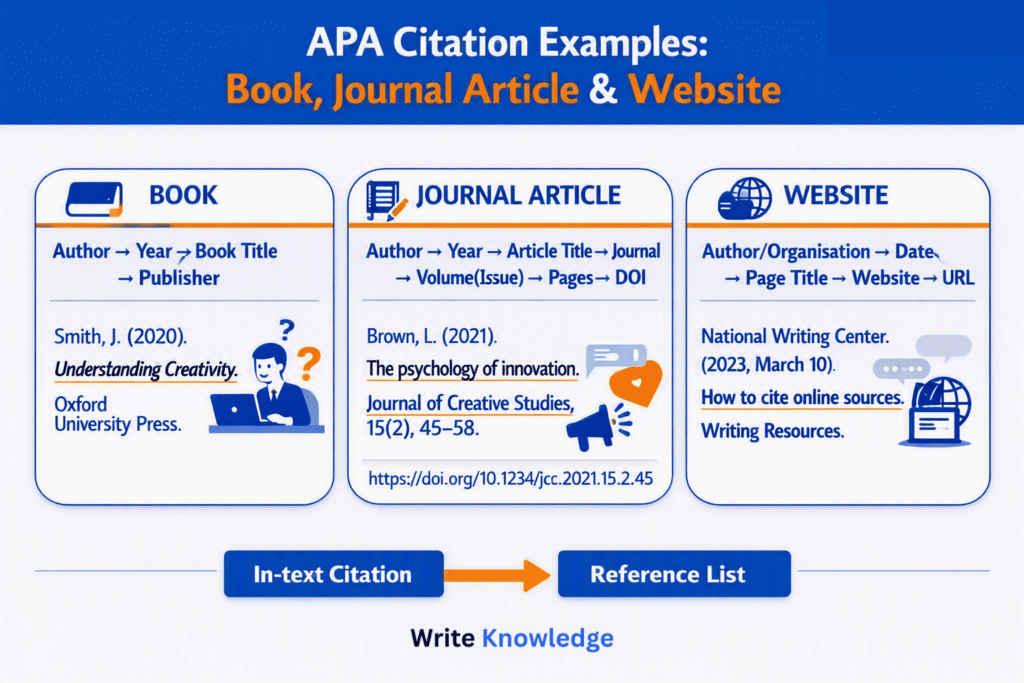
APA reference formats depend on the type of source.
The first step is therefore to identify the source correctly.
How to Cite a Book in APA Style
A simplified book reference follows this general pattern:
Author, A. A. (Year). Title of book. Publisher.
For example:
King, S. (2000). On writing: A memoir of the craft. Scribner.
The exact formatting depends on the source information available and the applicable APA rules.
How to Cite a Journal Article in APA Style
A journal article reference generally contains:
- Author
- Year
- Article title
- Journal title
- Volume
- Issue, when applicable
- Page range
- DOI, when available (Digital Object Identifier)
A simplified example might look like:
Smith, J. A. (2024). Writing habits and academic performance. Journal of Academic Research, 12(2), 45–61. https://doi.org/xxxxx
The journal title and volume information help readers distinguish the article from other publications by the same author.
NOTE about DOI:
a DOI is a permanent identification number for a scholarly work, such as a journal article, research paper, book chapter, or dataset.
For example: https://doi.org/10.1037/0022-0663.99.3.445
Think of it like a permanent address for an academic article.
Why do academic articles have DOIs?
A normal webpage URL can change or stop working if a journal redesigns its website. A DOI is designed to remain associated with the same publication even if the publisher’s website or article URL changes.
So:
Normal URL:https://examplejournal.com/articles/writing-study-2024
DOI:https://doi.org/10.xxxx/xxxxx
The DOI link redirects you to the article’s current location.
What does 10.1037/0022-0663.99.3.445 mean?
You don’t need to understand the individual pieces to use it. The whole string is simply a unique identifier assigned to that particular publication.
And importantly, it isn’t a suspicious link. The dots and numbers are just part of the identifier.
In APA 7
When a journal article has a DOI, APA generally wants you to include it at the end:
Author, A. A. (Year). Title of article. Journal Title, volume(issue), pages. https://doi.org/xxxxx
So DOI is essentially the academic publishing world’s permanent ID + link for a particular scholarly work.
How to Cite a Website in APA Style
A webpage reference may require:
- Author or organisation
- Date
- Page title
- Website name
- URL
For example:
American Psychological Association. (2024). Writing and psychology. APA. URL
The exact structure depends on the webpage and the information available.
The important lesson is that a website is not automatically one standard source type. Identify the webpage, its author, date, and publication context before formatting the reference.
APA Reference List
The reference list appears at the end of the paper and provides fuller information about the sources cited in the text.
A reader should be able to move from:
(Taylor, 2024)
in the main text to the corresponding entry under References.
Basic APA Reference List Rules
A reference list generally requires:
- A separate References section
- Alphabetical organisation
- Consistent formatting
- Matching citations and references
- Hanging indents
- Appropriate source information
Example of Citation-to-Reference Matching
Suppose your paper says:
Reading regularly can improve vocabulary (Taylor, 2024).
The reference list should contain a corresponding source beginning with Taylor and the appropriate publication information.
This prevents a common problem: mentioning a source in the paper without giving readers enough information to identify it.
APA Reference Page Format
The References section begins on a new page after the main text.
The heading References identifies the section.
Entries are generally arranged alphabetically according to the surname of the first author.
APA also uses a hanging indent.
For example, conceptually:
Taylor, J. A. (2024). Understanding academic writing. Example Publisher.
The second line of the same entry is indented.
The hanging indent makes it easier to distinguish one reference from another when a list contains many sources.
APA Direct Quotations
A direct quotation reproduces another writer’s exact words.
For example:
According to Zinsser (1976), “Writing is thinking on paper” (p. vii).
The quotation should be appropriately attributed to its original source. For a direct quotation, APA requires a page number when the source has page numbers.
For longer quotations of 40 words or more, APA uses a block quotation format rather than keeping the entire quotation within ordinary quotation marks.
Reference:
Zinsser, W. (1976). On writing well: An informal guide to writing nonfiction. Harper & Row.
When Should You Use a Direct Quote?
Use a direct quotation when the exact wording is particularly important.
For example, you might quote:
- A precise definition
- A significant statement
- A distinctive argument
- Wording that would lose meaning if paraphrased
Don’t quote simply because a source contains a sentence you like.
In many academic situations, paraphrasing demonstrates stronger understanding.
APA Paraphrasing
Paraphrasing means expressing another author’s idea using your own wording and sentence structure.
Consider this original idea:
Regular writing practice helps students develop greater confidence in academic communication.
A weak paraphrase might be:
Regular writing practice helps students gain more confidence in academic communication.
Only a few words have changed.
A stronger paraphrase could be:
Students may become more comfortable communicating academically when writing becomes a regular part of their study routine.
The wording and sentence structure have been substantially changed while preserving the original meaning.
The source must still be acknowledged.
APA Tables and Figures
Tables and figures allow writers to present information visually.
A table is useful for structured information arranged in rows and columns.
A figure can include:
- Graphs
- Charts
- Diagrams
- Images
- Other visual displays
Example: When to Use a Table
Suppose a researcher compares three groups:
| Group | Participants | Average Score |
| Group A | 30 | 72 |
| Group B | 30 | 78 |
| Group C | 30 | 84 |
A table makes the comparison easy to scan.
Example: When to Use a Figure
If the researcher wants to show how scores changed over several months, a line graph may communicate the trend more effectively than a paragraph of numbers.
The principle is simple:
Use the visual format that makes the information easier for the reader to understand.
APA Numbers and Abbreviations
APA includes conventions for writing numbers and abbreviations consistently.
For example, academic writing may distinguish between:
five participants
and:
25 participants
The appropriate choice depends on the context and the applicable APA rule.
Abbreviations should also be introduced clearly.
For example:
The World Health Organization (WHO) published the report.
Later references can use:
WHO reported that…
This prevents readers from having to guess what an abbreviation means.
APA Style and Inclusive Academic Writing
APA encourages clear and respectful language.
Academic writers should avoid unnecessary wording that stereotypes, marginalises, or misrepresents people.
This can affect how writers discuss:
- Gender
- Age
- Race and ethnicity
- Disability
- Sexual orientation
- Socioeconomic status
- Other demographic characteristics
The broader principle is accuracy.
Describe people and groups in ways that are relevant to the research rather than introducing unnecessary assumptions or labels.
Learn more about academic writing here.
Common APA Style Mistakes
Mixing APA With Another Style
One of the easiest mistakes is combining citation rules from different systems.
For example, a writer might use an APA author-date citation in one paragraph and then insert a numbered citation system elsewhere.
Choose the required style and apply it consistently.
Missing Citations
If a source contributes an idea, finding, statistic, quotation, or other information to your paper, determine whether attribution is required.
Don’t assume that changing the wording makes the source unnecessary.
Citation and Reference Mismatch
Suppose your text contains:
(Wilson, 2023)
but your References section contains no Wilson source from 2023.
The reader cannot easily trace the citation.
Always cross-check both sections.
Incorrect Reference Formatting
Common errors include inconsistent:
- Author formatting
- Dates
- Titles
- Italics
- DOI information
- URLs
- Punctuation
Treating APA as Only a Citation System
APA Style covers much more than citations.
It also provides conventions for document organisation, headings, tables, figures, numbers, abbreviations, quotations, and academic language.
How to Learn APA Style
You don’t need to memorise every APA rule before you can write effectively.
Start with the areas you use most often.
Learn the Core Rules First
Focus on:
- Basic paper formatting
- Headings
- In-text citations
- Reference lists
- Common source types
- Quotations
- Paraphrasing
Once these become familiar, move into less common rules.
Practise With Real Sources
Instead of only studying hypothetical examples, practise citing sources you actually use.
Take:
- One book
- One journal article
- One webpage
and create the appropriate APA references.
Then insert each source into a sample paragraph using both parenthetical and narrative citations.
This turns APA from a memorisation exercise into a practical writing skill.
APA Style for Students
Students commonly encounter APA Style in:
- Research papers
- Essays
- Literature reviews
- Reports
- Lab reports
- Case studies
- Research projects
- Theses and dissertations
However, students should always check assignment instructions.
An instructor may specify additional requirements for:
- Title pages
- Fonts
- Page limits
- Headings
- Abstracts
- Tables
- References
When those instructions differ from a general APA example, follow the assignment requirements.
APA Style for Academic and Research Writing
APA is particularly useful in research-oriented writing because its author-date citation system makes publication dates easy to identify.
For example:
Recent research indicates that sleep quality may influence academic performance (Lee, 2025).
The year immediately tells the reader when the cited research was published.
This can be especially useful in rapidly changing research areas.
Writers exploring different types of writing may encounter APA frequently when moving into academic, research, scientific, or evidence-based writing.
APA Style in Writing Careers
APA knowledge can also be valuable outside university assignments.
Writers and editors may encounter APA requirements when working with:
- Universities
- Research institutions
- Academic publishers
- Scholarly journals
- Healthcare organisations
- Educational organisations
- Research-based publications
For example, an academic editor may need to check whether citations correspond correctly with reference entries, while a research writer may need to document studies consistently.
For writers considering different writing careers, understanding major style systems can therefore be a practical professional skill rather than simply an academic requirement.
APA Style Checklist
Before submitting an APA document, check the following.
Formatting
- Paper formatting is consistent
- Title page is appropriate
- Page numbers are included
- Spacing is consistent
- Heading levels are organised correctly
Citations
- Borrowed ideas are appropriately cited
- Author names are correct
- Publication years are correct
- Quotations are attributed
- Paraphrases are appropriately documented
References
- References appear in the required section
- Entries are alphabetised
- Hanging indents are applied
- Source information is complete
- In-text citations correspond with references
Final Review
- Tables and figures are appropriately presented
- Numbers and abbreviations are consistent
- Language is clear and appropriate
- Instructor, institution, or publisher requirements have been checked
✅ Key Takeaways
APA Style provides a structured system for academic and research writing.
The most important areas to understand are:
- Formatting creates a consistent document.
- Headings organise longer papers.
- In-text citations connect ideas to their sources.
- Reference lists provide complete source information.
- Quotations require appropriate attribution.
- Paraphrases must genuinely use your own wording and structure.
- Tables and figures can make complex information easier to understand.
- Numbers and abbreviations should be presented consistently.
- Academic language should be clear, accurate, and respectful.
- Assignment or publisher requirements should always be checked.
You don’t need to memorise the entire APA Style system immediately. Learn the core rules first, practise them with real sources, and consult reliable APA guidance when you encounter unfamiliar situations.
Conclusion
APA Style becomes much easier when you understand its purpose rather than treating it as a long collection of isolated rules.
At its core, APA helps academic and research writers present information consistently, organise documents clearly, and show readers where evidence and ideas originated. Once you understand the relationship between in-text citations and reference entries, many of the other rules become easier to apply.
The best way to learn APA Style is through practice. Start with formatting, headings, common citations, references, quotations, and paraphrasing. Then gradually build familiarity with tables, figures, numbers, abbreviations, and other conventions as your writing requires them.
Frequently Asked Questions
What is APA Style?
APA Style is a system of writing, formatting, citation, and reference conventions developed by the American Psychological Association and widely used in academic and research writing.
How do you cite a source in APA Style?
APA generally uses an author-date system for in-text citations. A citation such as (Smith, 2024) identifies the author and publication year, while the full source information appears in the reference list.
What is the difference between APA and MLA?
APA generally uses author-date citations and is widely associated with social sciences and research writing. MLA commonly uses an author-page system and is strongly associated with literature and humanities.
Is APA Style only used in psychology?
No. APA Style is also widely used in education, sociology, social work, communication, nursing, public health, and other academic and research-oriented fields.
What is the difference between APA and AP Style?
APA is primarily associated with academic and research writing, while AP Style is commonly used in journalism, news, media, and public-facing communication.

Sachin is a Postgraduate in Technical Writing in Business Management specializing in creating SEO-friendly, User-friendly, and Reader-focused website articles on Education, Tech, Sports, Games, and Entertainment.
Through Write Knowledge, he helps students, bloggers, editors, and professionals develop practical writing skills using clear explanations, real-world examples, and internationally recognized writing standards.