Think about the last time you tried to convince someone to watch a movie, buy something, change their mind, or agree with your opinion.
You probably didn’t just throw a bunch of facts at them.
You gave them a reason.
Maybe you told them why the movie was worth watching. Maybe you explained why the product was better. Maybe you shared an example that made your point harder to ignore.
That is the basic idea behind persuasive writing.
Persuasive writing tries to move readers toward a particular opinion, belief, decision, or action. It can appear in school essays, advertisements, opinion articles, speeches, business communication, reviews, campaigns, and everyday online content.
If you are still learning how different forms of writing work, you can first explore our complete guide to Types of Writing to understand where persuasive writing fits alongside narrative, descriptive, and expository writing.
💡 Quick Answer
Persuasive writing is a type of writing designed to convince readers to accept a particular viewpoint, agree with an argument, or take a specific action.
A persuasive piece usually combines a clear position, supporting reasons, evidence, examples, and an understanding of the audience.
For example:
“Schools should start later because teenagers need adequate sleep to concentrate effectively during the school day.”
The writer is not simply explaining school schedules. The writer is making a claim and giving a reason intended to convince the reader.
What is Persuasive Writing?
Persuasive writing is writing that attempts to influence the reader.
The writer begins with a position or claim and then uses reasons, evidence, examples, explanations, and sometimes emotional appeals to make that position convincing.
The goal is not always to make the reader completely change their mind.
Sometimes persuasion simply means encouraging the reader to:
- Consider a different viewpoint
- Support an idea
- Choose one option over another
- Change a behaviour
- Take a particular action
📝 Example
Consider these two sentences:
Informative:
“Regular exercise can improve physical health.”
Persuasive:
“If you want to improve your health, making time for regular exercise should be one of your priorities.”
The first sentence mainly provides information.
The second sentence moves toward a recommendation. It tells the reader what they should do.
That difference is central to persuasive writing.
What are the Main Characteristics of Persuasive Writing?
Persuasive writing can take many forms, but effective persuasive pieces usually share several characteristics.
Clear Position
The reader should understand what the writer believes or recommends.
A vague position makes persuasion difficult.
Instead of:
Social media has both advantages and disadvantages.
A persuasive writer might say:
Students should limit social media use during study hours because constant notifications can make focused learning more difficult.
Now the reader knows exactly what the writer is arguing.
Strong Reasons
A claim becomes more convincing when it is supported by relevant reasons.
For example:
Schools should provide more outdoor learning opportunities because outdoor activities can encourage physical movement, improve engagement, and give students a different environment for learning.
Each reason contributes to the central argument.
Evidence and Examples
Persuasion becomes stronger when important claims are supported with evidence.
Depending on the context, evidence may include:
- Research findings
- Statistics
- Expert opinions
- Real-world examples
- Historical evidence
- Comparisons
- Specific observations
A persuasive writer should not assume that simply making a strong statement makes it true.
Audience Awareness
Good persuasion starts with understanding the person you are trying to convince.
The same argument may need to be presented differently to:
- Students
- Teachers
- Customers
- Business leaders
- Voters
- Parents
- General readers
A persuasive writer asks:
What does this audience already know? What do they care about? What might they disagree with?
Logical Organisation
Readers should be able to follow the argument without having to work out how each point connects to the next.
A common progression is:
Claim → Reason → Evidence → Explanation → Next Point
This makes the argument easier to understand and evaluate.
Emotional Appeal
Persuasive writing can appeal to emotions as well as logic.
A charity campaign, for example, may use a personal story to help readers understand the human consequences of a problem.
However, emotion works best when it supports the argument rather than replacing evidence.
Call to Action
Some persuasive writing ends by asking the reader to do something.
For example:
If you want to reduce unnecessary plastic use, start by carrying a reusable water bottle every day.
The requested action gives the persuasion a clear purpose.
What are the Types of Persuasive Writing?
Persuasive writing appears in both academic and everyday communication.
Persuasive Essay
A persuasive essay presents an argument about a particular issue and supports that position with reasons and evidence.
Example topic:
Should college students be required to complete an internship before graduation?
The writer chooses a position and builds an argument to support it.
Opinion Writing
Opinion articles express a particular viewpoint about an issue.
For example:
Why Schools Should Teach Practical Writing Skills
The writer presents an opinion and supports it through reasoning, examples, and evidence.
Editorial Writing
Editorials attempt to influence public opinion about current issues.
Newspapers and digital publications often use editorials to argue for or against policies, decisions, or social changes.
Review Writing
Reviews can also be persuasive.
A movie review might explain why readers should watch or avoid a particular film.
For example:
The film’s slow opening may test your patience, but its strong performances and carefully developed ending make it worth watching.
The reviewer is not merely describing the movie. They are influencing the reader’s decision.
Advertising and Copywriting
Advertising is one of the clearest forms of persuasive writing.
A product advertisement may try to convince readers that a product solves a problem, offers better value, or deserves their attention.
Copywriting often uses persuasive techniques such as:
- Benefits
- Emotional appeals
- Social proof
- Urgency
- Comparisons
- Calls to action
Persuasive Speech
A persuasive speech uses spoken language to influence an audience.
For example:
Our school should introduce a weekly reading period because students need regular opportunities to develop concentration, vocabulary, and independent learning habits.
The same principles of claim, reasoning, evidence, and audience awareness apply.
Business Persuasion
Businesses use persuasive writing in emails, proposals, presentations, sales pages, reports, and internal communication.
A proposal might persuade management to invest in new software by explaining the expected benefits, costs, risks, and long-term value.
What is the Difference Between Persuasive and Other Major Writings?
The easiest way to separate them is to look at their primary purpose.
| Type | Main Purpose | Typical Question |
| Persuasive | Influence the reader | Why should you agree or act? |
| Expository | Explain or inform | What is it and how does it work? |
| Narrative | Tell a story | What happened? |
| Descriptive | Create an experience or picture | What does it look, sound, or feel like? |
What is the Difference Between Persuasive and Expository Writing?
Simple Comparison
Expository:
Recycling reduces the amount of waste sent to landfills.
Persuasive:
More households should recycle because reducing landfill waste benefits both communities and the environment.
The first explains.
The second tries to convince.
Read our complete guide to Expository writing and learn how writers use clear, structured explanations to inform their readers.
What is the Difference Between Persuasive and Narrative Writing?
Narrative writing focuses primarily on storytelling.
Persuasive writing focuses primarily on influence.
A narrative might tell the story of a student who struggled with school transportation.
A persuasive article might use that experience as evidence for changing a school’s transportation policy.
In other words, the two can overlap.
A persuasive writer may use a story to make an argument more memorable, while a narrative writer may use persuasive elements to influence how readers interpret a character or event.
Read our complete guide to Narrative writing to learn how writers use characters, events, conflict, and storytelling techniques to create engaging narratives.
What is the Difference Between Persuasive and Descriptive Writing?
Descriptive writing focuses on helping readers experience or imagine something through details.
Persuasive writing focuses on influencing what readers think, believe, or do.
For example:
Descriptive:
The park was covered with tall trees, damp pathways, and yellow leaves that moved whenever the wind passed through.
Persuasive:
The city should protect this park because its trees, walking paths, and open spaces provide residents with a valuable place to exercise and relax.
The persuasive version uses some description, but the description supports an argument.
Read our complete guide to Descriptive writing to learn how writers use specific details and sensory language to help readers see, hear, feel, and experience what they are describing.
What is the Structure of Persuasive Writing?
Persuasive writing does not have one fixed structure, but a clear argument usually follows a recognisable progression.
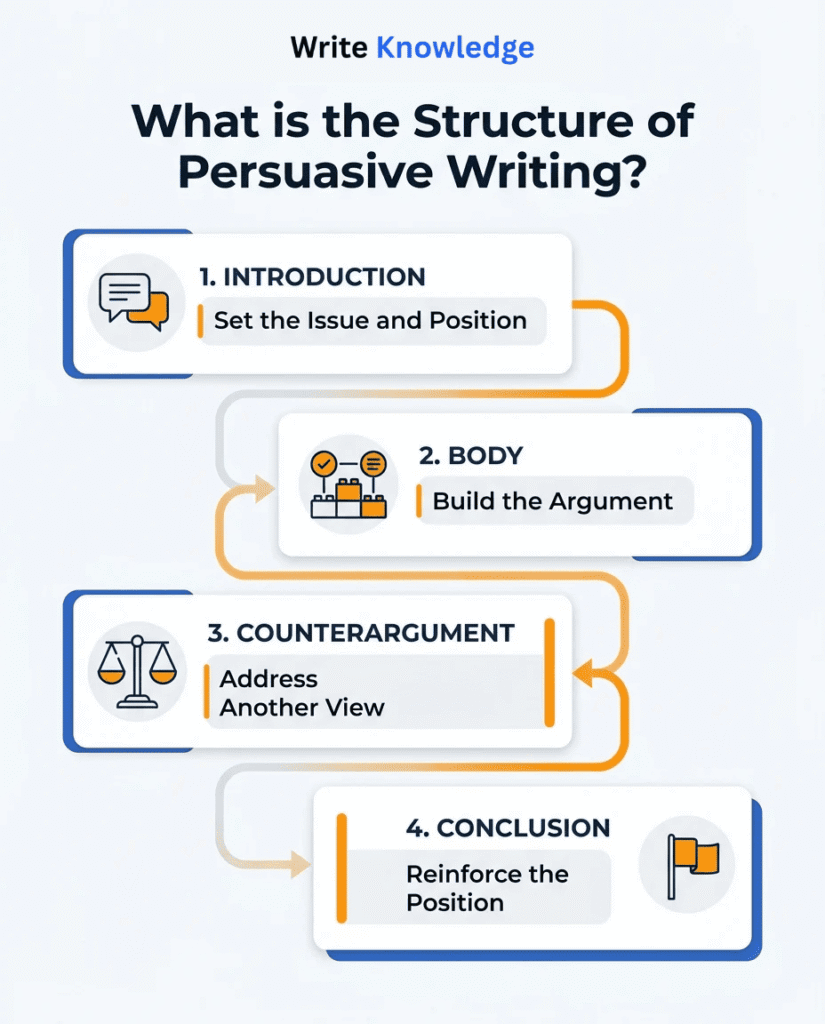
Introduction: Present the Issue and Position
The introduction should establish the issue and make the writer’s position clear.
For example:
“Many students struggle to concentrate during long school days. Schools should therefore consider introducing short movement breaks between lessons because brief physical activity can help students reset their attention.”
The reader immediately understands the issue and the writer’s position.
Body: Develop the Argument
Each body section should develop a reason supporting the central position.
A useful paragraph structure is:
Point → Evidence → Explanation → Connection to the argument
This prevents the body from becoming a collection of unrelated opinions.
Counterargument: Address Another View
Strong persuasive writing does not always pretend that opposing views do not exist.
Instead, it can acknowledge a reasonable counterargument and respond to it.
For example:
“Some teachers may argue that movement breaks reduce valuable teaching time. However, a short, structured break may be more useful than continuing a lesson when students are already struggling to concentrate.”
This shows that the writer has considered another perspective.
Conclusion: Reinforce the Position
The conclusion should bring the argument together without simply repeating the introduction word for word.
It can:
- Reinforce the central position
- Highlight the most important reason
- Explain why the issue matters
- Encourage a specific action
How to Write Persuasively
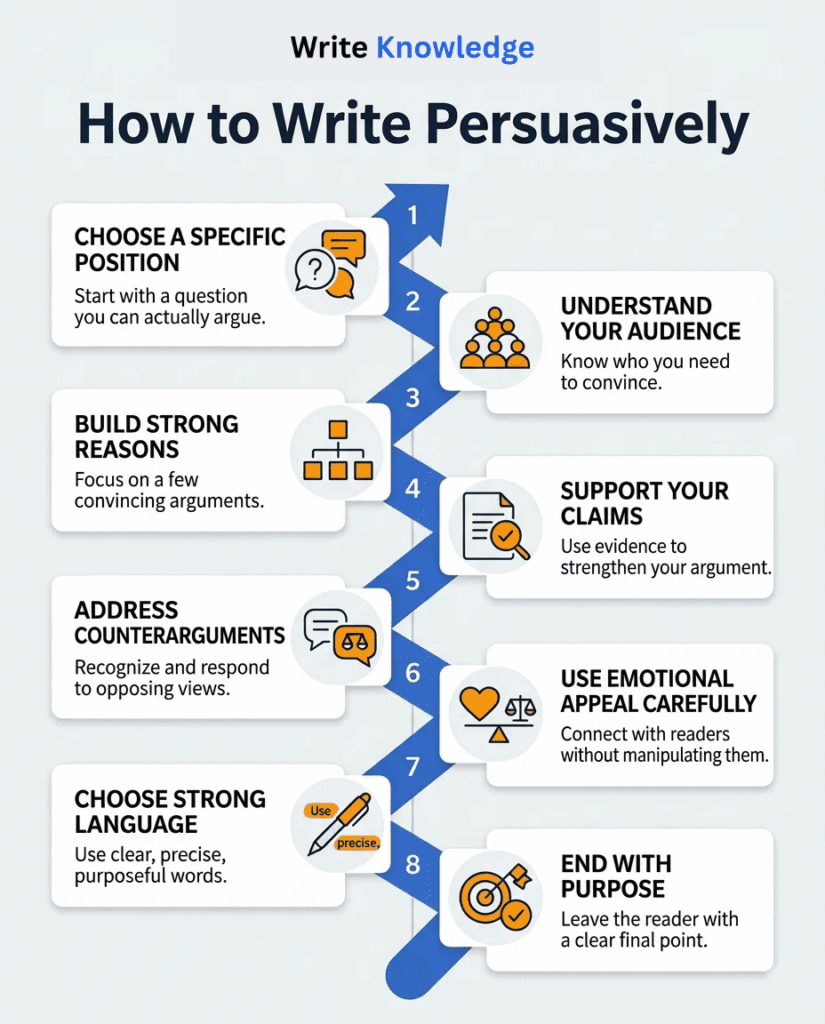
1. Choose a Specific Position
Start with a question that can actually be argued.
Instead of:
Is technology important?
Try:
Should schools allow students to use AI tools for certain assignments?
A specific question gives you something meaningful to argue.
2. Understand Your Audience
Before writing, identify who needs to be convinced.
Ask:
- What does this audience already believe?
- What might concern them?
- What evidence would they trust?
- What objections might they raise?
Your argument becomes stronger when it is built for the actual reader.
3. Build Strong Reasons
Choose a few strong reasons instead of collecting every possible argument.
For each reason, ask:
Does this actually support my main claim?
If it doesn’t, remove it.
4. Support Your Claims
Opinions can start an argument, but evidence can make the argument more credible.
For important factual claims, look for reliable sources and explain how the evidence supports your position.
5. Address Counterarguments
Ask yourself:
What would someone who disagrees with me say?
Then decide whether you can answer that objection fairly.
This often exposes weaknesses in your own argument before your reader does.
6. Use Appropriate Emotional Appeal
Emotion can make an argument memorable.
But emotional language should not become manipulation.
Use stories, examples, human consequences, or carefully chosen language when they genuinely help the reader understand why the issue matters.
7. Choose Strong Language
Persuasive writing benefits from precise language.
Compare:
This policy is bad.
with:
This policy creates unnecessary costs for small businesses without addressing the problem it was designed to solve.
The second statement gives the reader something specific to evaluate.
8. End with Purpose
Don’t let the argument simply disappear.
Give the reader a clear final thought.
If action is appropriate, tell the reader what they can do.
If the purpose is academic, reinforce why the argument matters.
Example:
Topic: Should schools introduce a daily reading period?
Weak:
“Schools should have reading time because reading is good and students need it.”
Stronger:
“Schools should introduce a short daily reading period because regular reading can give students consistent practice with vocabulary, comprehension, and sustained attention. Even 15 minutes a day would create a structured opportunity for students to read without competing with homework or extracurricular activities.”
The second version has a clearer claim, specific reasons, and a practical proposal.
Persuasive Writing Techniques to Try
Once you understand the basic structure, several techniques can make your arguments more effective.
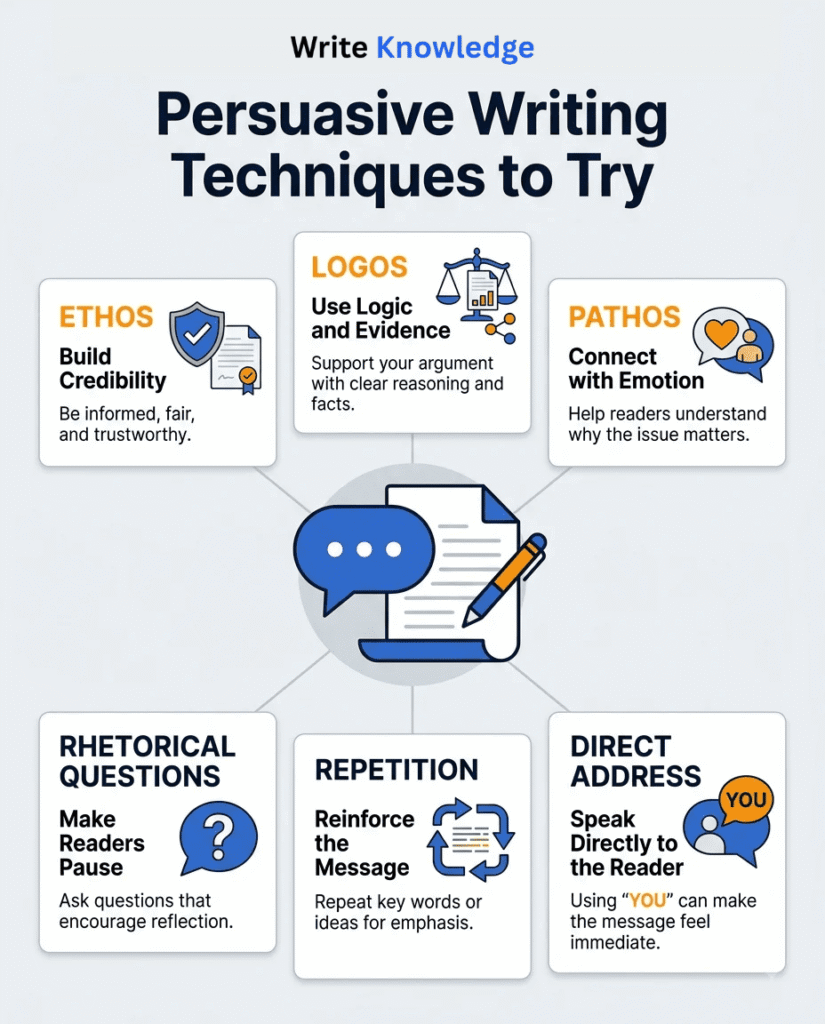
Ethos: Build Credibility
Readers are more likely to consider an argument when the writer appears informed, fair, and trustworthy.
Using credible evidence and acknowledging reasonable opposing views can strengthen credibility.
Logos: Use Logic and Evidence
Logos refers to reasoning and evidence.
Statistics, research findings, comparisons, examples, and logical explanations can all support an argument.
Pathos: Connect with Emotion
Pathos appeals to feelings.
A personal story or concrete example can help readers understand the human impact of an issue.
Rhetorical Questions
A rhetorical question can make readers pause and consider an issue.
For example:
If students are expected to develop strong writing skills, shouldn’t they also be taught how to use modern writing tools responsibly?
Use rhetorical questions carefully. Too many can make the writing feel forced.
Repetition
Repeating an important phrase or idea can reinforce a central message.
However, repetition should create emphasis … not simply add words.
Direct Address
Using you can make some persuasive writing feel immediate and conversational.
For example:
“If you want to reduce unnecessary spending, start by identifying the subscriptions you rarely use.”
Whether direct address is appropriate depends on the audience and context.
Common Mistakes in Persuasive Writing
Making Claims Without Evidence
A confident statement is not automatically a convincing argument.
Everyone knows online learning is better.
Who is “everyone”? Better in what way?
Specific claims need appropriate support.
Ignoring the Audience
An argument that works for one audience may fail with another.
A student essay, product advertisement, and political editorial cannot all use the same persuasive approach.
Using Too Much Emotion
Emotion can strengthen an argument, but excessive emotional language can make the writing appear manipulative.
Use emotion to support your reasoning rather than replace it.
Attacking People Instead of Ideas
Disagreeing with an argument does not require attacking the person making it.
Focus on the claim, evidence, reasoning, or consequences.
Repeating the Same Point
Restating the same argument several times does not necessarily make it stronger.
If the reader understands the point, move the argument forward with evidence, explanation, or a new perspective.
✍️ Writing Tip
Before you finish a persuasive piece, read every paragraph and ask:
“What does this paragraph do for my argument?”
If the answer is unclear, the paragraph may need to be rewritten, moved, supported with evidence, or removed.
Good persuasive writing is not about saying more. It is about making every important point work toward the central argument.
Persuasive Writing Examples
Persuasive writing appears in many everyday situations.
Academic Example
Universities should offer students basic financial-literacy courses because understanding budgeting, credit, taxes, and loans can help students make more informed financial decisions after graduation.
Interested in knowing more about academic writing? We have already made a comprehensive post just for you!
Advertisement Example
Upgrade to a faster laptop and spend less time waiting for applications to load. With improved performance and longer battery life, you can get more done without constantly searching for a power outlet.
Opinion Article Example
Schools should teach students how to evaluate AI-generated information. As AI tools become easier to access, knowing how to question, verify, and interpret generated information is becoming just as important as knowing how to use the tools themselves.
Everyday Example
You should carry a reusable bottle instead of buying bottled water every day. It is cheaper over time, easier to keep with you, and can reduce unnecessary plastic waste.
Notice that each example has a different audience and purpose, but each attempts to move the reader toward a particular conclusion or action.
Tips to Improve Your Persuasive Writing
You don’t need to become aggressive or overly dramatic to become a better persuasive writer.
Instead, focus on making your reasoning easier to understand.
Try these habits:
- Write your main claim in one sentence before drafting.
- Identify the audience before choosing your arguments.
- Use fewer but stronger reasons.
- Support important factual claims with reliable evidence.
- Include examples that make abstract ideas easier to understand.
- Address reasonable objections instead of ignoring them.
- Remove emotional language that does not strengthen the argument.
- Read your writing from the perspective of someone who disagrees with you.
- Make your conclusion feel like the natural result of the argument.
✅ Key Takeaways
- Persuasive writing aims to influence what readers think, believe, decide, or do.
- A strong persuasive piece has a clear position supported by relevant reasons and evidence.
- Understanding the audience is just as important as having a strong argument.
- Persuasive writing can appear in essays, opinion articles, editorials, reviews, advertising, speeches, and business communication.
- Logical reasoning, credible evidence, and appropriate emotional appeal can work together to strengthen persuasion.
- Addressing reasonable counterarguments can make an argument more credible.
- Effective persuasion is not about using the strongest language; it is about making the strongest case.
Conclusion
Persuasive writing is ultimately about giving readers a reason to care, agree, reconsider, or act. The strongest persuasive writing does not simply tell people what to think. It shows them why a particular position deserves their attention.
Whether you’re writing a school essay, reviewing a product, creating an advertisement, or arguing for a change, the fundamentals remain similar: understand your audience, make a clear claim, support it with strong reasoning and evidence, and give the reader a meaningful reason to respond.
Frequently Asked Questions
Is persuasive writing the same as argumentative writing?
They overlap, but they are not always identical. Both can use claims, reasoning, evidence, and counterarguments. Persuasive writing often places greater emphasis on influencing the reader, while argumentative writing is commonly associated with developing and defending a position through structured reasoning and evidence.
Can persuasive writing use storytelling?
Yes. A story can make an argument more memorable and help readers understand its human impact. However, the story should support the persuasive purpose rather than replace the argument.
Can persuasive writing be based on facts?
Absolutely. Facts and evidence are often essential to credible persuasion. The key is to explain how the evidence supports the position instead of simply listing facts.
What are the three main persuasive appeals?
The three traditional rhetorical appeals are ethos (credibility), logos (logic and evidence), and pathos (emotion). Effective persuasive writing may combine all three.

Sachin is a Postgraduate in Technical Writing in Business Management specializing in creating SEO-friendly, User-friendly, and Reader-focused website articles on Education, Tech, Sports, Games, and Entertainment.
Through Write Knowledge, he helps students, bloggers, editors, and professionals develop practical writing skills using clear explanations, real-world examples, and internationally recognized writing standards.