If you’ve ever been told to make your writing more formal, objective, and evidence-based, you’ve already encountered the basic expectations of academic writing.
But academic writing isn’t simply about using complicated words or making every sentence sound serious.
Its real purpose is to communicate ideas, explain evidence, develop arguments, and contribute to a subject in a clear and structured way.
Whether you’re writing an essay, research paper, dissertation, literature review, or academic report, understanding how academic writing works can help you produce work that is easier to read, evaluate, and support with evidence.
If you’re still exploring the broader category, start with our Types of Writing guide to see where academic writing fits alongside other forms of writing.
💡 Quick Answer
Academic writing is a formal style of writing used in schools, colleges, and research settings. It focuses on clear structure, logical arguments, evidence from reliable sources, and proper citations. You’ll find it in essays, research papers, dissertations, literature reviews, and case studies.
What is Academic Writing?
It is a formal type of writing used to present research, explain ideas, analyze information, and support arguments with evidence in educational and scholarly contexts.
It is usually:
- Formal and objective
- Evidence-based
- Logically structured
- Properly cited
- Clear and precise
- Audience-aware (written for teachers, researchers, or peers)
Unlike casual writing or creative storytelling, academic writing prioritizes accuracy, credibility, and critical thinking over personal opinion or emotional language.
You’ll encounter this type of writing in universities, research journals, conferences, and any setting where knowledge needs to be shared rigorously.
📝 Example
A general blog post might say:
Social media has changed how people communicate.
An academic writer might approach the same subject more carefully:
The growth of social media platforms has altered patterns of interpersonal communication, particularly by increasing the frequency and speed of digital interaction.
The second example does not necessarily use “better” English. It is simply written for a different context and purpose.
That distinction is important.
Academic writing should be formal enough for its audience but clear enough to communicate the idea effectively.
What is Academic Writing Used For?
Academic writing serves several practical purposes, such as:
- Present research findings
- Analyze existing knowledge
- Support arguments with evidence
- Demonstrate understanding of a topic
- Contribute to scholarly discussion
- Fulfill academic requirements (essays, theses, reports)
One point is to be noted that it is not limited to long research papers only. Even short essays, lab reports, and literature reviews fall under academic writing.
Who Reads Academic Writing?
You just can’t simply write the academic format for any readers!
The audience depends on the document, but common readers include:
- Professors and instructors
- Peer reviewers
- Fellow researchers and students
- Academic committees
- Professionals in specialized fields
Because the audience often has some background knowledge, academic writing can use field-specific terms, but it still needs to remain clear and well-supported.
Why Audience and Purpose Matter
As an academic writer, you should not be even questioning this. But for those who arrived late in the party…
Imagine explaining the (below) same research finding to two different readers:
To a professor in the field:
“The regression analysis (β = 0.42, p < 0.01) supports the hypothesized relationship between variables X and Y.”
To a broader academic audience:
“Statistical analysis showed a significant positive relationship between the two variables, supporting the study’s main hypothesis.”
The information is similar. The level of detail and terminology changes based on who will read it.
Now you know why purpose and audience matter.
You don’t want to send your hard-workingly written academic copy to the wrong audience and then receive few curses.
What are the Types of Academic Writing?
Academic writing appears in several common forms. The exact format depends on the purpose and discipline.
Essays
Academic essays present a focused argument or analysis on a specific topic. They usually include an introduction, body paragraphs with evidence, and a conclusion.
Research Papers
Research papers report original research or detailed investigation. They typically follow a structured format: abstract, introduction, methodology, results, discussion, and references.
Literature Reviews
A literature review summarizes and evaluates existing research on a topic. It identifies trends, gaps, and debates in the current body of knowledge.
Dissertations and Theses
These are long-form academic documents that present original research. They require extensive literature review, clear methodology, and rigorous analysis.
Case Studies
Case studies examine a specific person, group, event, or organization in depth. They combine description, analysis, and often recommendations.
Lab Reports and Scientific Papers
Common in science and engineering, these documents report experiments, methods, results, and conclusions in a precise, structured format.
Annotated Bibliographies and Abstracts
Shorter academic forms that summarize sources or provide concise overviews of larger works.
What Are the Main Characteristics of Academic Writing?
Academic writing has several characteristics that distinguish it from more casual or creative forms of writing.
Formal Language
Academic writing generally avoids highly casual expressions, slang, and conversational shortcuts.
For example:
Kids nowadays spend way too much time online.
could become:
Young people increasingly spend significant amounts of time using online platforms.
However, formal does not mean unnecessarily complicated.
The goal is to choose language that is appropriate, precise, and clear.
Clear and Precise Language
Academic readers need to understand exactly what the writer means.
Instead of:
This thing has a big effect on students.
a stronger academic sentence might be:
Excessive screen time can affect students’ concentration and sleep patterns.
The second sentence identifies the subject and explains the effect more precisely.
Evidence-Based Claims
Academic writing generally requires claims to be supported by appropriate evidence.
Instead of simply stating:
Online learning is more effective than classroom learning.
an academic writer might examine research comparing learning outcomes in different educational environments.
The evidence can then be used to support, qualify, or challenge the claim.
Logical Organization
Academic writing usually follows a recognizable structure.
Ideas should appear in an order that allows the reader to follow the writer’s reasoning.
This may involve:
- An introduction
- Background or context
- Main arguments or analysis
- Evidence
- Discussion
- Conclusion
- References or other source documentation
The exact structure depends on the type of academic document.
Objective and Reasoned Discussion
Academic writing often requires writers to examine an issue rather than simply state an opinion.
This does not mean that writers can never express an interpretation or position.
Instead, their position should generally be supported by reasoning and evidence.
Accurate Source Documentation
When you use another person’s ideas, research, data, or words, you may need to document the source.
The required system depends on the discipline and assignment.
For example, APA is commonly associated with social sciences, while MLA is widely used in literature and humanities. IEEE is strongly associated with technical and engineering communication.
You can learn more about these systems through our writing style guides.
How is Academic Writing Different from Other Types of Writing?
Academic writing overlaps with some other forms, especially expository writing, but its purpose and standards are distinct.
| Type of Writing | Main Purpose | Typical Example |
| Narrative | Tell a story | Personal narrative |
| Descriptive | Create vivid mental images | Travel writing |
| Expository | Explain or inform | Educational article |
| Persuasive | Influence opinions or actions | Opinion essay |
| Technical | Help readers perform a task | User manual |
| Academic | Present research and evidence-based arguments | Research paper or essay |
Academic writing can explain (like expository writing) and sometimes persuade (like persuasive writing), but it always prioritizes evidence, formal structure, and scholarly standards.
Academic Writing vs Expository Writing
These two are often confused because both explain information.
Expository writing primarily aims to inform or explain a topic clearly.
Example: “Photosynthesis is the process by which plants convert light energy into chemical energy.”
Academic writing also explains, but it does so within a scholarly framework that includes evidence, analysis, and proper citation.
Example: “Recent studies (Author, Year) have shown that the rate of photosynthesis increases under specific light wavelengths, supporting the hypothesis that…”
The difference lies in the level of formality, the requirement for sources, and the expectation of critical engagement with existing knowledge.
How is Academic Writing Structured?
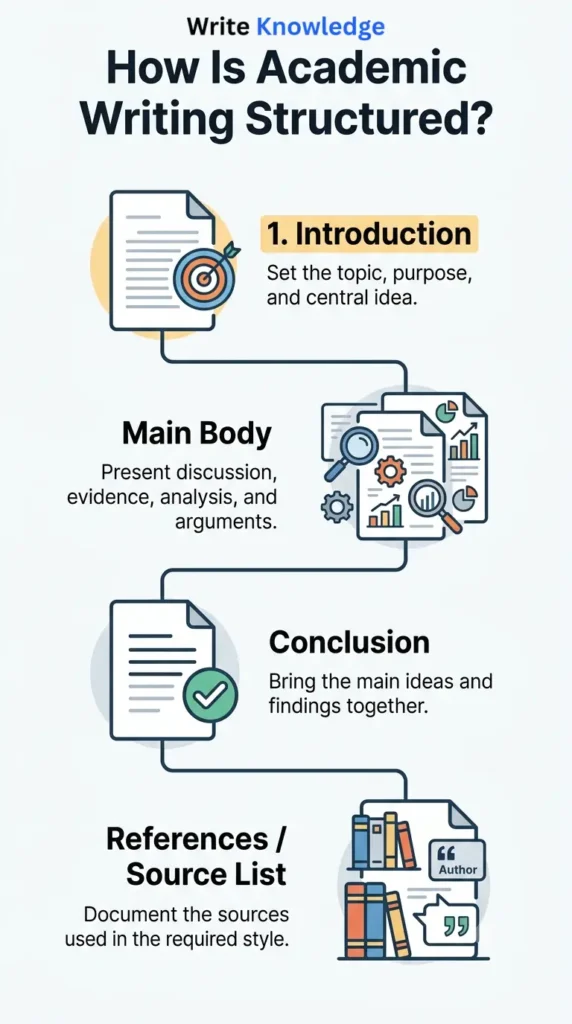
The structure of academic writing depends on the assignment, but many academic documents follow a general pattern.
Introduction
The introduction establishes what the document is about.
It may provide:
- Background information
- Context
- The research problem
- The research question
- The purpose of the paper
- The thesis or central argument
A good introduction prepares the reader for what follows.
Main Body
The body contains the main discussion, analysis, evidence, or argument.
Each paragraph should generally have a clear purpose.
A useful paragraph structure might look like:
Main point → Evidence → Analysis → Connection to the argument
For example, don’t simply provide a quotation and move on.
Explain:
What does the evidence show?
and:
Why does it matter to your argument?
Conclusion
The conclusion brings the discussion together.
It may:
- Restate the central argument
- Summarize major findings
- Explain the significance of the discussion
- Identify implications
- Suggest areas for further research
A conclusion should not simply repeat the introduction word for word.
References or Source List
Academic work often ends with a list documenting the sources used.
The name and format of this section depend on the required style.
For example:
- APA → References
- MLA → Works Cited
- IEEE → Numbered references
The exact rules vary according to the source type and required edition of the style.
How to Write an Academic Document
Strong academic writing becomes much easier when you follow a clear process.
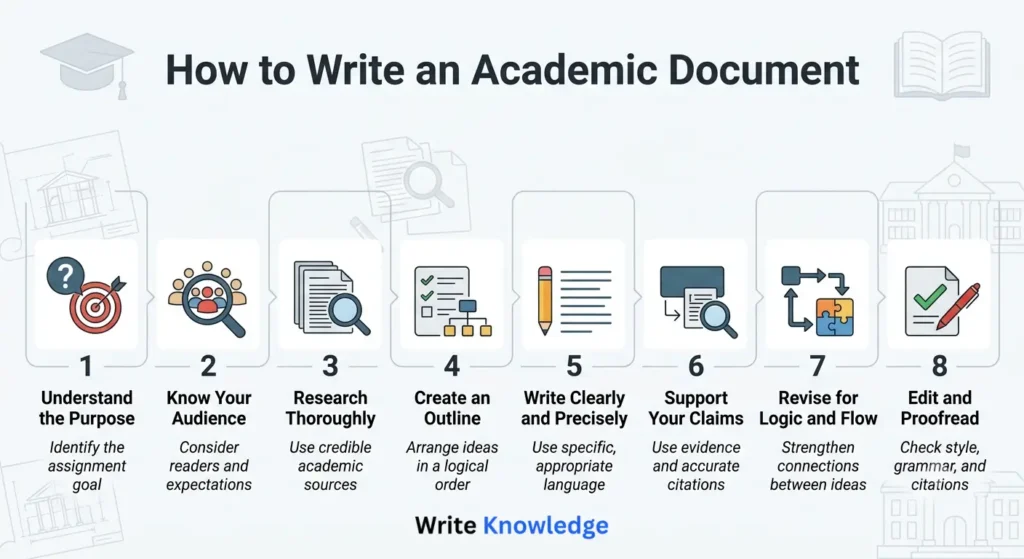
1. Understand the Assignment or Purpose
Ask: What is the exact goal? Is it to argue, analyze, review, or report research?
2. Analyze the Audience
Consider the knowledge level and expectations of your readers (professors, peers, or reviewers).
3. Conduct Thorough Research
Gather information from credible academic sources. Take careful notes and track citation details.
4. Create a Clear Outline
Organize your main points logically before writing the full draft. A strong structure prevents confusion later.
5. Write with Clarity and Precision
Use specific language. Prefer active voice when appropriate, and define specialized terms when needed.
6. Support Claims with Evidence
Every major point should be backed by data, research, or authoritative sources. Cite them correctly.
7. Revise for Logic and Flow
Check whether ideas connect smoothly. Ensure each paragraph supports the overall argument or purpose.
8. Edit for Style, Grammar, and Citations
Review for formal tone, consistency, accuracy of references, and adherence to the required style guide (APA, MLA, Chicago, etc.).
⚠️ Common Academic Writing Mistakes
Even strong ideas can weaken if common errors appear. Knowing what not to do can be just as useful as knowing what to do.
- Using informal or conversational language
- Making claims without evidence
- Poor or inconsistent citations
- Weak structure or unclear thesis
- Overusing quotations instead of analysis
- Ignoring the required formatting style
- Writing long, dense paragraphs without clear topic sentences
Avoiding these mistakes significantly improves the quality of academic work.
What Skills are Important for Academic Writing?
Academic writing requires a combination of research, thinking, and communication skills:
- Clear and formal writing
- Critical reading and analysis
- Research and source evaluation
- Logical organization
- Proper citation and referencing
- Attention to detail
- Ability to revise based on feedback
These skills develop with practice and are highly transferable to professional writing as well.
Be very-very clear about this👉 Perfect grammar cannot rescue a paper with a confusing argument, and an impressive vocabulary cannot replace evidence or analysis.
✍️ Writing Tip: Make Every Paragraph Do a Job
Before keeping a paragraph, ask yourself:
“What is this paragraph contributing to my argument?”
If you cannot answer that question clearly, the paragraph may need to be rewritten, moved, combined with another paragraph, or removed.
A useful academic paragraph usually has a clear relationship with the paragraph before it and the point that follows it.
This simple check can make a long paper much easier to follow.
Is Academic Writing a Good Type of Writing to Learn?
Yes!
Especially if you are a student, researcher, or someone who needs to communicate complex ideas formally.
Learning academic writing helps you:
- Organize thoughts logically
- Support ideas with evidence
- Write with greater clarity and precision
- Meet academic and professional standards
Even if you do not plan a research career, the discipline of academic writing strengthens overall communication skills.
Where is Academic Writing Used?
Academic writing appears across many fields:
- Universities and colleges
- Research institutions
- Scientific journals
- Conference papers
- Grant proposals
- Scholarly books and reports
- Professional certifications and advanced degrees
How Can You Start Improving Academic Writing?
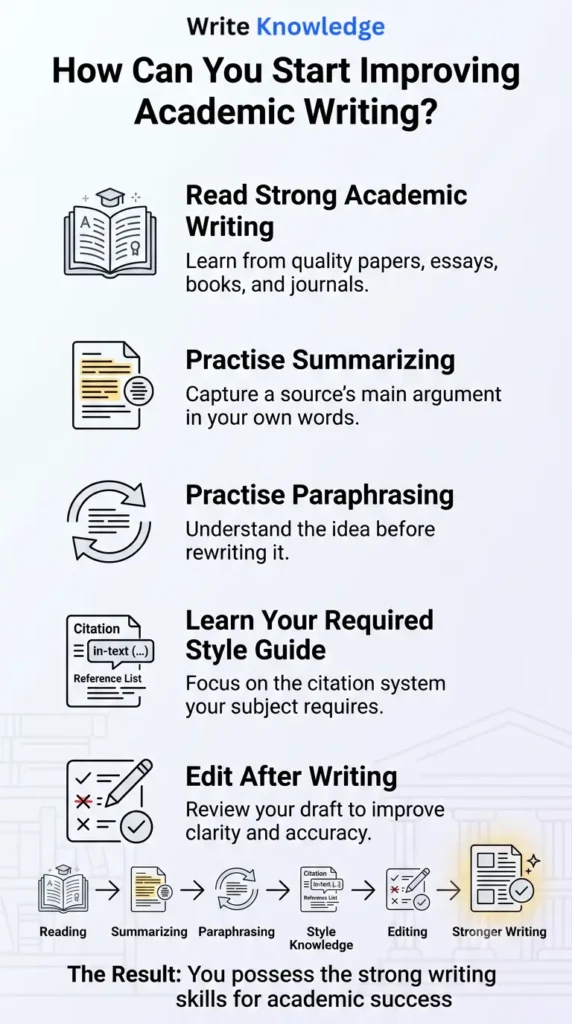
You do not need to begin with a complex research paper.
Start small:
- Practice writing short analytical paragraphs on familiar topics
- Summarize academic articles in your own words
- Focus on clear thesis statements and topic sentences
- Learn one citation style thoroughly (APA or MLA is a good starting point)
- Seek feedback and revise
Over time, move toward longer essays and research-based writing.
The goal is not to sound impressive.
The goal is to communicate ideas clearly, accurately, and with proper support.
Still thirsty for more improvement tips. Here you go:
Read Strong Academic Writing
Reading research papers, well-written essays, academic books, and journal articles helps you recognize how experienced writers:
- Introduce ideas
- Develop arguments
- Use evidence
- Transition between points
- Qualify claims
- Draw conclusions
Practise Summarizing Sources
Take a research article and summarize its main argument in your own words.
Then identify:
- The author’s main claim
- Supporting evidence
- Important limitations
- Your own interpretation
This helps you move beyond copying information toward genuine analysis.
Practise Paraphrasing
Paraphrasing requires you to understand an idea before expressing it in your own words.
Don’t simply replace individual words with synonyms.
Instead, read the source, understand the meaning, and reconstruct the idea naturally while documenting the source appropriately.
Learn the Style Guide You Actually Need
You don’t need to memorize every academic style at once.
Start with the system required by your subject or institution.
If you regularly work across disciplines, learning the differences between major systems such as APA, MLA, and IEEE can make switching between academic contexts easier.
Edit After Writing
Your first draft doesn’t need to be perfect.
After completing it, review the document for:
- Unclear sentences
- Repetition
- Unsupported claims
- Weak transitions
- Inconsistent terminology
- Citation problems
- Formatting issues
Editing is where much of the clarity in academic writing is created.
Academic Writing Checklist
Before submitting an academic document, check:
- Is the purpose of the document clear? ✅
- Does the introduction establish the central idea? ✅
- Does each section contribute to the overall purpose? ✅
- Are important claims supported by appropriate evidence? ✅
- Have sources been paraphrased or quoted accurately? ✅
- Have you explained the significance of your evidence? ✅
- Is the language formal and precise? ✅
- Have you removed unnecessary words and repetition? ✅
- Is the required citation style applied consistently? ✅
- Do in-text citations correspond to the appropriate source list? ✅
- Are headings and formatting consistent? ✅
- Does the conclusion follow logically from the discussion? ✅
If your assignment has specific institutional or instructor requirements, add those requirements to the checklist before submitting.
✅ Key Takeaways
- Academic writing is formal, evidence-based writing used in education and research.
- Common forms include essays, research papers, literature reviews, dissertations, and case studies.
- It prioritizes clarity, objectivity, logical structure, and proper citation.
- Academic writing differs from other types mainly through its scholarly standards and reliance on evidence.
- Strong academic writing follows a clear process: understand purpose, research, outline, write, support with evidence, and revise.
- Common mistakes include informal language, missing citations, and weak structure.
- The best academic writing helps readers understand and evaluate ideas with confidence.
Conclusion
Academic writing is more than following a set of formal rules. At its core, it is about communicating knowledge responsibly.
A well-written academic document presents ideas clearly, supports them with credible evidence, organizes information logically, and respects the standards of scholarly communication.
Whether you are writing a short essay, a research paper, or a dissertation, the same principles apply: understand your purpose, know your audience, support your claims, and write with clarity.
Frequently Asked Questions
What is academic writing in simple words?
Academic writing is formal writing used in schools and research. It presents ideas and findings clearly, supports them with evidence, and follows proper citation rules.
What are the main types of academic writing?
Common types include essays, research papers, literature reviews, dissertations, theses, case studies, and lab reports.
How is academic writing different from other types of writing?
It is more formal, requires evidence and citations, follows strict structure, and focuses on scholarly standards rather than storytelling or persuasion alone.
Do I need to use a specific style guide?
Yes. Most academic work follows a required style such as APA, MLA, Chicago, or IEEE, depending on the discipline or institution.
How Can I Improve My Academic Writing?
Read strong academic sources, practice summarizing and paraphrasing, develop clear arguments, support claims with evidence, learn the style guide required for your work, and edit your writing carefully before submission.

Sachin is a Postgraduate in Technical Writing in Business Management specializing in creating SEO-friendly, User-friendly, and Reader-focused website articles on Education, Tech, Sports, Games, and Entertainment.
Through Write Knowledge, he helps students, bloggers, editors, and professionals develop practical writing skills using clear explanations, real-world examples, and internationally recognized writing standards.