Medical writing is a specialized career that combines strong writing skills with knowledge of medicine, science, research, and healthcare communication. Medical writers may create documents for patients, healthcare professionals, researchers, pharmaceutical companies, medical-device organizations, regulatory authorities, and other audiences.
The field is broader than simply writing health articles. It includes areas such as regulatory documents, scientific publications, patient education, health communication, medical marketing, and continuing education.
If you are considering a medical writing career, the important question is not simply whether you can write. You also need to understand what medical writers actually do, which specialization fits your background, what skills employers expect, and how to demonstrate those skills.
💡 Quick Answer
A medical writing career involves creating clear, accurate content about healthcare, medicine, and scientific research. Medical writers may work on research papers, patient information, regulatory documents, medical publications, or health communication materials.
The field suits people who enjoy writing and research and are willing to build a strong understanding of medical and scientific concepts.
What Is a Medical Writing Career?
A medical writing career involves researching, writing, editing, and communicating information related to medicine, healthcare, biomedical science, pharmaceuticals, medical devices, or clinical research.
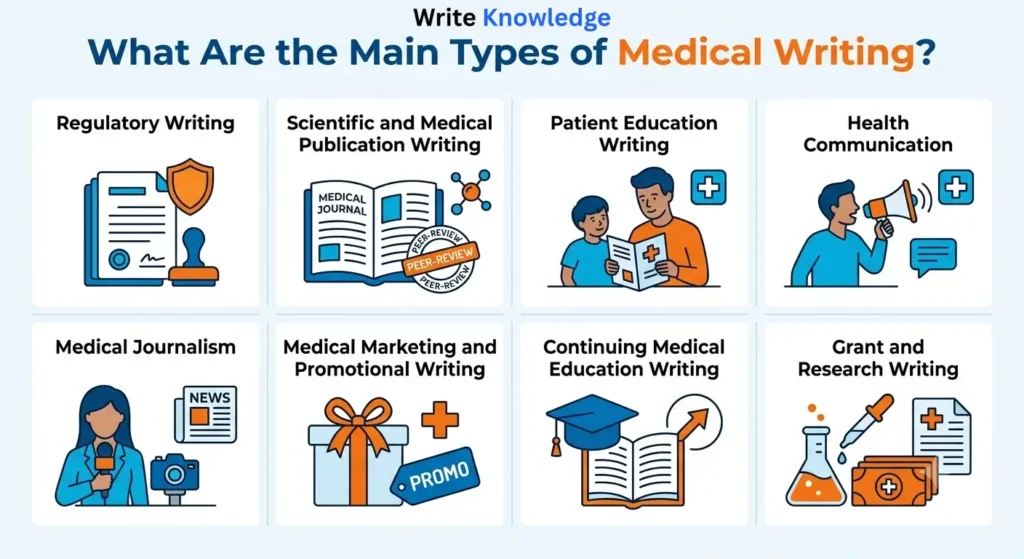
Medical writers work in several areas, including:
- Regulatory writing
- Scientific and medical publications
- Patient education
- Health communication
- Medical journalism
- Medical marketing and promotional communication
- Continuing medical education
- Grant and research writing
You do not necessarily need to be a physician or hold a doctorate to enter medical writing. People enter the profession from science, healthcare, English, communications, journalism, and other backgrounds.
However, writers need enough medical and scientific knowledge to understand the information they communicate accurately.
What Does a Medical Writer Do?
A medical writer turns complex medical or scientific information into documents that are accurate, understandable, and appropriate for a particular audience.
The exact work depends heavily on the specialization.
For example, a regulatory medical writer may work on documents associated with drug or medical-device development and regulatory submissions. A scientific publications writer may help communicate research findings, while a patient-education writer may translate complex medical concepts into language that general readers can understand.
Typical responsibilities can include:
- Researching medical and scientific information
- Reviewing scientific literature
- Interpreting research data and statistics
- Writing and editing documents
- Checking facts and references
- Organizing information for specific audiences
- Working with subject-matter experts
- Following publication, regulatory, or organizational guidelines
- Revising documents based on expert or editorial feedback
- Preparing tables, graphs, presentations, or supporting materials
This makes medical writing different from general content writing. The writer is not simply trying to make information interesting. Accuracy, evidence, ethics, audience, and appropriate terminology are central to the work.
What Are the Main Types of Medical Writing?
Medical writing covers several professional areas. You do not have to master every specialization before entering the field.
Regulatory Writing
Regulatory writers prepare documents used during the development and approval of medicines, biologics, and medical devices.
The work can involve highly structured documents and requires familiarity with clinical research, regulatory requirements, scientific terminology, and documentation standards. identifies regulatory writing as one of the major professional focus areas within medical communication.
Scientific and Medical Publication Writing
Publication writers work with research findings intended for professional or scientific audiences.
Examples include:
- Journal manuscripts
- Research summaries
- Review articles
- Abstracts
- Posters
- Conference materials
This area requires careful handling of research evidence, references, data, and publication requirements.
If you are already interested in Academic Writing, developing skills in evidence-based writing, citations, research organization, and formal style can provide a useful foundation.
Patient Education Writing
Patient education focuses on communicating medical information to patients and caregivers.
The challenge is to make information understandable without changing its meaning.
For example, instead of assuming that readers understand specialist terminology, a patient-education writer may explain a medical concept using plain language while retaining the medically important information.
Health Communication
Health communication covers information created for broader public or professional audiences.
It can include:
- Health education materials
- Public-health communication
- Healthcare websites
- Educational resources
- Digital health content
- Disease-awareness materials
The intended audience determines the appropriate level of technical detail and terminology.
Medical Journalism
Medical journalists research and report on developments related to medicine, healthcare, public health, research, and science.
This can involve interviews, source verification, research, news reporting, and explanatory writing.
If you are interested in journalism as a career path, see the Write Knowledge guide to Journalistic Writing.
Medical Marketing and Promotional Writing
Medical writers may also work on communications for pharmaceutical, biotechnology, medical-device, or healthcare organizations.
Depending on the role, this can include educational or promotional materials for healthcare professionals, patients, sales teams, or other audiences.
Medical promotional communication requires particular attention to accuracy, evidence, audience, and applicable requirements.
Continuing Medical Education Writing
Some medical communicators create educational materials designed to support continuing education for healthcare professionals.
The writing needs to communicate scientific information clearly while matching the educational purpose and requirements of the program.
Grant and Research Writing
Medical and scientific organizations also need writers who can communicate research ideas and proposed projects effectively.
Grant writing combines scientific understanding with persuasive and structured writing. The writer needs to explain the problem, proposed work, significance, methodology, and expected contribution clearly.
What Skills Do You Need for a Medical Writing Career?
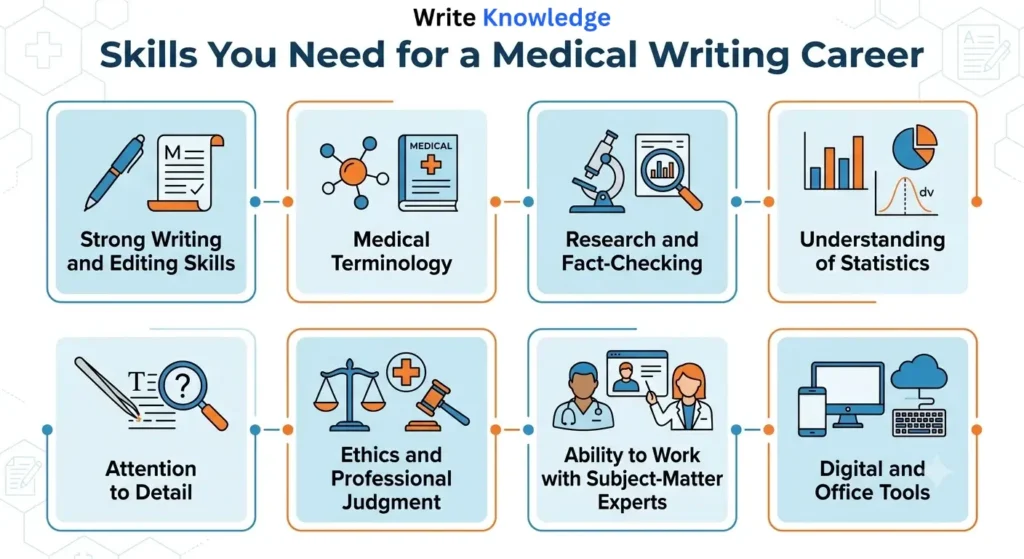
Medical writing requires a combination of writing ability, scientific understanding, research skills, attention to detail, and professional communication.
Strong Writing and Editing Skills
Medical writers must be able to communicate complex information clearly and concisely.
Strong grammar and sentence construction matter because unclear writing can change how readers understand important information.
Editing skills are equally important. Medical writers often need to identify ambiguity, unnecessary wording, inconsistencies, unsupported claims, and structural problems.
Medical Terminology
You need to understand the terminology used in the area you write about.
That does not mean memorizing every medical term.
It means being able to research unfamiliar terminology, understand it in context, and use it accurately.
Research and Fact-Checking
Medical writing depends heavily on reliable information.
A medical writer may need to locate and evaluate:
- Scientific papers
- Clinical research
- Regulatory information
- Medical guidelines
- Institutional resources
- Other authoritative sources
The ability to distinguish strong evidence from unsupported claims is particularly important.
Understanding of Statistics
Medical research frequently involves statistics, tables, graphs, and numerical results.
You do not necessarily need to become a statistician, but you should understand enough statistics to interpret and communicate research findings accurately. specifically identifies statistics, tables, and graphs among the skills used in medical communication.
Attention to Detail
Medical writing often involves details that cannot be treated casually.
Names, doses, measurements, study populations, percentages, dates, references, terminology, and numerical data may all need careful verification.
Ethics and Professional Judgment
Medical communication requires ethical awareness.
Ethical practice in medical communication involves principles such as honesty, confidentiality, objectivity, and fairness. These values guide writers to maintain integrity and transparency when presenting scientific or clinical information.
A medical writer should therefore understand that writing quality is not only about grammar. It also involves responsible handling of information.
Ability to Work with Subject-Matter Experts
Medical writers often work with scientists, physicians, researchers, editors, regulatory professionals, and other specialists.
You need to be comfortable asking questions, receiving corrections, handling feedback, and incorporating expert information without losing clarity.
Digital and Office Tools
Medical writers may work with common productivity and document tools such as Microsoft Word, PowerPoint, Excel, Google Docs, and Adobe Acrobat.
However, the exact software depends on the employer and specialization.
Do You Need a Medical Degree to Become a Medical Writer?
No. A medical degree is not universally required for a medical writing career.
Medical writers enter the profession from many backgrounds.
People from diverse academic and professional backgrounds such as science, healthcare, humanities, and social sciences can successfully transition into medical writing. The field values both subject‑matter expertise and strong communication skills, making it accessible to individuals with varied experience.
However, your background affects the skills you may need to develop.
A science graduate may already understand biology and scientific research but need more training in professional writing and editing.
A professional writer may already have strong communication skills but need to build knowledge of medical terminology, scientific research, statistics, and healthcare concepts.
This makes medical writing a skills-bridging career for many people.
What Qualifications Do Medical Writers Need?
There is no single qualification that every medical writer must have.
Many medical writers have bachelor’s degrees, while others hold master’s or doctoral degrees. Science and healthcare backgrounds can be helpful, but also notes that people with English, communications, journalism, and related backgrounds enter the field.
Depending on the specialization, useful qualifications may include:
- Bachelor’s degree in science, healthcare, English, communications, or a related field
- Master’s or doctoral degree where relevant
- Medical writing or medical communication training
- Experience with scientific or healthcare content
- Editing experience
- Specialized regulatory or publication knowledge
- Professional development courses
- Relevant portfolio work
Certification can be useful later in a career. For example, the Medical Writing Certification Commission, in collaboration with AMWA, administers the Medical Writer Certified (MWC®) credential.
Certification should be viewed as one possible professional-development route rather than a universal entry requirement.
NOTE: You need to check with your local laws based on the country you are living.
Can You Become a Medical Writer Without a Science Background?
Yes, but you need to build the scientific knowledge required for the type of medical writing you want to do.
This is especially relevant for professional writers transitioning from fields such as English, communications, journalism, or content writing.
A practical transition might look like this:
Writing background → Basic medical science → Medical terminology → Research and statistics → Medical writing practice → Portfolio → Entry-level opportunities
Writers transitioning into medical communication often benefit from refreshing their knowledge of core scientific areas such as cell biology, chemistry, pharmacology, and epidemiology, alongside strengthening writing fundamentals and medical terminology. Building this foundation helps bridge the gap between strong communication skills and the technical accuracy required in medical writing.
You do not have to learn all of medicine before applying for your first role. Start by developing knowledge relevant to your intended specialization.
How to Start a Medical Writing Career
A practical entry path can be broken into manageable steps.
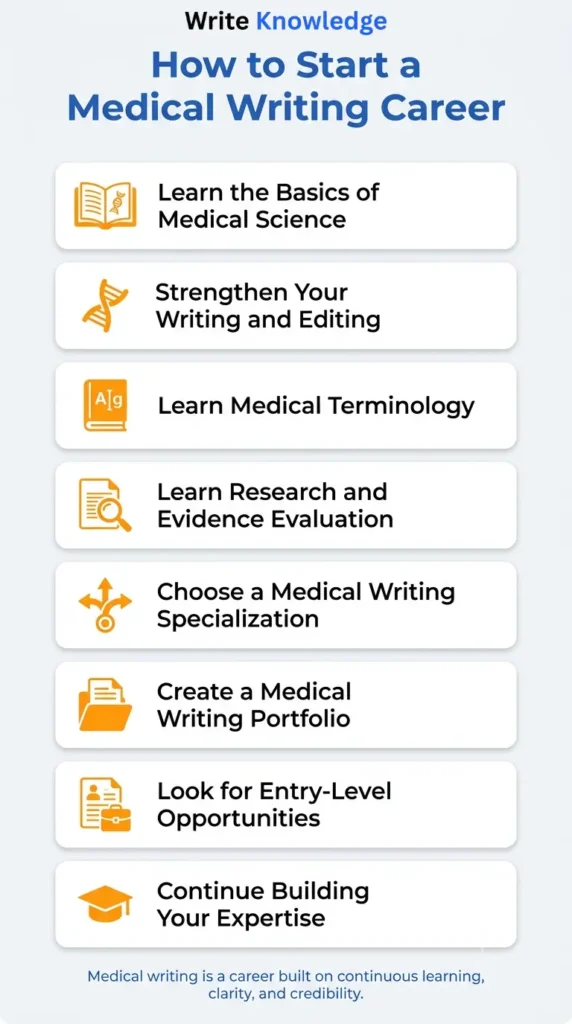
1. Learn the Basics of Medical Science
Start with foundational subjects such as:
- Anatomy and physiology
- Biology
- Pharmacology basics
- Epidemiology
- Common diseases and treatments
- Clinical research basics
The depth you need depends on your intended specialization.
2. Strengthen Your Writing and Editing
Review grammar, punctuation, sentence structure, clarity, concision, and editing.
If you already have professional writing experience, focus on adapting your writing to scientific and healthcare contexts.
3. Learn Medical Terminology
Build a working vocabulary rather than trying to memorize an entire medical dictionary.
Learn how terms are constructed and practise understanding them in context.
4. Learn Research and Evidence Evaluation
Practise finding credible sources and distinguishing primary research from secondary explanations.
Learn how to read research papers and understand basic study design, data, tables, graphs, and statistical findings.
5. Choose a Medical Writing Specialization
You could begin with:
- Patient education
- Health communication
- Medical content
- Scientific publications
- Regulatory writing
- Medical journalism
- Medical marketing
- Continuing medical education
Choosing a direction helps you decide what skills and portfolio samples to build.
6. Create a Medical Writing Portfolio
Your portfolio should demonstrate that you can handle medical information responsibly.
Possible samples include:
- Patient-friendly health explainer
- Scientific research summary
- Medical article
- Drug or disease information overview
- Clinical research summary
- Healthcare FAQ
- Medical editing sample
- Evidence-based health article
Avoid presenting invented medical claims as real evidence. Clearly label educational or hypothetical samples.
7. Look for Entry-Level Opportunities
Search for roles such as:
- Junior medical writer
- Medical writer
- Medical communications writer
- Healthcare content writer
- Scientific writer
- Medical editor
- Regulatory writing assistant
- Medical communications associate
Internships and apprenticeships can also provide an entry route. notes that some larger organizations offer internships and apprenticeship opportunities for aspiring medical writers.
8. Continue Building Your Expertise
Medical writing is not a field where learning ends after getting the first job.
Writers need to stay current with scientific developments, guidelines, technologies, and professional practices. ‘s career guidance emphasizes continuing education, technology, core knowledge, and professional development as writers advance.
What Does a Medical Writer Career Path Look Like?
There is no single medical writing career path.
One person might begin in healthcare content and move into medical communications. Another might move from scientific research into regulatory writing. A professional editor might specialize in medical editing, while a freelance writer might develop a niche in patient education.
A simplified progression might look like:
Entry-level medical writer → Medical writer → Senior medical writer → Lead/Principal writer → Manager or specialist role
However, progression depends on specialization, organization, experience, and professional goals.
Some writers move toward management and project leadership. Others deepen their expertise in areas such as regulatory writing, scientific publications, medical editing, or freelance consulting.
Where Do Medical Writers Work?
Medical writers can work across different parts of the healthcare and life-sciences ecosystem.
Potential employers include:
- Pharmaceutical companies
- Biotechnology companies
- Medical-device companies
- Contract research organizations
- Medical communications agencies
- Healthcare organizations
- Hospitals and research institutions
- Scientific publishers
- Educational organizations
- Health-focused media organizations
- Freelance businesses
Is Medical Writing a Freelance Career?
Yes. Medical writing can be pursued as a freelance career as well as a full-time profession.
Freelancers may work directly with clients or through agencies and can specialize in particular areas of medical communication.
A freelance medical writer needs more than writing ability. You also need skills in:
- Client communication
- Project management
- Research
- Editing
- Meeting deadlines
- Scope management
- Invoicing and business administration
- Maintaining professional confidentiality
For someone coming from general content writing, freelance medical writing can therefore be a specialization path, not simply a change in job title.
How to Build a Medical Writing Portfolio?
A good medical writing portfolio should answer one question:
Can this writer understand complex health information and communicate it accurately to the intended reader?
Instead of filling your portfolio with many generic articles, create several targeted samples.
For example:
| Portfolio sample | Skill demonstrated |
| Patient-friendly disease explainer | Plain-language communication |
| Research summary | Scientific comprehension |
| Clinical-study summary | Data interpretation |
| Medical FAQ | Audience-focused writing |
| Medical editing sample | Editorial accuracy |
| Regulatory-style sample | Structured professional writing |
If you already have experience in technical writing, emphasize skills such as research, documentation, structured information, accuracy, and explaining complex subjects.
What Is the Difference Between Medical Writing and Technical Writing?
Medical writing and technical writing overlap in their emphasis on clarity, accuracy, research, and specialized information, but their subject matter and audiences differ.
Technical writing can cover software, engineering, scientific technology, products, procedures, and other specialized subjects.
Medical writing focuses specifically on medicine, healthcare, biomedical science, pharmaceuticals, medical devices, and related communication.
A technical writer can therefore transition into medical writing, but usually needs to develop additional medical and scientific knowledge.
If you’re comparing career options, the broader Writing Careers resource can help you explore other professional writing paths.
What Is the Salary of a Medical Writer?
There is no single reliable global salary figure for medical writers because compensation varies substantially by country, specialization, experience, employer, employment arrangement, and industry.
This is also why generic online salary claims should be treated cautiously.
Medical writer salaries in India vary by experience, specialization, location, employer, and type of medical writing. Regulatory writing, medical communications, scientific writing, medical information, and specialized safety writing can have different compensation levels.
As of August 2026, an average base salary of about ₹4.88 lakh per year for medical writers in India, based on 12 reported salaries. Its reported range is approximately ₹2.12 lakh to ₹11.22 lakh per year, showing how widely compensation can vary across experience levels and employers.
Digging more sources show a similar broad picture, reporting average base pay of around ₹5 lakh per year, with a typical base-pay range of approximately ₹4 lakh to ₹7 lakh per year.
Recent reported salaries on the platform include around ₹4–6 lakh per year for several writers with 1–3 years of experience, while some 4–6-year and 7–9-year professionals report higher figures.
Medical writing compensation should therefore be researched using the specific country, role, specialization, and experience level relevant to the job you are considering.
Medical Writer Salary by Experience
A broad way to understand the Indian market is:
| Experience | Approximate annual range* |
| Entry-level / trainee | ₹2.5–₹4.5 lakh |
| 1–3 years | ₹4–₹6 lakh |
| 4–6 years | ₹6–₹9 lakh |
| 7+ years | ₹8–₹12 lakh+ |
*These are indicative ranges rather than official salary bands. Actual compensation can be lower or higher depending on specialization, employer, location, and role.
How Can You Improve Your Medical Writing Skills?
Improvement comes from combining medical knowledge with repeated writing and editing practice.
Read Medical and Scientific Material Regularly
Read research summaries, medical publications, healthcare resources, and professional communication.
Pay attention to how complex information is organized.
Practise Explaining Complex Topics Simply
Choose a medical topic and explain it for different audiences.
For example:
Audience 1: general reader
Audience 2: university student
Audience 3: healthcare professional
The underlying facts may remain similar, but the terminology, structure, and level of detail should change.
Practise Data Interpretation
Work with tables, charts, percentages, and basic statistics.
The goal is not to become a statistician. It is to avoid misrepresenting what data actually show.
Practise Medical Editing
Take an existing piece of medical or scientific writing and identify:
- Unclear sentences
- Unnecessary jargon
- Unsupported claims
- Inconsistent terminology
- Poor organization
- Citation problems
- Ambiguous statements
Then rewrite it while preserving the intended meaning.
Learn Relevant Style and Editorial Standards
Medical communication can involve different publication, organizational, regulatory, or client requirements.
Your broader understanding of Writing Style Guides can therefore become useful when you move into specialized medical communication.
How Is AI Changing Medical Writing Careers?
AI-assisted tools are increasingly relevant to professional medical communication, but they do not remove the need for human expertise.
Medical writers still need to understand the underlying science, evaluate information, make editorial decisions, and take responsibility for the final communication.
For aspiring medical writers, the practical approach is to learn how AI tools can assist with tasks such as:
- Organizing research
- Generating early outlines
- Identifying repetitive wording
- Supporting editing workflows
- Summarizing information for further human review
But AI-generated medical claims should not be accepted without verification.
The writer remains responsible for checking sources, accuracy, context, terminology, and the suitability of the final content.
What Makes Medical Writing Different from General Health Content Writing?
General health content may focus primarily on making information understandable and useful to a broad audience.
Medical writing is a broader professional field that can involve scientific publications, regulatory documents, clinical research, patient education, medical communications, and other specialized outputs.
The difference is therefore not simply the subject.
It is also the level of evidence, audience, document purpose, professional responsibility, and specialized knowledge required.
Someone writing a general wellness article and someone preparing a regulatory document may both be writing about health, but the expectations for their work are very different.
Common Mistakes to Avoid in a Medical Writing Career
Treating Medical Writing as Ordinary Content Writing
Medical writing requires specialized knowledge and evidence-handling skills. A writer cannot simply apply general SEO-writing techniques to medical subjects and assume the work meets professional expectations.
Relying on Unverified Health Information
Medical claims should be supported by appropriate, credible sources.
Using AI Output Without Expert Review
AI can produce convincing but incorrect statements. Human verification is essential when working with medical and scientific information.
Ignoring Statistics
A writer who misunderstands study data can unintentionally misrepresent research findings.
Using Excessive Medical Jargon
Technical accuracy does not require making every sentence difficult to understand.
Failing to Identify the Audience
A patient, physician, researcher, regulator, and pharmaceutical sales representative may need very different versions of the same underlying information.
Focusing Only on Writing
Writing is important, but medical writers also need research, scientific understanding, data interpretation, ethics, collaboration, and continuing professional development.
Who Is a Medical Writing Career Suitable For?
A medical writing career can suit people who enjoy both writing and learning about medicine or science.
Potential starting backgrounds include:
- Science graduates
- Healthcare professionals
- Researchers
- Professional writers
- Editors
- Journalists
- English and communications graduates
- Technical writers
- Freelancers interested in healthcare specialization
The starting point is less important than the willingness to close knowledge gaps.
For example, a science graduate may need to strengthen writing and editing, while an experienced writer may need to strengthen medical terminology, scientific research, and statistics. describes both kinds of transitions into medical writing.
How to Choose Your Medical Writing Specialization
Choosing a specialization becomes easier when you compare three things:
What you already know + what you enjoy + what the role requires
If you enjoy scientific research and formal documents, scientific publications or regulatory writing may be worth exploring.
If you enjoy explaining complex concepts to general readers, patient education or health communication may be more suitable.
If you enjoy reporting, interviewing, and current developments, medical journalism may be a better direction.
If you enjoy marketing and persuasive communication, medical marketing or promotional writing could be another pathway.
You do not have to commit permanently to one specialization at the beginning. Medical communicators can move between focus areas as their skills and interests develop.
Medical Writing Career Checklist for Beginners
Before applying for your first medical writing role, check whether you can confidently say yes to most of these:
- I can write clearly and concisely
- I understand basic medical terminology
- I can research information from credible sources
- I understand basic scientific evidence
- I can interpret simple tables and graphs
- I understand basic statistics
- I can distinguish facts from unsupported claims
- I understand the importance of ethics in medical communication
- I can adapt writing for different audiences
- I can work with subject-matter experts
- I have several relevant writing samples
- I can explain why my portfolio demonstrates medical-writing skills
If several areas are missing, use them to create your learning plan rather than treating them as reasons to abandon the career.
✅ Key Takeaways
- A medical writing career combines writing, science, research, editing, and audience-focused communication.
- Medical writing includes regulatory documents, scientific publications, patient education, health communication, journalism, marketing, and other specialized areas.
- A medical degree is not universally required, although medical and scientific knowledge is important.
- Writers from English, communications, journalism, and technical-writing backgrounds can transition into medical writing by developing relevant scientific knowledge.
- Important skills include writing, editing, medical terminology, research, statistics, data interpretation, ethics, and attention to detail.
- A focused portfolio can demonstrate your ability to communicate complex medical information responsibly.
- Medical writing can be pursued through full-time employment, agency work, or freelance work.
- AI tools can support medical-writing workflows, but human verification, judgment, and accountability remain essential.
- The best specialization depends on your existing background, interests, skills, and career goals.
Conclusion
A medical writing career can be a practical path for people who enjoy writing but also want to work with medicine, science, healthcare, or research. The profession is broader than healthging and includes specialized areas such as regulatory writing, scientific publications, patient education, and medical communication.
You do not need to follow one fixed route into the field. Build the skills your background lacks, choose a specialization, create evidence-based portfolio samples, and gradually develop the scientific and editorial expertise expected in professional medical communication.
Frequently Asked Questions
What is a medical writing career?
A medical writing career involves researching, writing, editing, and communicating information related to medicine, healthcare, biomedical science, pharmaceuticals, medical devices, or clinical research.
Can I become a medical writer without a medical degree?
Yes. Medical writers come from science, healthcare, English, communications, journalism, and other backgrounds. However, writers need sufficient medical and scientific knowledge for the type of work they undertake.
What skills are needed to become a medical writer?
Important skills include writing and editing, medical terminology, research, statistics, data interpretation, ethics, attention to detail, and the ability to communicate with different audiences.
What types of jobs can medical writers do?
Medical writers can work in regulatory writing, scientific publications, patient education, health communication, medical journalism, medical marketing, continuing medical education, grant writing, and related areas.
Can a technical writer become a medical writer?
Yes. Technical-writing experience can provide transferable skills such as research, structured communication, documentation, editing, and explaining complex information. The writer would still need to build relevant medical and scientific knowledge.

Sachin is a Postgraduate in Technical Writing in Business Management specializing in creating SEO-friendly, User-friendly, and Reader-focused website articles on Education, Tech, Sports, Games, and Entertainment.
Through Write Knowledge, he helps students, bloggers, editors, and professionals develop practical writing skills using clear explanations, real-world examples, and internationally recognized writing standards.