Every day, we explain ideas, describe processes, answer questions, and share factual information. Whether you’re writing a school essay, a technical report, a user manual, a news article, or a business document, you’re likely using expository writing.
Because of its practical nature, expository writing is one of the most widely used forms of writing in education, journalism, business, and professional communication.
💡 Quick Answer
Expository writing is a type of writing that explains, informs, or describes a topic using facts, evidence, logical organisation, and objective language. Its primary goal is to educate readers rather than persuade or entertain them.
What Is Expository Writing?
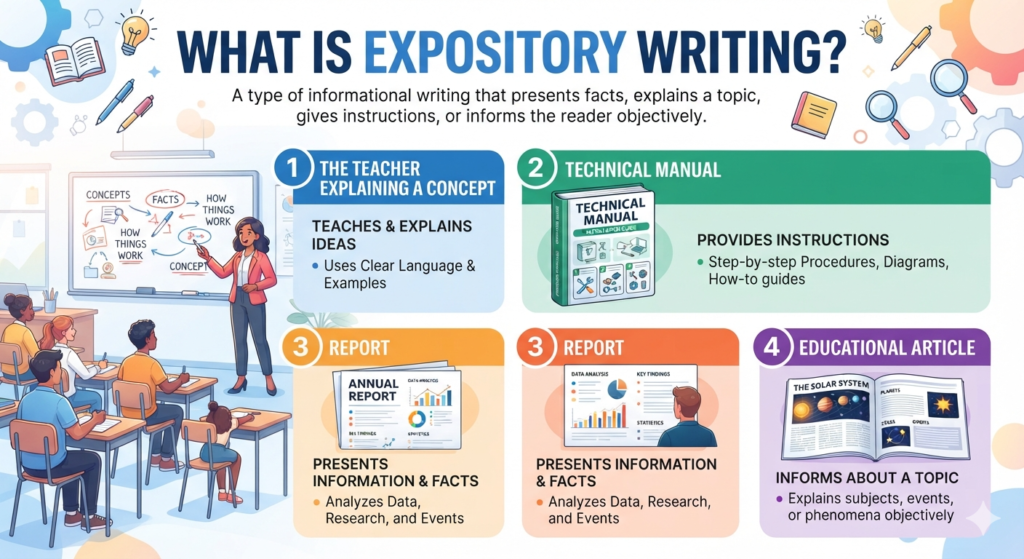
Expository writing is a form of informative writing that presents information clearly, logically, and objectively. It explains a subject using verifiable facts, examples, statistics, definitions, and logical reasoning.
And yes, it steers clear from expressing personal opinions or attempting to influence the reader’s beliers.
In simple terms, expository writing answers questions such as:
- What is it?
- How does it work?
- Why does it happen?
- What are its characteristics?
- What should readers know about it?
You’ll encounter expository writing in many everyday situations … from textbooks and encyclopedias to instruction manuals, research papers, business reports, educational blogs, and government publications.
📝 Example
Suppose someone asks:
“How does photosynthesis work?”
A persuasive writer might argue why environmental conservation is important.
A narrative writer might tell a story about a scientist.
An expository writer would explain the biological process step by step using facts and scientific evidence.
That difference captures the true purpose of expository writing: to explain, not to persuade or entertain.
Why Expository Writing Matters
Due to its nature of communicating information accurately, it forms the foundation of effective communication in both academic and professional setting.
Students rely on it to write essays and assignments. Businesses use it to create reports, proposals, and documentation. Technical writers prepare software manuals and product guides using expository techniques. Journalists explain current events through factual reporting, while researchers present findings in a structured, evidence-based manner.
Without expository writing, sharing reliable knowledge would become difficult.
Some of its key benefits include:
- It improves understanding through logical explanations.
- It helps readers learn new concepts quickly.
- It presents information objectively without emotional bias.
- It builds credibility by relying on evidence rather than opinion.
- It supports informed decision-making in education, business, and public communication.
Because of these strengths, expository writing is considered one of the core writing skills every student, professional, and aspiring writer should master.
📌 Remember
Expository writing informs the reader. It does not attempt to persuade, entertain, or tell a personal story.
Key Characteristics of Expository Writing
Understanding the characteristics of expository writing helps writers recognise when this writing style is appropriate and how to produce effective informational content.
1. Objective Tone
Expository writing avoids personal opinions, emotions, and subjective language. Instead, it presents information fairly and factually.
Instead of writing:
“I think this is the best solution.”
An expository writer would write:
“Research indicates this solution reduces processing time by 35 percent.”
2. Logical Organisation
Information follows a structured flow so readers can understand ideas without confusion.
Common organisational patterns include:
- General to specific
- Cause and effect
- Problem and solution
- Process or sequence
- Comparison and contrast
Each section builds naturally upon the previous one.
3. Evidence-Based Information
Effective expository writing relies on:
- Facts
- Research
- Examples
- Statistics
- Definitions
- Expert opinions
The goal is to explain ideas using reliable information rather than assumptions.
4. Clear and Precise Language
Good expository writing values clarity over complexity.
It avoids unnecessary jargon unless the audience requires technical terminology.
5. Informational Purpose
Every paragraph contributes toward explaining the topic.
Rather than asking readers to agree with an opinion, expository writing helps them understand the subject thoroughly.
6. Formal Structure
Most expository pieces follow a recognisable structure:
- Introduction
- Body paragraphs
- Conclusion
This predictable organisation improves readability and helps readers locate information quickly.
Summary of Key Characteristics
| Characteristic | Purpose |
| Objective tone | Presents information without personal bias |
| Logical organisation | Improves readability and understanding |
| Evidence-based content | Builds credibility and trust |
| Clear language | Makes complex ideas easier to understand |
| Informational focus | Educates rather than persuades |
| Structured format | Creates a smooth reading experience |
Types of Expository Writing
Although expository writing has one primary goal—to explain information—it can be organized in different ways depending on what the writer wants readers to understand.
Understanding the types of expository writing helps writers choose the most suitable structure for their topic rather than forcing every subject into the same format.
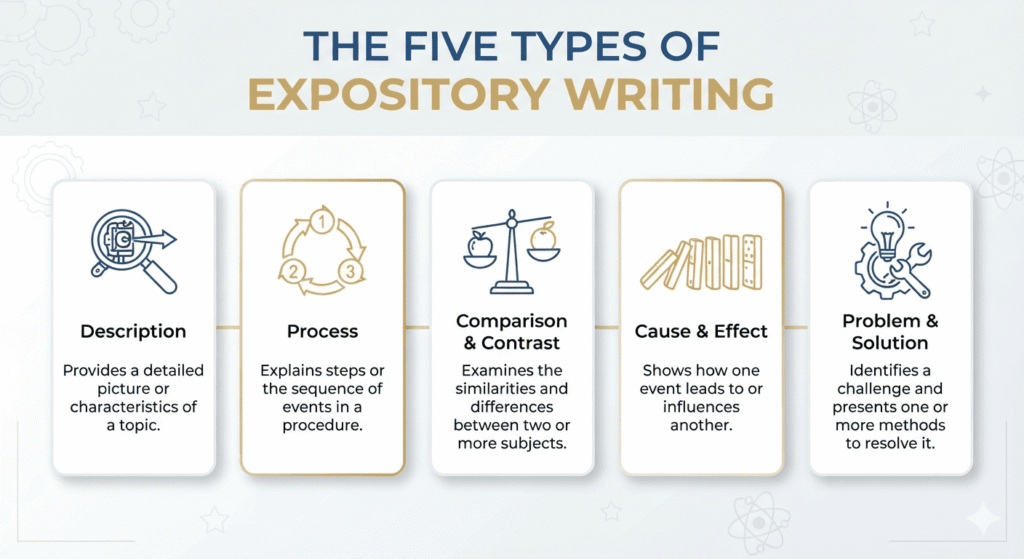
1. Descriptive Expository Writing
This type explains the characteristics, features, or qualities of a person, object, place, event, or concept using factual observations rather than personal emotions.
Its purpose is to help readers understand what something is like.
Examples:
- Describing how cloud computing works
- Explaining the characteristics of the human heart
- Describing the features of a software application
Unlike descriptive writing (covered separately in our Types of Writing series), descriptive expository writing remains objective and informative.
2. Process (How-To) Expository Writing
Process writing explains how something works or how to complete a task by presenting information in a logical sequence.
Readers should be able to follow each step without confusion.
Examples include:
- How to bake bread
- How online banking works
- How search engines index websites
- How to install computer software
Instruction manuals, user guides, recipes, and technical documentation commonly use this organisational pattern.
3. Comparison and Contrast Expository Writing
Sometimes readers understand a topic better by comparing it with another.
This pattern explains the similarities and differences between two or more subjects without arguing that one is superior.
Examples:
- Windows vs Linux
- Online learning vs classroom learning
- Electric cars vs petrol cars
- APA vs MLA citation styles
Comparison writing helps readers evaluate information objectively while developing a deeper understanding of each subject.
4. Cause and Effect Expository Writing
This pattern explains why something happens and what results from it.
Rather than merely describing an event, it explores the relationship between actions and outcomes.
Examples:
- Causes of climate change
- Effects of social media on communication
- Reasons for inflation
- Impact of artificial intelligence on writing careers
Cause-and-effect writing is widely used in academic research, journalism, business analysis, and policy reports.
5. Problem and Solution Expository Writing
Many informational documents are written to identify a problem before presenting one or more practical solutions.
This approach is common in business, government, healthcare, education, and technology.
Examples:
- Reducing workplace burnout
- Improving cybersecurity in organisations
- Solving traffic congestion
- Increasing student engagement in online learning
A good problem-and-solution article clearly defines the issue before evaluating realistic solutions supported by evidence.
Comparing the Different Types of Expository Writing
| Type | Primary Purpose | Common Examples |
| Descriptive | Explain characteristics | Scientific descriptions, product overviews |
| Process | Explain how something works | Tutorials, manuals, instructions |
| Comparison & Contrast | Compare subjects objectively | Product comparisons, style guide comparisons |
| Cause & Effect | Explain reasons and outcomes | Research papers, analytical reports |
| Problem & Solution | Present practical solutions | Business reports, policy documents |
No single type is better than another. The best choice depends entirely on the information you want readers to understand.
Structure of Expository Writing
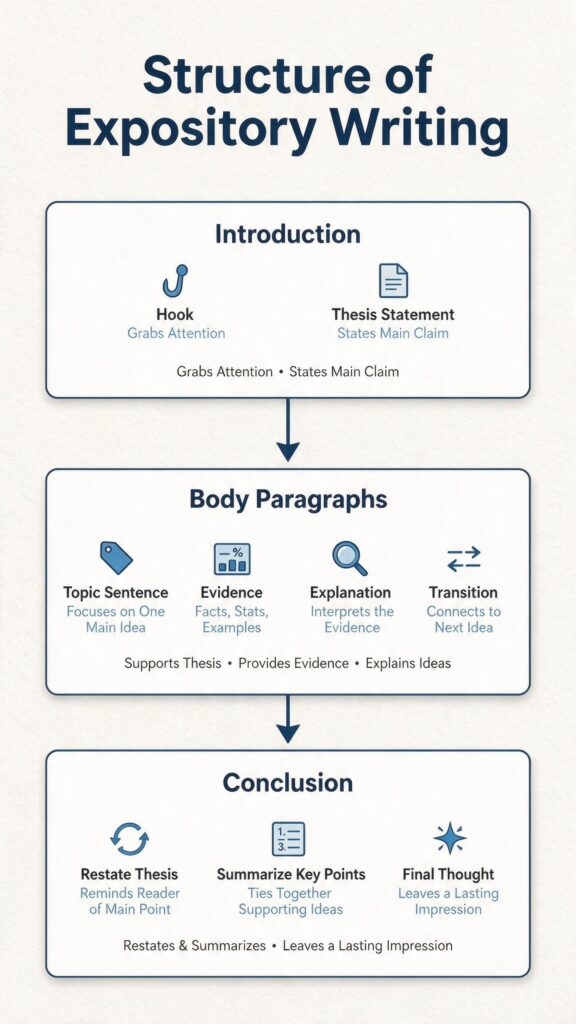
One reason expository writing is effective is its predictable structure. Readers know where to find definitions, explanations, supporting information, and conclusions because the content follows a logical sequence.
Most expository pieces use three major sections.
“Introduction”
The introduction introduces the topic, provides context, and prepares readers for what follows.
An effective introduction should:
- Introduce the subject clearly
- Explain why the topic matters
- Present the central idea
- Establish the scope of the discussion
Avoid overwhelming readers with unnecessary background information. The opening should create clarity, not complexity.
“Body Paragraphs”
The body forms the core of the article.
Each paragraph should focus on one main idea, supported by:
- Factual explanations
- Definitions
- Examples
- Evidence
- Statistics where appropriate
Use transition words to connect ideas smoothly so the discussion progresses naturally from one point to the next.
For longer resources, dividing the body into meaningful headings and subheadings significantly improves readability, especially for mobile users.
“Concluding the Blog/Article”
The conclusion summarises the key ideas without introducing new information.
Rather than repeating every point, it reinforces the main takeaway and reminds readers what they have learned.
A concise conclusion helps readers leave with a clear understanding of the topic.
How to Write Expository Writing
Understanding the characteristics and structure is only the first step. The real skill lies in organizing information so readers can understand it easily.
Whether you’re writing a school assignment, a technical document, a blog post, or a business report, the writing process follows the same basic principles.
Step 1: Understand the Topic Thoroughly
Before writing anything, spend time researching the subject.
Since expository writing explains rather than persuades, your understanding should be based on reliable information instead of assumptions.
Ask yourself:
- What exactly am I explaining?
- Who is my audience?
- What information will readers expect?
- Which facts are essential?
The stronger your understanding, the easier it becomes to explain the topic clearly.
Step 2: Define the Purpose
Every expository article should answer one primary question.
Examples:
- What is cloud computing?
- How does artificial intelligence work?
- Why is cybersecurity important?
- What causes earthquakes?
Avoid trying to answer multiple unrelated questions within one article.
A focused objective keeps the content organised and prevents readers from becoming confused.
Step 3: Gather Reliable Information
Good writing depends on trustworthy information.
Use sources such as:
- Academic books
- Research papers
- Government publications
- Recognized industry organizations
- Official documentation
- Reputable educational websites
Avoid relying solely on personal opinions or unverified online sources.
Step 4: Organize Your Ideas
Before drafting, create a simple outline.
For example:
Introduction
↓
Definition
↓
Characteristics
↓
Types
↓
Examples
↓
Common Mistakes
↓
Conclusion
Planning your article first helps maintain a logical flow and reduces unnecessary rewriting later.
Step 5: Write a Clear Introduction
The introduction should immediately tell readers:
- What the topic is
- Why it matters
- What they will learn
Avoid lengthy background stories.
Readers appreciate getting to the point quickly, especially when searching for informational content.
Step 6: Develop One Idea Per Paragraph
Each paragraph should explain only one concept.
Instead of writing:
Expository writing is objective. It has many types. It also uses facts. Students write essays. Businesses write reports.
Separate the ideas:
- One paragraph about objectivity
- Another about evidence
- Another about real-world applications
This improves readability, particularly on mobile devices.
Step 7: Support Ideas with Evidence
Readers trust explanations that include:
- Examples
- Statistics
- Definitions
- Expert observations
- Practical situations
Rather than making unsupported claims, explain why something is true.
For example:
Instead of:
Technical documentation is important.
Write:
Technical documentation helps users understand complex products through structured instructions, reducing errors and improving usability.
Step 8: Use Logical Transitions
Transitions connect ideas naturally.
Examples include:
- First
- Next
- Similarly
- However
- In contrast
- As a result
- Therefore
- Finally
These small phrases improve the reading experience by helping readers follow the progression of ideas.
Step 9: Maintain an Objective Tone
Remember that expository writing explains information rather than expressing personal opinions.
Avoid phrases such as:
- I believe…
- In my opinion…
- I feel…
Instead, rely on evidence and factual explanations.
The writing should remain neutral, balanced, and informative throughout.
Step 10: Review and Edit
Before publishing or submitting your work, review it carefully.
Check for:
- Factual accuracy
- Logical organisation
- Grammar and punctuation
- Unnecessary repetition
- Readability
- Consistency in terminology
Editing often improves an article more than writing the first draft.
✍️ Writing Tip
If a sentence feels difficult to read aloud, it will probably feel difficult to read silently as well. Simplify it.
Real-World Examples of Expository Writing
Many people associate expository writing only with school essays, but it appears in almost every industry.
Education
- Textbooks
- Assignments
- Encyclopaedias
- Study guides
Journalism
- News reports
- Background explainers
- Investigative summaries
Business
- Annual reports
- Policy documents
- Standard operating procedures
- White papers
Technical Communication
- User manuals
- Software documentation
- API documentation
- Installation guides
Healthcare
- Patient information leaflets
- Medical reports
- Clinical guidelines
Government
- Public notices
- Policy explanations
- Tax guides
- Legal information pages
Although these documents serve different audiences, they all share the same purpose: to communicate information accurately and objectively.
Expository Writing vs Other Types of Writing
One of the easiest ways to understand expository writing is to compare it with other writing styles.
| Writing Type | Primary Goal | Example |
| Expository | Explain and inform | Textbook chapter |
| Narrative | Tell a story | Novel |
| Descriptive | Create sensory imagery | Travel writing |
| Persuasive | Convince readers | Opinion article |
This comparison highlights why choosing the correct writing type matters.
Common Mistakes Writers Make in Expository Writing
Since the purpose of expository writing is to explain ideas clearly and objectively, these errors often reduce readability, confuse readers, or damage credibility.
Understanding these common mistakes helps you recognise and eliminate them before publishing your work.
1. Including Personal Opinions
One of the biggest misconceptions about expository writing is that writers can freely include personal viewpoints.
Instead of explaining information objectively, many beginners write sentences such as:
I believe online education is the best way to learn.
This shifts the article towards persuasive writing.
A better approach would be:
Online education provides flexibility, wider accessibility, and personalised learning opportunities.
The second sentence explains factual advantages without attempting to persuade readers.
2. Writing Without Enough Research
Expository writing depends on facts, not assumptions.
Insufficient research often leads to:
- Inaccurate information
- Unsupported claims
- Outdated facts
- Weak explanations
Before writing, gather information from credible sources such as academic publications, official organisations, government websites, and recognised industry resources.
3. Poor Organisation
Readers should never feel lost while reading.
Jumping randomly between ideas makes the article difficult to follow.
For example:
Definition
↓
Examples
↓
History
↓
Benefits
↓
Back to Definition
This creates unnecessary confusion.
Instead, organize information logically so every section builds naturally on the previous one.
4. Overloading Readers with Information
Many writers believe that adding more information automatically improves quality.
In reality, excessive detail often overwhelms readers.
Focus on explaining:
- What readers need to know
- Why it matters
- How it works
Avoid including unrelated facts that interrupt the flow.
5. Using Complex Language Unnecessarily
Long words and complicated sentences do not make writing more professional.
For example:
The implementation of multifaceted methodological approaches facilitates enhanced comprehension.
A simpler version communicates the same idea more effectively:
Using different methods helps readers understand the topic more clearly.
Good expository writing values clarity over complexity.
6. Ignoring the Target Audience
The same explanation should not be written for everyone.
A school student, software engineer, medical professional, and business executive all require different levels of explanation.
Always ask:
- Who will read this?
- What do they already know?
- What do they need to learn?
Writing for the audience dramatically improves communication.
7. Forgetting Examples
Definitions alone rarely make concepts memorable.
Examples transform abstract ideas into practical understanding.
Compare:
Expository writing explains information objectively.
Now compare:
A textbook chapter explaining photosynthesis is an example of expository writing.
The second explanation is immediately easier to understand.
8. Weak Conclusions
Many writers simply stop writing after the final section.
A good conclusion should briefly reinforce the key learning without repeating every point.
Readers should leave with a clear understanding of the topic and know where to continue learning next.
Tips to Improve Your Expository Writing
Like every writing skill, expository writing improves through practice. The following techniques help writers produce clearer, more engaging, and more informative content.
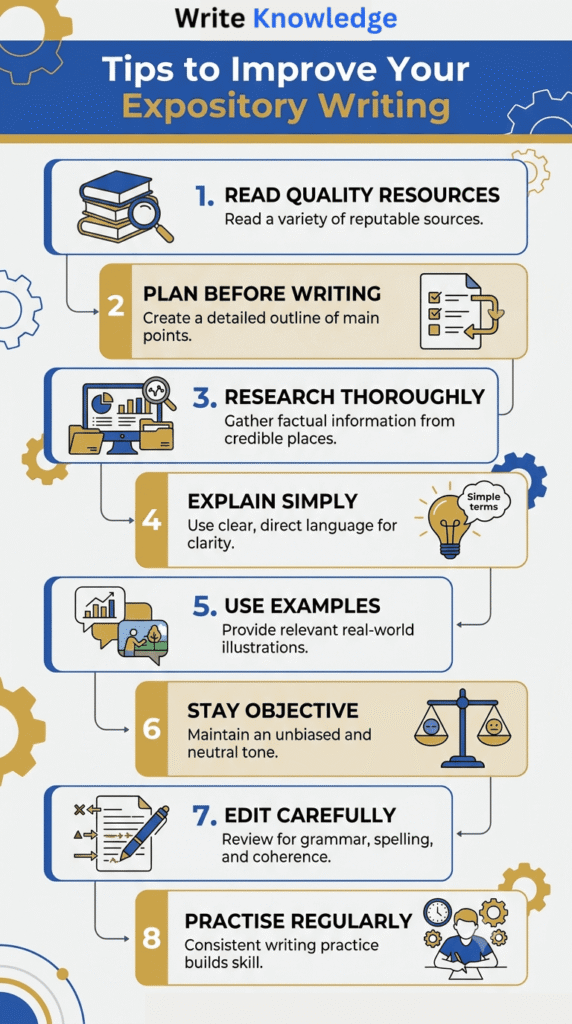
Read High-Quality Informational Writing
Study well-written:
- Textbooks
- Encyclopaedias
- Educational blogs
- Technical documentation
- Research explainers
Observe how professional writers organise information and transition between ideas.
Create an Outline Before Writing
Planning first saves time later.
Even a simple outline keeps your article organised and prevents repetition.
Explain Complex Ideas Simply
Imagine explaining the topic to someone unfamiliar with it.
If readers need to reread a sentence several times, it probably needs simplifying.
Use Examples Frequently
Whenever introducing a new concept, ask yourself:
Can I provide a simple example?
Examples improve understanding far more effectively than lengthy definitions.
Keep Paragraphs Focused
Each paragraph should discuss one main idea.
This improves readability on both desktop and mobile devices.
Edit Ruthlessly
After completing the first draft:
- Remove repetition
- Shorten long sentences
- Eliminate unnecessary words
- Verify facts
- Improve transitions
Good writing is often the result of careful editing rather than perfect first drafts.
📚 Continue Learning Different Writing Styles
Mastering expository writing becomes easier when you understand how it differs from other writing styles.
These guides will help you identify when each writing style is most appropriate and how they differ in purpose, tone, and structure.
When Should You Use Expository Writing?
Expository writing is the right choice whenever your primary goal is to educate, explain, or inform.
Use it when writing:
- School and university assignments
- Research papers
- Educational blog posts
- Technical documentation
- User manuals
- Business reports
- White papers
- Policy documents
- Instructional guides
- Encyclopedia entries
If your objective is storytelling, persuasion, or emotional expression, another writing style will usually be more appropriate.
Conclusion
Expository writing is one of the most valuable writing skills because it enables writers to communicate ideas clearly, logically, and objectively. Whether you’re writing for school, work, business, or online publishing, the ability to explain information accurately helps readers learn, solve problems, and make informed decisions.
Frequently Asked Questions (FAQs)
What is expository writing in simple words?
Expository writing is a type of writing that explains, informs, or describes a topic using facts, logical organisation, and objective language.
What is the main purpose of expository writing?
The main purpose is to help readers understand a subject clearly rather than persuade, entertain, or express personal opinions.
What are the five main types of expository writing?
The five common types are:
- Descriptive
- Process (How-To)
- Comparison and Contrast
- Cause and Effect
- Problem and Solution
Where is expository writing commonly used?
Expository writing appears in textbooks, research papers, reports, instructional guides, technical documentation, educational blogs, government publications, and business documents.

Sachin is a Postgraduate in Technical Writing in Business Management specializing in creating SEO-friendly, User-friendly, and Reader-focused website articles on Education, Tech, Sports, Games, and Entertainment.
Through Write Knowledge, he helps students, bloggers, editors, and professionals develop practical writing skills using clear explanations, real-world examples, and internationally recognized writing standards.