A SaaS content writing career sits at the intersection of writing, technology, SEO, and business. Instead of simply writing about software, a SaaS content writer helps readers understand a product, solve a problem, evaluate solutions, and make informed decisions.
For writers who want to specialise beyond general blog writing, SaaS can offer a practical path into technology-focused content work.
💡 Quick Answer: Who is SaaS Content Writer
A SaaS content writer creates content for Software as a Service companies. Their work can include SEO articles, product explainers, feature guides, comparison pages, use-case content, website pages, case studies, and educational resources.
The role requires strong writing and research skills along with an understanding of software products, target audiences, search intent, and basic SEO.
What Is SaaS Content Writing?
SaaS content writing is the creation of written content for companies that deliver software through a subscription or online service model. SaaS stands for Software as a Service, where customers generally access software through the internet rather than purchasing and installing a traditional standalone product.
A SaaS content writer has to do more than explain what software does. The content usually needs to connect a user problem with a software solution.
For example, imagine a Bengaluru-based project management platform. A generic article might explain what project management is. A SaaS content writer could instead create a resource explaining how distributed teams can manage deadlines, assign tasks, and track project progress using the platform’s features.
That difference is important. SaaS writing usually connects education with the customer’s journey.
If you are new to specialised writing, the broader B2B Content Writing career is also relevant because many SaaS companies sell their products to businesses.
What Does a SaaS Content Writer Do?
The exact responsibilities vary between companies, but a SaaS content writer may work across several stages of the customer journey.
Common responsibilities include:
- Researching SaaS products, industries, competitors, and audiences
- Writing SEO-focused blog posts and educational resources
- Explaining software features and use cases
- Creating product comparison and alternative pages
- Writing website and landing-page content
- Developing how-to guides and tutorials
- Creating case studies and customer-focused resources
- Writing industry reports and thought-leadership content
- Updating existing content based on search performance or product changes
- Working with SEO, product, marketing, design, and subject-matter teams
- Fact-checking technical and product information before publication
A writer may therefore move between educational writing, marketing writing, technical explanation, and search-focused content during the same week.
What Types of Content Does a SaaS Writer Create?
SaaS companies need content for different stages of the customer journey, so the work is rarely limited to blog posts.
SEO Blog Posts and Educational Resources
These resources answer questions potential users are already searching for.
For example, a cybersecurity SaaS company might publish resources about password security, phishing prevention, or endpoint protection before introducing its own product as one possible solution.
The writer’s job is to answer the reader’s question first rather than turning every paragraph into a sales pitch.
Product and Feature Pages
A writer may explain what a product or feature does, who it is for, and what problem it solves.
This requires understanding the actual product instead of relying on generic descriptions. Product pages also need to communicate benefits without making claims that the software cannot support.
Comparison and Alternative Pages
SaaS buyers often compare tools before making a decision.
A writer may create pages such as:
[Product A] vs [Product B]
or
Alternatives to [Product A]
These pages require careful research because inaccurate comparisons can damage both credibility and user trust.
Case Studies and Customer Stories
Case studies show how a real customer used a product to address a business problem.
For example, a SaaS company could document how a Jaipur-based e-commerce business improved its internal workflow after adopting a particular software platform.
The writer typically has to understand the original problem, implementation process, measurable or observable outcome, and customer’s perspective.
Website, Email, and Conversion Content
SaaS writers may also work on homepage copy, service pages, landing pages, email sequences, newsletters, product announcements, FAQs, and other customer-facing resources.
The writing style changes according to the purpose. A product announcement may need to be concise, while an educational guide may require considerably more explanation.
SaaS Content Writer Skills: What do You Need?
You do not need to be a software developer to become a SaaS content writer. However, you do need to become comfortable learning technology and explaining it accurately.
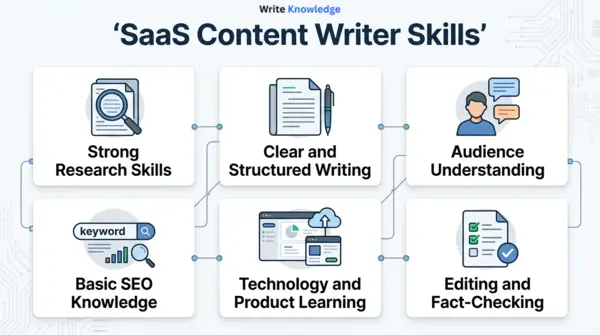
Strong Research Skills
SaaS writers frequently encounter unfamiliar products and technical concepts. The ability to research, understand, verify, and simplify information is therefore essential.
A writer covering cloud software today might need to understand an unfamiliar industry or product tomorrow.
Clear and Structured Writing
Technical concepts become useful only when readers can understand them.
A good SaaS writer can take information from product documentation, interviews, research, or subject-matter experts and turn it into clear content without unnecessarily reproducing technical jargon.
Audience Understanding
A developer, startup founder, HR manager, marketing executive, and small-business owner may use different software for completely different reasons.
A SaaS writer needs to understand who is reading, what problem they have, what they already know, and what they need to decide next.
Basic SEO Knowledge
SaaS content often depends heavily on organic search.
Writers should understand search intent, keyword research, topic coverage, headings, internal linking, title tags, meta descriptions, and basic on-page optimisation.
SEO should support the content rather than dictate every sentence.
Technology and Product Learning
You do not have to know every technology before starting. What matters is your ability to learn.
A writer working for a CRM company, for example, should gradually understand concepts such as leads, contacts, pipelines, workflows, automation, integrations, and reporting.
Editing and Fact-Checking
SaaS content can contain product specifications, integrations, technical terminology, statistics, pricing information, and claims.
A strong writer checks these details instead of assuming that a source or AI-generated draft is automatically correct.
Where Can SaaS Content Writers Work?
SaaS writers can work directly for software companies or through agencies and other organisations that serve technology businesses.
Common employers include:
- SaaS companies
- Software startups
- B2B technology companies
- Product-led businesses
- Digital marketing agencies
- SEO agencies serving SaaS clients
- Technology consultancies
- B2B media and publishing companies
- Enterprise software companies
India has a particularly large technology and startup ecosystem, so SaaS writers may encounter opportunities connected with companies in Bengaluru, Hyderabad, Pune, Gurugram, Noida, Chennai, Mumbai, Ahmedabad, and other technology hubs.
Remote work also means the employer does not necessarily need to be located in the writer’s city.
How to Become a SaaS Content Writer?
You do not need to wait for a company to give you SaaS experience before learning the field. You can build relevant experience through focused practice and portfolio work.
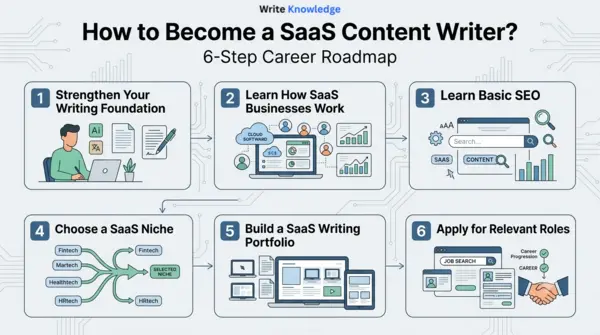
Step 1: Strengthen Your Writing Foundation
Start with grammar, sentence construction, research, paragraph structure, editing, and the ability to explain unfamiliar subjects clearly.
Your first objective is not to sound technical. It is to become useful to the reader.
Step 2: Learn How SaaS Businesses Work
Understand basic concepts such as software products, subscriptions, users, features, integrations, customer problems, and buying journeys.
Study several SaaS websites and notice how they explain their products to different audiences.
Step 3: Learn Basic SEO
Learn how to identify search intent and create content around genuine user questions.
You should be comfortable with keyword research, search-focused outlines, internal linking, title and meta-description writing, and content optimisation.
Step 4: Choose a SaaS Niche
You do not have to specialise immediately, but choosing an area can make portfolio development easier.
Possible areas include:
- Marketing technology
- HR technology
- Cybersecurity
- Project management
- Customer relationship management
- Finance and accounting software
- E-commerce software
- Education technology
- Healthcare technology
For example, a writer interested in cybersecurity could gradually build knowledge around security software, threat detection, data protection, and security awareness.
Step 5: Build a SaaS Writing Portfolio
Create a small number of strong samples rather than filling your portfolio with dozens of average pieces.
A useful beginner portfolio could contain:
- One educational SaaS blog post
- One product or feature page
- One comparison article
- One use-case or case-study-style resource
If the company or product is fictional, clearly identify the sample as hypothetical.
Step 6: Apply for Relevant Roles
Search for positions such as SaaS Content Writer, B2B Content Writer, SEO Content Writer, Technical Content Writer, or Content Marketing Writer.
When applying, place your most relevant SaaS sample where recruiters can find it quickly.
📌 Remember
You can become a SaaS content writer by strengthening your writing fundamentals, learning how SaaS businesses and software products work, developing basic SEO skills, choosing a SaaS niche, building a focused portfolio, and applying for relevant writing roles.
You can gain relevant experience through well-researched practice and clearly labelled hypothetical samples—even before working for a SaaS company.
What Should a SaaS Content Writer Portfolio Include?
A SaaS portfolio should demonstrate more than good English.
It should show that you can understand a product, identify an audience, explain a problem, structure information, and guide the reader towards a useful next step.
For example, suppose you want to work with HR software companies. You could create a fictional portfolio around an employee-management platform and produce:
| Sample | What it demonstrates |
| How Employee Onboarding Software Works | Research and educational writing |
| Employee Onboarding Software Comparison | Comparative and decision-support writing |
| Feature Page for Automated Onboarding | Product-focused writing |
| Customer Story for a Pune Startup | Case-study storytelling |
This gives a potential employer a much better idea of what you can actually do.
SaaS Content Writing Examples
Consider a fictional SaaS company called TaskFlow, a project-management platform used by distributed teams.
A weak topic might be:
Project Management Software
That topic is too broad to demonstrate much understanding.
A more useful SaaS content resource could be:
How Remote Teams Can Manage Projects Across Multiple Time Zones
The article could explain common coordination problems, practical workflows, and relevant software features.
Similarly, a product page could explain how TaskFlow’s task assignment and deadline-tracking features help managers coordinate teams in Mumbai, Kochi, and Guwahati without relying on scattered spreadsheets and messages.
The point is not to insert the product into every paragraph. The content should first address the reader’s actual problem.
What Is the Difference Between SaaS Content Writing and Technical Writing?
SaaS content writing and technical writing can overlap, but they usually serve different purposes.
A SaaS content writer may create a search-focused guide that helps potential customers understand a problem or evaluate software.
A technical writer may create product documentation explaining exactly how users should configure, operate, or troubleshoot the software.
For example:
SaaS content:
“How Can CRM Automation Reduce Repetitive Sales Tasks?”
Technical documentation:
“How to Configure an Automated Lead Assignment Workflow”
Both require accuracy and technical understanding, but their audiences, objectives, and formats can be different.
Writers interested in both paths can explore Technical Writing as a related career direction within the broader Writing Careers ecosystem.
Is SaaS Content Writing a Good Career Path?
SaaS content writing can be a useful specialisation for writers who enjoy technology, research, business topics, and problem-solving.
The advantage of specialising is that your knowledge can compound. After writing repeatedly about one industry, you become faster at understanding its terminology, audiences, products, and common questions.
However, SaaS writing is not simply about adding words such as “software,” “automation,” or “AI” to ordinary blog posts. Strong SaaS writing requires genuine product understanding and the ability to communicate value accurately.
How Can AI Be Used in SaaS Content Writing?
AI tools can support parts of the SaaS writing workflow, but they should not replace research, product understanding, or editorial judgement.
A practical workflow can look like this:
Research → Brief → Outline → Draft → Fact-check → Edit → Optimise → Final review
AI can help with brainstorming, outlining, reorganising information, identifying unanswered questions, or improving clarity. However, product claims, technical information, statistics, customer results, and other factual details still require human verification.
This is particularly important when writing about software because an AI-generated explanation can sound convincing while misunderstanding how a product actually works.
The writer remains responsible for the final content.
Common Mistakes SaaS Content Writers Should Avoid
Writing About Features Without Explaining Their Value
Listing software features does not automatically help readers.
Explain the problem a feature addresses and why that matters to the intended user.
Using Too Much Technical Jargon
Technical vocabulary is sometimes necessary, but unexplained terminology creates friction.
Use the simplest accurate explanation first and introduce specialised terms when they genuinely help.
Making Every Resource Promotional
Readers do not search for an advertisement disguised as an educational resource.
Useful SaaS content should answer the reader’s question even when the reader is not ready to buy anything.
Relying on AI Without Verification
AI can accelerate writing, but it can also produce inaccurate product descriptions, invented statistics, outdated information, or technically incorrect explanations.
Human review is essential.
Ignoring Search Intent
A keyword is not a content strategy.
If someone searches for “CRM software for small businesses,” they may need comparison criteria, important features, use cases, pricing considerations, or recommendations. A generic definition of CRM will not fully satisfy that intent.
⚠️ Common Mistakes
Common mistakes SaaS content writers should avoid include:
- Listing software features without explaining their user value.
- Using excessive or unexplained technical jargon.
- Turning every educational resource into a sales pitch.
- Publishing AI-generated content without verifying its accuracy.
- Writing about a keyword without addressing the reader’s search intent.
How Does a SaaS Content Writer Build a Career Path?
A SaaS writing career can develop in several directions rather than following one fixed ladder.
A possible progression is:
Content Writer → SaaS Content Writer → Senior Content Writer → Content Strategist
Other directions can include:
- SEO Content Specialist
- Technical Content Writer
- Content Marketing Specialist
- Product Marketing Writer
- Thought-Leadership Writer
- Content Strategist
- Editorial Manager
As your experience grows, your responsibilities can move beyond writing into content planning, research, briefs, topic selection, content optimisation, performance analysis, and editorial management.
Your career does not have to follow the same path as another writer. Some people may deepen their technical specialisation, while others may move towards SEO, product marketing, or content strategy.
✅ Key Takeaways
- SaaS content writing combines writing, technology, SEO, and business understanding.
- SaaS writers create blogs, product pages, feature guides, comparisons, case studies, and other resources.
- Strong research and clear explanation are more important than trying to sound overly technical.
- Basic SEO and search-intent knowledge can make a SaaS writer more effective.
- A focused portfolio can help beginners demonstrate SaaS writing ability.
- AI can support the workflow, but human research, fact-checking, and editorial judgement remain essential.
- SaaS writing can lead towards content strategy, technical writing, SEO, product marketing, and other specialised careers.
Conclusion
A SaaS content writing career is a practical specialisation for writers who want to combine communication skills with technology and business knowledge. You do not need to become a developer, but you do need to become comfortable learning products, understanding users, researching unfamiliar subjects, and explaining technical ideas clearly.
Start with strong writing fundamentals, learn how SaaS businesses and search work, choose an area to explore, and build a focused portfolio. From there, you can develop towards more specialised SaaS, B2B, technical, SEO, or content-strategy roles within the wider Writing Careers ecosystem.
Frequently Asked Questions
What is SaaS content writing?
SaaS content writing involves creating content for Software as a Service companies. It can include blogs, product pages, feature guides, comparisons, case studies, tutorials, and educational resources.
What does a SaaS content writer do?
A SaaS content writer researches software products and their audiences and creates content that educates readers, addresses problems, supports search visibility, or helps potential customers understand a product.
Do I need technical knowledge to become a SaaS content writer?
You do not need to be a software developer, but you need to be willing to learn technical concepts and understand the products you write about.
How can I get a SaaS content writing job without experience?
Build a focused portfolio with several realistic SaaS samples, learn basic SEO, study SaaS products, and apply for entry-level content, SEO, B2B, technology, and SaaS writing roles.
Can AI replace SaaS content writers?
AI can assist with research organisation, brainstorming, outlining, and drafting, but SaaS content still requires human product understanding, fact-checking, audience judgement, editing, and responsibility for accuracy.

Sachin is a Postgraduate in Technical Writing in Business Management specializing in creating SEO-friendly, User-friendly, and Reader-focused website articles on Education, Tech, Sports, Games, and Entertainment.
Through Write Knowledge, he helps students, bloggers, editors, and professionals develop practical writing skills using clear explanations, real-world examples, and internationally recognized writing standards.