You finish writing an article, read it twice, and everything looks fine.
Then you publish it.
And five minutes later, you spot it:
“Their” instead of “there.”
Or a missing comma. A heading with inconsistent capitalization. A double space. Maybe even a sentence that somehow survived three rounds of editing.
That’s the kind of problem proofreaders are hired to catch.
Proofreading may sound like simply “checking for mistakes,” but professional proofreading is more systematic than that. A proofreader works through content carefully to identify errors that could affect its accuracy, consistency, readability, presentation, and professionalism.
💡 Quick Answer
A proofreading career means checking written content for spelling, grammar, punctuation, and formatting errors before it’s published. Proofreaders make sure writing looks polished, professional, and easy to read — whether it’s a book, article, website, or business document.
In short, it’s about perfecting the final version of text so it’s clear, accurate, and error‑free.
For publishers, websites, businesses, authors, academic researchers, and agencies, that final check can make the difference between content that looks finished and content that still feels unfinished.
If you enjoy working with language, noticing small details, and improving text without necessarily rewriting it from scratch, a proofreading career may be worth exploring.
What is a Proofreading Career?
A proofreading career involves reviewing written content for errors in spelling, grammar, punctuation, formatting, consistency, and other surface-level issues before the content is published or submitted.
Proofreaders may work on:
- Books
- Articles
- Websites
- Blogs
- Reports
- Academic papers
- Marketing content
- Business documents
- Newsletters
- Product content
- Other written materials
A proofreader’s job is usually different from an editor’s. Editors may substantially improve structure, clarity, organization, and wording, while proofreaders generally work closer to the final version and focus on identifying remaining errors and inconsistencies.
Who Exactly is a Proofreader?
A proofreader is the person who checks a document after it has gone through the main writing and editing process.
The exact responsibilities vary depending on the employer and type of content, but the basic goal is consistent:
Find problems that should be fixed before the reader sees the final version.
A proofreader may check whether:
- Words are spelled correctly
- Punctuation is used consistently
- Grammar is correct
- Headings follow the required style
- Capitalization is consistent
- Numbers and dates are formatted correctly
- Links work
- Captions match images
- Page elements are positioned correctly
- The document follows the relevant style or house rules
A proofreader therefore needs more than a good command of English.
What Does a Proofreader Do?
Proofreading can involve several different kinds of checks.
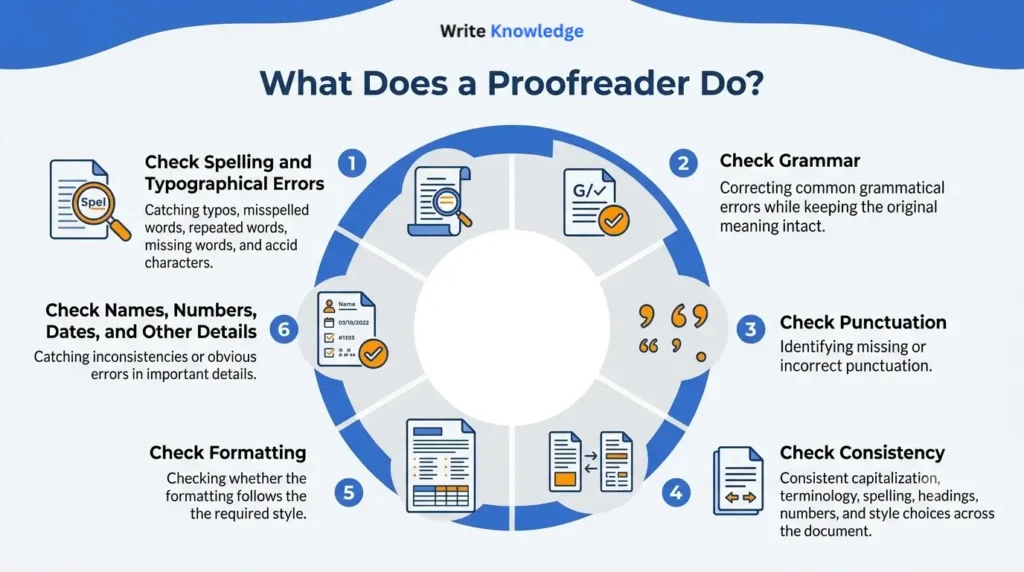
Check Spelling and Typographical Errors
This is one of the most obvious parts of proofreading.
A proofreader looks for:
- Misspelled words
- Typing mistakes
- Repeated words
- Missing words
- Extra words
- Accidental characters or spaces
📝 Example
Incorrect:
The report contains several usefull examples.
Correct:
The report contains several useful examples.
Notice the extra ‘l’ in ‘useful’ in the incorrect sentence? These errors may be small, but repeated mistakes can make otherwise good content look careless.
Check Grammar
Proofreaders also identify grammatical errors that remain after editing.
📝 Example
Incorrect:
The list of requirements are available below.
Correct:
The list of requirements is available below.
Notice the use of ‘are’ and ‘is’ in both the sentences? The proofreader isn’t necessarily expected to rewrite every sentence stylistically. The focus is on making sure the final text is grammatically sound and consistent with the required standard.
Check Punctuation
Punctuation errors can change the meaning of a sentence or simply make professional content look inconsistent.
A proofreader may check:
- Commas
- Apostrophes
- Quotation marks
- Colons
- Semicolons
- Parentheses
- Hyphens
- Periods
They may also check whether punctuation follows a particular style guide or house style.
Check Consistency
Consistency is one of the areas where proofreading becomes more than simple spell-checking.
For example, imagine an article uses:
- email in one section;
- e-mail in another;
- Email in a third.
None of these necessarily makes the entire document incomprehensible, but inconsistent usage can make the content look poorly controlled.
A proofreader may identify and standardize such inconsistencies according to the applicable style.
Check Formatting
Depending on the job, proofreading may include checking visual and structural elements.
This can include:
- Headings
- Subheadings
- Bullet points
- Numbered lists
- Tables
- Captions
- Spacing
- Fonts
- Page numbers
- References
For print publishing, proofreading can extend into checking the final typeset pages. For digital content, it may involve reviewing how the content actually appears on a webpage or content-management system.
Check Names, Numbers, Dates, and Other Details
A proofreader may also catch small factual or consistency problems that are visible from the document itself.
For example:
The article refers to an event as taking place on March 12 in one section and March 21 in another.
A proofreader may flag the inconsistency rather than simply assuming which date is correct.
This distinction matters:
Proofreading is not the same as fact-checking.
A proofreader should not automatically be expected to verify every factual claim unless that responsibility is specifically part of the role.
Where Do Proofreaders Work?
Proofreaders can work across many industries because almost every industry produces written material.
Publishing
Traditional publishing remains one of the most recognizable areas for proofreading.
Proofreaders may work on:
- Books
- Magazines
- Journals
- Educational publications
- Other published materials
For book publishing and long-form editorial work, the Chicago Manual of Style (CMOS) is particularly relevant because it covers much more than citations. It provides guidance on editorial conventions, punctuation, capitalization, manuscript preparation, typography, and other publishing practices.
Digital Media and Websites
Websites produce enormous amounts of written content, including blog posts, landing pages, articles, newsletters, product descriptions, and knowledge-base content.
For news-oriented websites, digital media, and journalism, proofreaders may encounter AP Style, which provides conventions for areas such as capitalization, numbers, dates, titles, abbreviations, and terminology.
For general blogs and website content, however, there may not be a formal external style guide. In those cases, the website’s own editorial or house style is usually more important.
This distinction is useful because a proofreader shouldn’t assume that every website follows AP Style.
Proofreaders may review:
- Blog posts
- Landing pages
- Articles
- Newsletters
- Website copy
- Product descriptions
- Knowledge-base content
Academic and Research Content
Proofreading is also common in academic environments, including dissertations, theses, research papers, journal submissions, academic articles, and reports.
The appropriate style guide depends heavily on the subject and institution. For example, APA Style is commonly associated with psychology, education, social sciences, and research-oriented writing.
For literature, language, and many humanities subjects, MLA Style is often the more relevant standard.
For Academic and Research Content, the work may include:
- Dissertations
- Theses
- Research papers
- Journal submissions
- Academic articles
- Reports
If you have now become curious about academic writing, explore more about it here.
Corporate and Business Content
Companies also need proofreading for:
- Reports
- Presentations
- Proposals
- Internal documents
- Newsletters
- Training materials
- Business communications
These materials do not necessarily follow one universal style guide. Many organizations instead maintain an internal house style covering terminology, capitalization, formatting, tone, names, product references, and other editorial preferences.
Marketing and Advertising
Marketing agencies and businesses may hire proofreaders to check:
- Advertisements
- Social media content
- Email campaigns
- Brochures
- Website copy
- Promotional materials
What Skills Do You Need for a Proofreading Career?
You don’t need to be an award-winning writer to become a good proofreader.
In fact, some of the most important proofreading skills have little to do with creativity.
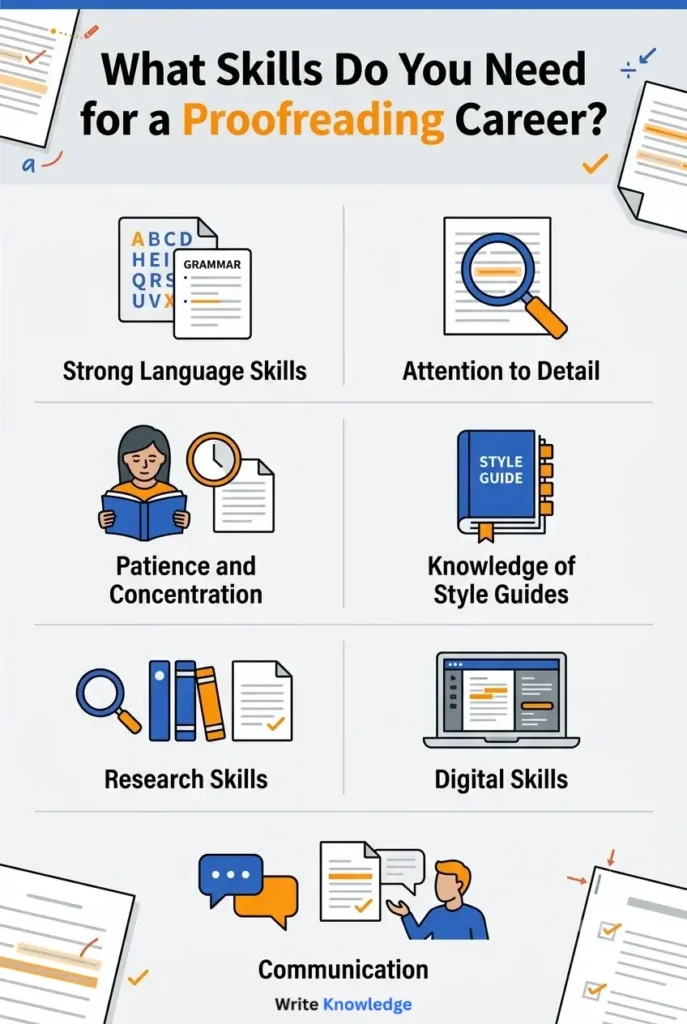
Strong Language Skills
You need a strong understanding of:
- Grammar
- Spelling
- Punctuation
- Sentence structure
- Usage
- Standard written English
You should be able to recognize when something sounds wrong and, more importantly, understand why it is wrong.
Attention to Detail
This may be the most important proofreading skill.
A proofreader needs to notice things that other readers overlook.
That could be a missing apostrophe, an inconsistent heading, an extra space, or a small difference between two versions of a name.
Patience and Concentration
Proofreading can be repetitive.
You may spend hours reviewing similar material while maintaining the same level of concentration.
That requires patience.
Knowledge of Style Guides
Different organizations follow different editorial standards.
Depending on the work, you may need familiarity with style guides such as:
- APA
- MLA
- Chicago
- IEEE
- And organization’s own house style
You don’t necessarily need to memorize every rule.
You do need to know where to find the answer when you’re unsure.
Fortunately, we have a dedicated section for writing style guides that you can take help of.
Research Skills
Proofreaders sometimes need to investigate an unfamiliar term, name, spelling, abbreviation, or formatting convention.
Being comfortable checking reliable sources is therefore useful.
Digital Skills
Modern proofreading increasingly happens digitally.
Useful skills can include working with:
- Microsoft Word
- Google Docs
- PDFs
- Track changes
- Comments
- Content-management systems
- Basic document-formatting tools
The exact tools depend on the employer.
Communication
A proofreader needs to know how to flag an error without unnecessarily rewriting someone else’s work.
For example, there’s a difference between:
“This sentence is terrible. Rewrite it.”
and:
“This sentence may need revision for clarity. Did you intend to say…?”
Professional proofreading requires tact, especially when working with writers, editors, researchers, or subject-matter experts.
Do You Need a Degree to Become a Proofreader?
No single degree is required for every proofreading job.
Educational expectations vary by employer, industry, country, and level of responsibility.
Relevant educational backgrounds can include:
- English
- Literature
- Journalism
- Communications
- Publishing
- Linguistics
- Media studies
- Other fields involving substantial writing and language work
In India, a degree can be useful when applying for traditional publishing, editorial, academic, or corporate positions, particularly when an employer lists a specific educational qualification.
However, proofreading is also a field where demonstrable skills and practical experience can matter considerably.
For freelance work and many digital-content roles, clients may be more interested in whether you can consistently deliver accurate, polished work than in the exact subject of your degree.
A strong portfolio can therefore help demonstrate your ability.
What is the Salary of a Proofreader?
There is no single salary figure that represents every proofreading career.
Pay can vary significantly according to:
- Location
- Experience
- Industry
- Employer
- Type of content
- Employment status
- Specialization
- Whether you work independently or as an employee
In India, proofreading opportunities may range from entry-level editorial roles to specialized proofreading work involving academic, technical, legal, medical, or publishing content.
Freelancers may also charge:
- Per word
- Per page
- Per hour
- Per project
- According to the complexity of the material
Rather than treating one online salary figure as a universal benchmark, look at current job listings and freelance rates for your specific location, experience level, and specialization.
Proofreading Career Path
Proofreading doesn’t always follow one fixed career ladder.
A person might enter the field directly as a junior proofreader, while another might begin as a writer, content creator, copy editor, or editorial assistant.
A possible progression could look like this:
Editorial Assistant → Proofreader → Senior Proofreader → Copy Editor → Editor → Senior Editor
However, careers don’t necessarily move in a straight line.
Someone interested in digital content might move from:
Content Writer → Proofreader → Content Editor → Managing Editor
while another person might specialize in academic or technical proofreading.
For a broader look at editing as a profession, see our complete guide to Editorial career.
Proofreading vs Editing: What’s the Difference?
The two roles overlap, but they aren’t identical.
| Proofreading | Editing |
| Usually happens near the end of the content process | Can happen throughout the development of a document |
| Focuses heavily on errors and consistency | Can involve substantial changes to the content |
| Checks spelling, grammar, punctuation, and formatting | May improve structure, clarity, flow, and organization |
| Usually works from an already developed draft | May reshape or rewrite sections |
| Focuses on the final quality of the text | Can influence the content itself |
Simple Example
Suppose a sentence says:
“The company have launched a new product which is designed to help users.”
A proofreader might correct:
“The company has launched a new product that is designed to help users.”
An editor might go further:
“The company launched a new product designed to help users manage their projects more efficiently.”
The second version changes the wording and potentially the style or emphasis.
That’s why proofreading and editing should not be treated as exactly the same job.
Proofreading vs Copy Editing
Proofreading and copy editing are even closer, which can make the distinction confusing.
A copy editor may work more deeply on:
- Sentence structure
- Clarity
- Word choice
- Consistency
- Organization
- Style
- Grammar
- Factual or logical problems, depending on the role
Meanwhile, a proofreader usually works on a later version and concentrates on catching the remaining errors before publication.
The exact boundary varies between organizations.
A publishing house may have a clearly separated editorial workflow, while a small content agency may expect one person to perform both editing and proofreading.
Can You Become a Freelance Proofreader?
Yes.
Freelance proofreading can be an accessible way to build experience because you can work with different types of clients and content.
Potential clients include:
- Authors
- Bloggers
- Businesses
- Agencies
- Students
- Researchers
- Publishers
- Website owners
What Can You Offer as a Freelance Proofreader?
You might specialize in:
General proofreading
Articles, blogs, websites, and business documents.
Academic proofreading
Theses, dissertations, research papers, and academic assignments, subject to the client’s requirements and applicable academic-integrity rules.
Publishing proofreading
Books, manuscripts, magazines, and other publication material.
Technical proofreading
Software documentation, technical reports, manuals, and specialized documents.
Specialization can make it easier to explain what you offer and identify the type of clients you want to work with.
How to Start a Proofreading Career
You don’t need to wait until someone gives you a proofreading job before you start practicing.
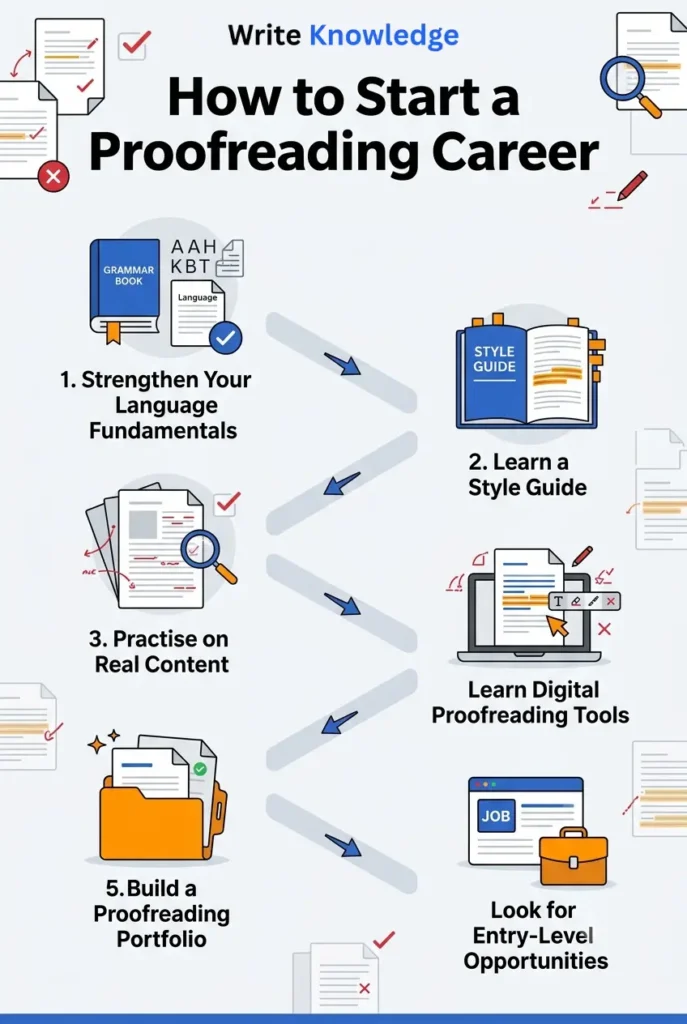
1. Strengthen Your Language Fundamentals
Start with:
- Grammar
- Punctuation
- Spelling
- Sentence structure
- Capitalization
- Common usage problems
Your goal should be to understand the rules rather than simply rely on what “sounds right.”
2. Learn a Style Guide
Choose a style guide relevant to the type of work you want to pursue.
For example:
- MLA for many humanities contexts
- APA for many social-science and academic contexts
- IEEE for many technical and engineering contexts
- Chicago for a broad range of publishing and academic applications
3. Practise on Real Content
Take published material and proofread it yourself.
Look for:
- Grammar errors
- Punctuation problems
- Inconsistent capitalization
- Spelling mistakes
- Formatting inconsistencies
- Awkward or ambiguous wording
Then compare your work with the published version where possible.
4. Learn Digital Proofreading Tools
Become comfortable with tools such as:
- Microsoft Word Track Changes
- Google Docs Suggesting mode
- PDF annotation
- Comments
- Basic document formatting
These tools are often more useful professionally than simply knowing how to identify errors.
5. Build a Proofreading Portfolio
A portfolio can contain before-and-after examples showing the corrections you made.
For example:
Before:
The results shows that there is several important differences.
After:
The results show that there are several important differences.
You can create sample projects if you don’t yet have paid client work.
Just make it clear that the samples are practice projects.
6. Look for Entry-Level Opportunities
Search for roles such as:
- Proofreader
- Junior Proofreader
- Editorial Assistant
- Copy Editor
- Content Editor
- Publishing Assistant
- Editorial Intern
Don’t restrict your search to jobs with the exact title “Proofreader.”
Some employers combine proofreading with editing or content responsibilities.
Common Proofreading Career Mistakes to Avoid
Relying Entirely on Software
Grammar and spelling tools can identify many errors, but they don’t understand every context.
A tool might flag a sentence that is correct or miss an inconsistency that requires understanding the document as a whole.
Changing the Writer’s Voice Unnecessarily
A proofreader isn’t always supposed to rewrite everything.
If the sentence is correct and fits the required style, changing it simply because you would phrase it differently may make the proofreading less useful.
Reading Too Quickly
Familiarity creates a problem.
After reading the same paragraph several times, your brain may start seeing what you expect to see rather than what is actually on the page.
Reading slowly and systematically can help.
Ignoring the Style Requirements
A sentence can be grammatically correct and still violate the publication’s style.
For professional proofreading, always know what style or house rules you’re expected to follow.
Treating Every Problem as a Proofreading Problem
Not every weakness should be fixed by a proofreader.
Some issues belong to:
- The writer
- The editor
- The designer
- The subject-matter expert
Knowing the boundaries of your role is part of being a good proofreader.
Is Proofreading a Good Career for You?
Proofreading may suit you if you genuinely enjoy working with language and details.
You may enjoy it if you:
- Notice small errors easily
- Like grammar and punctuation
- Enjoy checking consistency
- Prefer careful work to constant brainstorming
- Can concentrate for long periods
- Don’t mind repetitive tasks
- Enjoy working independently
- Like helping other people’s writing become more polished
It may be less suitable if you strongly dislike repetitive review work or prefer creating ideas and writing from scratch all the time.
That’s an important distinction.
Being good at writing doesn’t automatically mean you’ll enjoy proofreading.
Proofreading requires a particular mindset: patient, analytical, careful, and willing to inspect details that most readers would simply overlook.
✅ Key Takeaways
- A proofreading career focuses on reviewing written material for errors and inconsistencies before publication or submission.
- Proofreaders commonly check spelling, grammar, punctuation, formatting, capitalization, and consistency.
- Proofreading is generally different from editing, although the responsibilities can overlap depending on the employer.
- You don’t necessarily need a specific degree to become a proofreader, although educational requirements vary by employer and industry.
- Strong language skills, attention to detail, patience, concentration, style-guide knowledge, and digital-document skills are particularly useful.
- Proofreaders can work in publishing, digital media, academia, business, marketing, technical communication, and other fields.
- Freelance proofreading can provide another career route, particularly when supported by a clear portfolio and specialization.
- A practical way to start is to strengthen language fundamentals, learn a relevant style guide, practise on real content, build a portfolio, and apply for entry-level opportunities.
- Proofreading software can assist the process, but professional proofreading still requires human judgment.
- The best proofreaders don’t simply find mistakes. They understand which changes are necessary, which are optional, and which belong to someone else’s role.
Conclusion
A proofreading career may not sound as glamorous as some other writing careers, but it plays an important role in producing professional, trustworthy content. A small spelling mistake, inconsistent heading, incorrect punctuation mark, or formatting error can undermine an otherwise strong piece of writing.
The good news is that proofreading is a skill you can develop through practice. You can start with language fundamentals, learn how different style guides work, practise on real documents, and gradually build a portfolio.
Frequently Asked Questions
What does a proofreader do?
A proofreader reviews written content near the end of the publishing process to identify errors in spelling, grammar, punctuation, formatting, capitalization, and consistency.
Do you need a degree to become a proofreader?
No single degree is required for every proofreading role. Requirements vary by employer and industry. Relevant education can help, but practical skills, experience, and a strong portfolio can also be important.
Is proofreading the same as editing?
No. Proofreading generally focuses on finding remaining errors and inconsistencies in a near-final document, while editing can involve deeper changes to structure, clarity, organization, wording, and style.
Can proofreading be a freelance career?
Yes. Freelance proofreaders can work with authors, businesses, agencies, publishers, researchers, and website owners. Specializing in a particular type of content can help define the services you offer.
What skills are most important for proofreading?
Strong language skills and attention to detail are essential. Patience, concentration, knowledge of style guides, research ability, digital-document skills, and professional communication are also valuable.

Sachin is a Postgraduate in Technical Writing in Business Management specializing in creating SEO-friendly, User-friendly, and Reader-focused website articles on Education, Tech, Sports, Games, and Entertainment.
Through Write Knowledge, he helps students, bloggers, editors, and professionals develop practical writing skills using clear explanations, real-world examples, and internationally recognized writing standards.