Have you ever read a bestselling book, a powerful speech, or a polished business article and wondered who actually wrote the words?
In many cases, the name on the cover is not the person who drafted every sentence. That person is often a ghostwriter.
A ghostwriting career involves writing content that is officially credited to someone else. The work is real, the skill required is high, and the demand continues across books, business, politics, entertainment, and digital media.
If you enjoy writing, researching, adapting to different voices, and working behind the scenes, ghostwriting can be a flexible and rewarding professional path.
💡 Quick Answer about Ghostwriting Career
A ghostwriting career means writing books, articles, speeches, blog posts, or other content that is published under someone else’s name. Ghostwriters capture the client’s ideas, voice, and expertise, then turn them into clear, polished writing while remaining anonymous or receiving limited public credit.
What Is a Ghostwriting Career?
A ghostwriting career involves creating written content for another person or organization, with the finished work generally published or presented under the client’s name rather than the ghostwriter’s. Ghostwriters may work on books, articles, speeches, scripts, blogs, newsletters, social media content, and other forms of writing.
The defining feature is not necessarily the type of writing.
It is who receives the public credit for the work.
A ghostwriter may spend weeks researching a subject, interviewing a client, developing ideas, drafting the content, revising it, and polishing the final version yet their name may never appear on the finished work.
That can sound strange if you’re used to writing for your own byline.
But for many ghostwriters, writing well without needing public recognition is part of the profession.
What Is Ghostwriting?
Ghostwriting is the practice of writing content on behalf of another person or organization, with the client generally receiving the public authorship or credit.
A ghostwriter could, for example, write:
- A business leader’s article
- An author’s memoir
- A celebrity’s book
- An executive’s speech
- A founder’s LinkedIn posts
- A website’s thought-leadership content
- A podcast script
- A newsletter
- Songs
- Screenplays
- A fictional manuscript
The ghostwriter often needs to understand the client’s ideas, personality, knowledge, preferred tone, audience, and goals before turning those inputs into finished writing.
Why Is It Called Ghostwriting?
The name comes from the idea that the writer remains largely invisible.
The finished work may carry the client’s name, while the person who actually wrote the words remains uncredited.
That doesn’t mean the ghostwriter’s contribution is unimportant.
In fact, successful ghostwriting often requires the writer to become highly skilled at making their own writing style less noticeable.
What Does a Ghostwriter Do?
A ghostwriter’s responsibilities depend heavily on the project and client.
A typical assignment can involve:
- Understanding the client’s purpose and expectations
- Researching the subject
- Interviewing the client or gathering source material
- Developing ideas or an outline
- Writing the first draft
- Matching the client’s voice and tone
- Revising the content
- Fact-checking information where appropriate
- Applying formatting or editorial requirements
- Delivering the final work
Ghostwriting Is More Than Writing
This is one of the most important things to understand before pursuing the career.
A client may know exactly what they want to say but struggle to express it.
The ghostwriter’s job is to transform that knowledge into writing that sounds appropriate for the person who will receive the credit.
Imagine an entrepreneur saying:
“I want to explain why small businesses shouldn’t try to copy everything large companies do.”
The ghostwriter might turn that idea into a structured article while preserving the entrepreneur’s perspective and personality.
The writer isn’t simply adding words.
They’re helping the client’s ideas become readable communication.
What Types of Work Do Ghostwriters Do?
Ghostwriting isn’t limited to books.
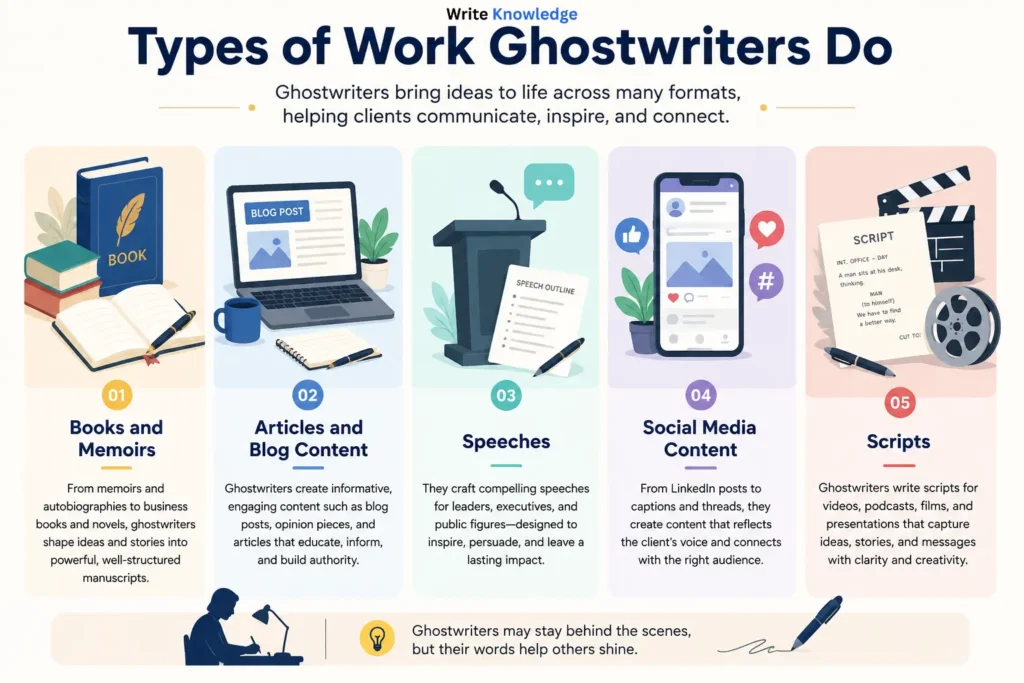
Books and Memoirs
Book ghostwriting can include:
- Memoirs
- Autobiographies
- Business books
- Self-help books
- Fiction
- Biography
- Personal-development books
A memoir ghostwriter may need to conduct interviews, organize memories, research background information, and turn spoken experiences into a coherent narrative.
Articles and Blog Content
Businesses, professionals, executives, and public figures may hire ghostwriters to create:
- Blog posts
- Opinion pieces
- Thought-leadership articles
- Industry articles
- Newsletters
- Website content
Here, the writer often needs to reproduce a client’s professional voice while maintaining clarity and accuracy.
Speeches
A speech ghostwriter helps someone prepare words they will deliver publicly.
The writing therefore has to sound natural when spoken.
A good speech may require different sentence lengths, repetition, rhythm, emphasis, and transitions than a conventional article.
Social Media Content
Ghostwriters can also create content for platforms such as LinkedIn and other social channels.
For example, an executive may provide an experience or opinion, while the ghostwriter turns it into a concise post that sounds like the executive.
Scripts
Ghostwriting can also extend to scripts for:
- Videos
- Podcasts
- Presentations
- Speeches
- Other media projects
The exact responsibilities vary considerably depending on the client and project.
What Skills Do You Need for a Ghostwriting Career?
Being a good writer is necessary, but ghostwriting requires additional skills.
The writer has to create strong content while adapting to someone else’s voice and expectations.
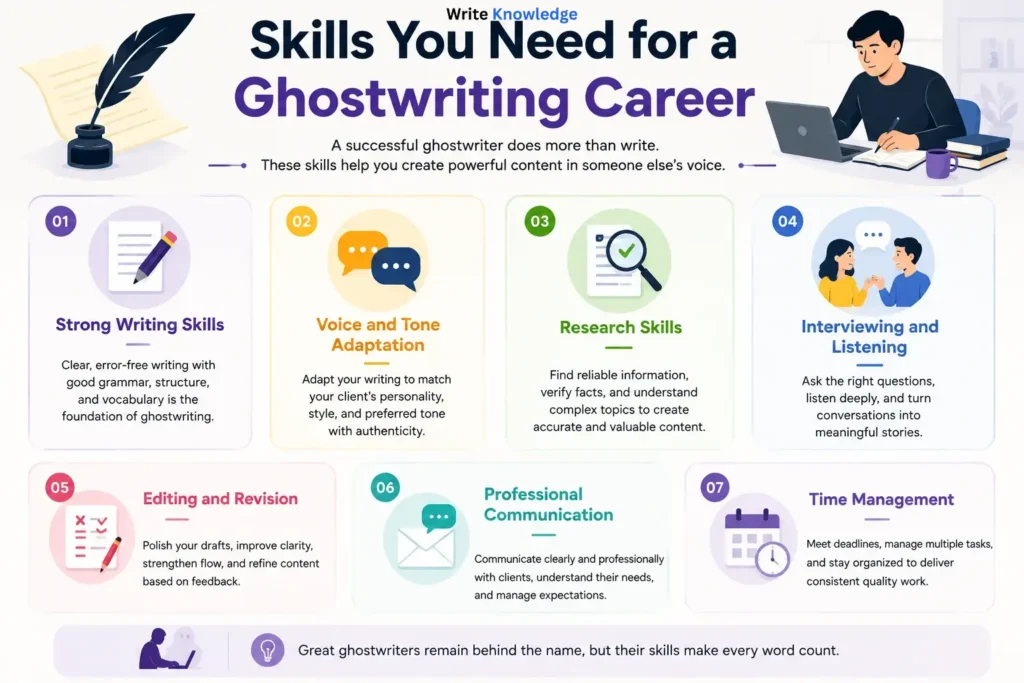
Strong Writing Skills
You need a solid command of:
- Grammar
- Punctuation
- Sentence structure
- Vocabulary
- Organization
- Clarity
- Tone
- Style
The writing should be polished without sounding artificially complicated.
Voice and Tone Adaptation
This is arguably one of the defining skills of ghostwriting.
You need to understand how another person communicates.
For example, one client might prefer:
“Here’s the thing: we made a mistake.”
Another might naturally say:
“Our analysis revealed a significant strategic error.”
Both can communicate a similar idea.
The ghostwriter’s responsibility is to understand which voice belongs to which client.
Indeed notes that successful ghostwriters need to work across different tones and styles and capture a client’s voice.
Research Skills
Ghostwriters frequently work on subjects they don’t already know deeply.
Research therefore becomes an essential part of the job.
You may need to:
- Find credible sources
- Understand unfamiliar topics
- Compare information
- Identify relevant evidence
- Organize research
- Verify important details
Interviewing and Listening
For some projects, especially books and personal content, the client’s spoken words become an important source of material.
A ghostwriter needs to listen carefully.
You aren’t only asking:
“What happened?”
You may also need to discover:
“Why did it matter?”
“What did you think at the time?”
“What changed afterward?”
Those answers can provide the material needed to create authentic writing.
Editing and Revision
Ghostwriting often involves multiple rounds of feedback.
You need to be comfortable changing your draft without losing the client’s intended meaning or voice.
Professional Communication
You may need to discuss:
- Deadlines
- Deliverables
- Revisions
- Research requirements
- Fees
- Feedback
- Confidentiality
Strong communication can prevent many avoidable problems.
Time Management
A freelance ghostwriter may work on several projects at once.
Managing interviews, research, drafts, revisions, deadlines, and client communication requires organization.
How Is Ghostwriting Different from Other Writing Careers?
Ghostwriting overlaps with several writing careers, but its defining feature is the credit arrangement.
| Career | Main Focus | Public Credit |
| Content Writer | Informative or audience-focused content | Usually receives credit |
| Copywriter | Persuasive and marketing content | Usually receives credit or works for a brand |
| Author | Creates books or other literary works | Receives authorship |
| Ghostwriter | Creates content for another person | Usually receives no public authorship |
| Editor | Reviews and improves existing content | Usually receives editorial credit |
| Screenwriter | Writes scripts for film/TV | Usually receives screenwriting credit |
The boundaries can overlap.
For example, a writer might produce a client’s blog content as a ghostwriter while also performing editing and research.
That’s why the client arrangement and actual responsibilities matter as much as the job title.
If you’re interested in how writing careers compare more broadly, explore our Writing Careers post.
Where Do Ghostwriters Work?
Ghostwriters can work across several industries.
Publishing
Book publishing is one of the most recognizable areas of ghostwriting.
Ghostwriters may work with:
- Authors
- Entrepreneurs
- Public figures
- Experts
- Executives
- Individuals with personal stories
Business and Corporate Communication
Businesses may use ghostwriters for:
- Executive articles
- Thought leadership
- Speeches
- Reports
- Newsletters
- Website content
- Professional social media posts
Digital Media
The growth of online publishing creates opportunities for ghostwriters to work on blogs, articles, newsletters, scripts, and social media content. Indeed notes that ghostwriting can extend across blogs, articles, emails, social media, marketing materials, and other digital content.
Personal Branding
Experts and professionals may have valuable knowledge but lack the time to turn their ideas into regular content.
A ghostwriter can help transform:
Ideas → Research → Draft → Client Review → Published Content
The final article may appear under the expert’s name.
How to Become a Ghostwriter?
You don’t necessarily need to wait for a client before developing ghostwriting skills.
A practical starting process looks like this.
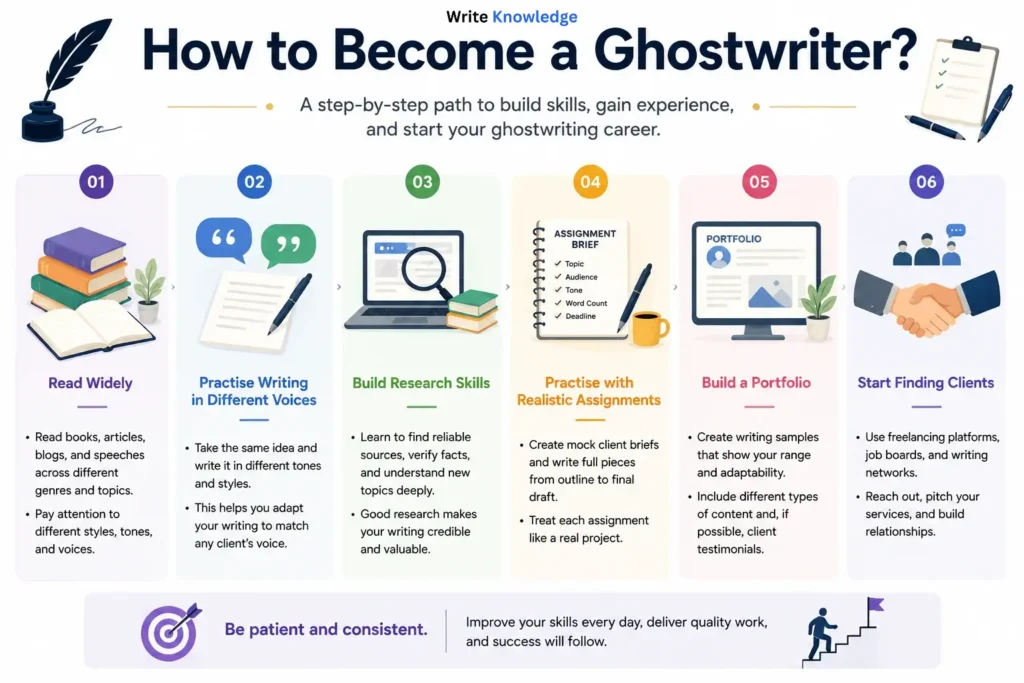
1. Read Widely
Read different writers and different types of content.
Pay attention to:
- Tone
- Vocabulary
- Sentence length
- Rhythm
- Organization
- Personality
Ghostwriters need to understand different voices rather than developing only one recognizable style.
2. Practice Writing in Different Voices
Take the same idea and write it three ways.
For example:
Professional:
Our latest results indicate that the strategy produced measurable improvements.
Conversational:
The strategy worked and the numbers prove it.
Personal:
I was skeptical at first, but the results changed my mind.
The exercise teaches you to separate your own voice from the client’s voice.
3. Build Research Skills
Choose unfamiliar subjects and practise researching them.
Don’t simply collect information.
Learn to identify:
- Reliable sources
- Relevant facts
- Conflicting claims
- Important context
- Useful supporting information
4. Practice With Realistic Assignments
Create fictional clients.
For example:
“A technology founder wants a 700-word article explaining why small businesses should simplify their software stack.”
Then imagine what that person’s voice might sound like.
Write the article.
Afterward, edit it for clarity, tone, structure, and consistency.
5. Build a Portfolio
This can be difficult for ghostwriters because the work may belong to the client and may be confidential.
Don’t publicly claim confidential work without permission.
The Association of Ghostwriters specifically highlights this challenge and recommends using alternatives such as authorized acknowledgments, anonymized examples, or general descriptions of experience where permitted.
You can also build portfolio samples specifically for demonstration purposes.
For example:
Sample: Executive thought-leadership article
Client: Fictional technology founder
Goal: Establish expertise in small-business technology
That demonstrates your ability without pretending that a fictional project was paid client work.
6. Start Finding Clients
Potential clients can include:
- Authors
- Entrepreneurs
- Coaches
- Consultants
- Executives
- Businesses
- Agencies
- Public speakers
- Professionals building personal brands
You can look for opportunities through freelance platforms, writing networks, agencies, professional networking, referrals, and direct outreach.
Your approach should match the type of ghostwriting you want to do.
How Can You Find Ghostwriting Jobs?
Searching only for “ghostwriter” can limit your results.
Depending on your specialization, also look for related opportunities such as:
- Book writer
- Book collaborator
- Content writer
- Executive writer
- Thought-leadership writer
- Speechwriter
- Scriptwriter
- Newsletter writer
- Personal-brand writer
- Content ghostwriter
- Editorial writer
Build Relationships, Not Just Applications
Ghostwriting is often based on trust.
A client is giving you their:
- Ideas
- Experiences
- Knowledge
- Personal stories
- Business information
- Public voice
That makes professional reliability extremely important.
A strong relationship can eventually lead to repeat projects or referrals.
How Much Can a Ghostwriter Earn?
There is no single standard ghostwriter salary or rate.
Earnings can vary substantially depending on:
- Experience
- Type of project
- Length of work
- Research requirements
- Subject expertise
- Client budget
- Deadline
- Number of revisions
- Confidentiality requirements
- Whether you work independently or for an organization
A short article and a full-length memoir obviously involve very different amounts of work.
For that reason, avoid judging the career from a single advertised rate.
A better question is:
How much time, expertise, responsibility, and revision does this project require, and what fee makes that work worthwhile?
Freelance ghostwriters should also account for the business side of their work, including client acquisition, contracts, scheduling, invoices, and workload management.
What Should a Ghostwriting Contract Include?
A professional ghostwriting project should not depend entirely on a verbal agreement.
A written contract can clarify expectations about:
- Scope of work
- Deliverables
- Word count
- Deadlines
- Payment
- Revision limits
- Confidentiality
- Ownership and rights
- Attribution or credit
- Termination
- Dispute procedures
The Authors Guild’s legal guide similarly identifies ownership and control, editorial control, confidentiality, earnings, attribution, liability, and dispute provisions as issues that should be addressed in writing.
Why Confidentiality Matters
Confidentiality can be particularly important in ghostwriting.
A client may share private experiences, unpublished ideas, business information, research, or other sensitive material.
A confidentiality clause or NDA can establish what information must remain private and what the writer can or cannot disclose.
But don’t assume every ghostwriting agreement is identical.
Read the actual contract before signing it.
What About Ownership?
Ownership should also be clearly addressed in the agreement.
Copyright and ownership arrangements can vary by jurisdiction and contract structure. A professional agreement may use mechanisms such as an assignment of rights or, where legally applicable, a work-for-hire arrangement.
The important practical lesson is:
Don’t assume who owns the finished work. Make sure the agreement says.
For significant projects, legal advice can be worthwhile.
Can Ghostwriters Put Client Work in Their Portfolio?
Not automatically.
This is one of the unusual challenges of the career.
A ghostwriter may have years of experience but very little publicly attributable work.
If a contract includes confidentiality restrictions, publicly revealing the client’s name or project could violate the agreement.
The safest approach is to ask for permission before identifying a client or using their work publicly. The Association of Ghostwriters specifically recommends not discussing client work without permission and suggests alternatives for demonstrating experience.
Possible approaches, where authorized, include:
- Anonymous case studies
- Authorized excerpts
- Client testimonials
- Acknowledgment in the finished book
- General descriptions of the project
- Fictional demonstration samples
What Are the Advantages of a Ghostwriting Career?
Ghostwriting can offer several advantages.
You Can Work Across Subjects
You may write about business one month and personal development the next.
This can make the work intellectually varied.
You Can Develop Adaptability
Writing for different clients forces you to work with different voices, audiences, structures, and expectations.
That can strengthen your overall writing ability.
You Can Work Behind the Scenes
Not every writer wants a public byline.
Some enjoy the craft itself and are comfortable allowing the client to receive the public recognition.
Freelancing Can Offer Flexibility
Freelance ghostwriters may have more control over:
- Clients
- Projects
- Working arrangements
- Schedule
- Specialization
However, flexibility comes with responsibility.
You also have to manage the business.
What Are the Challenges of a Ghostwriting Career?
The career isn’t ideal for everyone.
Your Name May Not Appear
If you enjoy seeing your name attached to your work, ghostwriting can feel frustrating.
You may create something excellent and receive no public credit.
You Must Adapt to Other People’s Voices
You can’t always write in the style you personally prefer.
The client’s voice and the project’s purpose come first.
Confidentiality Can Limit Your Portfolio
Your strongest work may be exactly the work you’re not allowed to show publicly.
Client Feedback Can Be Extensive
Ghostwriting often involves collaboration.
You may need to revise your work repeatedly until the client feels that it sounds like them.
Scope Creep Can Become a Problem
A project that begins as:
“Write 10 LinkedIn posts.”
can gradually become:
“Can you also research these topics, rewrite our website, create a newsletter, and help with the next month’s content?”
Clear contracts and revision limits help prevent this.
Is Ghostwriting a Good Career for You?
Ghostwriting may suit you if you:
- Enjoy writing for different audiences
- Can adapt your tone and style
- Like researching unfamiliar topics
- Listen carefully
- Accept constructive criticism
- Can preserve another person’s voice
- Are comfortable working without public credit
- Communicate professionally
- Can meet deadlines
- Enjoy independent work
It may be less suitable if you:
- Strongly need public recognition for your writing
- Dislike revisions
- Prefer writing only in your own style
- Don’t enjoy research
- Find client communication frustrating
- Struggle with deadlines
There is no universally “best” writing career.
The better question is:
Which type of writing work matches the way you naturally like to work?
If you enjoy improving existing writing more than creating content from scratch, you might also explore our Copy Editing career guide or Proofreading career guide.
✍️ Writing Tip
Listen before you imitate.
When you’re trying to reproduce someone’s voice, don’t begin by copying their vocabulary.
First, study how they think and communicate.
Notice:
- How directly they make a point
- Whether their sentences are short or elaborate
- Which words they naturally repeat
- How formal or conversational they sound
- Whether they use stories, examples, questions, or data
- How they express opinions
Voice is more than vocabulary.
The better you understand the person behind the words, the easier it becomes to make the finished writing feel natural.
⚠️ Common Mistake
Writing in your own voice and simply replacing a few words with the client’s preferred vocabulary.
That isn’t genuine voice adaptation.
Suppose your natural writing is formal and academic, but your client speaks casually and uses short sentences.
Changing a few words won’t make the article sound like the client.
You may need to change:
- Sentence length
- Rhythm
- Vocabulary
- Level of formality
- Use of contractions
- Examples
- Degree of directness
- Overall tone
A ghostwriter’s goal isn’t to make the client sound like a professional writer.
It is to make the professional writing sound like the client.
What Is the Career Path for a Ghostwriter?
Ghostwriting doesn’t have one fixed career ladder.
A possible path could look like:
Writing Assistant → Freelance Writer → Junior Ghostwriter → Ghostwriter → Specialist Ghostwriter → Senior/Book Ghostwriter
But career development can happen in different directions.
For example, a writer might specialize in:
Business → Executive Thought Leadership → Book Ghostwriting
Another might develop:
Content Writing → Personal Branding → Social Media Ghostwriting
Someone interested in literary work might move toward:
Fiction Writing → Developmental Writing → Book Ghostwriting
Your specialization can gradually become part of your professional identity.
How Can You Specialize as a Ghostwriter?
Specialization can help you explain your services more clearly.
You might specialize by content type:
- Books
- Articles
- Speeches
- Scripts
- Social media
- Newsletters
Or by subject:
- Business
- Technology
- Finance
- Health
- Personal development
- Education
- Travel
- Lifestyle
You can also combine the two.
For example:
Business book ghostwriter
is much more specific than:
I write anything.
You don’t have to reject every project outside your niche.
But having a clear specialization can make it easier for potential clients to understand why they should hire you.
Can You Become a Ghostwriter Without a Degree?
Yes, a degree is not the only route into ghostwriting.
A relevant degree in English, journalism, communications, literature, publishing, or another writing-related field can provide useful foundations.
However, ghostwriting also depends heavily on demonstrated writing ability, adaptability, research, communication, and practical experience.
You can develop experience through:
- Freelance writing
- Personal projects
- Practice assignments
- Blogging
- Student publications
- Writing internships
- Content writing
- Editing
- Volunteer projects
The strongest evidence of your ability is often what you can actually write.
How Can You Build Experience Before Getting Paid Ghostwriting Work?
You can create your own practice environment.
Create Fictional Clients
Invent a client with:
- A profession
- A target audience
- A communication style
- A subject area
- A specific writing goal
Then create content for that client.
Rewrite the Same Idea in Different Voices
Write one topic in:
- Formal professional voice
- Conversational voice
- Expert voice
- Friendly voice
- Personal storytelling voice
This demonstrates adaptability.
Study Existing Voices
Choose public writing from different authors or professionals.
Analyze:
Vocabulary + Sentence Patterns + Tone + Structure + Personality
Then write an original piece using those characteristics without copying the source.
Create Before-and-After Samples
For practice, create a short “client brief” and show:
Client idea → Your draft → Revised version
Explain the editorial decisions you made.
This can demonstrate your process to prospective clients.
📚 Continue Exploring Writing Careers
Ghostwriting is only one possible direction for someone who enjoys working with words.
If you’re still exploring your writing career options, visit more below:
- Content Writing Career — for writers interested in creating informative, engaging, and audience-focused content across different formats and industries.
- Copywriting Career — for writers interested in persuasive content designed to encourage readers to take action.
- Editorial Career — for writers who enjoy reviewing, improving, fact-checking, and shaping content before publication.
✅ Key Takeaways
- A ghostwriting career involves writing content for another person or organization, usually without public authorship credit.
- Ghostwriters can work on books, memoirs, articles, blogs, speeches, scripts, newsletters, social media content, and other projects.
- Writing well is only one part of the job; voice adaptation, research, listening, editing, and communication are also important.
- A ghostwriter needs to understand the client’s ideas, personality, audience, and communication style.
- Confidentiality can be a significant part of professional ghostwriting arrangements.
- Ghostwriters should understand contracts covering scope, payment, revisions, confidentiality, ownership, and attribution.
- Confidential projects may not be usable in a public portfolio without permission.
- There is no single standard ghostwriter salary or rate; fees vary according to project, experience, complexity, and client arrangements.
- A relevant degree can help, but practical experience and demonstrated ability can also contribute to a ghostwriting career.
- Ghostwriting may suit writers who enjoy adapting their voice and working behind the scenes.
- It may be less suitable for writers who strongly value public authorship and recognition.
Conclusion
A ghostwriting career is different from many other writing careers because the writer’s success can depend partly on becoming invisible.
You may research the subject, shape the ideas, write the draft, revise it several times, and polish every sentence … only for someone else to put their name on the finished work. For the right writer, however, that isn’t a disadvantage. It can be an opportunity to work across subjects, experiment with different voices, collaborate closely with clients, and concentrate on the craft itself.
If you want to pursue ghostwriting, start with the fundamentals: strengthen your writing, practise adapting your voice, learn to research unfamiliar subjects, develop professional communication skills, and build a portfolio that honestly represents your experience. When you begin working with clients, pay particular attention to contracts, confidentiality, scope, payment, and ownership.
Frequently Asked Questions
What is a ghostwriting career?
A ghostwriting career involves creating written content for clients who generally publish or present the finished work under their own name.
What does a ghostwriter do?
A ghostwriter may research, interview clients, develop ideas, write drafts, adapt voice and tone, revise content, fact-check information, and deliver the final work.
What types of content do ghostwriters write?
Ghostwriters may write books, memoirs, articles, blogs, speeches, scripts, newsletters, social media posts, and other content.
Do ghostwriters get credit for their work?
Usually, ghostwriters do not receive public authorship credit. The exact arrangement depends on the project and contract.
How do ghostwriters find clients?
Ghostwriters can find clients through referrals, freelance platforms, agencies, professional networking, writing communities, direct outreach, and relationships developed through previous work.
Can ghostwriters show their work in a portfolio?
Not necessarily. Confidentiality agreements may prevent them from identifying clients or showing completed work. Writers should obtain permission before publicly discussing or displaying confidential projects.
Is ghostwriting legal?
Ghostwriting itself is a professional writing arrangement. The legal details surrounding copyright, ownership, attribution, confidentiality, and payment depend on the agreement and applicable law. A clear written contract is important, particularly for substantial projects.
Do ghostwriters get royalties?
Payment arrangements vary. A ghostwriter may receive a flat fee, milestone payments, or another arrangement negotiated with the client. Don’t assume that every ghostwriting project includes royalties.

Sachin is a Postgraduate in Technical Writing in Business Management specializing in creating SEO-friendly, User-friendly, and Reader-focused website articles on Education, Tech, Sports, Games, and Entertainment.
Through Write Knowledge, he helps students, bloggers, editors, and professionals develop practical writing skills using clear explanations, real-world examples, and internationally recognized writing standards.