
You don’t need to be an engineer to build a six-figure career in technology, but you do need to know how to explain what engineers build. That’s the quiet superpower of a technical writing career: turning dense specifications, cryptic code, and complex workflows into documentation that actually helps people get things done.
And the good news… well, technical writers are in demand across software, healthcare, engineering, and finance and they are earning competitive salaries, enjoying remote flexibility, and shaping how users experience products.
If you love clarity, curiosity, and the satisfaction of making the complicated feel simple, this career might be your next move.
💡 Quick Answer
A technical writing career involves creating documentation that helps users understand products, complete tasks, or make informed decisions. It combines strong writing skills with research, audience analysis, and technical understanding.
What Is a Technical Writing Career?
A technical writing career is a professional path where your primary responsibility is to translate complex, specialized information into clear, usable documentation for specific audiences. Unlike creative or marketing writing, technical writing prioritizes accuracy, clarity, and task completion over persuasion or storytelling.
Technical writers work across industries, from software companies and engineering firms to healthcare organizations and financial institutions. There, they are creating user manuals, API documentation, standard operating procedures (SOPs), troubleshooting guides, and knowledge base articles.
If you’re exploring different professional writing paths, this guide sits under our broader Writing Careers post, while our complete guide to Technical Writing explains what technical writing is.
Why Choose a Career in Technical Writing?
Technical writing has become one of the most stable and rewarding writing professions in 2026. Here’s why:
High Demand Across Industries
Nearly every technology-driven organization needs documentation. Software companies, SaaS startups, engineering firms, healthcare providers, and financial institutions all hire technical writers to create product documentation, user guides, and compliance materials.
Competitive Salaries
Technical writer salary is the query that most of the aspiring writers look forward to. So, here you go:
In the United States, the median annual salary for technical writers is $91,670 as of 2026, with entry-level positions starting around $60,000–$80,000 and senior roles reaching $145,000–$190,000 at top tech companies.
In India, technical writers earn:
- Junior (0–2 years): ₹5–9 LPA
- Mid-Level (3–5 years): ₹9–16 LPA
- Senior (6+ years): ₹16–24 LPA
Specialized skills like API documentation or docs-as-code workflows can increase salaries by 35–70%.
NOTE: The salary highly depends on the company, work location, and your expertise. The above shown data is not standard among countries, cities, companies and experience. They may vary dramatically. So, it is recommended you do your own research about the salary part and not take this as a standard payment.
Remote and Flexible Work
Technical writing is among the most remote-friendly writing careers. Many companies offer fully remote positions, freelance contracts, or hybrid arrangements, making it ideal for location-independent professionals.
Clear Career Progression
Technical writers can advance through individual contributor tracks:
Junior → Technical Writer → Senior → Staff/Principal) or move into management (Technical Writing Manager → Director of Documentation.
What Does a Technical Writer Do Daily?
A technical writer’s day varies by industry and company, but core responsibilities remain consistent.
Core Responsibilities
- Interview subject-matter experts (SMEs): Gather information from engineers, developers, product managers, and designers.
- Write and edit documentation: Create user manuals, API references, how-to guides, release notes, and knowledge base articles.
- Test products and procedures: Verify that instructions work by following them firsthand.
- Organize information architecture: Structure documentation so users can find answers quickly.
- Collaborate with cross-functional teams: Work with UX designers, developers, localization teams, and support staff.
- Maintain style guides and standards: Ensure consistency across all documentation using organizational or industry style guides (e.g., IEEE, Microsoft Manual of Style).
- Create visuals: Add screenshots, diagrams, and flowcharts to improve clarity.
Typical Time Breakdown
One senior technical writer describes their weekly time allocation as:
- 25% – Research & Discovery (analyzing specs, code, existing materials)
- 20% – Collaboration & Communication (meeting with SMEs, engineers)
- 30% – Drafting & Development (writing, structuring, creating examples)
- 15% – Reviews, Feedback & Refinement (incorporating peer and stakeholder feedback)
- 10% – Standardization & Quality Assurance (style guide compliance, grammar checks)
Technical Writer Career Path and Levels
Technical writing offers multiple progression tracks depending on your goals and strengths.
Individual Contributor (IC) Track
| Level | Title | Typical Experience | Salary Range (India) | Salary Range (US) |
| Entry | Junior Technical Writer | 0–2 years | ₹5–9 LPA | $60,000–$95,000 |
| Mid | Technical Writer | 2–5 years | ₹9–16 LPA | $80,000–$115,000 |
| Senior | Senior Technical Writer | 5–8 years | ₹16–24 LPA | $105,000–$145,000 |
| Staff | Staff/Principal Technical Writer | 8–12 years | ₹24–35 LPA | $130,000–$175,000 |
| Lead | Lead Technical Writer | 10+ years | ₹35–50 LPA+ | $145,000–$190,000+ |
Note: Indian salary ranges are based on 2026 market data from Indian tech hubs (Bangalore, Hyderabad, Pune, Gurgaon). Premium skills like API documentation, docs-as-code, and developer relations can increase these ranges by 35–70%.
Management Track
- Technical Writing Manager: Oversees a team of writers, sets documentation strategy, manages budgets and timelines.
- Director of Documentation: Leads documentation across multiple products or departments.
- Head of Developer Experience: Combines documentation, developer relations, and community management.
Specialized Career Paths
Technical writers can also specialize in high-demand niches:
- API Technical Writer: Documents APIs, SDKs, and developer tools (premium salaries).
- Docs-as-Code Specialist: Manages documentation in Git repositories using Markdown, CI/CD pipelines.
- Medical/Regulatory Writer: Creates clinical documentation, regulatory submissions, and patient education materials.
- UX Writer: Writes microcopy for user interfaces (buttons, error messages, onboarding flows).
Skills Required for a Technical Writing Career
Successful technical writers combine writing expertise with technical literacy and soft skills.
Essential Hard Skills
- Writing and Editing: Clear, concise, grammatically correct prose.
- Technical Understanding: Ability to read code, understand APIs, and grasp engineering concepts (you don’t need to write production code).
- Documentation Tools: Proficiency with Markdown, Git, Docusaurus, MkDocs, Confluence, MadCap Flare, or similar platforms.
- Information Architecture: Organizing content logically with headings, tables, and navigation.
- Visual Communication: Creating screenshots, diagrams, and annotated images.
Critical Soft Skills
- Research: Verifying information from specifications, code, and SMEs.
- Audience Analysis: Adapting content to readers’ knowledge levels.
- Communication: Collaborating effectively with engineers, product managers, and designers.
- Critical Thinking: Identifying gaps, inconsistencies, and unclear explanations.
- Time Management: Handling multiple projects and deadlines simultaneously.
Industries Hiring Technical Writers
Technical writers work in diverse sectors. The top industries include:
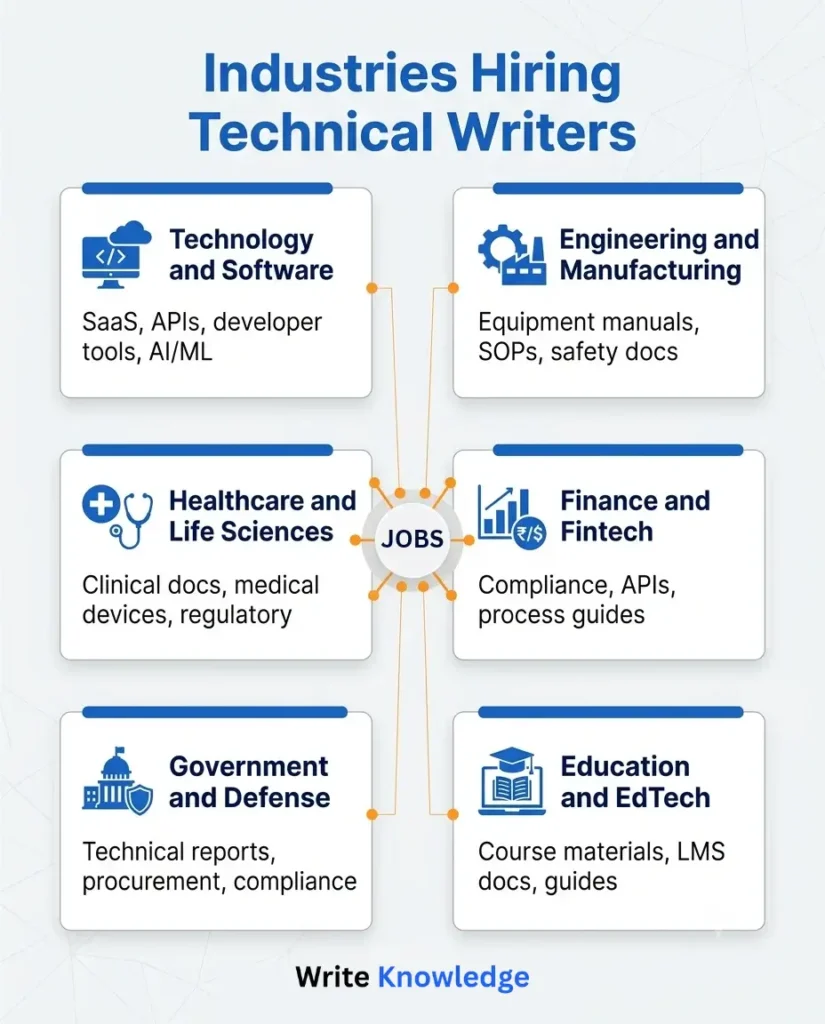
Technology and Software
- SaaS companies: Product documentation, help centers, release notes.
- Developer tools: API documentation, SDK guides, code samples.
- AI/ML companies: Model documentation, integration guides, ethical AI guidelines.
Engineering and Manufacturing
- Equipment manuals, maintenance guides, safety documentation, SOPs.
Healthcare and Life Sciences
- Clinical trial documentation, medical device instructions, regulatory submissions, patient education materials.
Finance and Fintech
- Compliance documentation, API references for payment systems, internal process guides.
Government and Defense
- Technical reports, procurement documentation, compliance materials (often requiring security clearances).
Education and EdTech
- Course materials, learning management system documentation, instructional guides.
How to Become a Technical Writer: Step-by-Step
Breaking into technical writing doesn’t require a single specific degree. Here’s a practical roadmap:
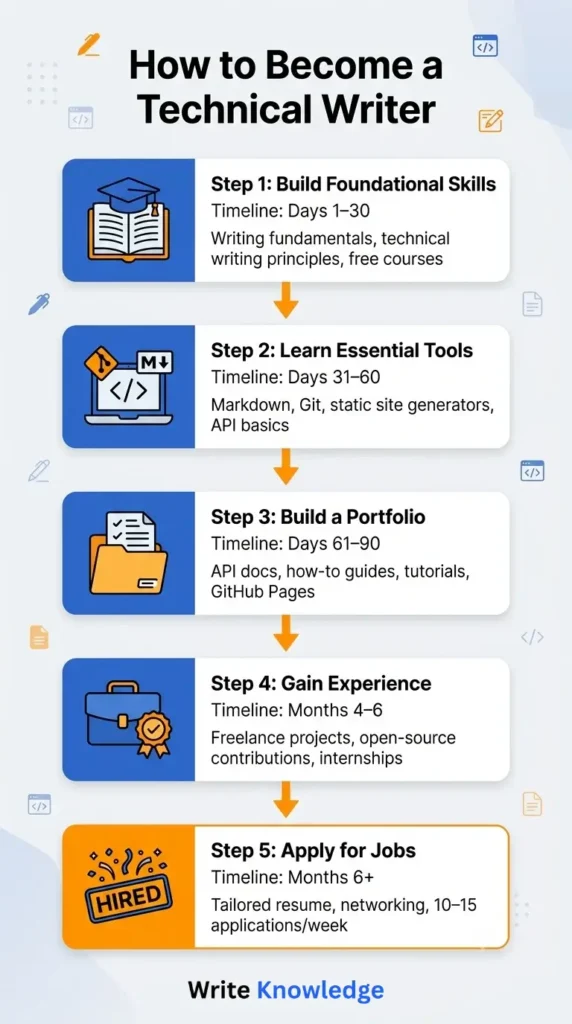
Step 1: Build Foundational Skills (Days 1–30)
- Learn writing fundamentals: Grammar, clarity, conciseness, active voice.
- Study technical writing principles: Audience analysis, information architecture, documentation types.
- Complete free courses: Google’s Technical Writing courses, ‘s technical writing specializations.
Step 2: Learn Essential Tools (Days 31–60)
- Markdown: Write documentation in plain text.
- Git and GitHub: Version control for docs-as-code workflows.
- Static site generators: Docusaurus, MkDocs, or Hugo for publishing documentation.
- API basics: Understand REST, endpoints, JSON, authentication.
Step 3: Build a Portfolio (Days 61–90)
Create 3–5 portfolio pieces:
- API reference: Document a public API (e.g., GitHub API, Stripe API).
- How-to guide: Write a tutorial (e.g., “How to Set Up a React App”).
- Conceptual documentation: Explain a technical concept (e.g., “What Is OAuth?”).
- Troubleshooting guide: Create a diagnostic article for a common problem.
Publish your portfolio on GitHub Pages or a personal website.
Step 4: Gain Experience (Months 4–6)
- Freelance projects: Offer documentation services on Upwork, Fiverr, or LinkedIn.
- Open-source contributions: Improve documentation for open-source projects on GitHub.
- Internships: Apply for technical writing internships at tech companies.
Step 5: Apply for Jobs (Months 6+)
- Tailor your resume: Highlight documentation projects, tools, and technical understanding.
- Network: Join technical writing communities (Write the Docs, LinkedIn groups).
- Apply strategically: Target 10–15 roles per week with customized cover letters.
Education and Certifications
Educational Background
While no single degree is required, common educational paths include:
- Bachelor’s degree: English, Communications, Journalism, Technical Writing, Computer Science, Engineering, or related fields.
- Master’s degree (optional): Advanced roles may prefer degrees in Technical Communication, Professional Writing, or related disciplines.
Technical Writing Certifications
Certifications validate your skills and can improve job prospects. Top options include:
| Certification | Provider | Best For |
| Certified Professional Technical Communicator (CPTC) | Society for Technical Communication (STC) | Industry-recognized credential |
| Technical Writing Certification | Technical Writer HQ | Low-cost, self-paced |
| API Documentation Certification | Various providers | API-focused roles |
| Adobe Certified Expert (ACE) | Adobe | Documentation using Adobe tools |
| Microsoft Certified: Technical Writing Specialist | Microsoft | Enterprise documentation |
Note: Most recognized certifications require 3–5 years of prior technical writing experience before you can sit for the exam.
Technical Writer Salary and Job Outlook
India (2026)
- Junior (0–2 years): ₹5–9 LPA
- Mid-Level (3–5 years): ₹9–16 LPA
- Senior (6+ years): ₹16–24 LPA
- Lead/Manager (8–12 years): ₹24–35 LPA+
United States (2026)
- Median salary: $91,670/year
- Entry-level (0–2 years): $60,000–$80,000
- Mid-level (3–5 years): $80,000–$115,000
- Senior (5–8 years): $105,000–$145,000
- Staff/Principal: $130,000–$175,000+
Top tech companies (FAANG, unicorns) pay significantly more:
- Senior at top tech: $145,000–$190,000
- Staff/Principal at top tech: $180,000–$240,000
BTW, FAANG stands for five major U.S. tech companies: Facebook (now Meta), Apple, Amazon, Netflix, and Google (Alphabet). This acronym was popularized by CNBC’s Jim Cramer in 2013 to describe the fastest-growing, most influential technology companies of the 2010s, originally as FANG and later including Apple in 2017 to form FAANG.
Okay, back to topic…
Premium skills (API documentation, docs-as-code, DevRel) can increase salaries by 35–70%.
Job Outlook
The U.S. Bureau of Labor Statistics projects 0.9% employment growth for technical writers from 2024–2034, with steady demand in technology, healthcare, and engineering sectors.
While India doesn’t have an official government body equivalent to the U.S. BLS that publishes occupation-specific growth projections, industry reports and employment surveys indicate strong and growing demand for technical writers across IT services, SaaS companies, product startups, and global capability centers (GCCs).
The expansion of India’s technology sector, increasing adoption of API-first development, and growth in documentation-driven roles (developer experience, DevRel) suggest positive employment trends through 2030 and beyond.
Remote and Freelance Opportunities
Technical writing is one of the most remote-friendly writing careers.
Remote Job Platforms
- WantRemote: Curated remote technical writer positions.
- RemoteFront: Remote technical writer jobs across industries.
- LinkedIn: Filter by “Remote” and “Technical Writer.”
- We Work Remotely: Regular technical writing postings.
Freelance Platforms
- Upwork: Technical writing, API documentation, user manual projects.
- Fiverr: Short-form documentation, editing, and review services.
- Toptal: High-end freelance technical writing for enterprise clients.
Many technical writers transition from full-time roles to freelance or combine both through part-time consulting.
Career Growth and Advancement
Technical writing offers multiple paths for advancement:
Individual Contributor Growth
- Specialize: Focus on high-demand niches (API docs, developer experience, medical writing).
- Build expertise: Become the go-to person for specific products or technologies.
- Publish thought leadership: Write articles, speak at conferences (Write the Docs, Conf42).
Management Growth
- Team Lead: Mentor junior writers, manage documentation projects.
- Documentation Manager: Oversee documentation strategy for a product or department.
- Director/VP: Lead documentation across the organization.
Lateral Moves
Technical writers often transition into related roles:
- UX Writer: Focus on microcopy and user interface text.
- Developer Advocate: Combine documentation with community engagement.
- Product Manager: Leverage deep product knowledge.
- Content Strategist: Plan and organize content across channels.
📚 Continue Learning
Want to explore beyond Technical Writing career? Here are your other career options:
- Content Writing Career
- SEO Writing Career
- Copywriting Career
- Content Strategy Career
- Editorial Career
- Proofreading Career
- Copy Editing Career
- Ghostwriting Career
New to technical writing? Start with our complete guide to Technical Writing to understand the craft.
✅ Key Takeaways
- Technical writing careers focus on creating clear, accurate documentation that helps users understand products, complete tasks, or make decisions.
- Median salary in the U.S. is $91,670/year, with significant variation by experience, industry, and specialization. In India, technical writers earn ₹5–9 LPA (junior), ₹9–16 LPA (mid-level), and ₹16–24 LPA+ (senior), with premium skills increasing salaries by 35–70%.
- Core skills include writing, research, audience analysis, technical understanding, and proficiency with documentation tools.
- Top industries hiring technical writers: software/SaaS, engineering, healthcare, finance, and government.
- Career paths include individual contributor (Junior → Senior → Staff/Principal) and management (Manager → Director).
- Remote work is common, with many fully remote and freelance opportunities available.
- Certifications (CPTC, API Documentation, etc.) can enhance credibility but often require prior experience.
- Portfolio building through personal projects, open-source contributions, and freelance work is essential for breaking into the field.
Conclusion
A technical writing career offers stability, competitive compensation, and diverse opportunities across industries. Whether you’re drawn to API documentation, user guides, or regulatory content, technical writing rewards those who enjoy explaining complex ideas clearly and helping others succeed.
The path into technical writing career is flexible: you can start with foundational writing skills, learn essential tools, build a portfolio, and gradually specialize. With the rise of remote work and the growing demand for documentation in technology-driven organizations, 2026 is an excellent time to explore this career.
Frequently Asked Questions
Do I need a technical degree to become a technical writer?
No. While degrees in English, Communications, or Technical Writing are common, many technical writers come from diverse backgrounds including engineering, computer science, journalism, and even unrelated fields. What matters most is your ability to learn technical concepts and communicate them clearly.
How long does it take to become a technical writer?
With focused effort, you can land an entry-level technical writing role in 3–6 months by building foundational skills, learning tools, and creating a portfolio. Some career-changers transition within 90–120 days through intensive bootcamps or self-study.
Is technical writing in demand in 2026?
Yes. As technology continues to evolve, organizations need documentation for software, APIs, AI systems, medical devices, and engineering products. The U.S. Bureau of Labor Statistics projects steady demand through 2034, with particular growth in technology and healthcare sectors.
Can technical writers work remotely?
Absolutely. Technical writing is one of the most remote-friendly writing careers, with many companies offering fully remote positions, freelance contracts, or hybrid arrangements. Platforms like WantRemote and RemoteFront specialize in remote technical writing jobs.
How much do technical writers earn in India?
In India, technical writers earn ₹5–9 LPA (junior), ₹9–16 LPA (mid-level), and ₹16–24 LPA+ (senior). Specialized skills like API documentation or docs-as-code can increase salaries by 35–70%.
What certifications should I pursue?
Top certifications include Certified Professional Technical Communicator (CPTC), Technical Writer HQ certification, and API Documentation certifications. However, most require 3–5 years of experience before you can sit for the exam.
How do I build a technical writing portfolio without experience?
Create documentation for open-source projects, write how-to guides for tools you use, document public APIs, or volunteer to write documentation for startups. Publish your work on GitHub Pages or a personal website to showcase your skills.

Sachin is a Postgraduate in Technical Writing in Business Management specializing in creating SEO-friendly, User-friendly, and Reader-focused website articles on Education, Tech, Sports, Games, and Entertainment.
Through Write Knowledge, he helps students, bloggers, editors, and professionals develop practical writing skills using clear explanations, real-world examples, and internationally recognized writing standards.