Writers often hear the advice “Show, Don’t Tell.” It means creating vivid scenes that let readers experience emotions and actions, instead of simply stating them. For example, instead of writing “Ravi was nervous,” you could write “Ravi’s hands trembled as he adjusted his kurta before stepping onto the stage in Lucknow.”
💡 Quick Answer: Show, Don’t Tell
Show, don’t tell is a writing technique that uses actions, dialogue, sensory details, specific descriptions, examples, or evidence to communicate an idea instead of stating it directly. It helps readers understand and experience what the writer is describing while still allowing the writer to use direct explanation when it is more appropriate.
What Does “Show, Don’t Tell” Mean in Writing?
Show, don’t tell is a writing technique in which the writer gives readers enough actions, details, dialogue, sensory information, or evidence to understand an idea instead of simply stating the conclusion.
📝 Example
Telling:
Priya was nervous before her interview.
Showing:
Priya checked her résumé for the third time, wiped her palms on her trousers, and glanced at the office door whenever footsteps approached.
Both sentences communicate nervousness. The first tells the reader what Priya feels. The second shows the feeling through observable details.
This does not mean that writers should eliminate telling completely. Telling can be useful when information needs to be communicated quickly, summarized, connected, or clarified. The real skill is knowing when to show, when to tell, and when to combine both.
Show, don’t tell is particularly useful in storytelling, narrative writing, creative writing, descriptive writing, scripts, case studies, and other forms of reader-focused communication. It can also be adapted to nonfiction when concrete evidence, examples, or specific details communicate an idea more effectively than a general statement.
If you are learning writing techniques as a broader skill, you can see how this technique fits alongside storytelling and other methods in the main Writing Techniques guide.
Show vs Tell at a Glance
| Telling | Showing |
| States the idea directly | Gives details that allow readers to understand it |
| Often uses general descriptions | Uses specific details |
| Can be quicker | Can create a stronger reader experience |
| Useful for summaries and transitions | Useful for scenes, emotions, actions, and evidence |
| Leaves less for the reader to infer | Gives readers something to interpret |
Neither approach is automatically better.
A well-written paragraph may use both.
Why Is Show, Don’t Tell Important?
Showing can make writing more concrete because readers receive something they can observe, imagine, interpret, or connect with.
Consider this sentence:
The market was crowded.
It communicates the basic idea, but it does not give the reader much information about what the crowd looks or feels like.
Now consider:
At Crawford Market in Mumbai, shoppers squeezed between vegetable carts while vendors called out prices over the noise of horns, footsteps, and bargaining voices.
The second version provides specific details. The reader can construct a clearer picture of the environment.
Showing can therefore help writers:
- Create more vivid scenes
- Communicate emotions indirectly
- Develop characters
- Make descriptions more specific
- Give abstract ideas a concrete form
- Help readers experience a situation
- Make storytelling more engaging
This is one reason the technique works particularly well with storytelling. Your existing Storytelling in Writing guide explains how writers use techniques such as hooks, dialogue, pacing, and sensory details to make information and experiences more engaging.
Showing Gives Readers Something to Interpret
One of the strengths of showing is that it allows readers to draw reasonable conclusions.
For example:
Arun was angry.
tells the reader exactly what to think.
Compare:
Arun pushed the chair away from the table and left his untouched tea behind.
The writer does not explicitly say that Arun is angry. The action provides evidence from which the reader can interpret his emotional state.
This does not mean the reader should be forced to solve a mystery every time. The amount of inference should match the purpose of the writing.
What Is the Difference Between Showing and Telling?
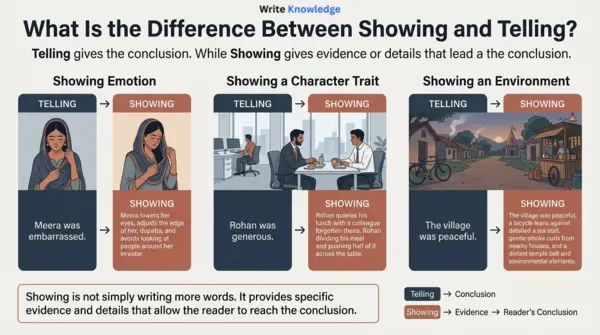
The simplest distinction is:
Telling gives the conclusion. Showing gives the evidence or details that lead the reader to the conclusion.
Consider three examples.
Showing Emotion
Telling:
Meera was embarrassed.
Showing:
Meera lowered her eyes, adjusted the edge of her dupatta, and avoided looking at the people around her.
Showing a Character Trait
Telling:
Rohan was generous.
Showing:
When the new intern realised he had forgotten his lunch, Rohan quietly divided his own meal and pushed half of it across the table.
Showing an Environment
Telling:
The village was peaceful.
Showing:
By six in the evening, the road had emptied. A bicycle leaned against the tea stall, smoke curled above the nearby houses, and the only regular sound was the temple bell in the distance.
The showing versions do not simply replace adjectives with longer sentences. They provide specific evidence.
That distinction matters.
Writing more words is not the same as showing.
How Do You Show Instead of Tell?
There is no single method for showing. Writers can use several tools depending on the situation.
Use Character Actions
Actions are one of the simplest ways to show personality, emotion, and intention.
Tell:
Kavita was determined to finish the project.
Show:
Kavita stayed at her desk after everyone else had left, crossed out the unfinished section, and started rewriting it from the beginning.
The action provides evidence of determination.
Use Body Language
People communicate emotions through physical behaviour, so body language can provide useful details.
Instead of:
He was uncomfortable.
try:
He shifted in his chair, loosened his collar, and kept checking the clock.
Body language can show nervousness, discomfort, hesitation, confidence, surprise, or frustration without naming the emotion directly.
However, avoid relying on the same expressions repeatedly. If every nervous character “swallows hard” or “has a racing heart,” the writing can quickly become predictable.
Use Dialogue
Dialogue can reveal personality, relationships, conflict, confidence, hesitation, and motivation.
Tell:
Ananya was worried about moving to Bengaluru.
Show:
“What if I don't find anyone there?” Ananya asked. “I know the job is good, but I don't know a single person.”
The dialogue communicates her concern without directly stating, “Ananya was worried.”
Dialogue becomes particularly useful when combined with action.
“I’m fine,” Ananya said, folding the same shirt for the third time.
The words say one thing. The action suggests another.
Use Sensory Details
Sensory details can show readers what a place or experience is like through sight, sound, smell, taste, and touch.
Tell:
The railway station was chaotic.
Show:
Announcements echoed across the platform as passengers dragged suitcases through the crowd. A chai vendor called out to commuters while families checked their phones for the platform number.
The second version gives the reader material from which to understand the atmosphere.
Use sensory details selectively. Including every possible sensation can make a paragraph unnecessarily heavy.
Use Specific Details
Specificity often turns telling into showing.
Compare:
The restaurant was expensive.
with:
The menu listed a ₹1,850 tasting course before taxes, and the waiter explained that reservations were required for the evening seating.
The second version provides information that allows the reader to understand what “expensive” means in that context.
This approach is particularly valuable in nonfiction.
Use Evidence and Examples
Showing is not limited to fiction.
Suppose you write:
The training programme was successful.
That is a conclusion.
A stronger nonfiction version might explain:
After the six-week programme, participants completed the final assessment with an average score of 82%, compared with 64% in the initial assessment.
The evidence allows the reader to evaluate the claim.
For informational writing, showing can therefore mean providing evidence rather than creating a dramatic scene.
Show, Don’t Tell Examples
The easiest way to understand the technique is to compare ordinary statements with more specific versions.
Emotion
Tell:
Sameer was excited about the result.
Show:
Sameer refreshed the results page twice before the marks appeared. When he saw his score, he jumped out of his chair and immediately called his brother in Jaipur.
Anger
Tell:
Farah was angry with her colleague.
Show:
Farah closed the laptop, pushed the report across the desk, and said, “You could have told me before sending it to the client.”
Confidence
Tell:
Neeraj was confident during the presentation.
Show:
Neeraj answered the first question without looking at his notes and moved directly to the next slide.
A Busy Place
Tell:
The street in Kolkata was busy.
Show:
Buses stopped inches from one another while pedestrians crossed between them, street vendors called to passing customers, and cyclists threaded through the traffic.
A Difficult Journey
Tell:
The trek to the village was difficult.
Show:
After the third steep climb, Aditi stopped to catch her breath. Her shoes were covered in mud, and the narrow path disappeared beneath loose stones.
A Successful Business
Tell:
The company was growing quickly.
Show:
The Pune startup had expanded from 12 employees to 48 in eighteen months and opened offices in Bengaluru and Hyderabad.
Notice that the showing versions do not merely become “more beautiful.” They become more specific.
That is an important principle for practical writing.
How Do You Turn Telling Into Showing?
Turning telling into showing is an editing skill. You do not necessarily need to rewrite an entire paragraph.
Start by identifying the statement that is doing all the explanatory work.
For example:
Riya was exhausted after the journey.
Ask:
What would I actually observe if Riya were exhausted?
You might come up with:
- She moves slowly
- She struggles to keep her eyes open
- She drops her bag near the door
- She speaks less than usual
- She falls asleep soon after sitting down
Now choose one or two details.
Riya dropped her suitcase beside the door and sat on the floor without taking off her shoes. Within minutes, her head had fallen against the wall.
The original statement has been transformed into observable behaviour.
A Simple Show-Don’t-Tell Editing Process
Use this five-step process:
1. Find the abstract statement
Look for words such as happy, sad, angry, nervous, beautiful, difficult, boring, successful, exciting, or confusing.
2. Ask what evidence supports the statement
What happened? What did the person do? What could someone observe?
3. Choose specific details
Select the details that best communicate the idea.
4. Remove unnecessary explanation
If the details already communicate the idea, you may not need to repeat the conclusion.
5. Read it from the reader’s perspective
Ask whether the reader can understand the intended meaning without becoming confused.
This is a practical way to apply the technique rather than treating “show, don’t tell” as an abstract writing rule.
✍️ Writing Tip
Apply “show, don’t tell” as a simple editing process: find abstract words like happy, sad, or difficult; ask what observable evidence supports them; replace the abstraction with specific details; remove redundant explanation; and reread from the reader’s perspective to ensure clarity.
When Should You Show Instead of Tell?
Showing is particularly useful when the reader benefits from experiencing or interpreting something.
Use showing when you want to:
Create a Scene
Scenes often benefit from actions, dialogue, setting, and sensory details.
Communicate Emotion
Actions and physical details can make emotions feel more concrete.
Develop a Character
Behaviour can reveal personality more naturally than repeatedly describing character traits.
Build Atmosphere
Specific environmental details can communicate whether a setting feels peaceful, tense, crowded, isolated, or unfamiliar.
Support an Important Claim
In nonfiction, evidence, examples, statistics, quotations, or documented observations can support a conclusion.
The technique is especially useful when the reader needs more than a bare statement.
📌 Remember
Use “show, don’t tell” when the reader benefits from experiencing or interpreting something: to create a scene, communicate emotion, develop a character, build atmosphere, or support an important claim with concrete evidence, examples, or observations.
When Is Telling Better Than Showing?
This is where the phrase “show, don’t tell” can become misleading.
Telling is not bad writing.
Sometimes telling is the more efficient choice.
Use Telling for Transitions
You do not need to describe every hour between two important events.
Three months later, Rahul returned to Delhi.
That sentence efficiently moves the narrative forward.
Use Telling for Background Information
A writer may need to provide context before entering an important scene.
The family had lived in Kochi for nearly twenty years.
There is no need to create a long scene simply to communicate that fact.
Use Telling for Summaries
If several similar events are not important individually, summarising them can improve pacing.
Over the next few weeks, she interviewed five local writers and collected their responses.
Showing every interview would unnecessarily slow the resource or narrative.
Use Telling When Precision Matters
Some information needs to be stated directly.
In technical, academic, legal, business, or instructional writing, excessive showing can actually reduce clarity.
For example:
Submit the completed form before 5 p.m. on Friday.
There is no advantage in turning a simple instruction into a scene.
Use Telling to Avoid Overwriting
Showing every emotion, movement, sound, and visual detail can make writing exhausting to read.
The objective is not:
Show everything.
The objective is:
Show what matters and tell what does not need extended treatment.
Show, Don’t Tell in Fiction vs Nonfiction
The technique works differently depending on the kind of writing.
Show, Don’t Tell in Fiction
Fiction writers commonly use showing for:
- Character emotions
- Character traits
- Relationships
- Conflict
- Setting
- Atmosphere
- Dialogue
- Scene development
For example:
“I'm not leaving,” Vikram said, placing his keys back on the table.
Instead of saying:
Vikram was determined to stay.
The action and dialogue communicate determination.
Show, Don’t Tell in Nonfiction
In nonfiction, showing often means using:
- Facts
- Evidence
- Examples
- Data
- Specific observations
- Quotations
- Case studies
- Concrete details
Suppose a content writer says:
Remote work can improve flexibility.
A more useful explanation could show what that means:
An employee who previously spent two hours commuting each day may use that time for childcare, exercise, professional learning, or additional rest.
The second version gives the reader a concrete situation.
Show, Don’t Tell in Content Writing
Content writers can use the technique to make explanations more relatable without turning every resource into a story.
For example:
A complicated onboarding process can frustrate new users.
could become:
A new user who has to open three separate emails, create two accounts, and search through a help centre before reaching the first useful feature may abandon the process altogether.
The writer is demonstrating the problem rather than merely labelling it “frustrating.”
This is particularly useful for educational resources, product content, case studies, and practical guides.
Common Show, Don’t Tell Mistakes
Understanding the technique also means knowing when not to use it.
Showing Every Detail
A writer may become so focused on showing that every movement receives description.
She stood up. She picked up her bag. She opened the door. She walked outside. She looked at the road.
Unless these actions matter, the paragraph becomes slow.
Replacing Simple Words With Complicated Descriptions
Showing does not mean making sentences unnecessarily elaborate.
Instead of:
He was angry.
you do not need:
A volcanic inferno of uncontrollable emotional fury erupted within the deepest chambers of his consciousness.
Specific, natural details are usually more effective.
Using Clichéd Physical Reactions
Repeated phrases such as “heart pounding,” “blood ran cold,” or “jaw dropped” can become predictable when overused.
Look for behaviour that fits the specific character and situation.
Making Readers Guess Too Much
Showing should not become a puzzle.
If readers cannot reasonably understand what happened because the writer has removed too much direct explanation, the technique has gone too far.
Confusing Length with Showing
A longer paragraph is not automatically better.
One precise detail can sometimes show more effectively than five sentences of description.
How Can Beginners Practise Show, Don’t Tell?
You can practise this technique without writing an entire story.
Exercise 1: Rewrite Emotions
Take five sentences such as:
Amit was nervous.
Sana was angry.
Joseph was relieved.
Kavya was excited.
Imran was disappointed.
Rewrite each one using an action, physical reaction, dialogue, or environmental detail.
Exercise 2: Describe a Familiar Place
Choose a place you know well, such as a railway station, college classroom, local market, office, café, or neighbourhood street.
Do not write:
It was busy.
Instead, provide three details that allow the reader to understand why it was busy.
Exercise 3: Remove the Emotion Word
Write a short paragraph containing an emotion.
Then remove the emotion word.
Ask whether the remaining actions and details still communicate the feeling.
Exercise 4: Compare Before and After
Create two versions of the same paragraph:
Version A: Mostly telling
Version B: Showing through specific details
Then compare:
- Which version is clearer?
- Which version creates a stronger mental picture?
- Which version is more appropriate for the intended audience?
- Is the showing version unnecessarily long?
This last question is important because the goal is effective writing, not maximum description.
Is “Show, Don’t Tell” Always the Best Writing Advice?
No.
“Show, don’t tell” is useful advice, but it should not be treated as an absolute rule.
Good writing requires a balance between direct explanation and demonstration.
A novelist may show an important emotional moment through action and dialogue, then tell the reader that several months passed.
A journalist may directly state a fact and then provide an example or quotation that helps readers understand its significance.
A technical writer may explain a process directly and then show how it works through a practical example.
A content writer may answer a question immediately and then use a scenario to demonstrate the concept.
The better principle is:
Show what benefits from experience or evidence; tell what benefits from clarity, efficiency, or summary.
That gives the writer more control over pacing and reader experience.
Show, Don’t Tell and Storytelling
Show, don’t tell and storytelling are closely related, but they are not the same technique.
Storytelling involves presenting experiences, events, people, ideas, or information through a narrative structure.
Show, don’t tell is one technique that can make that storytelling more vivid and engaging.
For example, a writer may create a story about a student’s first day at a university in Ahmedabad. Storytelling provides the sequence of events. Showing can communicate the student’s nervousness through actions, dialogue, setting, and sensory details.
This is why Show, Don’t Tell is a natural next step after learning Storytelling in Writing.
The two techniques can work together, but one does not replace the other.
Show, Don’t Tell and Other Writing Techniques
Show, don’t tell frequently overlaps with several other writing techniques.
Dialogue can show personality, relationships, conflict, and emotion.
Sensory details can show readers what a place or experience feels like.
Imagery can help readers form mental pictures.
Characterization can reveal personality through behaviour and choices.
Pacing determines how much space you give to an event or moment.
This interconnectedness is important because writing techniques rarely operate in isolation. A single paragraph may use showing, dialogue, sensory details, characterization, and pacing at the same time.
As Write Knowledge develops its Writing Techniques cluster, these concepts can be explored individually while still connecting back to the main pillar.
✅ Key Takeaways
- Show, don’t tell means communicating an idea through actions, details, dialogue, evidence, or specific description rather than simply stating the conclusion.
- Showing can make emotions, characters, settings, experiences, and claims more concrete.
- Telling is not bad writing and remains useful for summaries, transitions, background information, instructions, and concise explanations.
- Showing does not mean writing longer sentences or adding unnecessary description.
- Actions, body language, dialogue, sensory details, examples, facts, and evidence are common ways to show.
- Fiction often uses showing to develop characters, scenes, emotions, and atmosphere.
- Nonfiction can use showing through examples, evidence, data, observations, quotations, and case studies.
- The most effective writing usually balances showing with telling according to purpose, audience, format, and pacing.
- The goal is not to show everything but to show what matters.
Conclusion
Show, don’t tell is best understood as a writing choice rather than an absolute rule. When readers need to experience an emotion, understand a character, picture a setting, or evaluate a claim, specific details and evidence can communicate more effectively than a simple statement.
At the same time, good writers know when direct explanation is more useful. The real skill is deciding what deserves to be shown and what can be told efficiently. Once you understand that balance, you can use show, don’t tell alongside storytelling, dialogue, imagery, characterization, and other Writing Techniques to make your writing clearer, more purposeful, and more engaging.
Frequently Asked Questions
What does show, don’t tell mean in writing?
Show, don’t tell means communicating an idea through actions, dialogue, sensory details, specific description, examples, or evidence instead of simply stating the conclusion.
What is an example of show, don’t tell?
Instead of writing “Neha was nervous,” you could write, “Neha checked her notes twice, rubbed her palms together, and took a slow breath before entering the interview room.” The actions show her nervousness.
Is show, don’t tell only used in fiction?
No. It is commonly associated with fiction and creative writing, but the underlying principle can also be useful in nonfiction. For example, a writer can use facts, examples, data, observations, and case studies to demonstrate a claim rather than simply stating it.
Is telling bad writing?
No. Telling is useful for summaries, transitions, background information, instructions, and information that does not need extended description. Effective writing uses both showing and telling.
How can I practise show, don’t tell?
Start with simple statements such as “Ravi was nervous” or “The market was crowded.” Rewrite them using actions, dialogue, sensory details, body language, or specific evidence. Then remove unnecessary details and check whether the result remains clear.

Sachin is a Postgraduate in Technical Writing in Business Management specializing in creating SEO-friendly, User-friendly, and Reader-focused website articles on Education, Tech, Sports, Games, and Entertainment.
Through Write Knowledge, he helps students, bloggers, editors, and professionals develop practical writing skills using clear explanations, real-world examples, and internationally recognized writing standards.