
Who should read this article?
If you want to start a career in cybersecurity content writing, explore freelance opportunities, or understand the skills and qualifications employers expect, this guide will help you take your next step.
A cybersecurity content writing career involves creating clear, accurate content about digital security, cyber threats, data protection, and security products. Cybersecurity companies, IT service providers, software businesses, and security consultancies need writers who can explain complex technical topics to business decision-makers and everyday users.
You do not necessarily need to be a cybersecurity engineer or know how to code to enter this field. However, you must develop a sound understanding of cybersecurity concepts, research information carefully, and explain technical subjects without compromising accuracy.
What Is Cybersecurity Content Writing?
Cybersecurity content writing is the process of creating content that explains cybersecurity concepts, communicates security risks, educates users, or helps businesses understand and evaluate security solutions.
Unlike general content writing, cybersecurity writing often deals with sensitive technical subjects. A small factual error can misrepresent a security risk, confuse readers, or create unrealistic expectations about a product’s capabilities.
For example, a cybersecurity writer might explain how multi-factor authentication helps protect an account, create a blog about phishing attacks, or develop a white paper for a company selling endpoint security software.
Cybersecurity content writing can involve several forms of writing, including technical explanations, educational resources, marketing content, and business-focused documentation. Understanding different types of writing can help you recognize the formats and skills relevant to this career.
What Does a Cybersecurity Content Writer Do?
A cybersecurity content writer researches security topics and turns complex information into content that meets a specific audience’s needs. The work may focus on educating users, generating business leads, explaining products, or supporting technical teams.
Common responsibilities include:
- Researching cybersecurity threats, technologies, regulations, and industry developments
- Writing cybersecurity blogs, guides, and educational resources
- Explaining security concepts in accessible language
- Creating website copy for cybersecurity products and services
- Interviewing subject-matter experts and incorporating their feedback
- Optimising content for search engines and reader intent
- Checking facts, terminology, and technical claims
- Revising drafts based on editorial, technical, and compliance feedback
- Updating existing content when technologies, threats, or product features change
The exact responsibilities depend on the employer. A marketing agency may prioritise SEO blogs and lead-generation content, while a cybersecurity software company may require product explainers, technical guides, and customer education resources.
What Types of Content Do Cybersecurity Writers Create?
Cybersecurity writers produce different formats depending on the audience, purpose, and complexity of the subject.
- Cybersecurity blog posts: Explain topics such as phishing, ransomware, password security, and cloud security.
- Technical explainers: Clarify concepts such as encryption, firewalls, endpoint detection, and identity management.
- White papers and industry reports: Explore security challenges, research findings, or business risks in greater depth.
- Website and landing-page copy: Describe cybersecurity services, product features, and business benefits.
- Case studies: Explain how an organisation addressed a security challenge, using verified details approved for publication.
- Email newsletters: Share security updates, educational information, and product announcements.
- User guides and documentation: Explain how to configure, use, or troubleshoot security products.
- Security awareness materials: Teach employees how to recognise suspicious emails, handle sensitive information, and follow security practices.
- Social media content: Summarise security insights and direct readers to more detailed resources.
- FAQs and knowledge-base resources: Answer common questions about security products, account protection, and troubleshooting.
For example, a writer might create a beginner-friendly blog explaining phishing, followed by a more technical guide describing how an organisation can strengthen email security. Both concern the same subject, but their terminology, depth, and intended readers differ.
Cybersecurity Blog Writing Examples
Cybersecurity blog writing explains digital security topics in a way that helps readers understand threats, assess risks, and take appropriate action. The format and level of detail depend on the intended audience.
Here are examples of topics a cybersecurity content writer could develop into portfolio samples or client resources.
Example 1: How to Recognise a Phishing Email
Target audience: Everyday internet users and employees.
Purpose: Help readers recognise suspicious emails before they click links, open attachments, or share sensitive information.
Suggested outline:
- What is a phishing email?
- Common warning signs, such as unexpected requests and suspicious links
- How to verify a sender’s identity
- What to do after receiving a suspicious email
- How to report a suspected phishing attempt
A strong article should explain that warning signs are indicators rather than definitive proof. It should encourage readers to verify unexpected requests through trusted channels.
Example 2: Why Multi-Factor Authentication Matters for Businesses
Target audience: Small-business owners, managers, and IT teams.
Purpose: Explain how multi-factor authentication adds another layer of protection to user accounts.
Suggested outline:
- What is multi-factor authentication?
- How it differs from using a password alone
- Where businesses can enable it
- Common implementation considerations
- How to help employees adopt it
The article should explain the benefits without claiming that multi-factor authentication eliminates every account-security risk.
Example 3: Cybersecurity Awareness Training for Employees
Target audience: HR teams, business owners, and security managers.
Purpose: Show how employee education can support an organisation’s security practices.
Suggested outline:
- Common employee-facing security risks
- Why awareness training matters
- Topics to include in a training programme
- Ways to reinforce secure habits
- How organisations can evaluate training effectiveness
These examples demonstrate three different writing approaches: public education, business-focused content, and workplace security awareness. A beginner portfolio can include one of each to show versatility.
How to Write Cybersecurity Content for Businesses
Writing cybersecurity content for businesses requires more than explaining technical concepts. You must connect security topics to the reader’s responsibilities, business risks, and practical decisions without exaggerating threats or product benefits.
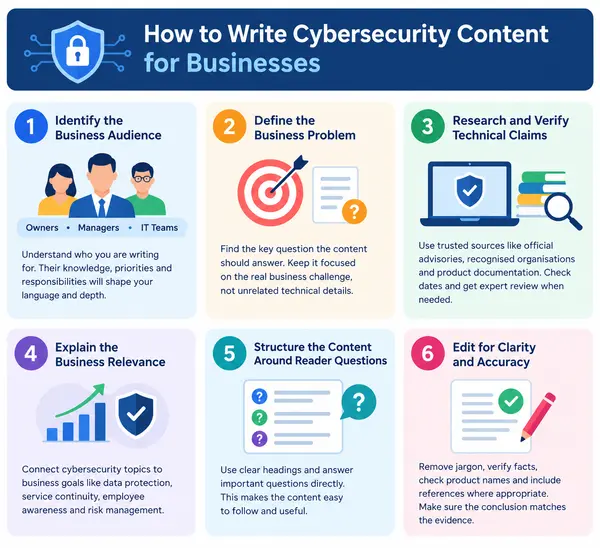
Follow these steps to develop useful business-focused content.
1. Identify the Business Audience
Determine whether you are writing for business owners, IT managers, security professionals, compliance teams, or senior decision-makers. Their knowledge, priorities, and responsibilities will influence the content’s terminology and depth.
For example, a small-business owner may need a straightforward explanation of account security, while an IT manager may need more detail about access controls and implementation.
2. Define the Business Problem
Identify the question the content should answer. It might concern protecting employee accounts, reducing phishing risks, securing cloud-based systems, or understanding a security product.
Keep the article focused on that problem instead of filling it with unrelated technical information.
3. Research and Verify Technical Claims
Use credible sources such as official security advisories, recognised cybersecurity organisations, and relevant product documentation. Check the dates of recommendations and distinguish general security principles from claims that apply only to a particular product or environment.
Seek review from a qualified subject-matter expert when the topic requires specialist knowledge.
4. Explain the Business Relevance
Connect technical information to legitimate business concerns, such as protecting data, maintaining service availability, supporting employee awareness, and managing operational risk. Avoid using fear-based language or suggesting that a single tool can solve every security problem.
5. Structure the Content Around Reader Questions
Use descriptive headings and answer important questions directly. A business-focused article about phishing protection, for example, could explain what phishing is, why it matters to organisations, how employees can recognise suspicious messages, and what steps a business can consider.
6. Edit for Clarity and Accuracy
Remove unnecessary jargon, check definitions, verify product names, and make sure the conclusion reflects what the evidence supports. Include references where appropriate and make clear when professional security advice may be necessary.
Business-focused cybersecurity content should help readers understand a problem and make informed decisions. Its value comes from accuracy and relevance, not from making the subject sound more complicated than it is.
Cybersecurity Content Writing Skills
So, what skills do you need for a cybersecurity content writing career?
Well, you need strong writing fundamentals, research discipline, cybersecurity knowledge, and the ability to adapt technical information to different audiences. The required depth depends on the role and content format.
Strong Writing and Editing Skills
You should be able to write clear introductions, organise information logically, explain unfamiliar terms, and remove unnecessary complexity. Grammar, sentence structure, proofreading, and consistency matter because readers must understand security information without ambiguity.
Learning practical writing techniques can help you improve clarity, structure, and readability.
Cybersecurity Fundamentals
You do not need to master every security discipline before starting, but you should understand common concepts such as:
- Malware, ransomware, and phishing
- Password security and multi-factor authentication
- Encryption and data privacy
- Network security and firewalls
- Cloud security and identity management
- Vulnerabilities, patches, and security updates
- Security awareness and incident response
Learn what these concepts mean, why they matter, and how they relate to one another. Avoid making claims about how a technology works until you have verified them through reliable technical sources.
Research and Fact-Checking
Cybersecurity information can become outdated, and inaccurate explanations can mislead readers. Learn to distinguish verified facts from assumptions, marketing claims, and speculation.
Use trustworthy sources such as official security advisories, recognised cybersecurity organisations, product documentation, and interviews with qualified subject-matter experts. Check publication dates and confirm that examples and technical recommendations remain relevant.
SEO and Search Intent
Many cybersecurity companies publish content to educate prospective customers and attract relevant organic traffic. You should understand keyword research, search intent, title and heading structure, internal linking, meta descriptions, and content updates.
SEO should support the reader’s task rather than encourage keyword stuffing. A useful resource on phishing, for instance, should explain what phishing is, how it works, how to recognize it, and what readers can do to reduce risk.
Audience Awareness
Cybersecurity content may target beginners, IT administrators, security analysts, business owners, compliance teams, or senior executives. Each audience needs a different level of detail.
A beginner may need an explanation of multi-factor authentication before learning how it works. An IT administrator may need implementation considerations, technical limitations, and configuration details.
Technical Communication and Documentation
Some positions involve user guides, troubleshooting instructions, product documentation, or detailed technical explanations. These roles require structured writing, consistent terminology, and the ability to work with engineers or product specialists.
If you are interested in this direction, explore a Technical Writing career and compare the responsibilities with those of a marketing-focused cybersecurity writer.
Do You Need a Technical Degree or Coding Skills?
No, not for every cybersecurity content writing role. Some employers accept writers with strong communication skills and demonstrated subject knowledge, while others prefer a technical degree, professional cybersecurity experience, or familiarity with specific technologies.
Coding requirements depend on the position. A writer creating introductory cybersecurity blogs may not need programming skills. A technical writer documenting APIs, developer security tools, or code-level vulnerabilities may need to understand programming concepts or read code.
Consider these broad role types:
- Beginner-friendly content writing: Focuses on educational blogs, introductory guides, and general security awareness. Strong research and writing skills are essential.
- B2B cybersecurity content writing: Explains business risks, product benefits, and security solutions for professional audiences. It requires an understanding of business needs and technical concepts.
- Cybersecurity technical writing: Covers product documentation, implementation instructions, and technical procedures. Deeper technical knowledge may be necessary.
- Security research writing: Explains vulnerabilities, attack methods, or original research. This usually requires more advanced subject knowledge and close collaboration with technical experts.
Do not assume that every cybersecurity writing vacancy is suitable for a beginner. Read the job description carefully and distinguish essential requirements from preferred qualifications.
What Is the Difference Between Cybersecurity Content Writing and Technical Writing?
Cybersecurity content writing is defined by its subject: cybersecurity. Technical writing is defined more by its purpose and approach: explaining technical information clearly and systematically. The two fields overlap, but they are not identical.
| Area | Cybersecurity content writing | Cybersecurity technical writing |
| Main purpose | Educate readers, build awareness, or support marketing | Explain how a system, tool, or process works |
| Common formats | Blogs, white papers, landing pages, awareness resources | User guides, configuration instructions, product documentation |
| Typical audience | General readers, business leaders, potential customers | Administrators, engineers, technical users, support teams |
| Main emphasis | Accuracy, clarity, audience relevance, and sometimes SEO | Technical precision, usability, consistency, and completeness |
| Coding requirement | Depends on the topic and role | May be required for developer-focused documentation |
For instance, a blog explaining why businesses need endpoint security is generally content marketing. A step-by-step guide showing an administrator how to configure endpoint protection is more likely to be technical documentation.
Writers can work across both areas, but they should build the skills and portfolio samples appropriate to each.
Where Can You Find Cybersecurity Content Writing Jobs?
Cybersecurity writing opportunities may exist in cybersecurity product companies, IT services firms, software-as-a-service (SaaS) businesses, specialist marketing agencies, consulting firms, and technical publications.
Potential job titles include:
- Cybersecurity Content Writer
- Cybersecurity Technical Writer
- Information Security Content Writer
- Cybersecurity SEO Content Writer
- Technical Content Writer – Cybersecurity
- B2B Content Writer – Cybersecurity
- Security Awareness Content Writer
- Cybersecurity Copywriter
- Content Specialist – Information Security
These titles are not interchangeable in every organisation. A copywriting position may focus on persuasive website content, while a technical documentation role may require product-specific knowledge.
When searching for jobs, use several title variations on job portals and company career pages. Review opportunities for remote work as well as roles based in major technology and business centres, but confirm location, experience, and eligibility requirements before applying.
Freelance opportunities may include writing security blogs for agencies, preparing educational content for software vendors, or developing awareness resources for businesses. Before accepting an assignment, clarify the scope, technical review process, payment terms, deadlines, and ownership of the content.
Cybersecurity Content Writing Freelance Opportunities
Freelance cybersecurity content writing allows writers to work with multiple clients instead of relying on a single employer. Potential clients include cybersecurity software companies, IT service providers, specialist marketing agencies, consulting firms, and businesses that need security-awareness resources.
Common freelance assignments include:
- Writing cybersecurity blogs and educational guides
- Creating SEO content for security-related websites
- Developing B2B content about security products and services
- Writing white papers and research-based resources
- Editing and updating existing cybersecurity content
- Creating employee security-awareness materials
- Preparing website copy and product explainers
Where Can Freelancers Find Clients?
Start by identifying companies that publish cybersecurity resources or sell security-related products. Review their existing content to understand the audiences they serve and the formats they use.
Potential routes to clients include freelance marketplaces, specialist content agencies, professional networking platforms, direct outreach to relevant businesses, and company websites that invite freelance contributions. Verify each opportunity’s legitimacy and terms before accepting work.
How Should You Price Freelance Cybersecurity Writing?
Rates depend on subject complexity, research requirements, word count, deadlines, revision rounds, technical review, and the client’s budget. White papers and specialised technical content may require a different pricing structure from shorter educational blogs.
Before quoting a fee, clarify the deliverable, expected depth of research, source requirements, review process, revisions, and deadline. Avoid setting rates solely by word count when an assignment involves substantial research or specialist collaboration.
Can Beginners Work as Freelance Cybersecurity Writers?
Beginners can pursue suitable assignments if they have the necessary writing skills and can demonstrate reliable research. Start with topics you understand, build original samples, and be transparent about your experience.
Do not accept work that requires technical expertise you cannot provide independently. For advanced topics, agree on access to a qualified reviewer or choose a less specialised assignment.
Cybersecurity Content Writing Jobs for Freshers
Cybersecurity content writing jobs for freshers may be available in content agencies, IT companies, software businesses, and organisations that publish educational resources. However, some employers require previous cybersecurity experience or advanced technical knowledge, so read the requirements carefully.
Which Entry-Level Job Titles Should You Search For?
Search for several related titles rather than relying on one exact phrase:
- Junior Cybersecurity Content Writer
- Entry-Level Technical Content Writer
- SEO Content Writer – Cybersecurity
- Information Security Content Writer
- Junior Technical Writer
- Content Writer – IT and Security
- Security Awareness Content Writer
These titles describe different types of work. A junior SEO writer may focus on educational blogs, while a technical writer may need to understand product documentation or technical procedures.
What Skills Should Freshers Highlight?
Emphasise skills you can demonstrate, including clear writing, research, fact-checking, editing, SEO fundamentals, and the ability to explain unfamiliar concepts. If you have completed relevant cybersecurity training, mention it accurately without implying professional security experience.
Include portfolio samples that demonstrate how you handle technical terms, cite reliable sources, and write for a defined audience.
How Can Freshers Apply Without Cybersecurity Work Experience?
Create two or three original samples on accessible topics, such as phishing awareness, multi-factor authentication, or safe account practices. Clearly identify them as portfolio projects rather than paid client work.
Tailor your resume to each role, include links to relevant samples, and explain how your existing writing skills transfer to cybersecurity content. Be honest about your current technical knowledge and willingness to learn.
How Can Freshers Evaluate a Job Description?
Look for the required experience level, technical knowledge, expected content formats, review process, and whether the employer provides access to subject-matter experts.
If a position requires vulnerability research, incident-response experience, or advanced technical documentation, it may not be suitable for someone who is just beginning. Focus first on roles that match your current capabilities while giving you room to develop specialised knowledge.
What Is the Salary of a Cybersecurity Content Writer?
There is no single standard salary for cybersecurity content writers. Compensation varies with experience, writing quality, technical knowledge, employer type, location, and the complexity of the assigned work.
Factors that can influence earnings include:
- Writing experience: A strong track record of delivering accurate, well-structured content can improve your competitiveness.
- Cybersecurity knowledge: Writers who can explain specialised topics accurately may qualify for roles requiring greater subject expertise.
- Content format: Research-heavy white papers, technical documentation, and specialist B2B content may have different compensation structures from general blogs.
- Employment type: Full-time employment, contract work, and freelancing have different payment and benefits arrangements.
- Portfolio quality: Relevant samples can help demonstrate your ability even when you have not held a cybersecurity-specific job title.
- Technical review requirements: Work involving extensive subject-matter review or specialised documentation may require additional skills.
For current salary expectations, compare recent job listings with similar responsibilities and experience requirements. Look for disclosed salary ranges and distinguish annual employment packages from freelance rates paid per word, project, or deliverable. Avoid relying on a single salary estimate as representative of the entire market.
How Can You Start a Cybersecurity Content Writing Career?
You can begin by learning foundational security concepts, practising with well-researched topics, and building a small portfolio that demonstrates accuracy and audience awareness.
1. Learn the Fundamentals of Cybersecurity
Start with introductory resources on phishing, malware, authentication, encryption, data privacy, network security, and cloud security. Learn the basic terminology before attempting advanced topics such as vulnerability exploitation or threat intelligence.
Prefer educational material from established security organisations and official documentation. Keep notes on definitions, common misconceptions, and the sources supporting important claims.
2. Choose an Initial Content Format
Decide whether you want to start with educational blogs, SEO content, B2B marketing resources, or technical documentation. Beginners may find introductory blogs easier to practise because they allow them to demonstrate research, organisation, and explanation skills without claiming advanced technical expertise.
As your knowledge grows, you can explore more specialised formats.
3. Create Portfolio Samples
Prepare two or three original samples on subjects you understand well. For example:
- A beginner’s guide to recognising phishing emails
- A blog explaining multi-factor authentication
- A business-focused guide to cybersecurity awareness training
Use reliable sources, include appropriate references where needed, and explain technical terms clearly. Label these as independent portfolio samples rather than client assignments. Do not invent client results, professional credentials, or first-hand security testing experience.
4. Learn the Basics of SEO
Practise matching content to search intent, creating descriptive headings, writing useful meta descriptions, and linking to relevant resources. Learn to answer the reader’s main question early, then provide the detail needed to understand the topic.
If you want to work with software businesses, studying SaaS content writing careers can help you understand how content supports product education and business goals.
5. Get Technical Feedback
Ask a qualified cybersecurity professional to review your samples when possible. If you cannot access a reviewer, cross-check key claims against multiple authoritative sources and clearly acknowledge the limitations of your research.
Never present an unverified explanation of a vulnerability, security control, or product feature as established fact.
6. Apply for Relevant Opportunities
Search for entry-level and mid-level roles that match your actual skills. Tailor your resume to highlight research, writing, editing, SEO, and your cybersecurity learning. Include links to relevant samples and be honest about your level of technical expertise.
You can also approach specialist agencies and software companies with a focused portfolio and a clear description of the content you can deliver.
📌 Remember
Start your cybersecurity content writing career by learning security fundamentals, choosing a content format, building well-researched portfolio samples, and practicing SEO.
Prioritize accuracy, seek technical feedback where possible, and apply for opportunities that match your skills.
Clearly label independent samples and be honest about your technical knowledge, credentials, and experience.
How Do You Build a Cybersecurity Content Writing Portfolio Without Client Experience?
You can build a credible beginner portfolio using original sample projects, provided you identify them honestly and demonstrate sound research practices.
A useful portfolio can include three different pieces:
- An educational blog: Explain a common security issue in plain language for beginners.
- A B2B resource: Describe how a business can assess a security-related challenge without making unsupported promises.
- A technical explainer: Explain a security concept or product function using verified information and clear terminology.
For each sample, state the intended audience, purpose, and content format. Include references for technical claims where appropriate, and revise the piece to remove unsupported statements, exaggerated benefits, and unnecessary jargon.
You can also create a sample content brief showing the target reader, search intent, key questions, outline, and source list. This demonstrates your process as well as the finished writing.
A portfolio does not replace professional cybersecurity experience, but it gives employers evidence of your research, writing, and communication abilities.
What Mistakes Should Cybersecurity Content Writers Avoid?
Cybersecurity writing requires particular care because readers may use the information to make decisions about their accounts, devices, or organisations.
Avoid these common mistakes:
- Using technical terms without explanation: Define unfamiliar terminology when it first appears and match the depth to the intended audience.
- Relying on one unverified source: Check important claims against reliable documentation or additional authoritative sources.
- Making absolute security claims: Avoid statements such as “this tool prevents all cyberattacks” unless a claim is precisely supported—and such absolute claims are rarely defensible.
- Confusing related concepts: Do not treat privacy, security, compliance, and risk management as interchangeable terms.
- Using outdated information: Check dates, software versions, advisories, and changes in recommended practices.
- Overusing AI-generated text: AI tools can assist with outlining or editing, but generated technical claims must be independently verified.
- Ignoring the intended audience: A beginner’s guide and a technical implementation document should not use the same level of detail.
- Inventing case studies or credentials: Use only verified examples and clearly distinguish hypothetical scenarios from real incidents.
Accuracy should take priority over publishing quickly. When a topic requires specialist knowledge, seek qualified review or narrow the scope to what you can substantiate.
✅ Key Takeaways
- A cybersecurity content writing career involves explaining digital security concepts, risks, products, and practices to specific audiences.
- Common formats include blogs, technical explainers, white papers, website copy, user guides, and security awareness resources.
- Strong writing, research, fact-checking, cybersecurity fundamentals, and audience awareness are essential skills.
- Coding and technical degree requirements vary by role, so read job descriptions carefully before applying.
- Indian job opportunities may exist in cybersecurity companies, IT services firms, SaaS businesses, marketing agencies, and freelance projects.
- Salary depends on experience, technical expertise, employer, content format, and employment arrangement.
- A beginner can build a portfolio with original, carefully researched samples without claiming client experience.
- Technical accuracy and transparent sourcing are especially important when writing about security risks and protective measures.
- Cybersecurity blog writing samples, business-focused resources, and technical explainers can help demonstrate your skills when applying for jobs or freelance assignments.
- Freelancers can find potential clients among cybersecurity companies, IT service providers, SaaS businesses, and specialist content agencies.
- Freshers should target roles that match their current technical knowledge, build an honest portfolio, and seek expert feedback when writing about complex security topics.
Conclusion
A cybersecurity content writing career can suit writers who enjoy research and want to develop expertise in a specialised technical field. You do not need to begin as a cybersecurity engineer, but you do need to understand the fundamentals, verify technical claims, and recognise when expert review is necessary.
Start with a few well-researched portfolio samples, learn the SEO and communication skills relevant to your target roles, and apply for opportunities that match your current capabilities. As your subject knowledge grows, you can explore more specialised work in B2B cybersecurity content, technical documentation, and security education.
Frequently Asked Questions
Is cybersecurity content writing a good career for beginners?
It can be a suitable path for beginners who have strong writing and research skills and are willing to learn cybersecurity fundamentals. Start with accessible topics and build a portfolio before targeting highly specialised roles.
Can a non-technical person become a cybersecurity content writer?
Yes. Some roles focus on educational content, SEO blogs, and business communication rather than hands-on security work. However, non-technical writers still need enough subject knowledge to explain concepts accurately and recognise when expert input is required.
Do cybersecurity content writers need certifications?
Not always. Certification requirements depend on the employer and role. Introductory cybersecurity courses can help you build foundational knowledge, while relevant certifications may be useful for specialised positions. They do not replace writing ability or factual accuracy.
What should a cybersecurity content writing portfolio include?
Include original samples such as an educational blog, a B2B resource, and a technical explainer. Show clear structure, credible research, appropriate terminology, and an understanding of the intended audience. Label independent samples honestly.
How can you practice cybersecurity content writing without clients?
Choose beginner-friendly topics such as phishing awareness, password security, and multi-factor authentication. Research them using reliable sources, create original portfolio samples, and verify technical claims before publishing. Clearly label your work as independent practice rather than paid client work.
What topics should a cybersecurity content writer specialise in?
You can specialise in areas such as cloud security, data privacy, security awareness, identity and access management, or cybersecurity software. Start with topics you can research accurately, then develop deeper expertise based on your interests and the requirements of your target clients.
Is freelance cybersecurity content writing suitable for freshers?
It can be suitable for freshers who have strong writing and research skills and a basic understanding of cybersecurity. Start with assignments that match your knowledge, build relevant samples, clarify client expectations, and seek qualified technical review when necessary.

Sachin is a Postgraduate in Technical Writing in Business Management specializing in creating SEO-friendly, User-friendly, and Reader-focused website articles on Education, Tech, Sports, Games, and Entertainment.
Through Write Knowledge, he helps students, bloggers, editors, and professionals develop practical writing skills using clear explanations, real-world examples, and internationally recognized writing standards.