You may be the kind of person who notices that a sentence feels awkward even when there is technically nothing wrong with it.
Maybe you spot inconsistent capitalization. Maybe one paragraph says “website” while another says “web site.” Or perhaps you notice that a writer used three different terms for the same thing.
That instinct can be useful.
A copy editing career is built around exactly this kind of careful reading. Copy editors work on written content before publication, improving clarity, correctness, consistency, and readability while making sure the content follows the appropriate editorial or style requirements.
But copy editing is not simply proofreading with a different job title. The role usually involves more active decisions about language, consistency, facts, tone, and how effectively the writing communicates with its intended audience.
If you are exploring different professional paths, our writing careers post provides a broader look at how copy editing fits into the wider writing and editorial profession.
💡 Quick Answer: What is a Copy Editing Career?
A copy editing career involves reviewing and improving written content before publication. Copy editors typically check grammar, spelling, punctuation, sentence structure, consistency, clarity, factual details, formatting, and adherence to the relevant style guide or house style.
Copy editors may work in publishing, newspapers, magazines, digital media, businesses, agencies, academic publishing, and other industries. Some work as employees, while others build freelance copy editing careers.
What is Copy Editing?
Copy editing is the process of reviewing and refining written text to ensure accuracy, clarity, and consistency before publication. It involves checking grammar, spelling, punctuation, and usage, while also aligning the writing with a chosen style guide.
Beyond surface corrections, copy editing ensures that tone, formatting, and terminology remain consistent throughout a document, making the text polished, professional, and reader‑friendly.
What Does a Copy Editor Do?
A copy editor works closely with the actual text.
The goal is not necessarily to rewrite everything. Instead, the copy editor identifies problems that could make the content unclear, inconsistent, inaccurate, or unsuitable for its intended audience.
Typical responsibilities may include:
- Correcting grammar, spelling, and punctuation
- Improving sentence clarity and readability
- Checking consistency in terminology and capitalization
- Fact-checking names, dates, figures, and other details
- Checking citations and references where required
- Applying a house style or external style guide
- Identifying repetition and awkward wording
- Checking headings, captions, tables, and cross-references
- Communicating queries or suggested changes to writers
- Reviewing the final copy before it moves toward publication
The exact responsibilities depend on the employer and type of content. A copy editor working for a newspaper may perform different tasks from one working for an academic publisher or digital agency.
Copy Editing is More Than Correcting Grammar
This is one of the most important things to understand before pursuing this career.
Consider this sentence:
“The company launched a new product which is expected to probably become one of its most successful products.”
There is no obvious spelling mistake.
But a copy editor might tighten it:
“The company launched a new product that is expected to become one of its most successful.”
The second version is clearer and less repetitive.
That is the difference between simply finding errors and editing for quality.
What is the Difference Between Copy Editing and Proofreading?
Copy editing and proofreading overlap, but they usually happen at different stages and involve different levels of intervention.
A copy editor may work on:
- Sentence construction
- Word choice
- Clarity
- Consistency
- Facts
- Style
- Grammar
- Punctuation
- Overall readability
A proofreader generally works closer to the final publication stage and focuses more heavily on remaining errors, such as:
- Typographical mistakes
- Spelling
- Punctuation
- Formatting
- Missing or duplicated words
- Layout inconsistencies
Our Proofreading Career guide explores the proofreading side of editorial work in greater detail.
The distinction is not absolute. Some employers combine copy editing and proofreading responsibilities into one position.
Copy Editor vs Proofreader
| Copy Editor | Proofreader |
| Improves clarity and readability | Checks the near-final copy |
| Corrects language problems | Finds remaining errors |
| Checks consistency | Checks final consistency |
| May fact-check information | May verify final details |
| Applies style requirements | Checks whether corrections were applied |
| May suggest rewrites | Usually makes more limited changes |
The important point is that copy editing usually involves more editorial decision-making than proofreading.
What Skills Do You Need for a Copy Editing Career?
Being good at English is important, but professional copy editing requires more than knowing grammar rules.
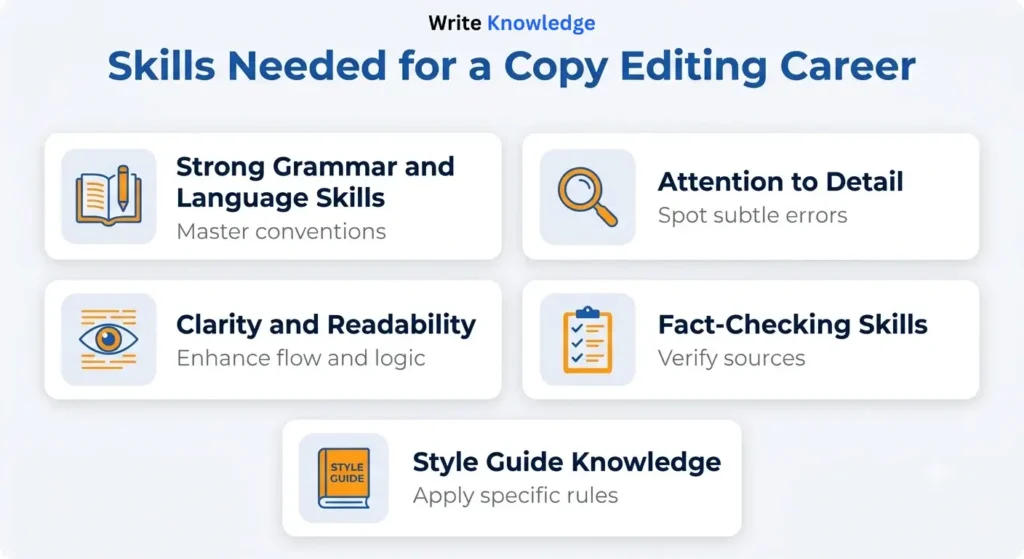
Strong Grammar and Language Skills
You need a reliable understanding of:
- Grammar
- Punctuation
- Sentence structure
- Spelling
- Word usage
- Capitalization
- Syntax
You should also understand that language decisions can depend on context and the style being followed.
Attention to Detail
Copy editors regularly look for small inconsistencies that ordinary readers may never notice.
For example:
Email → email → e-mail
If all three forms appear in the same document without a reason, the copy editor may need to standardize them.
Attention to detail is therefore one of the foundations of the profession.
Clarity and Readability
A grammatically correct sentence can still be difficult to understand.
A good copy editor asks:
Can the intended reader understand this immediately?
That means identifying unnecessarily complicated sentences, vague wording, repetition, weak transitions, and unnecessary jargon.
Fact-Checking Skills
Copy editors may need to verify:
- Names
- Dates
- Statistics
- Titles
- Locations
- Numbers
- Citations
- Other factual claims
The depth of fact-checking depends on the publication and job.
Style Guide Knowledge
Professional copy editors frequently work according to an organization’s house style or a recognised style guide.
Depending on the field, you may encounter AP Style, Chicago Manual of Style, APA, MLA, IEEE, or another standard.
Our writing style guides resource explains how different style guides are used across publishing, journalism, academic writing, and technical communication.
You don’t need to memorize every style guide.
Instead, learn how to find, understand, and consistently apply the rules relevant to your work.
Where Do Copy Editors Work?
Copy editors are not limited to book publishing.
They can work wherever substantial amounts of written content need to be reviewed before publication or distribution.
Publishing
Traditional publishing is one of the most recognizable areas.
Copy editors may work on:
- Books
- Manuscripts
- Magazines
- Journals
- Educational publications
- Reference material
Publishing environments often rely heavily on editorial standards and house style.
Newspapers and Digital Media
Copy editors may review:
- News articles
- Features
- Opinion pieces
- Website content
- Headlines
- Captions
- Newsletters
In journalism, copy editors may need to work under tight deadlines while maintaining accuracy and consistency.
Websites and Digital Content
Digital publications, agencies, and businesses also need editorial review.
A copy editor might work on:
- Blog articles
- Landing pages
- Website copy
- Knowledge-base articles
- Email content
- Product descriptions
- Long-form resources
This can overlap with SEO and content work, particularly when editors are expected to maintain readability while preserving search-focused structure.
You can explore the related SEO writing career guide to understand how writing and editorial work intersect in digital publishing.
Academic and Research Publishing
Academic copy editors may work on:
- Research papers
- Journal articles
- Dissertations
- Theses
- Conference papers
- Research reports
The work may involve checking references, terminology, formatting, citations, and adherence to the publication’s requirements.
The specific style guide depends on the institution, journal, publisher, or discipline.
Corporate Content
Businesses may hire editors to review:
- Reports
- Proposals
- Internal documents
- Training materials
- Newsletters
- Corporate communications
- Marketing content
Here, the editor may need to follow an organization’s internal style guide rather than a universally recognized external guide.
What Style Guides Should a Copy Editor Learn?
There is no single style guide that every copy editor uses.
The useful approach is to match your style-guide knowledge to the industry you want to enter.
| Work Area | Style Guide You May Encounter |
| Journalism and news | AP Style |
| Book publishing | Chicago Manual of Style |
| Academic/social sciences | APA |
| Humanities | MLA |
| Technical and engineering content | IEEE |
| Corporate content | Company/house style |
These are associations rather than universal rules. Employers and publishers may have their own requirements.
For example, someone interested in book publishing may benefit more from learning Chicago than spending months studying a style guide primarily used in another field.
Learn the Style Guide Your Target Industry Uses
You do not need to become an expert in five style guides before applying for your first job.
A better strategy is:
Choose an industry → identify its common editorial standards → learn those standards → practise applying them.
This makes your learning more practical and gives you something useful to demonstrate in your portfolio.
Do You Need a Degree to Become a Copy Editor?
Not necessarily.
A relevant degree can be helpful, particularly when applying for competitive editorial positions. However, copy editing also depends heavily on language ability, editorial judgment, subject knowledge, practical experience, and demonstrated skills.
Experience can come from:
- Internships
- Freelance projects
- Volunteer editing
- Student publications
- Personal projects
- Editorial assistant roles
- Practice editing samples
Indeed similarly notes that relevant education can help, but practical experience and editorial skills can also be important when building an editing career.
What Should You Study?
Useful educational backgrounds can include:
- English
- Literature
- Journalism
- Communications
- Publishing
- Technical writing
- Linguistics
- Other writing-related disciplines
But your degree does not automatically make you a good copy editor.
The ability to identify a problem, understand why it is a problem, and make an appropriate editorial decision matters more.
How Can You Start a Copy Editing Career?
You don’t need to wait until someone gives you your first copy editing job.
You can start practising now.
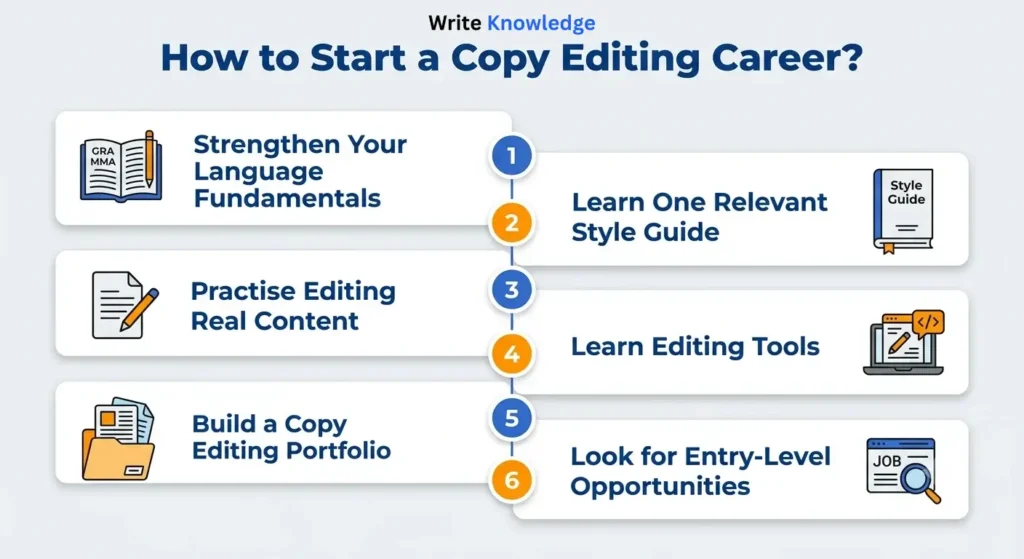
1. Strengthen Your Language Fundamentals
Work systematically on:
- Grammar
- Punctuation
- Sentence construction
- Word choice
- Capitalization
- Common usage problems
You should be able to explain your corrections rather than simply make them.
2. Learn One Relevant Style Guide
Choose the guide that matches your intended field.
If you’re interested in publishing, start with Chicago.
If journalism interests you, learn AP.
If academic editing interests you, explore APA or MLA depending on the subject area.
3. Practise Editing Real Content
Take an existing article and edit it yourself.
Look for:
- Unnecessary words
- Awkward sentences
- Repetition
- Grammar problems
- Inconsistent terminology
- Punctuation errors
- Factual inconsistencies
Then compare your version with the published version when possible.
4. Learn Editing Tools
Professional editors may work with tools such as:
- Microsoft Word Track Changes
- Google Docs Suggesting mode
- PDF annotation tools
- Comments
- Spelling and grammar checkers
- Style-checking tools
Technology can help identify potential problems, but editorial judgment still matters.
5. Build a Copy Editing Portfolio
A portfolio can be particularly useful if you don’t yet have professional experience.
Create before-and-after samples.
For example:
Before
“The results of the study shows several important difference between the two groups.”
After
“The results of the study show several important differences between the two groups.”
Then explain what you changed and why.
You can create practice samples around different content types instead of waiting for paid work.
6. Look for Entry-Level Opportunities
Don’t search only for the exact title Copy Editor.
Related positions may include:
- Editorial Assistant
- Junior Editor
- Proofreader
- Content Editor
- Publishing Assistant
- Editorial Intern
- Copy Editor
Our Editorial career guide explains how copy editing fits alongside other editorial roles.
Can You Become a Freelance Copy Editor?
Yes.
Freelancing can be an attractive option because copy editing can be performed for different clients and content types.
A freelance copy editor may work with:
- Authors
- Publishers
- Businesses
- Agencies
- Websites
- Researchers
- Academic organizations
- Independent creators
However, freelancing means that editing is only part of the business.
You also need to manage:
- Finding clients
- Pitching
- Pricing
- Contracts
- Deadlines
- Invoices
- Client communication
- Revisions
This makes freelancing different from working as an in-house copy editor.
How Much Can a Copy Editor Earn?
There is no single salary for a copy editor.
Earnings can vary significantly according to:
- Country
- Location
- Experience
- Industry
- Employer
- Specialization
- Full-time or freelance work
- Type of content
- Client base
For this reason, salary figures found online should be treated as market-specific estimates, not guaranteed earning levels.
A beginner may start in an assistant or junior editorial role and gradually increase their earning potential through experience, specialization, and a stronger portfolio.
Specialization can also make a difference. For example, academic, medical, technical, legal, or highly specialized editing may require additional subject knowledge beyond general copy editing.
What is the Career Path for a Copy Editor?
A copy editing career does not have to remain at the same level forever.
A possible progression might look like:
Editorial Assistant → Junior Copy Editor → Copy Editor → Senior Copy Editor → Managing Editor
However, career paths vary between organizations.
You might also move sideways into related roles such as:
- Proofreader
- Content Editor
- Developmental Editor
- Technical Editor
- Managing Editor
- Editorial Manager
- Content Strategist
Your next step does not necessarily have to be a more senior version of the same job.
For example, someone who enjoys planning content more than sentence-level editing may eventually move toward content strategy. Our Content Strategy career guide explores that path separately.
Copy Editing Career vs Editorial Career
These roles are related, but they are not identical.
A copy editor generally works closely with the language and consistency of the text.
An editor may have a broader responsibility that includes structure, content decisions, writer management, editorial planning, and publication decisions.
Copy Editing vs Proofreading vs Editing
| Role | Main Focus |
| Developmental Editor | Structure, ideas, argument, organization |
| Editor | Overall content and editorial quality |
| Copy Editor | Language, clarity, consistency, accuracy, style |
| Proofreader | Final errors and presentation |
These boundaries can overlap depending on the employer.
That is why reading the actual job description is more useful than relying entirely on the job title.
Is Copy Editing a Good Career for You?
Copy editing may suit you if you naturally enjoy improving written content.
You may find it a good fit if you:
- Notice small language errors
- Enjoy reading carefully
- Like improving sentences
- Have strong attention to detail
- Enjoy consistency
- Like researching facts
- Can work with deadlines
- Don’t mind repetitive checking
- Enjoy helping other writers improve their work
It may be less suitable if you strongly prefer creating original content and dislike reviewing someone else’s work repeatedly.
Common Mistakes New Copy Editors Make
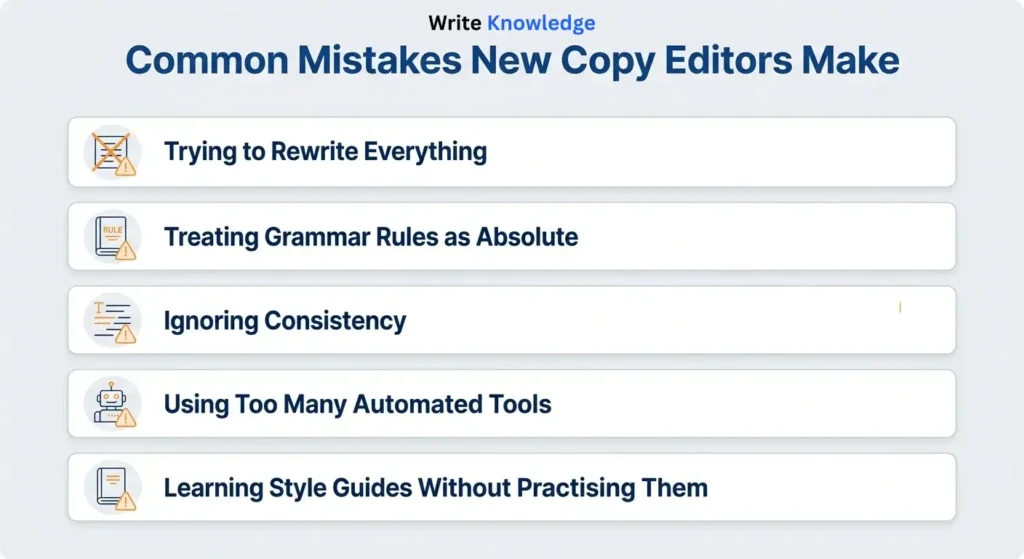
Trying to Rewrite Everything
A copy editor is not necessarily supposed to replace the writer’s voice.
The goal is usually to improve the text while preserving its intended meaning, tone, and purpose.
Treating Grammar Rules as Absolute
Language decisions depend on context, audience, publication, and style requirements.
A good copy editor knows when a rule applies and when a style guide or house preference changes the decision.
Ignoring Consistency
A document can contain individually correct sentences and still feel poorly edited if terminology, capitalization, formatting, dates, or numbers vary unnecessarily.
Using Too Many Automated Tools
Grammar and spelling tools can identify potential problems, but they cannot replace editorial judgment.
A tool may flag a sentence that is perfectly appropriate in context or miss a problem that requires understanding the surrounding content.
Learning Style Guides Without Practising Them
Reading a style guide is useful.
Applying it is better.
Take a real piece of content and deliberately edit it according to the rules. That is where the knowledge becomes practical.
✍️ Writing Tip
Don’t ask only, “Is this sentence grammatically correct?”
Ask:
“Is this the clearest, most consistent, and most appropriate way to communicate this idea to this particular reader?”
That shift in thinking is what takes you from someone who corrects mistakes to someone who can actually copy edit.
✅ Key Takeaways
- A copy editing career involves improving written content for clarity, accuracy, consistency, readability, and style.
- Copy editors may correct grammar and punctuation, but their work can also involve fact-checking, terminology, formatting, and style-guide compliance.
- Copy editing generally involves more intervention than proofreading.
- Copy editors work across publishing, journalism, digital media, academia, business, and other industries.
- Learning a relevant style guide can significantly improve your professional editing ability.
- A degree can help, but practical experience and a strong portfolio are also valuable.
- You can build experience through freelance work, internships, volunteer projects, and practice editing samples.
- Freelance copy editing offers flexibility but also requires basic business and client-management skills.
- Copy editors can eventually move into senior editorial, managing, specialist editing, or content strategy roles.
Conclusion
A copy editing career is a good option for people who enjoy working with language but would rather improve existing content than always start from a blank page.
The profession combines grammar, clarity, consistency, research, style-guide knowledge, and editorial judgment. And because written content is produced across publishing, media, business, academia, and digital platforms, copy editing can lead to several different professional environments.
You don’t need to master everything on day one. Start by strengthening your language fundamentals, learn the style guide relevant to the field you want to enter, practise on real content, and build examples that demonstrate how your editing improves the original.
That is how a copy editing skill can gradually become a copy editing career.
Frequently Asked Questions
What is a copy editing career?
A copy editing career involves reviewing and improving written content for grammar, clarity, consistency, accuracy, readability, and adherence to editorial or style requirements.
What does a copy editor do?
A copy editor may correct grammar and punctuation, improve sentence clarity, check facts, standardize terminology, apply style-guide rules, and identify inconsistencies before content is published.
Is copy editing the same as proofreading?
No. Copy editing generally involves more active improvement of language, clarity, consistency, and accuracy, while proofreading is usually a later-stage check for remaining errors and formatting problems.
Do you need a degree to become a copy editor?
A relevant degree can help, but it is not the only route. Practical experience, strong language skills, editorial knowledge, and a portfolio can also help you enter the profession.
Which style guides should a copy editor learn?
That depends on the field. AP is common in journalism, Chicago is important in publishing, APA and MLA are used in academic contexts, and IEEE may be relevant to technical and engineering content.
Can copy editing be a freelance career?
Yes. Freelance copy editors can work with authors, publishers, businesses, agencies, websites, researchers, and other clients. However, they also need to manage client acquisition, pricing, contracts, deadlines, and invoicing.
What skills are most important for copy editing?
Strong grammar and language knowledge, attention to detail, clarity, consistency, fact-checking ability, style-guide knowledge, organization, and communication are among the most useful skills.
What jobs can you get after copy editing?
Depending on your experience, you may move into roles such as senior copy editor, content editor, proofreader, managing editor, editorial manager, specialist editor, or content strategist.

Sachin is a Postgraduate in Technical Writing in Business Management specializing in creating SEO-friendly, User-friendly, and Reader-focused website articles on Education, Tech, Sports, Games, and Entertainment.
Through Write Knowledge, he helps students, bloggers, editors, and professionals develop practical writing skills using clear explanations, real-world examples, and internationally recognized writing standards.