
Writing is more than putting words on a page. Every sentence you write has a purpose … whether it’s explaining an idea, telling a story, describing an experience, or persuading someone to take action. The way you present that message determines how effectively your audience understands it. That’s why understanding the types of writing is one of the most important skills any writer can develop.
A research paper doesn’t read like a novel, a product description isn’t written like a newspaper article, and a business proposal shouldn’t sound like a personal diary. Each has its own purpose, structure, and audience. Choosing the right writing type can make the difference between confusing your readers and connecting with them.
This comprehensive guide explains the different types of writing, how they differ from one another, where they are used, and how to choose the right one for your purpose.
💡 Quick Answer
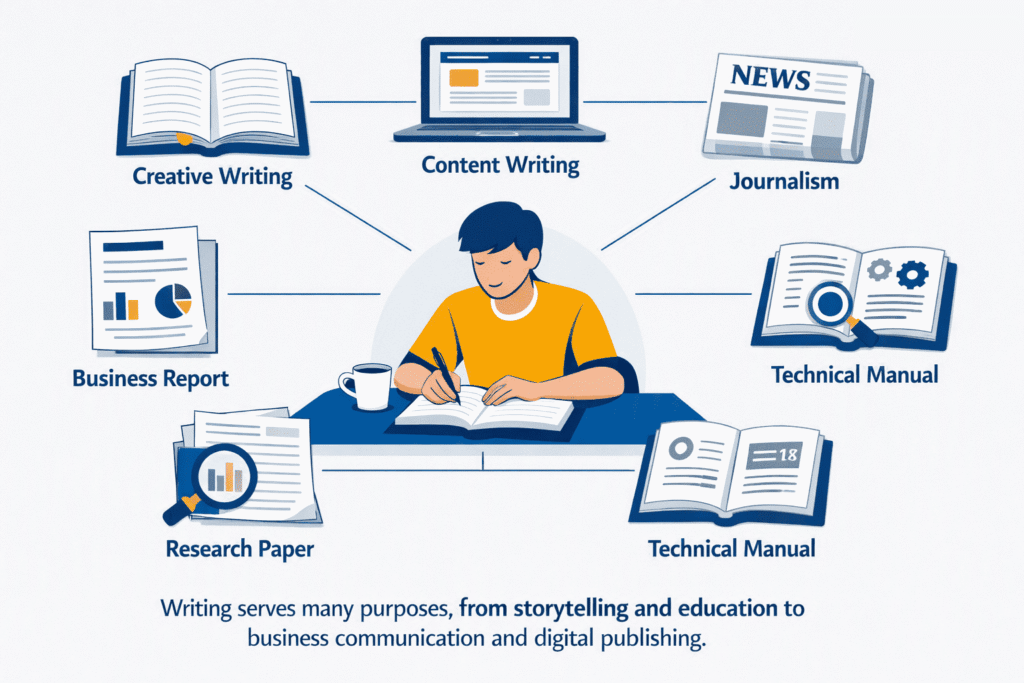
Types of writing are different methods of communicating ideas based on a writer’s purpose and audience. While writing can take many forms, it is traditionally divided into four primary types: Expository, Descriptive, Narrative, and Persuasive writing. Each serves a distinct purpose. Beyond these, modern communication also includes specialized writing such as Technical, Academic, Business, Creative, and Journalistic writing.
What Is Writing?
Basically, writing is everything that you write!
It can be your school home-work, grocery list, some sort of fill-in form, and many others. So, what exactly are you achieving with those writing?
Here is the answer. Writing is the process of communicating thoughts, ideas, information, or emotions through written language. It allows people to share knowledge, solve problems, entertain audiences, and influence opinions across cultures and generations.
Unlike spoken communication, writing gives both the writer and the reader time to think. A writer can organize ideas carefully before presenting them, while readers can absorb information at their own pace. This quality makes writing one of the most powerful forms of communication.
However, writing isn’t a one-size-fits-all skill. Imagine explaining a scientific discovery to researchers, telling a bedtime story to children, writing instructions for assembling furniture, or creating a marketing campaign for a new product.
Noticed the difference? All of those involve writing, but each requires a completely different approach. The language, tone, structure, and purpose change depending on who the audience.
This is precisely why different types of writing exist.
What Are Types of Writing?
As discussed earlier, same writing style doesn’t fulfill the requirement of different needs. So it can be said that writing types are broad categories that fulfills written communication according to its primary purpose. Rather than focusing on grammar or formatting, these categories help writers decide how information should be presented to achieve the desired outcome.
For example, if your goal is to explain how photosynthesis works, you’ll naturally write very differently than if you’re trying to convince readers to support an environmental campaign. Likewise, writing a novel demands a different style than drafting an employee handbook.
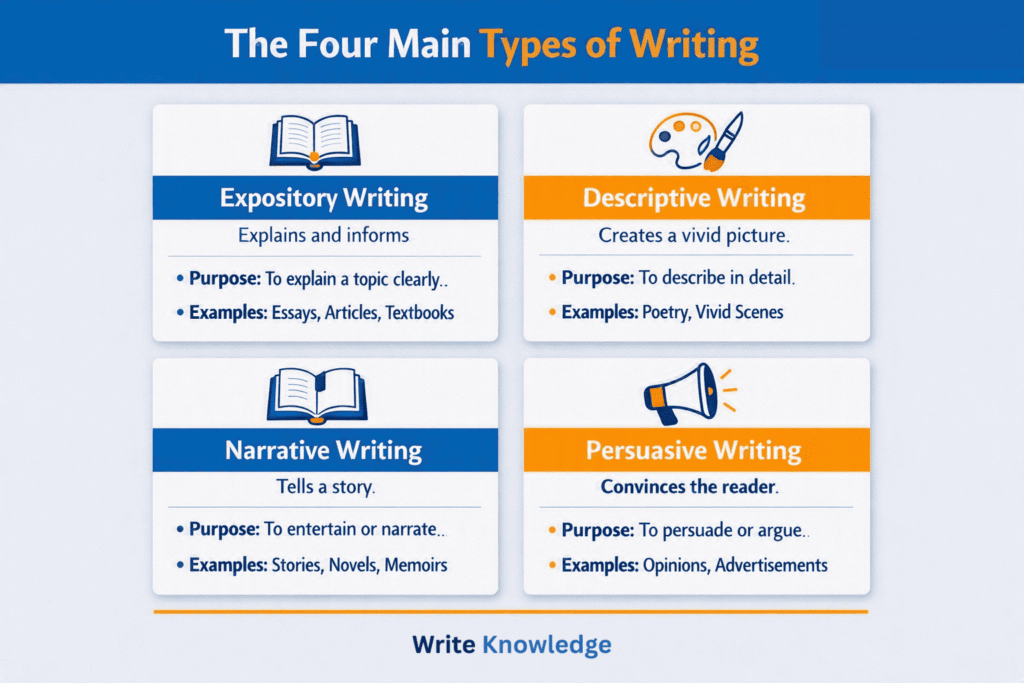
Although there are many specialized forms of writing today, most of them are built upon four foundational writing types:
- Expository writing explains and informs.
- Descriptive writing creates vivid mental images.
- Narrative writing tells stories.
- Persuasive writing influences opinions or actions.
These four categories form the foundation upon which most other writing styles are developed.
Why Do Different Types of Writing Exist?
We just discussed it!
Writing exists to solve different communication needs. Since no single writing style can effectively achieve every purpose, different writing types have evolved over time.
Consider the following situations:
-A history teacher wants students to understand the causes of World War II. The goal is education, so the writing needs to be factual, organized, and objective.
-A novelist wants readers to become emotionally invested in fictional characters. Here, storytelling takes priority over presenting factual information.
-A travel writer wants readers to imagine standing on a quiet beach at sunrise. This would require rich sensory details because it is more important than statistics or logical arguments.
-A company launching a new product wants potential customers to make a purchase. The writing must persuade rather than simply inform.
Although each example involves writing, the objectives are completely different. Trying to explain a scientific concept using storytelling alone would leave readers confused, just as using technical language in a children’s story would make it difficult to enjoy.
Understanding your target audience is the first step in choosing the right type of writng.
The Four Main Types of Writing
For decades, experts have grouped writing into four major categories. While modern writing often mixes these styles, understanding each one individually provides a strong foundation for becoming a more effective writer.
1. Expository Writing
Expository writing is designed to explain, inform, or educate. Its primary objective is to present information clearly, logically, and objectively (bias-free) so readers can understand a topic without being influenced by the writer’s personal opinions.
You’ll encounter expository writing almost everywhere. School textbooks, encyclopedia articles, research papers, instruction manuals, educational websites, and many how-to guides all rely on this style because readers expect accurate information rather than emotional storytelling.
Imagine you’re reading an article explaining how solar panels generate electricity. The writer isn’t trying to entertain you or convince you to purchase solar panels. Instead, the goal is to explain the process step by step using facts, examples, and clear language.
For anyone interested in writing blogs, technical documentation, educational content, or research-based articles, mastering expository writing is an essential skill.
2. Descriptive Writing
Descriptive writing is a completely different approach from Expository writng.
It focuses on creating vivid mental images by appealing to the reader’s senses. Rather than simply stating facts, it helps readers see, hear, smell, taste, or feel what the writer is describing.
Suppose you write, “The garden was beautiful.” While accurate, the sentence leaves much to the reader’s imagination. A descriptive writer might instead describe sunlight filtering through flowering trees, the fragrance of blooming roses, the gentle rustling of leaves, and the sound of birds singing nearby. Suddenly, readers aren’t merely reading about the garden … they’re experiencing it!
This writing style appears frequently in novels, travel writing, poetry, memoirs, and creative nonfiction. However, descriptive writing isn’t limited to fiction. Even product descriptions, restaurant reviews, and travel blogs often rely on descriptive techniques to create a more engaging reading experience.
Effective descriptive writing strikes a balance between detail and clarity. Too little description leaves readers disconnected, while too much can slow the pace of the writing. The goal is to include meaningful details that strengthen the reader’s understanding without overwhelming them.
3. Narrative Writing
Narrative writing tells a story. Whether the events are fictional or based on real life, this writing type guides readers through a sequence of events involving characters, settings, conflict, and resolution.
A strong narrative does more than describe what happened. It gives readers a reason to care. Characters face challenges, make decisions, overcome obstacles, and grow through their experiences. This emotional connection keeps readers engaged from beginning to end.
Today, narrative writing continues to appear in novels, short stories, biographies, memoirs, screenplays, and even many blog posts.
Interestingly, narrative techniques are increasingly used outside fiction. Many businesses begin presentations with customer stories. Bloggers often introduce articles with personal experiences.
When used effectively, narrative writing transforms information into experiences that readers connect with on a personal level.
4. Persuasive Writing
My personal opinion first. This is the most difficult type of writing yet very satisfactory if it achieves its objectve.
Persuasive writing aims to influence the reader’s thoughts, beliefs, decisions, or actions. Instead of simply presenting information, it builds arguments supported by logic, evidence, examples, and sometimes emotional appeal.
You’ll find persuasive writing in opinion pieces, editorials, advertising campaigns, political speeches, fundraising letters, sales pages, and marketing content. The objective isn’t merely to explain a topic but to encourage readers to agree with a viewpoint or take a specific action.
Now you know why I said in the opening sentence!
For example, a persuasive article about environmental conservation might present scientific evidence about climate change, discuss its impact on future generations, address common counterarguments, and conclude by encouraging readers to adopt more sustainable habits.
Readers are more likely to be convinced when they feel the writer understands the subject and respects opposing viewpoints.
Persuasive writing is particularly valuable in marketing, public communication, advocacy, and business, where influencing decisions is often the primary objective.
Modern Types of Writing
The four traditional types of writing form the foundation of written communication. But they don’t fully represent the variety of writing we see today. As education, technology, publishing, and digital communication have evolved, several specialized writing forms have emerged to meet specific needs.
These modern writing types are not separate from the four foundational categories. Instead, they often combine one or more of them while following their own styles, audience expectations, and objectives.
Technical Writing
Technical writing is commonly used in industries such as software development, engineering, healthcare, manufacturing, and information technology.
It focuses on explaining complex information in a way that is easy to understand. Unlike creative or persuasive writing, its primary goal is clarity rather than expression.
The places where technical writing is used are: user manuals, API documentation, installation guides, troubleshooting documents, and standard operating procedures (SOPs).
A good technical writer anticipates the reader’s questions before they arise. Instructions are presented logically, unnecessary details are removed, and terminology is explained whenever required.
So, the end goal of the technical writing is to translate the complex subject into reader-friendly writing by removing the jargons yet presenting the details logically.
Academic Writing
The name itself is self expalanatory!
Academic writing is used in educational and research environments. It emphasizes evidence, logical reasoning, and proper citation rather than personal opinion.
Essays, dissertations, research papers, literature reviews, and case studies all fall under academic writing. Academic work follows specific formatting and referencing styles such as APA, MLA, Chicago, AP, or IEEE, depending on the institution or discipline.
One of the defining characteristics of academic writing is its commitment to credibility. Claims are expected to be supported by reliable sources. Arguments are (and should be) presented objectively. This makes academic writing one of the most disciplined forms of written communication (no hard feelings for other types of writing though!).
Creative Writing
Creative writers are no less than an artist!
Creative writing gives writers the freedom to explore imagination, emotions, and storytelling. Just like painters use brush & canvas to showcase their painting creativity, creative writers use pen & paper to showcase their creativity!
While factual accuracy remains important in some forms, creative writing values originality, voice, and emotional impact above rigid structure.
Novels, poetry, short stories, scripts, flash fiction, and children’s literature are all examples of creative writing. Writers often mix narrative and descriptive techniques to create memorable characters, engaging plots, and immersive settings.
Business Writing
Ah, Business!
Businesses run the world. But who runs the business?
Of course, Business Writers!
Business writing helps organizations communicate clearly with employees, customers, clients, and stakeholders. Every email, proposal, report, presentation, or policy document represents the organization, making professionalism essential.
(You won’t get your salary on time if there’s no HR document policy regarding salary disbursal)😁
Readers are usually looking for decisions, updates, or solutions rather than detailed discussions. The best business writing removes ambiguity and helps readers quickly understand what is expected of them.
Effective business writing has become one of the most valuable professional skills across industries.
Journalistic Writing
What do you think journalists do? They report about the event and inform the viewers, or in our case … readers.
Journalistic writing informs the public about current events, issues, and developments. Keep this tightly locked in your mind that it places a strong emphasis on accuracy, fairness, and verification before publication. There is no excuse …. JUST NO EXCUSE for factual mistake!
News reports, feature stories, interviews, investigative journalism, and opinion columns are common examples. While straight news reporting aims to remain objective, opinion pieces allow journalists to present informed viewpoints supported by evidence.
Journalistic writing also follows a unique structure. Important information often appears at the beginning, allowing readers to understand the key facts even if they don’t read the entire article.
Digital Content Writing
Here comes GenZs favorite – Digital world!
Digital content writing has grown rapidly with the rise of websites, blogs, e-commerce platforms, and online learning. Unlike traditional publishing, digital content must balance readability, search visibility, and user experience.
A blog post, for example, may explain a topic using expository writing, include a personal anecdote through narrative writing, describe a product using descriptive language, and encourage readers to subscribe using persuasive writing—all within the same resource. Phew!
This flexibility makes digital content writing one of the most dynamic writing forms today. Successful digital writers understand not only how to write well but also how readers consume information online.
Comparison of Writing Types
Although each writing type has its own purpose, they often share certain characteristics. Understanding their differences makes it easier to choose the most appropriate style for a particular situation.
| Writing Type | Primary Purpose | Common Examples |
| Expository | Explain or inform | Textbooks, research papers, how-to guides, technical documentation, encyclopedias, educational blogs, business reports |
| Descriptive | Create vivid mental images | Novels, poetry, travel writing, product descriptions, restaurant reviews, nature writing, personal journals |
| Narrative | Tell a story | Short stories, novels, biographies, autobiographies, memoirs, children’s stories, personal essays |
| Persuasive | Influence opinions or actions | Advertisements, editorials, opinion articles, speeches, sales pages, fundraising campaigns, cover letters |
| Technical | Explain complex information clearly | User manuals, API documentation, installation guides, SOPs, troubleshooting guides, product specifications |
| Academic | Present research and evidence | Essays, dissertations, theses, literature reviews, research papers, case studies, lab reports |
| Creative | Entertain and express ideas | Novels, short stories, poetry, scripts, screenplays, flash fiction, children’s literature |
| Business | Communicate professionally | Emails, proposals, business plans, reports, meeting minutes, company policies, press releases |
| Journalistic | Report news and current events | News articles, feature stories, interviews, investigative reports, opinion columns, magazine articles |
| Digital Content | Inform and engage online audiences | Blog posts, website content, landing pages, email newsletters, product descriptions, social media content, online course materials |
Rather than viewing these categories as isolated, it’s more helpful to think of them as tools. Skilled writers choose the tool … or combination of tools … that best serves their audience and purpose.
📌 Remember
It’s important to remember that these categories often overlap. For example, a travel blog may combine narrative writing to share personal experiences, descriptive writing to paint vivid scenes, and persuasive writing to encourage readers to visit a destination. Similarly, a business report may include both expository and technical writing. Understanding these overlaps will help you choose the most effective writing style for your purpose.
Can One Piece of Writing Use Multiple Types?
Absolutely!
One of the biggest misconceptions about writing is that every document belongs to only one category. In reality, many successful pieces of writing combine multiple styles naturally.
Consider a travel blog. It may begin with a personal story about arriving in a new city, making the introduction narrative. The writer might then describe the local food and scenery using descriptive writing before explaining transportation options through expository writing. Finally, the article may end by encouraging readers to visit the destination, adding a persuasive element.
The same principle applies to many other forms of writing. Product reviews, educational blogs, speeches, documentaries, and even business presentations often mix different writing types.
The key is to ensure that each writing style supports the overall purpose rather than distracting from it.
How to Choose the Right Type of Writing
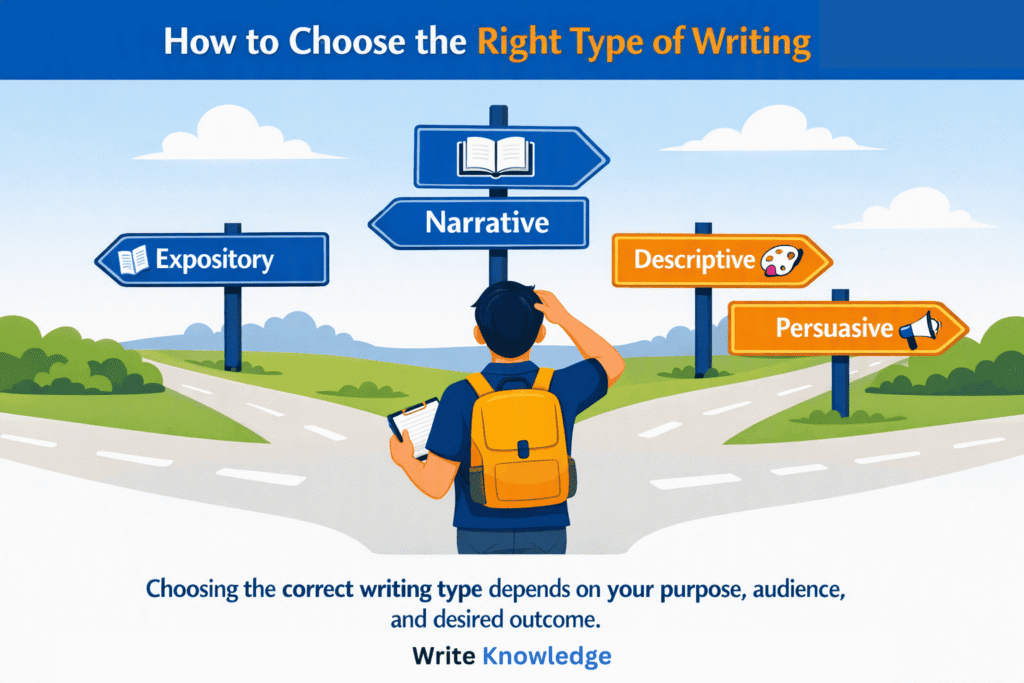
Choosing the appropriate writing style begins with understanding why you’re writing in the first place.
Ask yourself three simple questions:
Q1: What do I want my reader to do?
Should they learn something, visualize an experience, follow a story, or take action?
Q2: Who am I writing for?
The language used in a university research paper differs greatly from the language used in a children’s book or a company newsletter. Understanding your audience helps determine the right tone, vocabulary, and level of detail.
Q3: What is the best way to communicate this information?
Sometimes a straightforward explanation is enough. Other situations require storytelling, vivid descriptions, or carefully constructed arguments. Matching your writing style to your objective makes communication more effective.
When these three questions are answered before writing begins, the rest of the writing process becomes much easier.
Easy-peesy, right!
⚠️ Common Mistake Writers Make
If you have read the post till here, you now know that many writing problems don’t arise from poor grammar but from choosing the wrong writing style.
A common mistake is adding personal opinions to factual explanations, making expository writing appear biased. Others try to persuade readers without providing credible evidence, weakening otherwise strong arguments.
New writers also tend to overuse descriptive language. While vivid imagery can enrich a story, excessive detail often slows the pace and distracts readers from the main message.
✍️ Tips for Becoming a Better Writer
Improving your writing isn’t about mastering every writing type overnight. It’s about developing habits that strengthen your communication over time.
Read widely across different genres instead of limiting yourself to a single type of content. Study how experienced writers explain ideas, build stories, or persuade audiences.
Practice writing regularly, even if it’s only for a few minutes each day. Consistency develops confidence far more effectively than occasional bursts of motivation.
Writing is a skill that improves through deliberate practice rather than natural talent alone.
✅ Key Takeaways
- The four traditional types of writing: Expository, Descriptive, Narrative, and Persuasive form the foundation of most written communication.
- Modern writing includes specialized forms such as technical, academic, business, journalistic, creative, and digital content writing.
- Many real-world documents combine multiple writing types rather than relying on just one.
- Choosing the right writing style depends on your purpose, audience, and desired outcome.
- Becoming a better writer begins with understanding why different writing types exist and when each should be used.
Conclusion
Understanding the different types of writing helps you communicate your ideas more effectively, regardless of what you’re writing. Whether your goal is to inform, describe, tell a story, or persuade, choosing the right writing type ensures your message reaches the intended audience clearly.
Frequently Asked Questions
Are there only four types of writing?
No.
The four traditional types: Expository, Descriptive, Narrative, and Persuasive are considered the foundation of writing. However, there are more types of writing while combining elements of the four foundational types such as: technical, academic, business, creative, journalistic, and digital content writing.
What is the difference between writing types and writing styles?
A writing type simply tells who your target audience is. That becomes your primary purpose of writing, such as informing or persuading. A writing style, on the other hand, describes how the writer expresses ideas through tone, vocabulary, sentence structure, and voice. Two writers can produce expository writing while using very different writing styles.
Which type of writing should beginners learn first?
Expository writing. It is often the best starting point because it teaches writers to organize ideas logically and explain concepts clearly.