Descriptive writing is a type of writing that helps readers see, hear, smell, taste, feel, or experience a person, place, object, situation, or moment through words.
Instead of simply telling readers what something is, descriptive writing focuses on how it looks, sounds, feels, smells, tastes, and behaves. A strong description gives readers enough specific detail to create a clear mental picture.
For example, saying “The room was old” tells the reader very little. A descriptive writer might instead describe peeling blue paint, dusty wooden shelves, the smell of damp paper, and a window that rattles whenever the wind blows.
This makes descriptive writing particularly useful in creative writing, storytelling, journalism, marketing, travel writing, product descriptions, and other forms of communication where creating an impression matters.
💡 Quick Answer
Descriptive writing is a type of writing that uses specific sensory and observational details to help readers clearly imagine or experience a person, place, object, event, or situation. It commonly uses details related to sight, sound, smell, taste, and touch, along with precise word choice and imagery.
In simple terms: descriptive writing doesn’t just tell readers what something is like. It helps them see, hear, smell, taste, or feel it through words.
What Is Descriptive Writing?
Descriptive writing is writing that uses carefully selected details to create a vivid impression of something.
The subject might be:
- A person
- A place
- An object
- An event
- An animal
- A scene
- A memory
- An experience
- A product
- An atmosphere
The purpose is not simply to provide a list of characteristics. Instead, descriptive writing uses details to help the reader experience the subject through language.
A writer might describe a crowded railway station by mentioning the metallic screech of the train, the smell of hot tea, the movement of hundreds of passengers, and the loud announcements echoing from the platform.
The reader does not merely learn that the station is crowded. They can imagine being there.
What Is the Purpose of Descriptive Writing?
The primary purpose of descriptive writing is to create a strong impression of a subject.
However, writers can use description for several different purposes.
Descriptive writing can help to:
- Create a vivid mental image
- Establish a setting
- Develop a character
- Create mood and atmosphere
- Make an experience memorable
- Help readers understand unfamiliar subjects
- Make products or places more appealing
- Add depth to stories and articles
- Make explanations easier to visualise
The purpose depends on the context.
A novelist might use description to create an eerie atmosphere, while a travel writer might use it to help readers imagine a destination. A product writer might describe the texture, appearance, and functionality of a product so potential customers can understand what it is like to use.
This is why descriptive writing can appear across many different types of writing rather than existing only within creative work.
Key Characteristics of Descriptive Writing
Good descriptive writing has several characteristics that separate it from ordinary description.
Sensory Details
Sensory details are among the most important features of descriptive writing.
They appeal to the five senses:
| Sense | What the Writer Describes | Example |
| Sight | Colour, shape, appearance, movement | A pale orange sunset |
| Sound | Noise, volume, rhythm, silence | The distant hum of traffic |
| Smell | Odours and scents | The smell of freshly baked bread |
| Taste | Flavour and texture | A sharp, lemony taste |
| Touch | Temperature, texture, pressure | Rough, sun-warmed stone |
Using sensory details allows readers to experience the subject rather than simply receive information about it.
Specific Details
Descriptive writing works best when the writer chooses specific details instead of vague descriptions.
Compare:
The garden was beautiful.
with:
Purple bougainvillea climbed over the weathered brick wall, while small yellow butterflies moved between the marigolds.
The second sentence gives readers concrete information they can visualise.
Strong Word Choice
Descriptive writers carefully choose nouns, verbs, adjectives, and other words that communicate precise meaning.
Instead of saying:
The dog walked across the road.
a writer might say:
The tired dog limped slowly across the empty road.
The second sentence gives the reader more information without requiring a long explanation.
Figurative Language
This type of writing can also use figurative language to create stronger impressions.
Common techniques include:
- Simile
- Metaphor
- Personification
- Hyperbole
- Imagery
For example:
The moon hung above the village like a silver lantern.
The comparison creates a stronger visual image than simply saying that the moon was visible.
Mood and Atmosphere
Description can influence how readers feel about a scene.
A writer describing an abandoned building might use words such as cracked, silent, abandoned, shadowy, and decaying to create an unsettling atmosphere.
A writer describing the same building on a bright summer morning might use sunlit, warm, colourful, and peaceful.
The subject has not changed, but the description changes the reader’s emotional response.
Purposeful Description
Good descriptive writing does not describe everything.
Instead, it selects details that matter.
A writer describing a character does not need to mention every item of clothing. A few meaningful details may reveal much more about the person.
This is sometimes called selective description.
✍️ Writing Tip
Don’t confuse descriptive writing with simply adding lots of adjectives. Strong description comes from specific and meaningful details, not from filling every sentence with descriptive words.
Types of Descriptive Writing
Descriptive writing can take several forms depending on what the writer wants to describe.
Describing a Person
A writer can describe a person’s:
- Physical appearance
- Clothing
- Facial expressions
- Voice
- Body language
- Behaviour
- Personality
- Habits
For example:
Her silver-rimmed glasses rested low on her nose, and she pushed them back into place every time she looked down at the page.
This description provides information about appearance and behaviour at the same time.
Describing a Place
Place descriptions can establish a setting and atmosphere.
Writers may describe:
- Buildings
- Landscape
- Weather
- Lighting
- Sounds
- Smells
- Crowds
- Movement
- Architecture
This is particularly useful in travel writing and storytelling.
Describing an Object
Object descriptions explain how something looks or feels.
A writer may describe:
- Shape
- Size
- Colour
- Material
- Texture
- Weight
- Condition
- Function
Product descriptions frequently use this approach because readers often need to visualise an object before deciding whether it is suitable for them.
Describing an Event or Experience
Writers can also describe an event by focusing on what happened and what the experience felt like.
For example, a writer describing a thunderstorm might mention the sudden darkness, the smell of wet soil, the sound of rain against windows, and the flash of lightning across the sky.
Descriptive Writing Examples
Examples make it easier to understand how descriptive writing works.
Example of Describing a Place
Basic description:
The beach was crowded and beautiful.
Descriptive version:
Children chased one another along the warm sand while waves rolled toward the shore in long, white lines. The air smelled of salt and sunscreen, and the fading sunlight turned the water a deep shade of gold.
The second version uses sight, smell, touch, movement, and atmosphere to create a more vivid experience.
Example of Describing a Person
Basic description:
The man looked nervous.
Descriptive version:
He kept rubbing his palms against his trousers and glanced repeatedly at the closed office door. His voice became quieter whenever footsteps passed in the hallway.
The second version shows nervousness through behaviour instead of simply naming the emotion.
Example of Describing an Object
Basic description:
The notebook was old.
Descriptive version:
Its brown leather cover had softened at the edges, and several pages carried faint coffee stains. The corners were bent from years of being pushed into bags and pulled out again.
The reader can now visualise the notebook and understand its age through physical evidence.
Descriptive Writing vs Other Types of Writing
Descriptive writing is often confused with other major writing types because the techniques can overlap.
The key difference is purpose.
Descriptive Writing vs Expository Writing
Expository writing primarily explains, informs, or presents information about a subject.
Descriptive writing, by comparison, focuses on creating a vivid impression.
For example:
Expository: A desert is an environment that receives very little precipitation.
Descriptive: Dry sand stretched toward the horizon, broken only by scattered rocks and thorny shrubs beneath the harsh afternoon sun.
The first sentence provides information. The second creates an experience.
However, the two approaches can work together. An educational article might use expository writing to explain deserts while using descriptive passages to help readers visualize one.
Descriptive Writing vs Narrative Writing
Narrative writing tells a story involving events, characters, and often a sequence of actions.
Descriptive writing focuses more heavily on the details that help readers experience those events, characters, and settings.
For example:
The train disappeared into the tunnel.
is narrative because it tells the reader what happened.
Adding:
The last carriage vanished into the black tunnel as the metallic screech of the brakes faded into the distance.
introduces descriptive elements.
In practice, narrative writers frequently use description to make stories more immersive.
Descriptive Writing vs Persuasive Writing
Persuasive writing attempts to influence a reader’s opinion, belief, or action.
Descriptive writing does not necessarily attempt to persuade. Its primary purpose is to create an impression.
However, persuasive writers can use descriptive language strategically.
For example, an advertisement might describe a hotel room as:
A quiet ocean-facing room with soft white bedding, warm wooden floors, and a private balcony overlooking the sea.
The description can make the reader imagine the experience and may therefore strengthen the persuasive message.
How to Write Descriptive Writing

Writing a descriptive paragraph or article becomes easier when you follow a logical process.
Step 1: Choose Your Subject
Start by deciding exactly what you want to describe.
Avoid subjects that are too broad.
Instead of choosing “a city,” you might choose:
A crowded market in the city during a rainy evening.
A narrower subject gives you more opportunities to select meaningful details.
Step 2: Decide Your Purpose
Ask yourself why you are describing the subject.
Do you want readers to:
- Visualise something?
- Understand an experience?
- Feel a particular emotion?
- Imagine a location?
- Understand a product?
- Connect with a character?
Your answer determines which details deserve attention.
Step 3: Observe the Subject
Before writing, pay attention to the subject carefully.
If possible, consider all five senses.
Ask:
What can I see?
What can I hear?
What can I smell?
What can I taste?
What can I touch or feel?
Also consider movement, temperature, atmosphere, and emotional response.
Step 4: Select the Most Important Details
Do not include every observation.
Choose the details that best communicate the subject and support your purpose.
A good description is selective rather than overloaded.
Step 5: Organise the Description
Descriptions can be organised in different ways.
You might move:
- From general to specific
- From foreground to background
- From left to right
- From outside to inside
- From physical appearance to emotional impression
- Through the order in which details are noticed
A logical structure prevents the description from becoming a random list of observations.
Step 6: Use Precise Language
Replace vague words with more precise alternatives.
Instead of:
The room was nice.
you might write:
Sunlight entered through the tall windows and fell across the polished wooden floor.
Instead of:
She was angry.
you might write:
She clenched her jaw and placed the letter on the table without saying a word.
Step 7: Revise for Unnecessary Details
After writing the first draft, remove details that do not contribute to the reader’s understanding or experience.
Ask:
Does this detail help the reader imagine, understand, or feel something?
If the answer is no, consider removing it.
Descriptive Writing Techniques
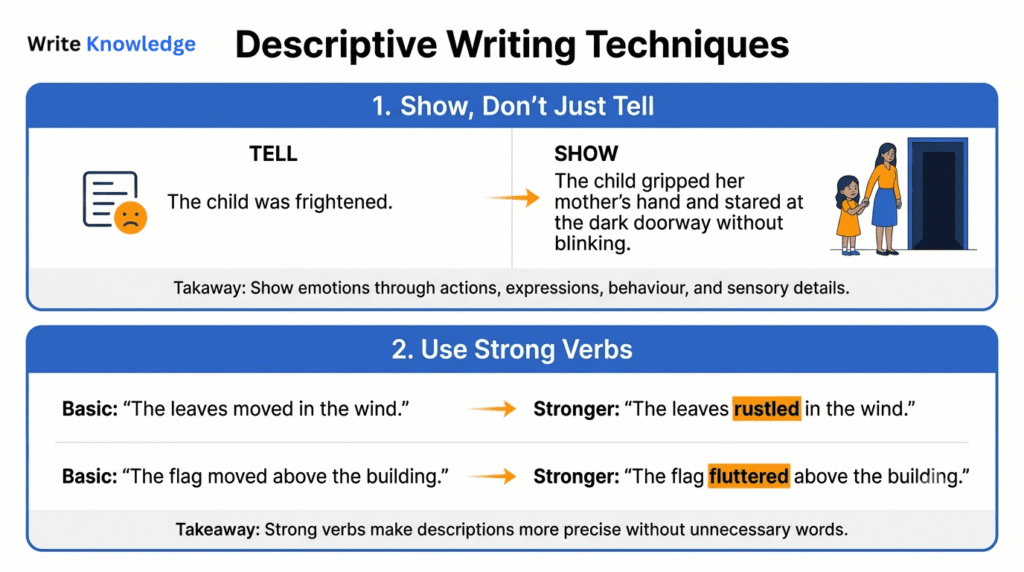
Writers can use several techniques to make descriptions stronger.
Show, Don’t Just Tell
Instead of directly stating an emotion or characteristic, show it through actions, expressions, behaviour, or sensory details.
Tell:
The child was frightened.
Show:
The child gripped her mother’s hand and stared at the dark doorway without blinking.
Showing allows readers to interpret the emotion themselves.
Use Strong Verbs
Strong verbs can make descriptions more precise without adding unnecessary words.
Compare:
The leaves moved in the wind.
with:
The leaves rustled in the wind.
Or:
The flag moved above the building.
with:
The flag fluttered above the building.
The stronger verb provides additional information.
Use Figurative Language Carefully
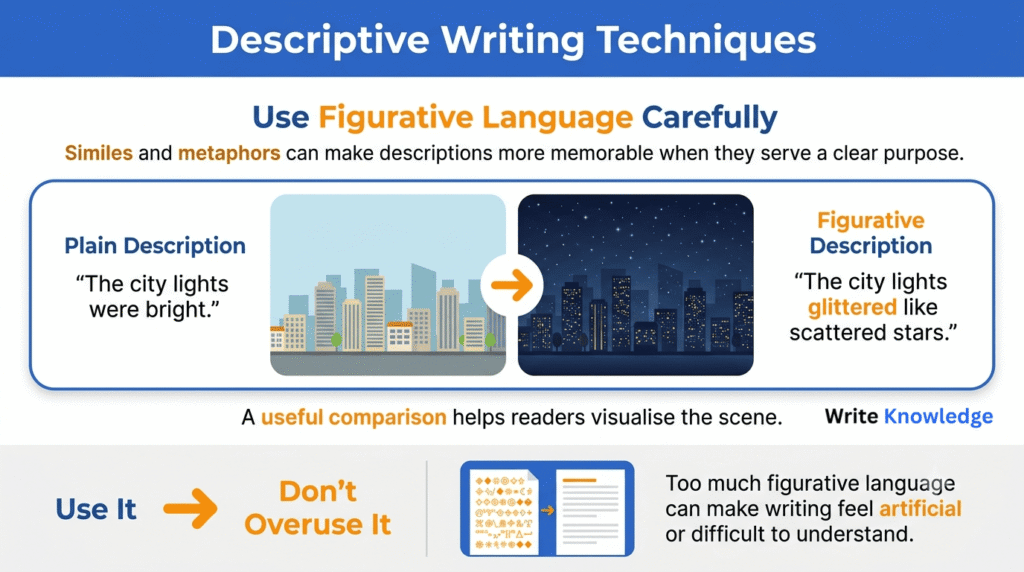
Similes and metaphors can create memorable descriptions, but they should serve a purpose.
For example:
The city lights glittered like scattered stars.
The comparison helps readers visualise the scene.
However, excessive figurative language can make writing feel artificial or difficult to understand.
Create an Appropriate Mood
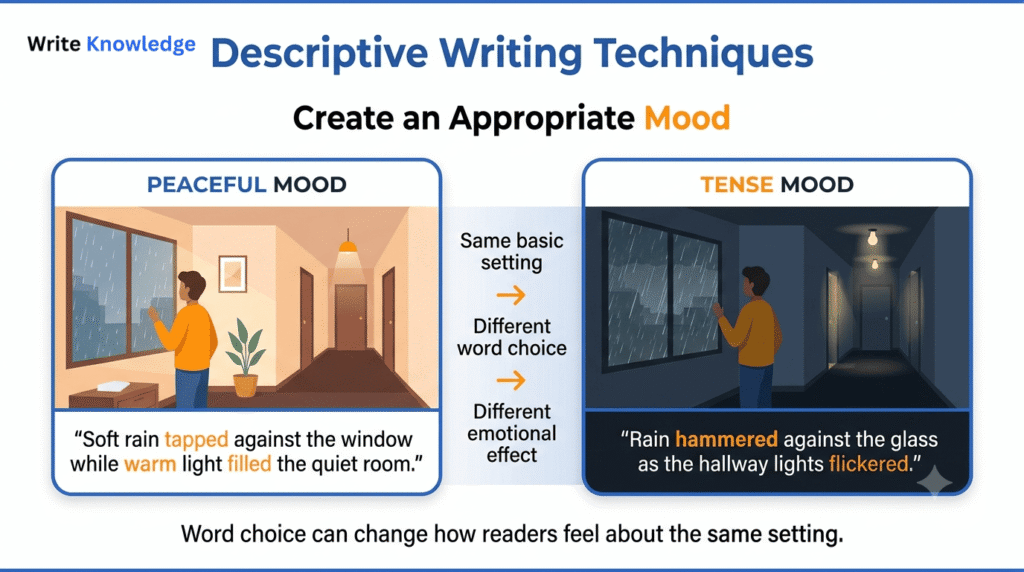
Word choice can influence the emotional atmosphere.
For a peaceful scene:
Soft rain tapped against the window while warm light filled the quiet room.
For a tense scene:
Rain hammered against the glass as the hallway lights flickered.
The same basic setting can produce very different emotional effects through word choice.
Descriptive Writing in Different Writing Careers
Descriptive writing is not limited to novelists or creative writers.
The ability to describe something clearly can be valuable across many professional writing careers.
A technical writer may need to describe a product, component, process, or interface clearly enough for users to understand it.
An SEO writer may use descriptive language when writing travel content, product descriptions, destination guides, or articles designed to help readers understand an experience.
A copywriter can use carefully selected details to help customers imagine a product or service.
A journalist may use descriptive details to establish the setting of a report without compromising factual accuracy.
Editors and content professionals also need to understand the difference between useful description and unnecessary detail.
If you’re exploring possible professional directions, visit our Writing Careers guide to learn more about different writing professions, their responsibilities, and the types of writing they commonly involve.
Descriptive Writing and Writing Style Guides
Descriptive writing is primarily concerned with how vividly and effectively a subject is presented, while a writing style guide establishes conventions for how the overall document should be written and formatted.
For example, a writer may use descriptive language in an article while following AP Style, APA Style, MLA Style, Chicago Manual of Style, or IEEE Style, depending on the context.
The appropriate style guide can influence areas such as:
- Capitalization
- Punctuation
- Numbers
- Abbreviations
- Citations
- References
- Headings
- Editorial conventions
This distinction is important: descriptive writing is a type or technique of writing, while a style guide provides editorial standards for presenting written content.
Descriptive Writing in Academic Work
Academic writers may use description when introducing a research setting, explaining an object of study, describing an observation, or providing contextual information.
However, academic description generally needs to remain precise and relevant rather than becoming overly decorative.
For example, a research paper might describe a historical document, experimental environment, geographical location, or observed phenomenon.
The writing style guide required by the institution or discipline will still determine how the document should be formatted and cited.
Descriptive Writing in Journalism
Journalists often use carefully chosen descriptive details to establish a sense of place or help readers understand an event.
The challenge is to remain accurate.
A journalist should not invent sensory details merely to make a story more dramatic.
Descriptive journalism therefore requires a balance between vividness and factual accuracy.
Descriptive Writing in Marketing
Marketing writers often use description to help audiences imagine a product, destination, service, or experience.
A product description might mention:
- Material
- Colour
- Texture
- Size
- Appearance
- Function
- User experience
However, marketing description should still remain accurate and avoid unsupported claims.
Common Descriptive Writing Mistakes
Using Too Many Adjectives
More adjectives do not automatically make writing more descriptive.
The beautiful, amazing, gorgeous, wonderful, bright, colourful garden…
This becomes repetitive.
A few precise details are generally more effective.
Relying Only on Visual Details
Description is not limited to sight.
Sound, smell, taste, touch, temperature, movement, and atmosphere can make writing much more immersive.
Using Vague Language
Words such as nice, beautiful, interesting, big, and good often communicate too little.
Replace them with specific observations.
Describing Everything
Too many details can overwhelm readers.
Select details according to your purpose rather than trying to describe every feature.
Forgetting the Reader
Description should always have a reason.
Ask what you want the reader to notice, understand, imagine, or feel.
✅ Key Takeaways
- Descriptive writing creates a vivid impression of a person, place, object, event, or experience.
- Sensory details are one of its most important features.
- Specific details are generally more effective than vague descriptions.
- Strong verbs can make descriptions more precise.
- Figurative language can add depth when used carefully.
- Descriptive writing can be combined with narrative, expository, and persuasive writing.
- Description is useful in creative writing as well as journalism, marketing, technical communication, and other professional writing careers.
- A Writing Style Guide determines editorial conventions, while descriptive writing focuses on creating an effective impression.
- Good descriptive writing is selective, purposeful, and reader-focused.
Conclusion
Descriptive writing helps readers experience a subject through carefully selected details. By using sensory language, precise words, strong verbs, meaningful observations, and appropriate figurative language, writers can turn simple information into a vivid and memorable experience.
Frequently Asked Questions
What is descriptive writing?
Descriptive writing is a type of writing that uses specific sensory and observational details to create a vivid impression of a person, place, object, event, or experience.
What are the main characteristics of descriptive writing?
The main characteristics include sensory details, specific word choice, strong verbs, figurative language, purposeful description, and the ability to create mood or atmosphere.
What are the five senses used in descriptive writing?
Writers can describe sight, sound, smell, taste, and touch. Using several senses can make a description more immersive.
Can descriptive writing be used in professional writing?
Yes. Descriptive writing can be useful in journalism, marketing, SEO writing, technical communication, travel writing, product descriptions, and several other writing careers.

Sachin is a Postgraduate in Technical Writing in Business Management specializing in creating SEO-friendly, User-friendly, and Reader-focused website articles on Education, Tech, Sports, Games, and Entertainment.
Through Write Knowledge, he helps students, bloggers, editors, and professionals develop practical writing skills using clear explanations, real-world examples, and internationally recognized writing standards.